
RCDD-116 · Lesson 3 of 12 · 23 min
Acceptance and warranties
▶ Video coming soon A video version of this lesson is on the way.
When the last test batch for Harbourview is submitted, Marcus Feld, the general contractor's project manager, emails Lakehead Signal to ask for written acceptance of the structured cabling so that his company can bill the remaining contract value. Ines Kowalczyk, the owner's IT director, sends a separate email the same morning asking when the 25-year manufacturer warranty certificate will arrive. Daniel realizes that both emails depend on the same thing: a clear, documented acceptance process that he wrote into the specification months ago and now has to run. This lesson describes that process.
What acceptance means
Acceptance is the formal act by which the owner, usually advised by the designer, confirms that the work meets the contract documents. It has legal and financial consequences. It typically triggers payment of amounts held back, the start of warranty periods and the transfer of responsibility for the system from the contractor to the owner. Because of those consequences, acceptance should never be informal. It should follow steps defined in the specification, rest on evidence, and be recorded in writing.
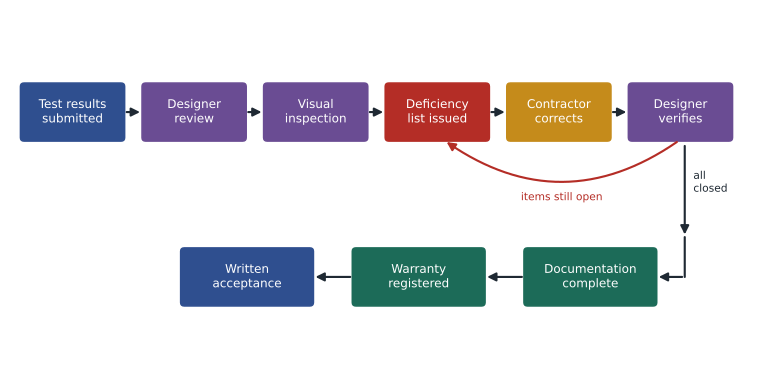
For ICT cabling, acceptance usually rests on four kinds of evidence: complete and passing test results for every link, a visual inspection of the installation, complete documentation such as labels, record drawings and the cable database, and, where specified, registration of the system with the manufacturer's warranty program. The specification should list each one as a condition of acceptance so that there is no doubt about what the contractor must deliver.
Partial and final acceptance
On a large project, acceptance often happens in stages. The owner may need to occupy the clinic floors before the classroom floor is finished, or a telecommunications room may be needed early to bring up network equipment. Partial acceptance lets the owner take over completed areas while work continues elsewhere. The designer should define what partial acceptance covers, such as particular rooms or floors, and what it does not, such as pathways shared with unfinished areas. Final acceptance follows when every area is complete, every deficiency is corrected and every deliverable is received.
The general contract has its own milestones, and the cabling process must fit them. In the United States, the key milestone is usually substantial completion, defined in the general conditions of the contract, often based on documents such as those published by the American Institute of Architects. Retainage, a share of each payment held back, is released at substantial or final completion under the contract and state prompt payment laws. The designer does not decide these legal milestones, but the cabling acceptance process provides evidence that the architect or contract administrator uses when certifying them.
Visual inspection
Test results prove electrical and optical performance, but they do not show everything. A link can pass every test while being installed in a way that will cause trouble later: cables lying on ceiling tiles instead of in supports, bend radius violated where cables enter a rack, firestopping missing at a wall penetration, or patch panels without strain relief. The designer, or a qualified inspector working for the owner, should walk the installation before acceptance with a checklist taken from the specification.
| Area | What to look for |
|---|---|
| Pathways | Cables supported at the required spacing; no cables on ceiling grid or pipes; fill within limits; tray bonded. |
| Penetrations | Firestop systems installed, labeled and matching the approved listed systems. |
| Telecommunications rooms | Racks anchored and bonded; cable managers dressed; service loops neat; clearances kept. |
| Terminations | Panels and jacks seated; pair untwist within the manufacturer's limit; strain relief in place. |
| Bonding | Busbars installed and labeled; bonding conductors sized and connected; racks and tray bonded. |
| Labels | Every panel, port, faceplate, cable end and pathway labeled to the administration scheme. |
| Work areas | Faceplates complete; outlets at the specified heights; cover plates on unused openings. |
Visual inspection is normally done by sampling in large buildings, for example every telecommunications room and a defined share of work areas on each floor. The specification should state how the sample is chosen and what happens if defects are found: usually the sample is expanded, and if defects are widespread the contractor must inspect and correct the entire installation.
The deficiency list
Every inspection and every test review produces a list of things to fix. This list goes by several names, including deficiency list, punch list and snag list. Each item should have a unique number, a location, a description, a reference to the specification clause it breaches, a photo where useful, and a status. The contractor corrects each item and reports it closed; the designer verifies the correction and signs it off. Items that need retesting, such as re-terminated links, are not closed until the new passing results are received.
Reviewing test results
The designer's review of test results is more than counting passes. Daniel's checklist for Harbourview includes the following questions for every batch.
- Is there a result for every link in the outlet schedule, and no results for links that do not exist?
- Was the correct limit, adapter and cable type used, as shown in each result?
- Was the tester within calibration, and are its serial number and software shown?
- Are there marginal passes, and does the specification accept them?
- For fiber, does every result state the reference method, both wavelengths and both directions?
- Do lengths match the drawings within reason, or do some links suggest unexpected routes?
The first question catches the most problems. Comparing the list of tested identifiers with the outlet schedule, which a spreadsheet can do in seconds, finds links that were never tested, links tested twice under different names, and links installed but never shown on the drawings. On Harbourview, the comparison shows nine links missing from the clinic floor results. They were installed in a room added by a change order, and the tester had never been loaded with their identifiers.
Who signs off on what
Acceptance involves several people, and each signs off on a different thing. The cabling contractor certifies that the work is complete and tested. The ICT designer reviews the evidence and recommends acceptance of the cabling to the architect or contract administrator. The architect or contract administrator certifies the contract milestones for the whole project. The owner accepts the work and pays for it. The manufacturer accepts the warranty registration. The specification should name the roles involved, so that the contractor knows whose approval it needs at each step and nobody assumes that someone else has already checked.
Written records of each sign-off matter later. A warranty claim ten years after opening may hinge on whether a link was accepted with a marginal result, or whether a firestop deficiency was closed. Lakehead Signal files the acceptance memo, the closed deficiency list and the test summaries together, with the date of each sign-off, in the project record. Daniel adds the manufacturer's registration number to the same file so that Ines can quote it when she calls the manufacturer.
Acceptance of work by others
ICT cabling depends on work by other trades: conduit and boxes from the electrical contractor, sleeves and firestopping that may be installed by a specialist, power and cooling in telecommunications rooms, and ceilings and access panels that let cables be reached. The cabling contractor should not have to accept responsibility for defects in that work, but it should report problems it finds before it builds on them. A good specification requires the cabling contractor to inspect the pathways and spaces before installing cable and to report deficiencies in writing, so that conduits with burrs, missing pull strings or overfilled sleeves are fixed by the trade that installed them.
Worked problem
Checking result completeness
The outlet schedule for the second floor lists 386 links. The contractor submits 392 results, of which 4 are duplicates of the same identifier and 3 carry identifiers not in the schedule. How many scheduled links have results, and how many are missing?
Show solution
- Unique results: 392 − 4 = 388.
- Results that match the schedule: 388 − 3 = 385.
- Missing scheduled links: 386 − 385 = 1.
Answer: 385 scheduled links have results and 1 is missing. The 3 unknown identifiers must also be explained before acceptance.
Manufacturer warranties
Most structured cabling manufacturers offer an extended system warranty, often for 20 or 25 years, when a complete system of their components is installed by a certified installer and registered with them. The warranty usually has two parts: a product warranty that the components will be free of defects, and an application or performance assurance that the cabling will support the applications defined for its category during the warranty period. These warranties go well beyond the contractor's own warranty, which is often one or two years.
Each manufacturer sets its own conditions, but they commonly include the following: all components in each link must come from the manufacturer or its approved partners; the installer must hold a current certification with that manufacturer, and often a minimum number of trained staff must be on the job; every link must be certified with an approved tester to the specified limits, with results submitted to the manufacturer; and the installation must follow the manufacturer's practices as well as the standards. The manufacturer reviews the submission and, if satisfied, issues a warranty certificate to the owner.
The designer's job is to make the warranty achievable. That means specifying a system that the manufacturer will warrant as a whole, requiring a contractor certified for that system, writing the test and documentation requirements to match the warranty program, and listing registration as a condition of final acceptance. A specification that allows mixing components from different manufacturers in the same link, or that omits the manufacturer's test requirements, can leave the owner with no extended warranty at all, even though the cabling performs well.
Warranty periods and start dates
Several warranties may apply to the same installation, each with its own start date. The contractor's warranty on workmanship usually starts at substantial completion or acceptance. The manufacturer's system warranty usually starts when the registration is approved. Product warranties on active equipment are separate again. The designer should collect all of these in a warranty schedule for the owner, listing each warranty, its provider, its period, its start date and how to make a claim. That schedule belongs in the closeout documents covered in lesson 12.
Worked problem
Warranty dates
Substantial completion at Harbourview is certified on 14 June. The contractor's workmanship warranty is 2 years from that date. The manufacturer approves the system registration on 30 August and grants 25 years. When does each warranty end?
Show solution
- Workmanship: 14 June plus 2 years ends on 14 June two years later.
- Manufacturer: 30 August plus 25 years ends on 30 August twenty-five years later.
Answer: The two warranties end more than 23 years apart, and the owner needs both dates recorded.
Withholding acceptance
Sometimes the right answer is not yet. If test results are incomplete, deficiencies remain open, or the warranty submission has been returned by the manufacturer, the designer should recommend that acceptance be withheld and say exactly what is outstanding. A clear, written list of outstanding items protects everyone: the owner knows what it is waiting for, the contractor knows what will close the job, and nobody can later claim that acceptance was given by silence. When the items are closed, acceptance follows promptly; holding it back for reasons outside the contract is unfair and usually breaches the contract.
Daniel's acceptance memo for Harbourview lists the nine untested links, two open firestop deficiencies and the pending manufacturer registration. Within three weeks all are closed. The memo that follows recommends final acceptance of the structured cabling, attaches the closed deficiency list and test summaries, and notes the start dates of each warranty. Marcus bills the remaining contract value the same day, and Ines files the warranty certificate when it arrives a week later.
Common mistakes
MistakeAccepting the work by paying the invoice without a written acceptance.
InsteadFollow the defined acceptance steps and record acceptance in writing.
MistakeRelying on test results alone.
InsteadCombine test results with visual inspection and documentation review.
MistakeClosing a re-terminated link before seeing new results.
InsteadClose test-related deficiencies only when new passing results are received.
MistakeAllowing mixed components in a link that needs a manufacturer warranty.
InsteadSpecify a complete warranted system from one manufacturer and its approved partners.
MistakeForgetting that warranties start on different dates.
InsteadRecord every warranty, provider, period and start date in a warranty schedule.
Summary and key terms
- Acceptance is a formal, written act that triggers payment, warranty start and transfer of responsibility.
- It rests on complete test results, visual inspection, complete documentation and, where specified, warranty registration.
- Partial acceptance lets owners occupy finished areas; final acceptance comes when everything is complete.
- Deficiencies are numbered, tracked, corrected, verified and closed, with retesting where needed.
- Manufacturer warranties often run 20 or 25 years but require a complete system, a certified installer and submitted test results.
- Withhold acceptance only for specific, written, contractual reasons, and grant it promptly when they are resolved.
- Acceptance
- The owner's formal confirmation that work meets the contract documents.
- Deficiency list
- A numbered list of items to correct before acceptance; also called a punch list.
- Holdback or retainage
- A share of each payment held back until a contract milestone.
- Certified installer
- A contractor trained and approved by a manufacturer to install its warranted system.
- System warranty
- A manufacturer's long-term warranty on components and application performance.
- Warranty schedule
- A list of every warranty with its provider, period, start date and claim process.
Practice problems
Work each problem on paper first, then reveal the answer to check.
Name the four kinds of evidence that cabling acceptance usually rests on.
Show answer
Test results, visual inspection, documentation and warranty registration.
A schedule lists 200 links; 203 results arrive, 2 duplicates and 1 unknown. How many links are missing?
Show answer
200 − (203 − 2 − 1) = 0.
Why might the owner need partial acceptance?
Show answer
To occupy completed areas before the whole project is finished.
What usually voids a manufacturer's system warranty?
Show answer
Mixing components from other manufacturers, an uncertified installer or missing test results.
When should a deficiency for a failed link be closed?
Show answer
When new passing test results are received.
What belongs in a warranty schedule?
Show answer
Each warranty, its provider, period, start date and claim process.
Lesson quiz · 5 questions
Score 60% or more to complete this lesson.
Create a free account to save your progress, take quizzes and earn a certificate.