
RCDD-110 · Lesson 11 of 12 · 20 min
Shielded and unshielded cabling choices
▶ Video coming soon A video version of this lesson is on the way.
The imaging equipment vendor's site requirements for Harbourview arrive with a line that catches Daniel's eye: 'Shielded network cabling recommended in the equipment room.' At the same time, the owner's facilities manager, who maintains another hospital, has strong opinions. 'We tried shielded cabling once,' she tells Daniel on a call. 'It cost more, took longer to install and we still had noise problems.' Roz is not surprised. 'Screened cabling works very well when it is designed and installed as a system,' she says, 'and badly when it is treated as unshielded cable with a foil wrapper. Let us work out where it helps and what it takes.'
Balanced twisted-pair cabling comes in unscreened and screened forms. Both can meet the same category limits, and in most commercial offices both perform well. The choice depends on the electromagnetic environment, the applications, the owner's practices, local custom and the bonding infrastructure. This lesson explains the constructions, how screens work, what they require and how to decide.
Names and constructions
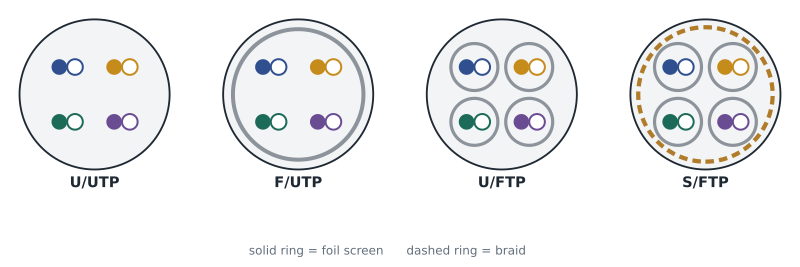
International standards name balanced cable constructions with a two-part code. The part before the slash describes the overall screen around all the pairs; the part after describes the treatment of each pair, followed by TP for twisted pair. U means unscreened, F means foil, S means braid, and SF means braid plus foil. North American usage often says 'shielded' and 'unshielded', and terms such as STP and ScTP appear in older documents, so it is worth translating everything into the international codes when writing specifications.
| Code | Overall screen | Individual pair screens | Common name |
|---|---|---|---|
| U/UTP | None | None | Unshielded twisted pair (UTP) |
| F/UTP | Foil | None | Foiled twisted pair (FTP or ScTP) |
| U/FTP | None | Foil on each pair | Pair-shielded |
| S/FTP | Braid | Foil on each pair | Fully screened, used for Class F and FA |
| SF/UTP | Braid and foil | None | Braid and foil screened |
How a screen works
A screen is a conductive layer that intercepts electric fields and induced currents before they reach the pairs, and contains fields from the pairs. Against electric field (capacitive) coupling, a screen works by giving the coupled current a path to ground instead of into the pairs. That only works if the screen is connected to ground, through the connectors and patch panel to the bonding system. A screen that is not connected to anything can actually make matters worse: it can act as an antenna, picking up interference and coupling it to the pairs along its length.
At high frequencies, a screen also attenuates radiated fields, both incoming and outgoing. The quality of a screen at high frequency is described by its transfer impedance, which relates the current flowing on the screen to the voltage it induces inside, and by coupling attenuation, which combines the effects of the screen and the balance of the pairs into one measure of how well the cable resists, or avoids causing, radiated interference. Lower transfer impedance and higher coupling attenuation are better.
Against low-frequency magnetic fields from power circuits, thin foil screens provide little protection, as Lesson 9 noted. The twist of the pairs does most of the work there. A braid adds some protection, but distance and steel pathways remain the main defense.
Where screened cabling helps
Screened cabling offers three main benefits. First, it reduces susceptibility to and emission of electromagnetic interference, which matters in E2 and E3 environments, near strong radio transmitters and in some healthcare and industrial settings. Second, it greatly reduces alien crosstalk between cables, because the screens isolate neighboring cables from each other. This allows Category 6A F/UTP cables to be smaller in diameter than U/UTP Category 6A cables, which can save pathway space. Third, some owners and some regions prefer screened cabling as a matter of policy or long practice, and some equipment vendors recommend it, as the imaging vendor at Harbourview did.
Screened construction is also required for the highest grades. Category 8 and ISO Class F and FA systems are screened, because their frequency ranges are beyond what unscreened pairs can support at acceptable crosstalk levels.
What screened cabling requires
Screened cabling is a system. Every component in the channel must be screened: cable, outlets, patch panels, patch cords and equipment cords. The screen must be continuous from end to end, terminated correctly at each connector with a full 360-degree contact where the design calls for it, and bonded to the telecommunications bonding system at the patch panel end through the rack or cabinet. Equipment at the far end usually provides a second connection through its own chassis ground.
This brings bonding into the picture. If the two ends of a screen are connected to grounds at different potentials, a current flows along the screen. At power frequencies this current is usually small if the bonding infrastructure is well designed, but in poorly bonded buildings it can be large enough to cause noise and, in extreme cases, safety concerns. The telecommunications bonding infrastructure described in RCDD-113, built to ANSI/TIA-607 or its international equivalents, keeps those potential differences small. Screened cabling should not be specified in a building without a properly designed bonding system.
Installation takes more care and usually more time. The installer must handle the screen and drain wire correctly at each termination, maintain bend radius so the foil does not tear, and use screened patch cords. Cable is usually somewhat stiffer and may cost more. These differences have narrowed over the years, and in some markets screened Category 6A is little more expensive than unscreened, but they still need to be planned and budgeted.
Worked problem
Ground potential difference and screen current
A screen bonded at both ends has a DC and power-frequency resistance of 0.5 ohm over its length. If the two ends are bonded to points with a potential difference of 0.2 V at 60 Hz, roughly what current flows on the screen?
Show solution
- By Ohm\'s law, \(I = V/R = 0.2/0.5 = 0.4\) A.
- If the difference were 2 V because of poor bonding, the current would be 4 A.
Answer: About 0.4 A, a level that a balanced system tolerates. Ten times the potential difference gives ten times the current, which shows why good bonding matters for screened systems.
Where unscreened cabling is the better choice
In typical commercial office environments, classified E1, well-installed U/UTP cabling of the right category supports all current applications, including 10GBASE-T over Category 6A. It is simpler to install, needs no screen termination and does not depend on bonding for its transmission performance. Most North American commercial buildings use U/UTP for horizontal cabling. The alien crosstalk limits for Category 6A U/UTP are met by cable design, such as larger diameter and special jackets, and by following the manufacturer's installation rules.
Unscreened cabling is also forgiving of imperfect bonding in older buildings and in renovations where the bonding infrastructure is not up to current standards. A screened system installed without proper bonding may perform worse than an unscreened one.
Fiber as the alternative
Where the environment is truly hostile to copper, such as around large motors, in some industrial areas, near very strong radio transmitters or between buildings with different ground systems, optical fiber is often the best answer. Fiber carries no current, is immune to electromagnetic interference and does not create ground loops. The cost is the need for media converters or optical interfaces on the equipment and, where the device needs power, a separate power source or composite cable with copper conductors for power.
Making the decision at Harbourview
Daniel prepares a short decision table for the design basis. For the general clinic and classroom floors, classified E1, the design uses Category 6A U/UTP from the chosen manufacturer's warranted system. For the imaging equipment room, the vendor's recommendation, the E2 classification near the equipment and the need to keep emissions low lead to Category 6A F/UTP, with screened panels and cords and a dedicated bonding connection from the rack to the telecommunications bonding busbar in the room. For the mechanical penthouse and elevator machine rooms, the few network devices will be served by fiber to an industrial-rated switch. The facilities manager's earlier problems are addressed directly: the specification requires screen continuity testing, bonding verification and use of screened cords, and the design shows every bonding connection.
Roz reviews the table and adds a line about patch cords. 'The number one cause of screened systems failing in practice,' she says, 'is someone replacing a screened cord with an unscreened one from the supply cupboard. Make the cords a different color.' Daniel adds it to the specification.
Testing screened systems
Field certification testers can verify screen continuity as part of the wire map test when screened permanent link adapters are used. The tester checks that the screen connects from one end to the other, which detects a missed drain wire, a torn foil at a termination or an unscreened outlet. Screen continuity does not prove that the system is bonded correctly; bonding is checked separately, by inspecting and measuring the bonding connections from panels and racks to the telecommunications bonding busbar.
Screened and unscreened systems must meet the same transmission limits, so the rest of the certification is identical. Alien crosstalk testing on screened systems is often reduced to a smaller sample or waived by manufacturers' warranty programs, because the screens control it by design.
Regional practice and owner policy
Screened cabling is common in parts of Europe and in some industries worldwide, while unscreened cabling dominates commercial buildings in North America. These differences reflect history, local codes and the experience of installers as much as engineering. An RCDD working for a multinational owner may need to follow the owner's global standard even where local practice differs, and should understand the reasons behind both. Where the owner has no policy, the designer should base the choice on the environment, the applications and the bonding infrastructure, and record the reasoning in the design basis.
Exam focus: screen questions
Expect questions on the construction codes, on what makes a screen effective and on what goes wrong. The key ideas are that a screen must be continuous and bonded to work, that all components and cords in a screened channel must be screened, that foil helps mostly against electric fields and high frequencies, and that a screened system depends on a sound bonding infrastructure. When a question describes noise on a screened system, look first for a break in screen continuity, an unscreened cord or a bonding problem.
Worked problem
Diagnosing a screened link
A screened Category 6A link in an imaging room passes certification but shows intermittent errors in service. Investigation finds that the patch cord at the switch is unscreened. Why does that matter, and what is the fix?
Show solution
- The unscreened cord breaks the screen path between the panel and the equipment.
- The screen on the permanent link is now bonded at the panel end only, and the cord section is unprotected near noisy equipment.
- Replacing it with a screened cord of the same grade restores continuity.
Answer: Replace the cord with a screened cord. Color-coding screened cords, as Roz suggested, helps prevent the problem recurring.
Common mistakes
MistakeLeaving a screen unconnected at both ends.
InsteadAn unbonded screen can act as an antenna. Screens must be continuous and bonded through the connectors and panels.
MistakeMixing screened and unscreened components in one channel.
InsteadThe screen must be continuous end to end; one unscreened component breaks it.
MistakeSpecifying screened cabling without a bonding design.
InsteadScreened systems depend on a well-designed telecommunications bonding infrastructure to keep screen currents small.
MistakeExpecting foil screens to stop power-frequency magnetic fields.
InsteadTwisting and distance do most of the work at low frequencies. Foil helps mainly with electric fields and high frequencies.
Summary and key terms
- Balanced cable constructions are named with international codes such as U/UTP, F/UTP, U/FTP and S/FTP.
- Screens intercept electric fields and high-frequency interference only when continuous and bonded; unbonded screens can make things worse.
- Screened cabling reduces EMI susceptibility, emissions and alien crosstalk, and is required for Category 8 and Class F and FA.
- Screened systems need screened components throughout, correct termination, screened cords and a well-designed bonding infrastructure.
- Unscreened Category 6A performs well in E1 environments; fiber is often best for hostile environments or between separate ground systems.
- Screen
- A conductive foil or braid layer around pairs or a whole cable that intercepts and contains electromagnetic fields.
- F/UTP
- A cable with an overall foil screen and unscreened pairs.
- S/FTP
- A cable with an overall braid and individually foil-screened pairs.
- Transfer impedance
- A measure of how much voltage a current on a screen induces inside it; lower is better.
- Coupling attenuation
- A measure combining screen and balance effects of how well a cable resists or avoids radiated interference.
- Drain wire
- A bare conductor in contact with a foil screen, used to terminate it at connectors.
Practice problems
Work each problem on paper first, then reveal the answer to check.
What does the code SF/UTP describe?
Show answer
A cable with an overall braid and foil screen and unscreened pairs.
Why can Category 6A F/UTP cable be smaller than U/UTP Category 6A?
Show answer
The screen controls alien crosstalk, so the cable does not need extra diameter or special jackets to keep neighboring cables apart.
Name two things a screened system needs that an unscreened one does not.
Show answer
Screened components and cords throughout, correct screen termination, and bonding of panels and racks to the telecommunications bonding system.
Lesson quiz · 5 questions
Score 60% or more to complete this lesson.
Create a free account to save your progress, take quizzes and earn a certificate.