
RAC-320 · Lesson 8 of 12 · 18 min
Installation: placement, line sets, electrical and condensate
The Novak installation was booked for two days in late September. Dana walked the house with the crew lead, Marcus, and with Theo the week before, and they marked everything on a site sketch: where the outdoor unit would stand, where the line set would run, where the old oil tank and furnace would come out and the new air handler would go, where the electrical circuits would come from and where the condensate would drain. "Most callbacks on new installations," Marcus told Theo, "come from something decided in the first ten minutes on site. Somebody put the outdoor unit under the eaves, or ran the drain uphill, or left the old line set in because it looked fine."
This lesson covers the installation decisions and practices for split systems and heat pumps: placing the outdoor unit, mounting the indoor equipment, running and sizing line sets, adjusting the charge for line length, wiring the equipment and handling condensate. Brazing, pressure testing and evacuation were covered in RAC-210 and RAC-220 and are only referred to here; start-up is the subject of lesson 10.
Placing the outdoor unit
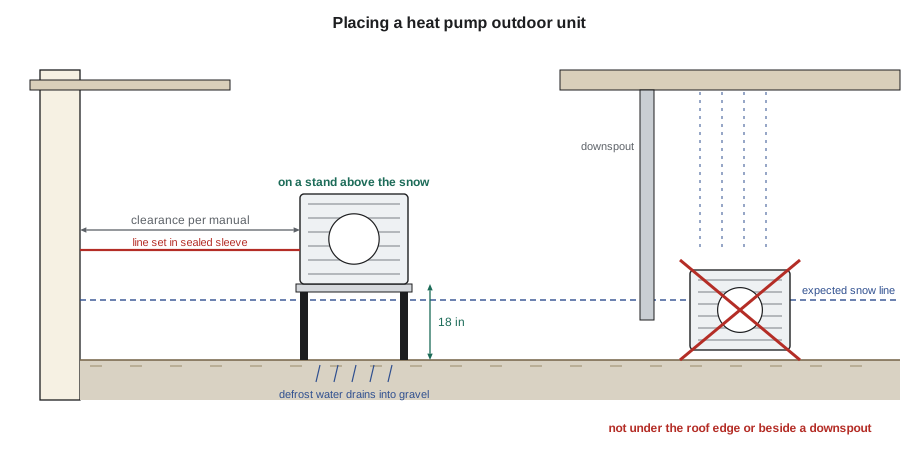
The outdoor unit needs air, access and protection. The manufacturer's installation manual gives minimum clearances on each side and above, for airflow and service; tighter spaces cause the discharge air to recirculate into the coil, which raises head pressure in summer and lowers capacity in winter. A unit squeezed into a corner between two walls, or under a deck, often performs well below its rating.
For heat pumps, and especially cold-climate units, snow and ice decide much of the placement:
- Raise the unit above the expected snow depth on a stand or wall bracket, so that the coil and the base pan's drain holes stay clear. Manufacturers and local practice give typical heights; in snowy areas a stand of 12 to 24 in or more is common.
- Keep it out of the drip line of the roof, where meltwater and icicles fall onto the unit, and away from downspouts. A small roof or hood over the unit, of the manufacturer's design or approved by them, helps where it cannot be moved.
- Leave room under it for defrost water to drain and freeze without building up to the coil, and do not place it where the water will run onto a walkway, step or driveway.
- Avoid places where the prevailing winter wind blows straight into the coil or against the fan discharge, and where drifting snow collects.
Other neighbors matter too. The unit should be away from bedroom windows and, where bylaws apply, a set distance from property lines. It must keep the clearances the gas code requires from a gas meter's regulator vent, and from dryer vents, which coat the coil with lint. For A2L equipment, the manufacturer's manual may set additional distances from openings into the building and from ignition sources such as an outdoor receptacle. The pad or stand must be level and stable; a composite pad on settled soil tilts, and a tilted unit drains badly and can strain its line set.
At the Novak house, the obvious place was the back corner, under the kitchen window and right beside the eavestrough downspout. Dana moved it six meters along the wall to the side of the house, onto a 18 in stand, clear of the roof edge and the gas service, with the line set running in a short, straight path into the basement.
Indoor equipment
The indoor half of a split system is either a coil on a furnace or an air handler with its own blower. Coils are made for specific orientations: upflow, downflow or horizontal, and some are multi-position. A coil installed in the wrong orientation will not drain properly and may blow water off the fins. The coil or air handler must match the outdoor unit in the AHRI combination, as lesson 1 explained, and must be sealed to the furnace and plenum so that air does not bypass it.
Air handlers and coils in attics, above finished ceilings or in closets need a secondary means of protecting the building from condensate: a secondary drain pan under the unit with its own drain to a visible location, or a float switch in the pan or the primary drain that shuts the system off if water rises. In attics, the code commonly requires one or the other, and many contractors fit both. The Novak air handler went in the basement where the oil furnace had been, on a stand that brought its return opening to the height of the new return duct.
Line sets
The line set's sizes are set by the manufacturer for each outdoor unit and line length. The vapor line, the larger one, carries suction vapor in cooling and hot discharge gas in heating; its size balances pressure drop, which costs capacity, against velocity, which carries oil back to the compressor. The liquid line's size is chosen for pressure drop and charge. Long runs and large height differences need the manufacturer's long-line instructions, which may call for a larger or smaller line, more oil, or a different charge.
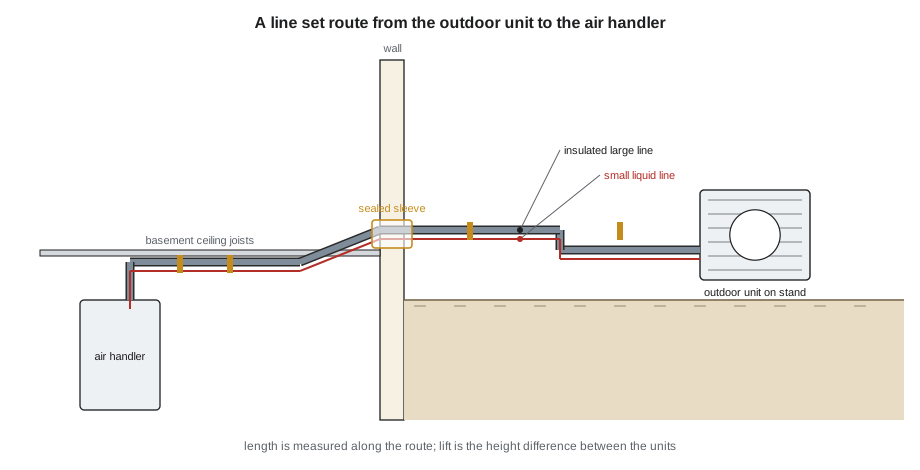
- Insulate the vapor line along its entire length with closed-cell insulation of the thickness the manual gives. On a heat pump this is essential in both modes: in cooling it prevents sweating and capacity loss, in heating it keeps hot gas from losing heat in a cold crawl space or garage. Outdoor insulation needs a UV-resistant cover or paint.
- Support the lines at the intervals the manual gives, with clamps that do not crush the insulation, and protect them where they could be damaged by a lawnmower, a ladder or a snow shovel.
- Avoid sags and loops that trap oil, and keep bends gentle. Coil any excess length horizontally, never vertically, if the manual permits coiling at all.
- Seal and sleeve every wall or floor penetration, and keep the line set away from sharp edges.
Reusing an existing line set is tempting and sometimes acceptable, but it needs care. The old set may be the wrong size for the new unit, especially if the new unit is larger or a different refrigerant. It holds old oil and, after a compressor burnout, acids and debris that can damage the new system, as RAC-210 explained. Its joints and tubing must be rated for the new refrigerant's pressures, and with A2L refrigerants the manual may forbid reuse or require flushing and a pressure test. The Novaks' old air conditioner had an R-22 line set of the wrong vapor line size for the new heat pump, so it was removed and a new set installed.
Charge adjustment for line length
Split systems are shipped with enough refrigerant in the outdoor unit for the outdoor unit, a matched indoor coil and a stated length of line set, often 25 ft or 50 ft. For longer lines, the installation manual gives an additional charge per unit of liquid line length, because almost all of the extra refrigerant sits in the liquid line. For shorter lines, some manufacturers say to remove refrigerant; others say not to. The line length is measured along the actual route, including vertical runs, not in a straight line between units.
The script below works out the Novak adjustment and checks the line length and lift against the manual's limits, then checks the circuit against the outdoor unit's nameplate.
# Line set charge adjustment and circuit sizing for the Novak outdoor unit (illustrative nameplate)
FACTORY_LEN = 25            # ft of line set the factory charge allows for
ADD_PER = 0.6                # oz of refrigerant per ft beyond that (from the installation manual)
actual = 43                 # ft measured along the installed route
extra = max(0, actual - FACTORY_LEN) * ADD_PER
print(f"line set {actual} ft: add {extra:.1f} oz of refrigerant, weighed in after evacuation")
MAX_LEN, MAX_LIFT, lift = 150, 65, 10
print(f"within limits: length {actual} <= {MAX_LEN} {actual <= MAX_LEN}, lift {lift} <= {MAX_LIFT} {lift <= MAX_LIFT}")
# Electrical: conductors must carry the minimum circuit ampacity; the breaker must not exceed the maximum overcurrent device
MCA, MOCP = 26.1, 40
breakers = [15, 20, 25, 30, 35, 40, 45, 50]
copper = {"14 AWG": 15, "12 AWG": 20, "10 AWG": 30, "8 AWG": 40}     # typical small-conductor limits; check the code tables
wire = next(w for w, a in copper.items() if a >= MCA)
brk = max(b for b in breakers if b <= MOCP)
print(f"MCA {MCA} A -> {wire} copper; MOCP {MOCP} A -> breaker no larger than {brk} A")line set 43 ft: add 10.8 oz of refrigerant, weighed in after evacuation within limits: length 43 <= 150 True, lift 10 <= 65 True MCA 26.1 A -> 10 AWG copper; MOCP 40 A -> breaker no larger than 40 A
The Novak line set measured 43 ft along its route, 18 ft beyond the factory charge's 25 ft, so 10.8 oz was added by weight after evacuation. The adjustment was written on the unit's charge label and in the job file with the total charge, which A2L equipment needs for its charge-limit records, as RAC-220 explained. Theo noticed that the length was well within the limit and the lift was small; a run near the maximum length or lift would have needed the manufacturer's long-line instructions.
Electrical work
The outdoor unit's nameplate gives two numbers for its supply circuit, as RAC-130 explained: the minimum circuit ampacity, MCA, which the conductors must be able to carry, and the maximum overcurrent protection, MOCP, which the fuse or breaker must not exceed. The breaker may be smaller than the MOCP, but large enough to allow the compressor to start. The script shows the choice for the Novaks' unit: conductors rated for at least 26.1 A and a breaker of no more than 40 A. The conductor size must be confirmed from the code's tables for the conductor type, insulation temperature rating, installation method and length, not only from a short list.
The National Electrical Code, adopted in Kentucky, sets the rules, especially its article on air conditioning and refrigerating equipment. It requires a disconnecting means within sight of the outdoor unit and a service receptacle near rooftop and some other equipment. New circuits normally need an electrical permit and inspection, and whether the HVAC contractor's own staff may do that wiring depends on state and local licensing; many contractors use a licensed electrician for new circuits. The Novaks' job needed two new circuits, one for the outdoor unit and one for the air handler and its heater kit, and the electrical service had enough capacity once the oil furnace's circuit was removed.
Low-voltage wiring between the thermostat, air handler and outdoor unit is the HVAC technician's own work. Use the cable the manufacturer specifies, especially for communicating systems; keep it separated from line-voltage conductors; and label both ends. Surge protection at the outdoor unit protects inverter boards, as lesson 5 explained.
Condensate and drains
The indoor coil produces condensate whenever it cools, as lesson 4 showed for ductless heads; a central system in a humid climate can produce tens of liters a day. The primary drain from the coil's pan needs a trap, because the coil sits on the suction side of the blower and air pulled up the drain would stop it emptying. Most manufacturers give the trap depth and require a vent after the trap. The drain must slope continuously, at least about 1/4 in per foot, to an approved discharge: a floor drain, a condensate pump or outdoors where allowed.
In a basement installation like the Novaks', the condensate usually goes to a floor drain or a condensate pump. In an attic or above a ceiling, the secondary pan and float switch protect the building if the primary drain blocks, and the secondary drain should discharge where the homeowner will notice it, such as above a window. When an air handler shares a drain with a condensing furnace or water heater, that drain carries acidic condensate, and any neutralizer belongs on that appliance's drain, as the appliance's instructions say.
Permits, inspection and the job file
Heat pump and air conditioner installations normally need a building or mechanical permit, an electrical permit for new circuits and, where fuel equipment is removed or altered, the appropriate gas or fuel work. For the Novaks, the propane furnace was disconnected and capped by the propane supplier, who also removed the tank. Inspections are booked before walls or ceilings are closed where lines run through them.
The job file is part of the installation: the load calculation and selection, the AHRI certificate, the site sketch, the line length and charge added, the pressure test and evacuation records, the electrical permit and inspection, photographs of the line set route and penetrations before they are closed in, and the start-up record from lesson 10. Customers' incentive applications often need several of those documents. Theo started a checklist on his phone that afternoon and used it on every installation after that.
Common mistakes
MistakePlacing the outdoor unit under a roof edge or beside a downspout.
InsteadKeep it out of the drip line, above the snow, with drainage and clearances.
MistakeLeaving the vapor line partly uninsulated on a heat pump.
InsteadInsulate it fully; it carries hot gas in heating and cold vapor in cooling.
MistakeReusing an old line set without checking it.
InsteadCheck size, contamination and pressure rating; replace or flush as the manual requires.
MistakeMeasuring line length in a straight line between units.
InsteadMeasure along the actual route for charge adjustment and limits.
MistakeRunning the condensate drain without a trap or slope.
InsteadTrap and vent it as the manufacturer requires and slope it continuously.
Summary and key terms
- Outdoor units need clearances, height above snow, freedom from roof drips and good drainage.
- Indoor coils and air handlers must suit their orientation and, above finished spaces, have secondary condensate protection.
- Line sets are sized from the manual, insulated fully on the vapor side, supported and sealed.
- Charge is adjusted by weight for the measured line length beyond the factory allowance.
- Circuits follow the nameplate MCA and MOCP and the electrical code; new circuits need permits.
- Condensate drains are trapped, vented and sloped to an approved discharge, and the job file records everything.
- Drip line
- The line under a roof edge where water and ice fall.
- MCA
- Minimum circuit ampacity: the current the supply conductors must be able to carry.
- MOCP
- Maximum overcurrent protection: the largest fuse or breaker allowed for the equipment.
- Secondary drain pan
- A pan under indoor equipment that catches condensate if the primary drain fails.
- Float switch
- A switch that stops the system when condensate rises in a pan or drain.
- Factory charge
- The refrigerant in a new outdoor unit, sized for a stated line length.
- Condensate trap
- A water seal in the drain that stops air being drawn through it.
Practice problems
Work each problem on paper first, then reveal the answer to check.
A unit's factory charge covers 50 ft of line, and the manual says to add 0.2 oz/ft. The installed line is 72 ft. How much is added?
Show answer
22 ft × 0.2 oz/ft = 4.4 oz.
An outdoor unit's nameplate gives MCA 18.5 A and MOCP 30 A. Can it be protected by a 35 A breaker?
Show answer
No; the breaker must not exceed the 30 A MOCP.
Why does the coil's primary drain need a trap?
Show answer
The coil is under negative pressure from the blower, which would draw air up an untrapped drain and stop it draining.
Give two reasons not to reuse an old R-22 line set on a new A2L heat pump without checking.
Show answer
Any two of: wrong size, old oil and contaminants, pressure rating, manufacturer's rules for A2L refrigerants.
Lesson quiz · 5 questions
Score 60% or more to complete this lesson.
Create a free account to save your progress, take quizzes and earn a certificate.