
RAC-320 · Lesson 11 of 12 · 18 min
Maintenance and performance testing
In June, the Bauers' new variable-speed system came up for its first maintenance visit under Northfield's service agreement. Theo went alone for the first time. Dana's instruction was short: "Do the full checklist, and do the capacity test. I want to know what that system is actually delivering, not what the brochure says." Mrs. Bauer had one question when he arrived: "It's brand new. Does it really need maintenance already?"
This lesson covers preventive maintenance for residential and light commercial air conditioners and heat pumps, the simple performance indicators technicians use on every visit, and the capacity test that measures what a system actually delivers. Ductless systems and rooftop units have their own items, which are included.
Why new systems need maintenance
Theo's answer to Mrs. Bauer was the same one Dana gave every customer. Most of what goes wrong with air conditioners and heat pumps is gradual: filters load up, coils collect dirt and cottonwood seed, drains grow slime, electrical connections loosen with heating and cooling cycles, and ducts and settings get changed by renovations. None of it causes a breakdown in the first year, but each takes a little capacity and efficiency, and together they turn a high-efficiency system into an ordinary one. A first-year visit also catches installation items that show up only after a season: a drain that holds water, a line set that has rubbed, a setting that does not suit the family.
There is also a warranty reason. Many manufacturers' extended warranties require proof of professional maintenance, and a record of the system's readings from its first year is the baseline against which every later problem is judged.
The maintenance checklist
Northfield's residential checklist followed the air and the refrigerant through the system. On a heat pump, the visit before the cooling season and the one before the heating season cover slightly different items, but most of the list is the same.
- Air side: filter checked and replaced or cleaned; return grilles and supply registers open; blower wheel inspected and cleaned if dirty; evaporator coil inspected with a light and mirror and cleaned if needed; total external static pressure measured and compared with the start-up record.
- Condensate: drain pan, trap and line flushed; float switch or secondary pan tested by lifting the float or adding water; condensate pump cleaned and its safety switch tested.
- Outdoor unit: coil inspected and cleaned from the inside out with a low-pressure rinse and a coil cleaner the manufacturer approves; debris, leaves and vegetation cleared to the manual's clearances; fan blade and motor checked; stand or pad level; base pan and drain holes clear; base pan heater checked before winter.
- Electrical: power off and locked out before covers come off; connections checked for tightness and heat discoloration; contactor contacts inspected on single-stage units; run capacitor measured against its rating, as RAC-130 described; compressor and fan currents measured under load and compared with the start-up record; on inverter units, the fault history read and recorded.
- Refrigerant: system performance checked from temperatures and the unit's own data first, and gauges connected only when the readings suggest a problem or the manufacturer requires it.
- Controls: thermostat operation and settings, lockouts and staging still as commissioned, reversing valve changeover in both modes, and, before winter, a forced defrost test.
The refrigerant item surprises some apprentices. Every time hoses are connected to a system, a little refrigerant is lost, and on a ductless unit with a small charge or a system with Schrader valves that are starting to leak, repeated gauge connections do more harm than good. A system whose temperatures, currents and temperature split all match its start-up record has the right charge. Northfield's technicians used low-loss fittings when gauges were needed, and on inverter units read the system's own pressure and superheat data before deciding.
Quick performance indicators
Several simple measurements, compared with the start-up record and the manufacturer's data, tell a technician most of what is happening in a system.
- Temperature split across the indoor coil in cooling: return air minus supply air, typically about 18 to 22 °F at normal airflow and indoor humidity, less on a humid day when more of the capacity is latent, more when airflow is low.
- Temperature rise in heating: supply minus return, which on a heat pump depends on the outdoor temperature and airflow; the start-up record gives the expected value.
- Condenser approach: the condensing temperature minus the outdoor air temperature, typically about 15 to 27 °F on residential units at full load and lower on high-efficiency units with large coils. A rising approach over time means a dirty coil or a fan problem.
- Compressor and fan currents against their ratings and the start-up record.
- Total external static pressure against the start-up record: a rise usually means a dirty filter or coil, or closed registers.
On an inverter system, these comparisons are made in the manufacturer's charge or test mode, so that the compressor is at the same speed as when the start-up readings were taken, as lesson 5 explained.
Measuring capacity
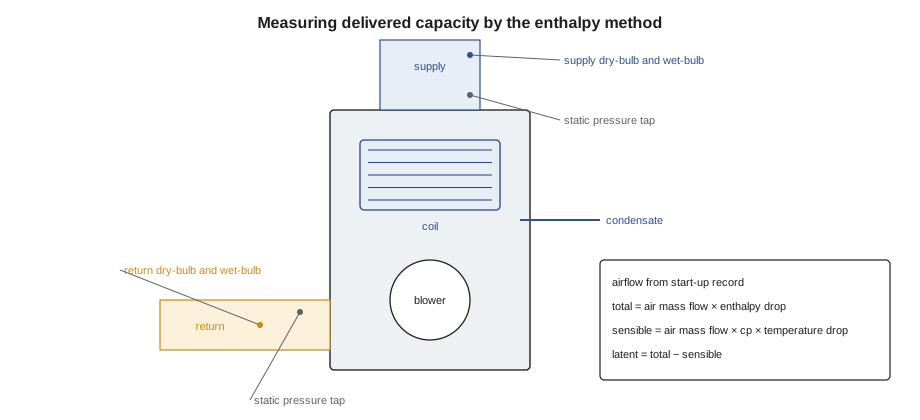
The quick indicators show whether something has changed. The capacity test shows what the system is delivering. It is the enthalpy method: measure the airflow through the indoor coil, and the dry-bulb and wet-bulb temperatures of the air entering and leaving it. Enthalpy, the heat content of moist air per kilogram or pound of dry air, can be found from the wet-bulb temperature alone with good accuracy. The total cooling capacity is the mass flow of air times the enthalpy difference; the sensible capacity is the mass flow times the specific heat times the dry-bulb difference; the latent capacity, the part that removes moisture, is the difference between them. RAC-330 explains the psychrometrics behind this; here it is a tool.
Theo put the Bauer system in the manufacturer's test mode at full speed, waited fifteen minutes for it to settle, and measured the return air at the filter and the supply air in the trunk duct, far enough downstream of the coil for the air to be mixed. The airflow came from the start-up record, confirmed by a static pressure reading against the blower table. The script calculates the enthalpies from the wet-bulb temperatures, then the total, sensible and latent capacities and the condensate the coil was producing.
# Cooling capacity test by the enthalpy method on the Bauer house's new unit
import math
def h_from_wetbulb_c(twb, p=101.325):
    """Enthalpy of saturated air at the wet-bulb temperature, kJ/kg dry air (very close to the air's enthalpy)."""
    pws = 0.61094 * math.exp(17.625 * twb / (twb + 243.04))       # kPa, Magnus formula
    w = 0.622 * pws / (p - pws)
    return 1.006 * twb + w * (2501 + 1.86 * twb), w
CFM = 1000                       # supply airflow, from the commissioning airflow test
ret_db, ret_wb = 75.0, 62.6      # return air, deg F
sup_db, sup_wb = 55.4, 53.2      # supply air, deg F
c = lambda f: (f - 32) / 1.8
h1, w1 = h_from_wetbulb_c(c(ret_wb))
h2, w2 = h_from_wetbulb_c(c(sup_wb))
dh = (h1 - h2) * 0.4299             # kJ/kg to Btu/lb
total = 4.5 * CFM * dh                # Btu/h; 4.5 = 60 min/h x 0.075 lb/ft3
sensible = 1.08 * CFM * (ret_db - sup_db)
print(f"enthalpy difference {dh:.2f} Btu/lb")
print(f"total {total:,.0f} Btu/h, sensible {sensible:,.0f} Btu/h, latent {total - sensible:,.0f} Btu/h, sensible heat ratio {sensible / total:.2f}")
print(f"against 30,000 Btu/h nominal: {total / 30000:.0%} (the rating is at standard conditions, so compare with the extended table)")
print(f"condensate: about {(total - sensible) / 1060:.1f} lb (about {(total - sensible) / 1060 / 8.34:.1f} gallons) per hour")enthalpy difference 6.12 Btu/lb total 27,547 Btu/h, sensible 21,168 Btu/h, latent 6,379 Btu/h, sensible heat ratio 0.77 against 30,000 Btu/h nominal: 92% (the rating is at standard conditions, so compare with the extended table) condensate: about 6.0 lb (about 0.7 gallons) per hour
The Bauer system was delivering about 27,500 Btu/h of total cooling, 92 % of its 30,000 Btu/h nominal rating, with a sensible heat ratio of 0.77. That sounded like a shortfall, but the nominal rating is at standard test conditions. Theo looked up the manufacturer's extended data for the measured indoor wet-bulb, outdoor temperature and airflow: at those conditions the expected capacity was within a few percent of what he had measured. The system was performing as designed. He recorded the test in the job file as the system's first-year baseline.
If the measured capacity had been well below the extended data, the indicators would have pointed to the cause: low airflow with a dirty coil or filter, low charge with high superheat and low subcooling, a restriction with low suction and high subcooling, or a compressor problem with low current and poor pumping. The capacity test does not replace the diagnosis; it tells you whether there is something to diagnose.
Ductless and rooftop maintenance
Ductless heads need particular attention to their indoor parts. Their filters are small and load quickly, and when they are neglected, dust and moisture grow mold on the coil and the cross-flow blower wheel, which customers notice as a musty smell when the unit starts. Cleaning a head properly means protecting the wall and the electronics with a cleaning bag or cover, cleaning the coil with an approved cleaner and rinsing it, and removing or cleaning the blower wheel, which on many models comes out after the drain pan is removed. Condensate pumps in line set covers need cleaning too. The outdoor unit's care is the same as for any split system.
Rooftop units add the economizer, belts and the roof itself, as lesson 9 explained. A rooftop maintenance visit checks the economizer's dampers and actuator through their full stroke, the minimum position, the outdoor air and return sensors and, where fitted, the fault detection diagnostics; replaces belts and checks sheave alignment and tension on belt-driven blowers; cleans the deep condensate trap and checks its freeze protection; and looks at the curb, the flashing and the roof around the unit for leaks or damage. Gas-fired rooftop units also need their heating section checked by a technician licensed for gas work.
Records and trends
A maintenance visit is only as useful as its record. Northfield's service software kept every reading against the system's start-up values: static pressure, temperature split or rise, currents, approach, superheat and subcooling when measured, and the capacity test when done. A single reading tells a technician little; three years of readings show a condenser approach creeping up, a static pressure rising as the family closes registers, or a compressor current falling as a valve wears. The record also tells the next technician, who may not have been on the original job, what normal looks like for that system.
Theo filled in the Bauer record, showed Mrs. Bauer the filter he had removed and the clean drain, and recommended one change: a filter with the same efficiency but more depth, because the existing one was loading quickly in a house with two dogs. He scheduled the heating-season visit for October.
Service agreements
Northfield sold most of its maintenance as service agreements: two visits a year for a heat pump, one before each season, with priority scheduling and a discount on repairs. For the company they smoothed out the year, filling the spring and fall when breakdown calls were few. For customers they meant a system that was checked before it was needed and a technician who could compare this year's readings with last year's. Theo learned that a good maintenance visit also produced sales opportunities that the customer actually wanted: a better filter, a condensate pump that was starting to fail, a thermostat setting that was costing money. He also learned not to invent them. A system that was performing well was reported as performing well, with the readings to prove it.
Common mistakes
MistakeConnecting gauges on every maintenance visit.
InsteadCheck temperatures, currents and the unit's own data first; connect gauges only when needed, with low-loss fittings.
MistakeComparing measured capacity with the nominal rating.
InsteadCompare it with the manufacturer's extended data at the measured conditions.
MistakeCleaning an outdoor coil from the outside in with high pressure.
InsteadRinse from the inside out at low pressure with an approved cleaner.
MistakeTesting an inverter unit's performance at whatever speed it happens to be running.
InsteadUse the manufacturer's test mode so readings compare with the start-up record.
MistakeCleaning only the filter of a smelly ductless head.
InsteadClean the coil and blower wheel, protecting the wall and electronics.
Summary and key terms
- Maintenance preserves capacity and efficiency that are otherwise lost gradually, and builds a baseline record.
- The checklist covers air side, condensate, outdoor unit, electrical, refrigerant performance and controls.
- Temperature split or rise, condenser approach, currents and static pressure are quick indicators compared with the start-up record.
- The enthalpy method measures total, sensible and latent capacity from airflow and wet-bulb temperatures.
- Measured capacity is judged against extended data at the measured conditions, not the nominal rating.
- Ductless heads need coil and blower wheel cleaning; rooftop units need economizer, belt, trap and roof checks.
- Preventive maintenance
- Scheduled inspection, cleaning and testing to prevent failures and keep performance.
- Temperature split
- The difference between return and supply air temperatures across a cooling coil.
- Condenser approach
- Condensing temperature minus outdoor air temperature.
- Enthalpy
- The heat content of moist air per unit mass of dry air.
- Sensible heat ratio
- Sensible capacity divided by total capacity.
- Latent capacity
- The part of cooling capacity that removes moisture from the air.
- Baseline
- The readings taken when a system was new or known good, used for later comparison.
Practice problems
Work each problem on paper first, then reveal the answer to check.
A system's condenser approach was 16 °F at start-up and is 29 °F three years later at similar conditions. What is the most likely cause?
Show answer
A dirty condenser coil or a condenser fan problem.
Return enthalpy is 28 Btu/lb and supply 22 Btu/lb at 1,000 cfm. What is the total capacity?
Show answer
4.5 × 1,000 × 6 = 27,000 Btu/h.
Why are gauges not connected on every maintenance visit?
Show answer
Each connection loses some refrigerant and can introduce leaks; temperatures and currents often show the charge is correct.
A ductless head smells musty at start-up. What should be cleaned?
Show answer
The coil and the blower wheel, as well as the filter.
Lesson quiz · 5 questions
Score 60% or more to complete this lesson.
Create a free account to save your progress, take quizzes and earn a certificate.