
RAC-320 · Lesson 3 of 12 · 19 min
Heat pump defrost and supplementary heat
The Ruiz family lived in an all-electric house on the edge of Northfield's service area: no gas line, a ducted heat pump on a pad behind the house and an air handler in the basement with an electric heater kit. Their first call of the winter came on a damp, foggy morning just below freezing. "The outdoor unit is steaming and making a whooshing noise," Mrs. Ruiz said, "and the air from the vents went cold for a few minutes." Theo went with Raj. On the way Raj said, "Nine calls out of ten like this, the unit is defrosting and doing exactly what it should. The tenth, it's not, and you have to be able to tell which."
RAC-230 covered how defrost controls decide when to start and end a defrost. This lesson covers the system side: why frost forms, what the refrigerant and the house see during a defrost, what supplementary and emergency heat are, how heater kits are sized and staged, and how all of it shows up in a customer's comfort and bill.
Why outdoor coils frost
In heating mode the outdoor coil is the evaporator, and it must be colder than the outdoor air to pick up heat. Typically its surface runs about 10 to 20 °F below the air. When the coil surface is below the outdoor air's dew point, moisture condenses on it, just as on an air conditioner's indoor coil. When the surface is also below freezing, that moisture freezes as frost.
Frost builds fastest when the air is cold enough for the coil to be below freezing but still holds a lot of moisture: roughly from 20 to 40 °F with high humidity, in fog, drizzle or wet snow. On very cold, dry days the air holds little water, so frost builds slowly even though the coil is very cold. That surprises customers, who expect the most defrosts on the coldest days.
Frost insulates the coil and blocks the air passages between the fins. As it builds, airflow falls, the coil gets colder, the suction pressure drops and capacity falls. Left alone, the coil would become a solid block of ice and the heat pump would deliver almost nothing. Periodic defrost is the price of using outdoor air as a heat source below freezing.
What happens in a reverse-cycle defrost
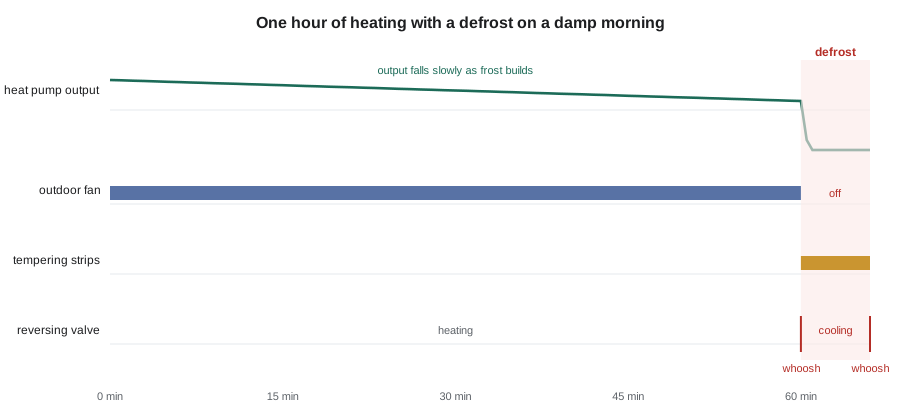
Almost all air-source heat pumps defrost by reversing the cycle: the reversing valve shifts to cooling mode, so hot discharge gas goes to the outdoor coil and melts the frost from the inside. The outdoor fan stops, so the heat stays in the coil instead of being blown away. The indoor coil becomes the evaporator and would blow cold air into the house, so most systems switch on part of the supplementary heat to temper the supply air.
- The start: the reversing valve shifts with a loud whoosh as the pressures equalize and reverse. Some inverter units slow the compressor first to soften the change.
- During defrost: the outdoor coil warms, frost melts and drains away, and a cloud of steam often rises from the unit as the warm coil meets cold air. Customers sometimes call the fire department about it.
- The end: when the coil sensor reaches its termination temperature, or a maximum time passes, the valve shifts back to heating, the outdoor fan restarts and the tempering heat goes off. There is another whoosh, and sometimes a burst of steam as the fan blows across the wet coil.
A typical defrost lasts from two to ten minutes. During it, the house gets no heat from the heat pump, and some of the heat it delivered earlier is pumped back outdoors to melt the ice. That is the defrost penalty. In mild, humid weather it may cost a tenth or more of the heat pump's output; on cold, dry days much less. HSPF2 ratings include an allowance for defrost, which is one reason seasonal efficiency is lower than the COP at a single test point.
Water, ice and placement
Each defrost releases water that must drain away from the unit. A coil that holds a few kilograms of frost releases a few liters of water every defrost, and on a damp day with twenty defrosts that can be tens of liters. If the water cannot drain freely, it refreezes under the unit and builds up an ice dam that eventually reaches the coil, and frost then builds faster than defrost can remove it. A unit buried in drifted snow, or one under a roof edge that drips onto it, has the same problem.
That is why heat pumps in cold climates are mounted on stands or wall brackets that lift the coil above the expected snow depth, with the base pan clear of the ground and the drain holes open. Many cold-climate units have base pan heaters that keep the drain holes from freezing. Lesson 8 covers placement in detail. On the Ruiz call, Raj looked first under the unit: the drain area was clear, the stand was high enough and the coil was clean between defrosts. He watched one full defrost, timed it at five minutes, checked that the coil came out of it clear and that the outdoor fan restarted, and told Mrs. Ruiz the unit was healthy.
When defrost goes wrong
Defrost problems show up as either too much ice or too many defrosts. RAC-230 described the control faults: sensors that have slipped or failed, boards with wrong settings, demand defrost systems that do not see the frost. On the system side, technicians check these too.
- Low charge: suction pressure and coil temperature run lower than normal, so frost builds faster and defrosts may end before the coil is clear.
- A reversing valve that does not shift fully: the coil warms only partly and ice remains in the lower circuits.
- An outdoor fan that keeps running during defrost, because of a failed relay, carries the heat away so the coil never warms.
- Poor drainage, a blocked base pan or a unit too low in snow: ice builds from the bottom.
- Dirty coils or debris: airflow falls, so frost forms faster.
A coil that is solidly iced must be defrosted before anything else can be checked. Technicians run the unit in a forced defrost or in cooling, or melt the ice with water, never by chipping at it, which damages fins and tubes. The aim is to find out why the ice formed before the customer's next cold, damp morning.
Supplementary heat and emergency heat
Below the thermal balance point the heat pump alone cannot keep up, as lesson 2 showed, so something else must add heat. In an all-electric house like the Ruiz house that is usually an electric heater kit, a set of resistance strips in the air handler downstream of the indoor coil. In a house with a furnace, the furnace provides the extra heat, which lesson 6 covers as dual fuel. Some systems use a hot water coil from a boiler or water heater.
Two terms are often confused. Supplementary heat, also called auxiliary heat, runs together with the heat pump when the heat pump cannot meet the load, and to temper the air during defrost. Emergency heat is the mode the homeowner or technician selects when the heat pump itself has failed or must not run: the thermostat locks out the compressor and heats with the strips or furnace alone. In emergency heat, the strips must carry the whole house, so the heater kit in a fully electric house is often sized for the full design load, not just the shortfall.
Thermostats usually call supplementary heat as a second stage, on the W2 or AUX terminal, when the first stage has run for a while without satisfying the setpoint or the room temperature falls a set amount below it. Communicating systems decide this from outdoor temperature and the heat pump's actual output. Many systems also use an outdoor thermostat or a lockout setting so that strips cannot run above a certain outdoor temperature, except in defrost and emergency heat. Without that lockout, a homeowner who raises the setpoint by three degrees in the morning may bring on the strips for half an hour on a mild day, and that one habit can double the heating bill.
Sizing and staging heater kits
Heater kits come in standard sizes, commonly 5, 8, 10, 15 and 20 kW for residential air handlers, and each air handler model accepts only certain kits. The right size depends on the shortfall at the design temperature, the need for emergency heat and the electrical service. The script below works through the Ruiz house: the shortfall between the design heat loss and what the heat pump still delivers at the design temperature, the kit needed for full emergency heat, and the cost of tempering heat during defrost on a damp day.
# Supplementary and emergency heat for the Ruiz house's all-electric heat pump
DESIGN_LOAD = 32000            # Btu/h at the outdoor design temperature
HP_AT_DESIGN = 18500           # Btu/h the heat pump still delivers at that temperature
STRIP_SIZES = [5, 8, 10, 15]  # kW heater kits the air handler accepts
TO_LOAD = 3412              # converts kW of strip heat to Btu/h
short = DESIGN_LOAD - HP_AT_DESIGN
supp = min(k for k in STRIP_SIZES if k * TO_LOAD >= short)
emerg = min(k for k in STRIP_SIZES if k * TO_LOAD >= DESIGN_LOAD)
print(f"shortfall at design: {short:,.0f} Btu/h -> smallest kit that covers it: {supp} kW")
print(f"emergency heat for the whole design load: {emerg} kW ({emerg * TO_LOAD:,.0f} Btu/h)")
# Defrost: on a cold, humid morning the unit defrosts for 6 minutes every 60 minutes of heating
RUN, DEF = 60.0, 6.0
HP_CAP = 22000               # Btu/h the heat pump delivers between defrosts that morning
lost = HP_CAP * DEF / (RUN + DEF)
print(f"heat pump output averaged over the cycle: {HP_CAP * RUN / (RUN + DEF):,.0f} Btu/h ({100 * DEF / (RUN + DEF):.0f} % of the hour in defrost)")
TEMPER = 5                     # kW of strip heat switched on during each defrost to stop cold air at the registers
print(f"strip energy per defrost: {TEMPER * DEF / 60:.2f} kWh; per day at 20 defrosts: {TEMPER * DEF / 60 * 20:.0f} kWh")shortfall at design: 13,500 Btu/h -> smallest kit that covers it: 5 kW emergency heat for the whole design load: 10 kW (34,120 Btu/h) heat pump output averaged over the cycle: 20,000 Btu/h (9 % of the hour in defrost) strip energy per defrost: 0.50 kWh; per day at 20 defrosts: 10 kWh
The Ruiz heat pump falls 13,500 Btu/h short at 10 °F, so a 5 kW kit would cover supplementary heat. For emergency heat, the strips must cover the full 32,000 Btu/h, which needs a 10 kW kit, about 34,000 Btu/h. The installer had fitted a 10 kW kit in two 5 kW stages. On a normal cold morning only the first stage comes on as supplementary heat; both come on only in emergency heat or on the coldest mornings. The defrost tempering uses one stage for five or six minutes at a time, about 10 kWh on a day with twenty defrosts.
Staging matters for comfort, cost and the electrical supply. A 10 kW kit at 240 V draws about 42 A, more than the heat pump's compressor. Kits have sequencers or relays that bring the elements on one at a time a few seconds apart, so that the full current does not arrive at once, and each element has its own limit switch and thermal fuse or fusible link. The air handler's circuit, conductors and overcurrent protection are sized for the kit, and the air handler's nameplate gives the minimum circuit ampacity and maximum overcurrent device for each kit size, as RAC-130 described. Installing a bigger kit than the air handler is listed for, or one on a circuit sized for a smaller kit, is a code violation and a fire risk.
Strips need airflow. If the blower fails or a filter is badly blocked, the limit switch should open the elements before they overheat, but limits that trip repeatedly weaken and eventually fail. A strip-heat call should always be checked with the blower confirmed running and the airflow correct; lesson 10 shows how the strips themselves can be used to measure airflow.
Supplementary heat and the bill
Resistance heat has a COP of 1. Every hour the strips run in place of the heat pump costs two to four times as much as the same heat from the heat pump. Customers who complain about high winter bills often have one of a few causes: emergency heat left on after a service call, a lockout set too high or not set at all, a thermostat programd with deep setbacks that bring on the strips every morning, or a heat pump that has failed quietly and left the strips doing all the work. Many communicating thermostats report strip run-time; on others, a technician can check the strips' hours on a smart thermostat's history or by measuring the current on the air handler circuit.
Theo found one more item on the Ruiz system: the thermostat's auxiliary heat lockout was off, and the history showed the strips running every morning when the family raised the setpoint from 17 to 21 degrees. With the family's agreement, he set the lockout so the strips could not run above 25 °F except in defrost and emergency heat, and changed the morning recovery to a smaller, earlier step. Raj called that the most valuable fix of the day, though nothing had been broken.
Common mistakes
MistakeChipping ice off an outdoor coil.
InsteadMelt it with a forced defrost, cooling mode or water, then find out why it formed.
MistakeTreating steam and a whoosh during defrost as a fault.
InsteadExplain them; watch a full defrost and check the coil clears.
MistakeConfusing emergency heat with supplementary heat.
InsteadEmergency heat locks out the heat pump; supplementary heat runs alongside it.
MistakeLeaving the auxiliary heat lockout disabled.
InsteadSet an outdoor lockout so strips run only when the heat pump truly needs help.
MistakeFitting a larger heater kit than the air handler and circuit are listed for.
InsteadUse only listed kits on circuits sized from the nameplate.
Summary and key terms
- Frost forms when the outdoor coil is below both freezing and the air's dew point; it builds fastest in mild, humid weather.
- Reverse-cycle defrost melts frost with hot gas while the outdoor fan stops and strips temper the supply air.
- Defrost water must drain freely; units sit above the snow with clear base pans.
- Supplementary heat runs with the heat pump below the balance point; emergency heat replaces it.
- Heater kits are sized from the design shortfall and the need for emergency heat, staged, and installed only as listed.
- Strip heat has a COP of 1; lockouts and sensible setbacks keep it from inflating bills.
- Defrost
- Removing frost from the outdoor coil, usually by reversing the cycle for a few minutes.
- Defrost penalty
- The heat lost and energy used to melt frost from the outdoor coil.
- Supplementary heat
- Resistance or fossil-fuel heat that runs with a heat pump when it cannot meet the load; also called auxiliary heat.
- Emergency heat
- A thermostat mode that locks out the heat pump and heats with the backup alone.
- Heater kit
- A set of electric resistance elements installed in an air handler.
- Sequencer
- A time-delay switch that brings heater elements on one after another.
- Auxiliary heat lockout
- A setting that prevents strip heat above a chosen outdoor temperature except in defrost and emergency heat.
Practice problems
Work each problem on paper first, then reveal the answer to check.
Why do heat pumps often defrost more on a foggy day near freezing than on a dry, very cold day?
Show answer
The humid air deposits much more frost on the coil.
A customer left the thermostat in emergency heat after a power failure. What happens to the bill?
Show answer
It rises sharply, because all heat comes from strips with a COP of 1.
A 10 kW heater kit runs at 240 V. What current does it draw?
Show answer
10,000 ÷ 240 = about 42 A.
Name two system faults, other than the defrost control, that can leave ice on an outdoor coil.
Show answer
Any two of: low charge, a reversing valve not shifting fully, the outdoor fan running in defrost, poor drainage, a dirty coil.
Lesson quiz · 5 questions
Score 60% or more to complete this lesson.
Create a free account to save your progress, take quizzes and earn a certificate.