
RAC-320 · Lesson 6 of 12 · 17 min
Cold-climate heat pumps and dual-fuel systems
Two jobs landed on Dana's desk in the same week. The first was the Novak house, a 1962 bungalow heated by a propane furnace, outside the gas utility's service area, with a failed air conditioner. Irene and Pavel Novak wanted to get rid of the furnace altogether and heat with a heat pump. The second was Erik Lindqvist, back with a follow-up question after Theo's visit: could the dual-fuel system be set to use the furnace less? "One house wants to go all electric in a cold climate," Dana said, "and the other wants to know when to stop using gas. Both answers come out of the same capacity tables and the same arithmetic."
This lesson explains what makes a heat pump suitable for a cold climate, how to read extended capacity data, how to check that a heat pump can carry a house at low temperatures, and how dual-fuel systems decide when to switch between the heat pump and a furnace. The Novak house is the capstone of lesson 12; here its heat pump is chosen.
What makes a heat pump cold-climate
Every heat pump loses capacity and COP as the outdoor temperature falls, as lesson 2 explained. A cold-climate heat pump is designed to lose much less, and to keep running at much lower temperatures. Several features make that possible:
- An inverter-driven compressor that can run well above its nominal speed in cold weather, making up for the lower density of the suction vapor.
- Vapor injection, sometimes called enhanced vapor injection: part of the liquid is expanded to an intermediate pressure, flashes in an economizer heat exchanger and is injected into the compressor partway through compression. That cools the compressor, raises the refrigerant flow through the indoor coil and allows higher pressure ratios without excessive discharge temperature.
- Large outdoor coils, often with wider fin spacing to delay frosting, and smart defrost controls.
- Base pan and sometimes drain heaters, so defrost water does not freeze under the coil.
- Electronics and lubricants rated for operation down to about −13 to −22 °F or lower, with published capacity at those temperatures.
A standard single-speed heat pump might deliver 55 to 65 % of its rated capacity at 17 °F and stop working usefully somewhere below 5 °F. A good cold-climate unit may deliver 90 to 100 % of its rated capacity at 17 °F and 70 to 80 % or more at 5 °F, with a COP still around 2.
Cold-climate specifications
Because the standard ratings say little about performance in deep cold, several programs define what cold-climate means. The Northeast Energy Efficiency Partnerships, NEEP, publishes a cold-climate air-source heat pump specification and a public product list. Its version 4.0, effective since 2023, asks among other things for a COP of at least 1.75 at 5 °F at maximum capacity, and it requires manufacturers to report capacity and COP at 47, 17 and 5 °F and at their lowest catalogd temperature. ENERGY STAR has a cold-climate designation with similar intent, and many incentive programs require a product to be on one of these lists.
The NEEP list is especially useful because it shows three capacities at each temperature: minimum, rated and maximum. The maximum is what the unit can deliver when the compressor runs at its highest speed; that is the number to compare with the house load on a cold day. The minimum shows how far the unit can turn down in mild weather, which decides how much it will cycle. A unit with a high maximum but a minimum that is still larger than the house's load on a mild autumn day will cycle for weeks at a time.
Checking capacity against the house
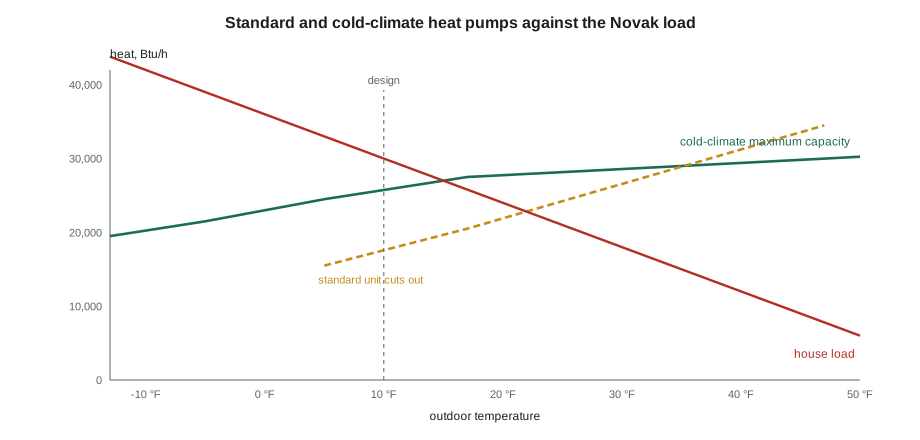
Northfield's load calculation for the Novak house, which lesson 7 works through, gave a design heat loss of 30,000 Btu/h at 10 °F, after the air sealing and attic insulation the Novaks had agreed to do first. Dana shortlisted a ducted variable-speed cold-climate heat pump, nominally 3 tons, and Theo entered its maximum-capacity figures from the extended data into the script below. The second part of the script answers Mr. Lindqvist's question, which comes later in the lesson.
# Part 1: the Novak cold-climate heat pump's maximum capacity against the house load
table = {-13: 19500, -5: 21500, 5: 24500, 17: 27500, 47: 30000}                 # outdoor temperature (°F): maximum heating capacity (Btu/h) from the manufacturer's extended data
DESIGN_T, DESIGN_LOAD, ZERO_T = 10, 30000, 60
def cap(t):
    pts = sorted(table.items())
    for (ta, ca), (tb, cb) in zip(pts, pts[1:]):
        if ta <= t <= tb:
            return ca + (cb - ca) * (t - ta) / (tb - ta)
    raise ValueError("outside the published range")
load = lambda t: DESIGN_LOAD * (ZERO_T - t) / (ZERO_T - DESIGN_T)
for t in [40, 25, 10, 5, -13]:
    print(f"{t:4.0f} °F: load {load(t):6.0f}, capacity {cap(t):6.0f} Btu/h -> covers {min(1, cap(t) / load(t)):5.0%}")
# Part 2: the Lindqvist dual-fuel system — the economic balance point
ELEC = 0.14                   # dollars per kWh
GAS, GAS_UNIT, GAS_KWH = 1.5, "therm", 29.3      # price per unit and kWh of heat per unit
AFUE = 0.96
gas_per_kwh = GAS / (GAS_KWH * AFUE)
cop_even = ELEC / gas_per_kwh
print(f"furnace heat costs {gas_per_kwh:.3f} dollars per kWh; the heat pump is cheaper whenever its COP exceeds {cop_even:.2f}")
T1, COP1, T2, COP2 = 47, 3.9, 17, 2.5
t_even = T2 + (cop_even - COP2) * (T1 - T2) / (COP1 - COP2)
print(f"economic balance point: about {t_even:.0f} °F outdoors")40 °F: load 12000, capacity 29417 Btu/h -> covers 100% 25 °F: load 21000, capacity 28167 Btu/h -> covers 100% 10 °F: load 30000, capacity 25750 Btu/h -> covers 86% 5 °F: load 33000, capacity 24500 Btu/h -> covers 74% -13 °F: load 43800, capacity 19500 Btu/h -> covers 45% furnace heat costs 0.053 dollars per kWh; the heat pump is cheaper whenever its COP exceeds 2.63 economic balance point: about 20 °F outdoors
The chosen unit carries the whole Novak load down to the mid-teens and still delivers 86 % of the load at 10 °F, the design temperature. Below that, a small electric heater kit makes up the difference, and on the rare mornings below zero the heat pump still supplies close to half the house's heat. The heater kit also gives the Novaks emergency heat, as lesson 3 explained.
Dana explained the decision to the Novaks this way. A bigger heat pump could carry the design day alone, but it would also be bigger in cooling and in mild weather, when the house needs very little, and the extra size would cost more. Since the hours at or below the design temperature are only a few dozen a year, a small amount of resistance heat for those hours costs little in energy. The aim is a unit whose maximum capacity covers most of the heating hours and whose minimum capacity is small enough to run smoothly in spring and fall.
Dual-fuel systems
A dual-fuel system, also called a hybrid system, pairs a heat pump with a fossil-fuel furnace. The heat pump's indoor coil sits on top of the furnace, downstream of the furnace's heat exchanger. The two cannot normally run together, because the furnace would blow hot air across the heat pump's coil, which in heating is the condenser; the condensing pressure would climb until the high-pressure switch tripped. So the control chooses one or the other: the heat pump in mild weather, the furnace in cold weather, and the furnace during defrost to temper the air.
The temperature at which the control switches is the changeover point. It can be set in two ways, and the right setting is the higher of the two:
- The thermal balance point, from lesson 2: below it the heat pump alone cannot keep the house warm, so the furnace must take over.
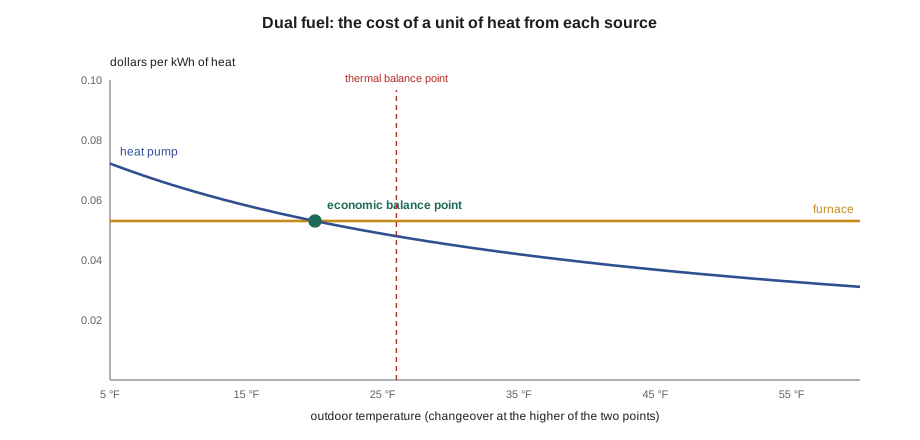
- The economic balance point: the outdoor temperature below which heat from the furnace costs less than heat from the heat pump. It depends on the prices of electricity and fuel, the furnace's efficiency and the heat pump's COP at each temperature.
The furnace's cost per unit of heat is the fuel price divided by the energy in each unit of fuel and the furnace's efficiency. The heat pump's cost per unit of heat is the electricity price divided by its COP. They are equal when the COP equals the electricity price divided by the furnace's cost per unit of heat:
The second part of the script works this out for the Lindqvists, using their furnace's 96 % efficiency, their utility prices and the heat pump's rated COPs from lesson 2.
At the Lindqvists' prices, the heat pump is cheaper whenever its COP is above about 2.6, which happens above about 20 °F. Their thermal balance point from lesson 2 was 26 °F, so the thermal point is the higher one and decides the changeover: about 26 °F. Below that the heat pump cannot keep up anyway, which is why the furnace ran so much in December. Using the furnace less would need a larger or cold-climate heat pump, or improvements to the house that lower its heat loss, rather than a different setting.
Prices change, so economic balance points change with them. A dual-fuel system's changeover setting should be reviewed when fuel or electricity prices move substantially, and some communicating systems can take price inputs or time-of-use schedules directly. Technicians should also be careful not to promise customers an economic result they cannot control; Northfield's practice was to show the calculation with the current prices, write the prices on it and leave the decision with the customer.
Incentives and programs
Heat pump installations are often supported by government and utility incentives, and customers expect contractors to know about them. The programs change often, so the only reliable advice is to check the current rules before quoting and to keep the paperwork the program needs: AHRI certificates, product listings, load calculations, invoices and photographs. In the United States, the federal tax credit for heat pumps under section 25C ended for equipment placed in service after December 31, 2025, under the budget law passed in July 2025. States administer rebate programs funded earlier, such as the home electrification rebates for income-qualified households, but their availability varies from state to state, and utilities run their own rebates. Each program sets its own eligible products, often from the ENERGY STAR or NEEP cold-climate lists, and its own paperwork. Theo learned to ask every heat pump customer early whether they were applying for a program, because some programs require approval or an assessment before any work begins.
Operating limits and protection
Every heat pump has a published low-ambient limit below which it stops and leaves the house to the backup heat. Cold-climate units list theirs, often about −13 to −22 °F. Near that limit, discharge temperatures rise, oil becomes thick and the compressor's pressure ratio approaches its maximum, so the controller protects the compressor by slowing it or stopping it. A customer whose all-electric house goes onto strip heat on the coldest night of the year should know in advance that this is normal, and the heater kit must be sized for those hours, as lesson 3 described.
Cold-climate units also depend on their installation more than standard units: they must be high above the snow, with clear drainage, as lesson 8 explains, and their line sets, charge and airflow must be right, because a unit that is short of charge or airflow loses its cold-weather advantage first. A cold-climate unit installed carelessly behaves like a standard unit in January.
Common mistakes
MistakeSizing a cold-climate heat pump from its nominal or rated capacity.
InsteadCompare the house load with the maximum capacity at low outdoor temperatures from the extended data.
MistakeChoosing the largest unit so that it covers the design day alone.
InsteadCheck the minimum capacity too; an oversized unit cycles in mild weather.
MistakeSetting a dual-fuel changeover below the thermal balance point.
InsteadUse the higher of the thermal and economic balance points.
MistakeRunning the furnace and heat pump together on a dual-fuel system.
InsteadThe control must choose one; the furnace would overload the heat pump's condenser.
MistakePromising a customer a fixed saving from incentives or fuel switching.
InsteadShow the calculation with current prices and programs, and let the customer decide.
Summary and key terms
- Cold-climate heat pumps keep much of their capacity and a useful COP far below freezing, using inverter compressors, vapor injection and large coils.
- Specifications such as NEEP's ask for a minimum COP at 5 °F and require minimum, rated and maximum capacities at several temperatures.
- Check the house load against maximum capacity at low temperatures, and minimum capacity against mild-weather loads.
- A small heater kit can cover the few hours below the heat pump's reach and provide emergency heat.
- Dual-fuel systems switch between heat pump and furnace at the higher of the thermal and economic balance points.
- Incentive programs change often; check them before quoting and keep the paperwork.
- Cold-climate heat pump
- A heat pump designed and listed to keep useful capacity and COP at very low outdoor temperatures.
- Vapor injection
- Injecting intermediate-pressure vapor into the compressor to raise capacity and limit discharge temperature in cold weather.
- Maximum capacity
- The output a variable-speed unit can deliver at its highest compressor speed at a given temperature.
- Dual fuel
- A heating system that combines a heat pump with a fossil-fuel furnace.
- Changeover point
- The outdoor temperature at which a dual-fuel system switches from the heat pump to the furnace.
- Economic balance point
- The outdoor temperature below which furnace heat costs less than heat pump heat.
- Low-ambient limit
- The outdoor temperature below which a heat pump stops and leaves heating to the backup.
Practice problems
Work each problem on paper first, then reveal the answer to check.
Electricity costs 0.14 per kWh and furnace heat costs 0.05 per kWh. Above what COP is the heat pump cheaper?
Show answer
0.14 ÷ 0.05 = 2.8.
Why can't a dual-fuel system normally run the furnace and the heat pump at the same time?
Show answer
The furnace's hot air would pass over the heat pump's condenser coil and drive its pressure too high.
A cold-climate unit's minimum capacity at 50 °F is twice the house's load at that temperature. What will happen?
Show answer
It will cycle on and off in mild weather.
Why should a customer applying for an incentive be identified before the work begins?
Show answer
Some programs require approval or an assessment before installation.
Lesson quiz · 5 questions
Score 60% or more to complete this lesson.
Create a free account to save your progress, take quizzes and earn a certificate.