
RAC-120 · Lesson 6 of 12 · 19 min
Certification, purchase restrictions and records
Theo's Section 608 exam was on a Saturday, at a supply house in Louisville that hosts a certifying organization's proctored test. Northfield paid the fee and gave him the Friday afternoon off to study. On Monday he came in with his results and a question for Dana: "Now that I'm certified, can I just go to the supply house and pick up a cylinder for a side job?" Dana laughed. "Legally, they'll sell it to you. But every pound you buy, charge and recover has to be written down, and the paperwork is what protects you when an inspector, a customer or a lawyer asks what happened to it."
This lesson covers three linked controls: who may handle refrigerant, who may buy it, and what must be recorded. Certification makes sure the people handling refrigerant know the rules and safe practices. Purchase restrictions keep refrigerant out of untrained hands. Records create a trail from the cylinder to the system to the reclaimer, so that refrigerant can be accounted for and leaks found.
Certification
EPA's Section 608 rules require anyone who maintains, services, repairs or disposes of stationary equipment in a way that could release refrigerant to be certified. Certification is earned by passing an exam given by an EPA-approved certifying organization. It covers technicians who attach and detach hoses and gauges, add or remove refrigerant, or do anything else that opens the refrigerant circuit. Apprentices may do this work without certification only under the direct supervision of a certified technician, and only for a limited period while they prepare for the exam.
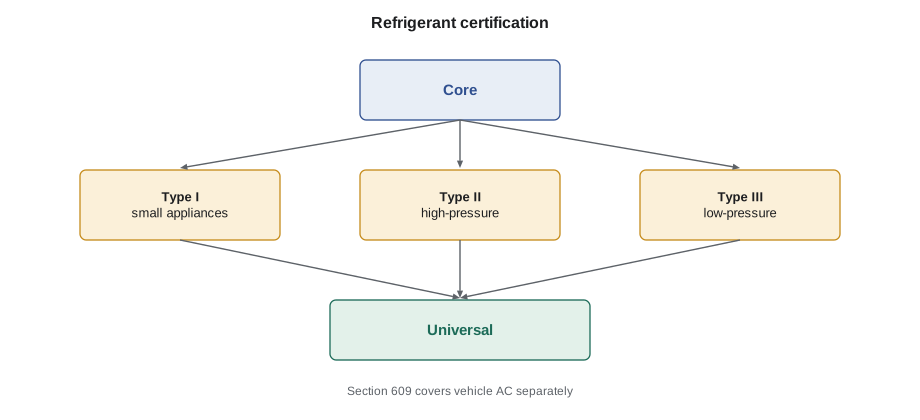
The Section 608 exam is modular. Every candidate takes the Core section, which covers ozone depletion and climate, the Clean Air Act and the regulations, the Montreal Protocol, substitute refrigerants, refrigeration basics, recovery, recycling and reclaiming, dehydration and safety. Then the candidate takes one or more of three technician types, each tied to a kind of equipment:
Type I covers small appliances: factory-manufactured, charged and hermetically sealed products holding 5 pounds or less of refrigerant, such as household refrigerators, window air conditioners, dehumidifiers and drinking-water coolers. Type II covers high-pressure and very high-pressure equipment, such as residential and commercial air conditioning, heat pumps and most commercial refrigeration. Type III covers low-pressure equipment, mainly chillers using refrigerants such as R-123 and R-1233zd(E). A technician who passes Core and all three types is Universal certified, the certification most service companies expect.
Each section has 25 multiple-choice questions, and a candidate must answer 18 correctly, 70 percent, to pass a section in a proctored, closed-book exam. Type I alone may also be taken as an open-book test without a proctor, but the passing score is then 84 percent, and an open-book result cannot be combined toward Universal certification. Section 608 certification does not expire. The technician must keep the card, or a copy of it, and show it when buying refrigerant or when asked by an employer or inspector. Lesson 12 reviews the topics in each section.
Certification for motor vehicle air conditioning is separate, under Section 609, and does not cover stationary equipment; a Section 608 certificate likewise does not cover vehicle work. Kentucky also licenses HVAC journeymen and master HVAC contractors through its Department of Housing, Buildings and Construction. A state license and EPA certification are separate requirements: one is about who may do the trade work, the other about who may handle refrigerant.
Who may buy refrigerant
EPA's sales restriction limits the sale of ozone-depleting refrigerants and their substitutes, including HFCs, to technicians certified under Section 608 or Section 609, with a few exceptions: sales for resale to other dealers, sales to employers of certified technicians who show evidence that they employ them, and sales of small cans of motor vehicle refrigerant with self-sealing valves. The restriction has applied to ozone-depleting refrigerants since the 1990s and was extended to HFCs from January 1, 2018. Sellers must verify certification and keep records. Equipment that is pre-charged at the factory, such as a split system with a charged line set, may be sold to anyone, but the buyer must have it installed by a certified technician or keep proof of that arrangement.
The purpose is the same in both countries. Refrigerant sold to untrained buyers tends to end up in the atmosphere, through leaking do-it-yourself recharges of systems that are never repaired. Restricting purchases to certified technicians means the person adding refrigerant knows that a system needing refrigerant has a leak, and that the leak should be found and fixed.
Service records
Records under the federal rules depend on the equipment. For equipment covered by leak repair, the technician must give the owner a record of each service that adds refrigerant, including the amount and type added, the date and the leak inspection and verification test results, and the owner must keep records of leak rate calculations, repairs, inspections and any retrofit or retirement plans, for three years. Technicians who dispose of equipment holding more than 5 and less than 50 pounds must keep records of the refrigerant recovered, by type and month, and of where it was sent, for three years. Reclaimers and distributors have their own record and reporting duties.
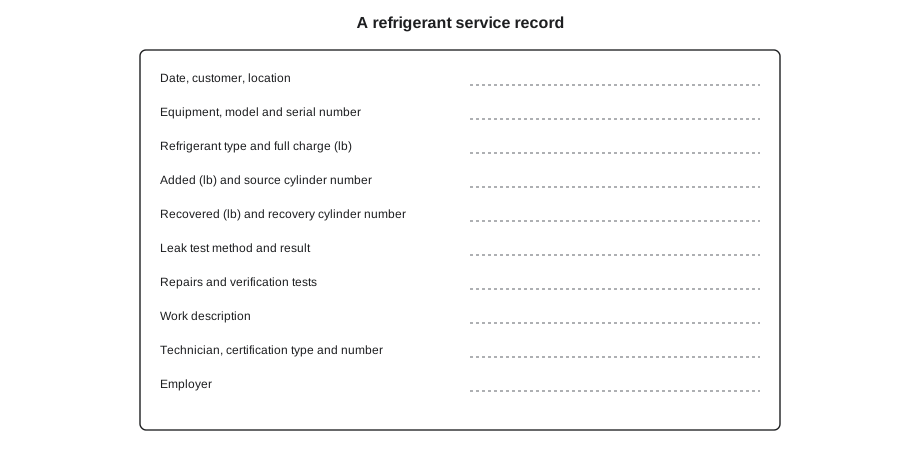
Northfield's service records are kept in the company's dispatch software, with a paper backup in each van, and every record includes the cylinder number for refrigerant added or recovered. That last detail is what makes the records useful: it links each job to a cylinder, each cylinder to a purchase or a reclaimer shipment, and so gives a complete trail.
| Item | Why it matters |
|---|---|
| Date, customer, equipment location and identification | Ties the record to one system |
| Refrigerant type and full charge | Decides which rules apply and allows leak rates to be calculated |
| Amount added, with source cylinder | Leak rate calculations; inventory reconciliation |
| Amount recovered, with destination cylinder | Shows refrigerant was not released; tracks it to the reclaimer |
| Leak test or inspection method and result | Proves compliance; guides the next technician |
| Repairs made and verification tests | Shows the leak was fixed and checked |
| Technician name, certificate number and employer | Shows the work was done by a certified person |
Accounting for every pound
Good companies go beyond the minimum records and reconcile their refrigerant inventory, much as a store reconciles its cash. At the end of each month, Northfield's office compares what came in with what went out, refrigerant type by type. The basic balance for a company or a van is:
Recovered refrigerant counts as coming into the company's cylinders, and refrigerant shipped to a reclaimer or returned to a supplier counts as going out. A small unaccounted amount is normal, from hose losses, scale rounding and the heel left in cylinders. A large or growing unaccounted amount means something is wrong: unrecorded charges, mislabeled cylinders, leaking cylinders, or refrigerant leaving the company in ways that should not happen.
Worked problem
Reconciling Theo's van for October
Theo's van started October with 62.8 lb of R-410A in new-refrigerant cylinders and recovery cylinders. During the month he bought 50.0 lb, recovered 21.6 lb, charged 41.0 lb into systems according to his service records, and shipped 26.5 lb of recovered refrigerant to the reclaimer. The end-of-month weigh-in showed 65.3 lb. How much is unaccounted for?
Show solution
- \[62.8 + 50.0 + 21.6 - 41.0 - 26.5 - 65.3 = 1.6\ \text{lb}\]
Answer: About 1.3 percent of what passed through the van is unaccounted for, which is within the range Northfield expects from hose losses and rounding. If the figure had been several pounds, Dana would have compared each service record with the dispatch log to find the missing entry.
# Monthly refrigerant reconciliation for each van, by refrigerant (lb)
vans = {
    "Van 4 (Theo)": {"R-410A": (62.8, 50.0, 21.6, 41.0, 26.5, 65.3),
                     "R-134a": (25.0, 0.0, 7.0, 2.5, 0.0, 29.3)},
    "Van 7":        {"R-410A": (68.3, 100.0, 9.0, 87.7, 0.0, 74.7),
                     "R-448A": (21.0, 25.0, 0.0, 13.2, 0.0, 20.8)},
}
LIMIT = 0.03   # flag if more than 3 % of throughput is unaccounted for
for van, refs in vans.items():
    for ref, (start, bought, recovered, charged, shipped, end) in refs.items():
        missing = start + bought + recovered - charged - shipped - end
        throughput = bought + recovered + charged + shipped
        share = missing / throughput if throughput else 0.0
        flag = "CHECK RECORDS" if share > LIMIT else "ok"
print(f"{van:14s} {ref:7s} unaccounted {missing:5.1f} lb ({share * 100:4.1f} % of throughput) {flag}")Van 4 (Theo) R-410A unaccounted 1.6 lb ( 1.2 % of throughput) ok Van 4 (Theo) R-134a unaccounted 0.2 lb ( 2.1 % of throughput) ok Van 7 R-410A unaccounted 14.9 lb ( 7.6 % of throughput) CHECK RECORDS Van 7 R-448A unaccounted 12.0 lb (31.4 % of throughput) CHECK RECORDS
Van 7's R-410A is flagged: more than 3 percent of its throughput is missing. When Dana checked, the technician had charged a heat pump on a warranty call and recorded the job in the warranty system but not in the dispatch software. One missing entry explained the gap. Without the reconciliation, the error would have sat in the records indefinitely, and the warranty system's numbers and the company's would never have agreed.
Records that protect the technician
Records are often seen as paperwork that gets in the way of the real job. They are better seen as protection. If a customer claims a system was overcharged, the record shows what was added. If an inspector asks why a cylinder of R-22 was shipped, the record shows where it came from. If a system develops a leak the week after service, the record shows what was done and what was tested. And when the next technician arrives, the record tells them the system's history: refrigerant type, full charge, past leaks and their locations, saving time and avoiding mistakes such as topping up with the wrong refrigerant.
Dana's rules for records are short. Write the record before leaving the site. Weigh, do not estimate. Record cylinder numbers. Never back-date or change a record after the fact; if a mistake is found, add a correction with the date and a note. And if the paperwork and the cylinder do not agree, stop and find out why before going on.
A service record, start to finish
On a Tuesday in November, Theo serviced the brewery's walk-in cooler after Priya, the head brewer, reported that the box was running warm. He found a dirty condenser and a low charge. A leak search with the electronic detector found a leak at the cap-less Schrader port on the liquid line, confirmed with bubbles. He recovered the charge, replaced the core, fitted a sealing cap, pressure tested with nitrogen, evacuated and recharged by weight with the R-448A he had recovered plus new refrigerant from the van.
His service record listed the date and time, the brewery's name and address, the condensing unit's model and serial number, the refrigerant and its full charge of 10 lb, the amount recovered and the recovery cylinder number, the amount of new refrigerant added and its cylinder number, the leak found and its repair, the nitrogen test pressure and result, the evacuation level reached, the final operating pressures, his name, his certification type and card number, and Northfield's name. Although the brewery's system is below the leak repair applicability level, he recorded the leak and repair exactly as he would for a covered system, and gave Priya a copy of the record.
When Dana reviewed it, she pointed to one thing that made the record valuable: anyone reading it a year later would know where the last leak was, what was done, and how much refrigerant went in and out. That is the test of a good record. It answers the questions the next person will ask without anyone having to remember.
Records for owners of larger systems
Owners of larger systems, such as supermarket chains, hospitals and property managers, usually keep their own refrigerant registers: a list of every system with its refrigerant, full charge, location and service history. Many require contractors to report every addition and recovery so that they can calculate leak rates, budget for refrigerant and plan replacements. Contractors who supply complete, consistent records make that easy, and owners notice. Some companies use barcodes or electronic tags on cylinders and equipment so that every transfer is captured automatically.
Common mistakes
MistakeLending a Section 608 card to an uncertified co-worker.
InsteadCertification is personal; each person handling refrigerant must hold their own valid certificate.
MistakeEstimating the amount of refrigerant added.
InsteadWeigh refrigerant in and out and record the actual amounts.
MistakeLeaving the record for later at the office.
InsteadComplete the record on site, while the facts are fresh.
MistakeAssuming EPA certification replaces a state HVAC license.
InsteadRefrigerant certification and trade qualification are separate requirements.
Summary and key terms
- Section 608 certification has a Core section and Types I, II and III; passing all is Universal; certification does not expire.
- Each section has 25 questions; 18 correct passes a proctored section; open-book Type I needs 84 percent.
- Refrigerant sales, including HFCs since 2018, are restricted to certified technicians, with narrow exceptions.
- Leak repair, disposal and service records are generally kept for three years.
- Records should include the cylinder numbers, which link every job to the refrigerant trail.
- Monthly reconciliation of refrigerant in, out and on hand finds missing records, mislabeled cylinders and leaks.
- Core
- The Section 608 exam section all candidates must pass.
- Type I
- Certification for small appliances of 5 pounds or less, factory charged and sealed.
- Type II
- Certification for high-pressure and very high-pressure equipment.
- Type III
- Certification for low-pressure equipment such as R-123 chillers.
- Universal
- Certification in Core and all three types.
- Sales restriction
- The rule limiting refrigerant sales to certified technicians.
- Reconciliation
- Comparing refrigerant in, out and on hand to find unaccounted amounts.
Practice problems
Work each problem on paper first, then reveal the answer to check.
Which certification type covers a 4 lb window air conditioner?
Show answer
Type I, small appliances.
Which type covers an R-123 chiller?
Show answer
Type III, low-pressure equipment.
A van starts with 22.0 lb, buys 11.0 lb, recovers 4.4 lb, charges 13.2 lb, ships nothing and ends with 23.3 lb. How much is unaccounted?
Show answer
22.0 + 11.0 + 4.4 − 13.2 − 0 − 23.3 = 0.9 lb.
Why should cylinder numbers be written on service records?
Show answer
They link each job to a specific cylinder and so to its purchase or reclaimer shipment.
Lesson quiz · 5 questions
Score 60% or more to complete this lesson.
Create a free account to save your progress, take quizzes and earn a certificate.