
RAC-120 · Lesson 1 of 12 · 24 min
Why refrigerant handling is regulated: ozone and climate
On the first morning of his second module, Theo Martel found a printed list taped to the shop door at Northfield Mechanical. It was last year's refrigerant log, summarized by Dana Okafor: every pound of refrigerant the company had bought, charged, recovered and sent away for reclaiming. At the bottom she had written a single number in red, the carbon dioxide equivalent of the refrigerant the company had pulled out of old equipment and kept out of the air. It was larger than the yearly emissions of all eleven service vans combined.
"Most people think our job is fixing coolers," Dana said when Theo asked about it. "It is. But every time we connect gauges we are also handling a substance that the law treats as a pollutant, because if it gets out it damages the ozone layer, warms the planet, or both. That is why there are rules about who can buy it, how we recover it, what we write down and how we fix leaks. This module is those rules, and the science behind them, so that you understand why they exist and do not just memorize them."
This lesson explains the two environmental problems that drive refrigerant regulation: depletion of the stratospheric ozone layer, and climate change. It introduces the measures used to compare refrigerants, ozone depletion potential and global warming potential, and the international agreements that control them, the Montreal Protocol and its Kigali Amendment. The rest of the course turns those ideas into the day-to-day practices of safe handling, recovery, leak repair and record keeping.
The ozone layer
Ozone is a molecule of three oxygen atoms, O₃. Near the ground it is an air pollutant, but most of the atmosphere's ozone sits in the stratosphere, roughly 9 to 22 miles above the surface, where it forms what is called the ozone layer. There it does essential work: it absorbs most of the sun's ultraviolet radiation in the UV-B band, which would otherwise reach the ground in much larger amounts. UV-B causes sunburn, skin cancers and cataracts in people, damages crops and harms plankton at the base of ocean food chains.
The amount of ozone is small. If all of the ozone above one spot were brought down to sea-level pressure, it would form a layer only about 1/8 inch thick. Ozone is constantly made and destroyed by sunlight in a natural balance. The problem that emerged in the twentieth century was that human-made chemicals were adding a new destruction route that tipped the balance.
How chlorine destroys ozone
In 1974 the chemists Mario Molina and F. Sherwood Rowland showed that CFCs, which were then used as refrigerants, aerosol propellants and foam-blowing agents, are so stable that they do not break down in the lower atmosphere. Over years they drift up into the stratosphere. There, intense ultraviolet light breaks them apart and frees chlorine atoms. A free chlorine atom reacts with ozone, forming chlorine monoxide and ordinary oxygen; the chlorine monoxide then reacts with a free oxygen atom, releasing the chlorine atom again. The chlorine is a catalyst: it comes out of the cycle unchanged and ready to destroy more ozone.
Because the chlorine is regenerated, one chlorine atom can destroy many thousands of ozone molecules before it is finally locked up in a more stable compound. Bromine, found in halons used for fire suppression and in methyl bromide used as a fumigant, works the same way and is even more destructive per atom. Molina and Rowland shared the 1995 Nobel Prize in Chemistry for this work with Paul Crutzen.
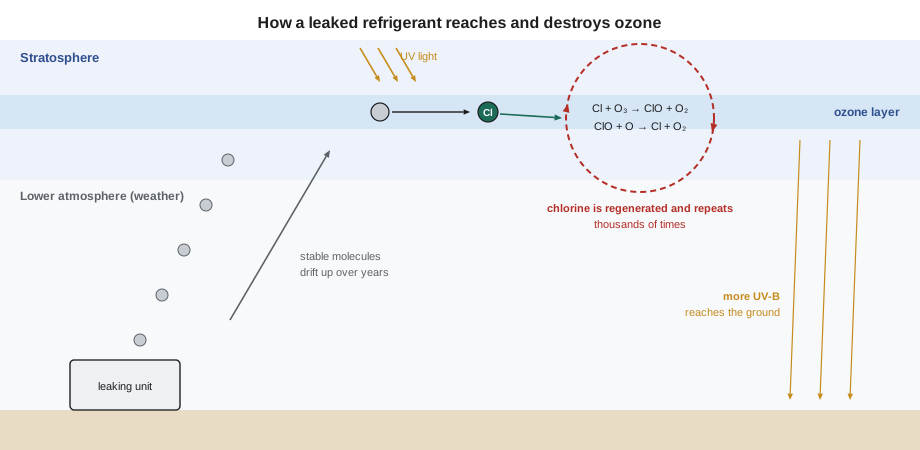
In 1985 scientists of the British Antarctic Survey reported that springtime ozone over Antarctica had fallen dramatically, creating what became known as the ozone hole. The cold, dark Antarctic winter forms polar stratospheric clouds whose ice surfaces convert stable chlorine compounds into forms that are released explosively when sunlight returns in spring. The discovery turned a scientific prediction into an urgent public problem, and governments moved quickly.
The Montreal Protocol
The Montreal Protocol on Substances that Deplete the Ozone Layer was agreed in Montreal in 1987. It set schedules to phase out the production and consumption of CFCs, halons and, later, HCFCs, methyl bromide and other ozone-depleting substances. Developed countries, including Canada and the United States, moved first; developing countries followed on a delayed schedule with financial support. The protocol has been strengthened several times by amendments and adjustments, and it became the first treaty of the United Nations to be ratified by every country in the world.
The results are measurable. Concentrations of ozone-depleting chlorine in the stratosphere peaked around the turn of the century and have been falling slowly since. Scientific assessments carried out for the protocol project that the ozone layer will return to its 1980 condition over most of the world around the middle of this century, with the Antarctic recovering last, in the 2060s. Recovery is slow because the molecules already released last for decades: R-12 and R-11 have atmospheric lifetimes measured in many decades, so the refrigerant leaked from a car air conditioner in 1985 may still be in the air today.
For technicians, the Montreal Protocol is why CFCs such as R-12 and R-502 vanished from new equipment in the 1990s, why R-22 followed, and why the remaining ozone-depleting refrigerants in service must be recovered rather than released. It is also why the rules treat a technician's handling practices, not just the manufacturers, as part of the solution: much of the ozone-depleting material that still exists is sitting inside older equipment, and it can escape only through leaks, careless service or improper disposal.
Ozone depletion potential
Ozone depletion potential, ODP, compares how much ozone a given mass of a substance destroys with the destruction caused by the same mass of R-11, whose ODP is set at 1. CFCs have ODPs near 1. HCFCs contain hydrogen, which makes many of their molecules break down in the lower atmosphere before they reach the ozone layer, so their ODPs are much lower: R-22's is about 0.055. HFCs, HFOs, hydrocarbons, ammonia and carbon dioxide contain no chlorine or bromine and have an ODP of zero.
| Refrigerant | Family | ODP (approx.) | GWP, 100-year (approx.) | Status for new equipment |
|---|---|---|---|---|
| R-11 | CFC | 1 | 4,750 | Phased out |
| R-12 | CFC | 1 | 10,900 | Phased out |
| R-502 | CFC blend | about 0.33 | 4,660 | Phased out |
| R-22 | HCFC | 0.055 | 1,810 | Phased out; service from recovered stock |
| R-123 | HCFC | about 0.02 | 77 | Being phased out |
| R-404A | HFC blend | 0 | 3,922 | Restricted in most new equipment |
| R-410A | HFC blend | 0 | 2,088 | Being replaced in new air conditioning |
| R-134a | HFC | 0 | 1,430 | Restricted in many new uses |
| R-32 | HFC | 0 | 675 | Current |
| R-454B | HFO/HFC blend | 0 | about 470 | Current |
| R-1234yf | HFO | 0 | less than 5 | Current |
| R-290 | Hydrocarbon | 0 | 3 | Current, small charges |
| R-744 | Carbon dioxide | 0 | 1 | Current |
| R-717 | Ammonia | 0 | 0 | Current, industrial |
Refrigerants and climate change
Solving the ozone problem created a second one. The main replacements for CFCs and HCFCs were HFCs such as R-134a, R-404A and R-410A. They contain no chlorine, so they do not harm the ozone layer, but they are powerful greenhouse gases. Like carbon dioxide, they absorb infrared radiation that the earth would otherwise radiate to space, warming the lower atmosphere. Kilogram for kilogram, they are hundreds to thousands of times stronger than carbon dioxide.
Global warming potential, GWP, measures this. It is the warming caused by releasing one kilogram of a gas, added up over a set period, usually 100 years, compared with the warming caused by one kilogram of carbon dioxide over the same period. The GWP of carbon dioxide is 1 by definition. R-410A's 100-year GWP is about 2,088, so releasing one kilogram of R-410A has roughly the same warming effect over a century as releasing about two tons of carbon dioxide. The values come from the assessment reports of the Intergovernmental Panel on Climate Change; the rules in Canada and the United States name the specific assessment they use, so figures can differ slightly between sources.
Multiplying a mass of refrigerant by its GWP gives its carbon dioxide equivalent, CO₂e. That is the number Dana wrote on the shop door, and it is the number that phasedown schedules, emission reports and company targets use.
Worked problem
The carbon dioxide equivalent of one leak
The brewery's walk-in cooler holds 10 lb of R-448A, GWP about 1,387. Last summer a cracked flare fitting let the whole charge escape before anyone noticed. What was the carbon dioxide equivalent of that release?
Show solution
- \[\text{CO}_2\text{e} = 10\ \text{lb} \times 1387 = 13{,}870\ \text{lb} \approx 6.3\ \text{metric tons}\]
Answer: One small cooler leak released about as much warming potential as driving a typical car for more than a year. Multiplied across the hundreds of thousands of commercial systems in Canada and the United States, leaks become a major source of emissions.
Refrigerant systems affect the climate in two ways. Direct emissions are the refrigerant that escapes through leaks, service losses and disposal. Indirect emissions come from generating the electricity the system uses over its life. A leaking system loses on both counts: it releases high-GWP refrigerant and, as the charge falls, it runs longer and less efficiently to do the same cooling. That is why the regulations on leak repair and the technician's skill at charging and tightness matter for the climate as much as the choice of refrigerant.
The Kigali Amendment and the HFC phasedown
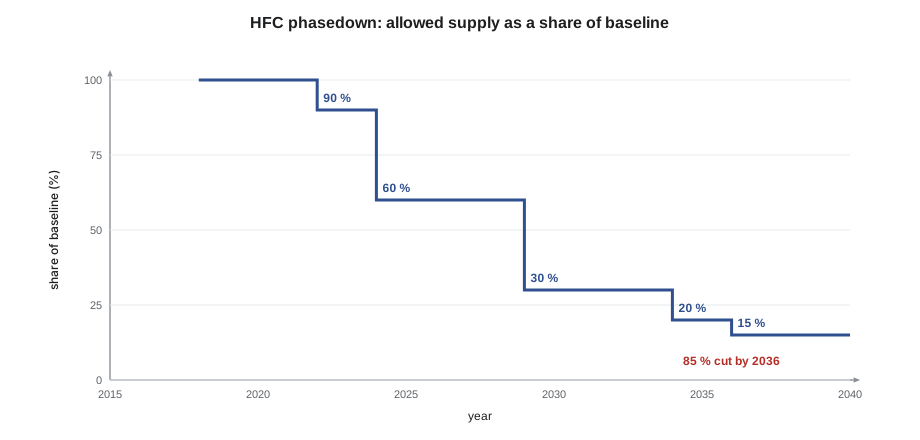
In 2016, at a meeting in Kigali, Rwanda, the parties to the Montreal Protocol agreed to add HFCs to the treaty. The Kigali Amendment, in force since 2019, does not ban HFCs. It sets a schedule for each country to cut its production and consumption of HFCs, measured in carbon dioxide equivalent, from a baseline. Developed countries reach an 85 percent cut by 2036; most developing countries follow a later schedule. Because the amendment counts CO₂e rather than kilograms, it pushes the market toward lower-GWP refrigerants: a supplier can sell far more kilograms of R-32 than of R-404A within the same allowance.
The United States implements the phasedown under the American Innovation and Manufacturing (AIM) Act of 2020, and the Senate approved ratification of the Kigali Amendment in 2022. EPA issues allowances to producers and importers, with the total cut 10 percent from the baseline for 2022 and 2023, 40 percent from 2024, 70 percent from 2029, 80 percent from 2034 and 85 percent from 2036. The AIM Act also lets EPA restrict high-GWP HFCs in new equipment and set rules for managing refrigerant in existing equipment.
The phasedown reaches the service van in three ways. New equipment arrives with lower-GWP refrigerants, many of them A2L or A3, which need new tools and procedures. Older high-GWP refrigerants become scarcer and more expensive as supply shrinks, so recovered refrigerant becomes valuable rather than waste. And the rules increasingly focus on keeping refrigerant inside existing systems: leak inspection, leak repair, reclaiming and record keeping. Every one of those is a technician's job.
Lifetimes and why prevention matters
A gas released today does not disappear tomorrow. Each refrigerant has an atmospheric lifetime, the average time a molecule stays in the air before it is broken down. CFCs last decades to a century or more. Many HFCs last years to decades: R-134a's lifetime is about fourteen years. HFOs break down within days to weeks because their carbon double bond reacts readily, which is why their GWPs are so low. One breakdown product of some HFOs and HFCs, trifluoroacetic acid, is being studied for its persistence in water, which is one reason natural refrigerants are also attracting attention.
Long lifetimes mean that emissions add up. The ozone layer is recovering only because emissions were cut decades ago; the warming effect of HFCs released today will be felt for years. Prevention at the source, keeping refrigerant in the system and recovering it at the end of the equipment's life, is far more effective than any cleanup could be, because there is no practical way to remove a gas once it is spread through the atmosphere.
# Northfield's refrigerant log: ozone and climate impact of recovered refrigerant
# Approximate ODP and 100-year GWP values used for teaching
props = {  # refrigerant: (ODP, GWP)
    "R-22": (0.055, 1810), "R-404A": (0.0, 3922), "R-410A": (0.0, 2088),
    "R-134a": (0.0, 1430), "R-448A": (0.0, 1387), "R-12": (1.0, 10900),
}
LB_PER_METRIC_TON = 2204.6
recovered_lb = {"R-22": 134.5, "R-404A": 85.0, "R-410A": 185.0,
                "R-134a": 48.5, "R-448A": 21.0, "R-12": 2.6}
total_co2e = 0.0
total_odp = 0.0
for ref, lb in recovered_lb.items():
    odp, gwp = props[ref]
    co2e_t = lb * gwp / LB_PER_METRIC_TON   # metric tons CO2e
    odp_lb = lb * odp                       # ODP-weighted lb (R-11 equivalent)
    total_co2e += co2e_t
    total_odp += odp_lb
    print(f"{ref:7s} {lb:6.1f} lb  {co2e_t:7.1f} t CO2e  {odp_lb:5.2f} lb R-11 eq")
print(f"Total kept out of the air: {total_co2e:.0f} metric tons CO2e and {total_odp:.1f} lb R-11 equivalent")
van_t = 11 * 6.5   # eleven vans at about 6.5 metric tons CO2 each per year (estimate)
print(f"Fleet driving emissions, estimated: {van_t:.0f} metric tons CO2 per year")R-22 134.5 lb 110.4 t CO2e 7.40 lb R-11 eq R-404A 85.0 lb 151.2 t CO2e 0.00 lb R-11 eq R-410A 185.0 lb 175.2 t CO2e 0.00 lb R-11 eq R-134a 48.5 lb 31.5 t CO2e 0.00 lb R-11 eq R-448A 21.0 lb 13.2 t CO2e 0.00 lb R-11 eq R-12 2.6 lb 12.9 t CO2e 2.60 lb R-11 eq Total kept out of the air: 494 metric tons CO2e and 10.0 lb R-11 equivalent Fleet driving emissions, estimated: 72 metric tons CO2 per year
The output confirms Dana's red number. The refrigerant Northfield recovered in a year carries several times the warming potential of a year of driving by the whole fleet, and the small amount of R-12 dominates the ozone column even though it is the smallest mass. Recovery is one of the most effective climate actions a trades company can take, and it happens one job at a time.
From science to rules
The rest of this course follows directly from the science. Because refrigerants damage the atmosphere when released, venting them is prohibited in Canada and the United States, with very narrow exceptions. Because whoever handles them decides whether they escape, the people who buy and handle them must be trained and certified. Because leaks are the largest source of emissions from operating equipment, larger systems must be inspected, leaks repaired within deadlines and records kept. Because refrigerant at the end of a system's life is still harmful, it must be recovered with certified equipment and either reused, reclaimed to a purity standard or destroyed. And because high-pressure gases and flammable refrigerants can injure people, all of this must be done safely.
In the United States, Section 608 of the Clean Air Act and EPA's rules under it govern technician certification, recovery, venting and sales of refrigerants, and the AIM Act adds HFC-specific rules on leak repair, reclaiming and new equipment. Some states add their own rules. Lesson 5 explains how these layers fit, with Kentucky as the home state in this course.
| Problem | Measure | Main agreement | What it changed for technicians |
|---|---|---|---|
| Ozone depletion | ODP, relative to R-11 | Montreal Protocol, 1987 | CFCs and HCFCs phased out; venting prohibited; recovery required |
| Climate change | GWP, relative to carbon dioxide | Kigali Amendment, 2016 | HFCs phased down; new refrigerants, often A2L or A3; leak repair and reclaiming emphasized |
Common mistakes
MistakeThinking HFCs are harmless because they do not deplete ozone.
InsteadMost HFCs are strong greenhouse gases; their high GWPs are why they are being phased down.
MistakeBelieving a small leak does not matter.
InsteadSmall leaks add up over years and across many systems; one cooler charge can equal a year or more of driving.
MistakeConfusing the Kigali Amendment with a ban.
InsteadKigali is a stepwise phasedown of supply measured in CO₂e, not an immediate ban.
MistakeExpecting the ozone layer to recover quickly.
InsteadLong atmospheric lifetimes mean recovery takes decades even after emissions stop.
Summary and key terms
- Stratospheric ozone absorbs harmful UV-B; chlorine and bromine from CFCs, HCFCs and halons destroy it catalytically.
- The Montreal Protocol of 1987 phased out ozone-depleting substances, and the ozone layer is slowly recovering.
- ODP compares ozone destruction with R-11; GWP compares warming with carbon dioxide over a set period, usually 100 years.
- Carbon dioxide equivalent equals mass times GWP and is the unit of the HFC phasedown.
- The Kigali Amendment phases down HFCs, reaching an 85 percent cut by 2036 for Canada and the United States.
- Prevention, keeping refrigerant in systems and recovering it, is the only practical control, and it depends on technicians.
- Stratosphere
- The layer of the atmosphere above the weather, where most ozone is found.
- Ozone layer
- The region of the stratosphere with the highest ozone concentration, which absorbs most UV-B radiation.
- Catalytic cycle
- A chain of reactions in which a chlorine or bromine atom destroys ozone and is regenerated.
- ODP
- Ozone depletion potential, compared with R-11, which is set at 1.
- GWP
- Global warming potential over a set time, compared with carbon dioxide, which is set at 1.
- CO₂e
- Carbon dioxide equivalent: mass of refrigerant multiplied by its GWP.
- Montreal Protocol
- The 1987 treaty that phases out ozone-depleting substances.
- Kigali Amendment
- The 2016 amendment to the Montreal Protocol that phases down HFCs.
- Atmospheric lifetime
- The average time a molecule remains in the atmosphere before breaking down.
Practice problems
Work each problem on paper first, then reveal the answer to check.
Why does an HCFC have a lower ODP than a CFC?
Show answer
Its hydrogen makes many molecules break down in the lower atmosphere before reaching the stratosphere.
What is the carbon dioxide equivalent of 6.6 lb of R-404A?
Show answer
6.6 × 3,922 ≈ 25,890 lb, or about 11.7 metric tons.
Name the two ways a refrigeration system contributes to climate change.
Show answer
Direct emissions of leaked refrigerant and indirect emissions from the electricity it uses.
Why does the Kigali phasedown count CO₂e instead of kilograms?
Show answer
So that switching to lower-GWP refrigerants lets more cooling be supplied within the same allowance.
What makes HFOs break down quickly in the atmosphere?
Show answer
The reactive carbon-carbon double bond in their molecules.
Lesson quiz · 5 questions
Score 60% or more to complete this lesson.
Create a free account to save your progress, take quizzes and earn a certificate.