
PWR-520 · Lesson 9 of 12 · 26 min
Review: prime movers and electrical
▶ Video coming soon A video version of this lesson is on the way.
The review of prime movers and electrical systems took two evenings, because it covered the most ground: steam turbines, gas turbines, condensers, governors, generators, transformers, protection and the grid. Ingeborg joined for the turbine part, with the vibration review from November 13 (PWR-320), and Ruaridh, Cantwell's electrician, who had joined Pilar's electrical study session there (PWR-410), came across for the second evening. Morwenna framed both evenings the same way: "The examiners will ask you to explain why a machine behaves as it does, and what you'd do when it doesn't. That's what a chief engineer does all day."
This lesson reviews the steam turbine, gas turbine, combined cycle and generator material of PWR-320, the advanced cycle and electrical material of PWR-410, and the high-voltage systems and protection of PWR-420, together with lessons 2 and 6 of this course. Worked problems use Keswold's condenser, gas turbine heat rate and generator currents.
Steam turbines
PWR-320 built up the steam turbine from its stages to its startup. The threads to carry into the examination are these.
- Impulse and reaction: impulse stages expand steam in fixed nozzles and turn it in moving blades; reaction stages expand it in both. Velocity diagrams show the blade work and the best ratio of blade speed to steam speed. Velocity-compounded Curtis stages take a large enthalpy drop in one wheel, as in Keswold's control stage.
- Construction: rotors, discs and blades, casings and diaphragms, labyrinth packing and spill strips, bearings and thrust bearings, couplings and turning gear.
- Governing: nozzle governing with sequential valves, throttle governing, droop and isochronous control, extraction control and the electro-hydraulic systems that implement them, with overspeed protection by an electronic trip and a mechanical bolt (Keswold's trips at 3,960 r/min).
- Lubrication: oil pumps on AC with DC emergency backup, jacking oil, coolers and filters, oil condition, and on hydrogen-cooled generators the seal oil system of lesson 2.
- Startup and warming: turning gear time, eccentricity limits, rub checks, critical speeds passed without holding, heat soaks, and rates of metal temperature change limited to control thermal stress (Keswold: 2.5 K per minute).
- Protection and trips: overspeed, low lube oil pressure, high vibration, thrust position, high exhaust temperature, low vacuum, high differential expansion and water induction, with the turbine's trip and the generator's reverse power protection working together.
- Condensers and vacuum: surface condensers, air removal by ejectors or vacuum pumps, cooling water systems, and the effect of vacuum on output.
- Vibration and inspection: proximity probes, 1X and other frequency components, orbits, phase and trending; borescopes; and major inspections based on equivalent hours (lesson 2).
Worked problem
Keswold's condenser duty
At full load, Keswold's cooling water flows at about 13,050 gpm and warms from 86 to 104 °F through the condenser (PWR-320). Find the condenser duty, and check it against 127,000 lb/h of exhaust steam giving up about 925 Btu/lb as it condenses.
Show solution
- \[Q_{cw} = 500 \times \text{gpm} \times \Delta T = 500 \times 13{,}050 \times 18 = 117.5 \text{ MMBtu/h} \qquad Q_{steam} = 127{,}000 \times 925 = 117.5 \text{ MMBtu/h}\]
Answer: The two sides balance, as they must. The condenser rejects about 117.5 MMBtu/h, or about 34 MW of heat, nearly twice the steam turbine's output, which is why condensing plants need so much cooling water and why a cogeneration plant that sends steam to a user instead of the condenser makes so much better use of its fuel. A rise in cooling water temperature rise at the same steam flow would point to a meter error; a rise in the terminal temperature difference, the gap between the saturation temperature and the cooling water outlet, would point to fouling or air in-leakage.
Gas turbines and combined cycles
From PWR-320 and PWR-410: the gas turbine's compressor, combustor and turbine; dry low-NOx combustion; the Brayton cycle and its optimum pressure ratios; the effect of ambient temperature, which costs Keswold's gas turbine about 5 MW on hot afternoons; compressor fouling and washing; hot gas path inspections; and, for combined cycles, the HRSG's pinch and approach, supplementary firing, and the combined efficiency relation.
Worked problem
Gas turbine heat rate and efficiency
After its October offline wash, Keswold's gas turbine's test corrected to 44.3 MW at a heat rate of 10,051 Btu/kWh on the lower heating value (PWR-410). Find its efficiency, and the fuel energy it would use in 24 hours at that output.
Show solution
- \[\eta = \frac{3{,}412.14}{10{,}051} = 0.340 \qquad E_{fuel} = 44{,}300 \times 24 \times 10{,}051 = 10.69 \times 10^9 \text{ Btu} = 10{,}690 \text{ MMBtu}\]
Answer: Heat rate and efficiency are reciprocals with a unit conversion, and an examiner may give either. Every point of heat rate is worth money: a 1 in 100 improvement in this gas turbine's heat rate would save about a hundred units of fuel energy a day at full output, which is why compressor washing, inlet filter maintenance and combustion tuning are worth their cost.
Generators and excitation
PWR-320 explained synchronous generators: the rotating field, the stator winding, synchronous speed set by frequency and poles, excitation systems (static or brushless, as on Keswold's steam turbine generator), synchronizing by matching voltage, frequency and phase, the effect of excitation on reactive power, and the capability curve of lesson 6. PWR-410 added the generator's phasor relation: the internal voltage equals the terminal voltage plus the voltage across the synchronous reactance, which sets the power angle and the stability margin.
Worked problem
Generator currents
Keswold's steam turbine generator is rated 22.5 MVA at 13.8 kV. Find its rated stator current, and the current when it carries 18 MW at 0.95 power factor.
Show solution
- \[I = \frac{S}{\sqrt{3}\,V_L} = \frac{22.5 \times 10^6}{\sqrt{3} \times 13{,}800} = 941 \text{ A} \qquad I_{0.95} = \frac{18 \times 10^6 / 0.95}{\sqrt{3} \times 13{,}800} = 793 \text{ A}\]
Answer: At 18 MW and 0.95 power factor the stator carries about 84 in 100 of its rated current. Raising reactive output to bring the power factor down to 0.80 would raise it to the full 941 A at the same real power. Stator heating rises with the square of current, so reactive output is not free; it uses part of the generator's thermal capacity, which is why the capability curve limits it.
Electrical systems and protection
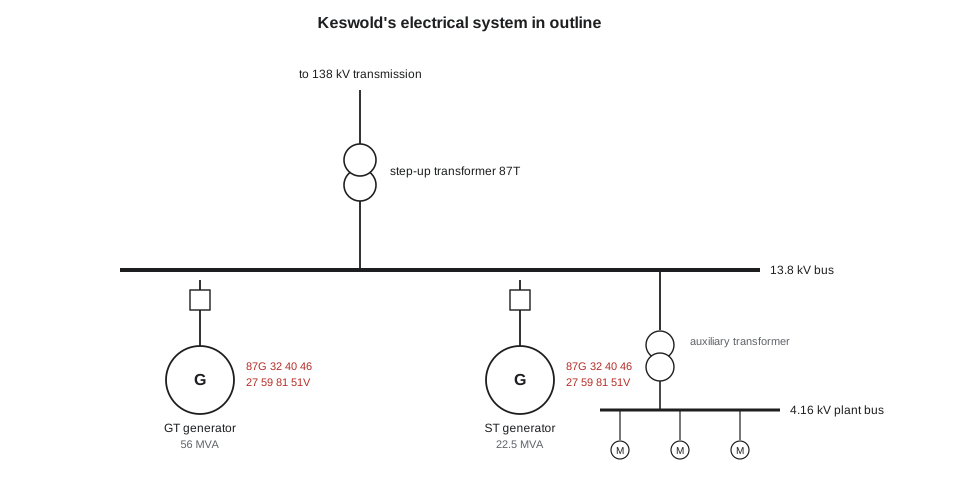
From PWR-410 and PWR-420: transformer construction, losses and efficiency; power factor correction; motor starting and drives; per-unit and fault calculations; and protection by device numbers, with overcurrent (50 and 51), differential (87), distance (21), reverse power (32), loss of field (40), negative sequence (46), voltage (27 and 59) and frequency (81) functions. Coordination ensures that the protective device nearest a fault clears it first. Arc flash studies under CSA Z462 or NFPA 70E set the incident energy at each panel and the protective equipment and approach boundaries for work on it.
A First Class question on protection is rarely about one relay. A typical question describes an event, such as a generator trip on reverse power after a steam turbine trip, or a transformer trip on differential after a through fault, and asks what happened, whether the protection operated correctly and what should be checked before the unit returns to service. Keswold's own history gave Anselm two examples: the steam turbine generator's 32 reverse power function, which operated twice during extraction tuning after outages, and its 87G differential, which has never operated in six years (PWR-420). The first shows protection doing its job during an abnormal operating condition; the second shows why a protection function that never operates must still be tested.
Explaining behavior
Morwenna ended the second evening with a list of questions of the form "why does this happen?" and asked Anselm to answer each in three sentences: the physical cause, the consequence, and what the operator or chief does about it.
- Why does a gas turbine lose output on a hot day? Warm air is less dense, so the compressor moves less mass and the turbine produces less power; the plant loses capacity when the grid needs it most; inlet cooling, as at Keswold, recovers part of the loss.
- Why does vacuum matter so much to a condensing turbine? A lower back pressure increases the enthalpy drop across the last stages, so each kilopascal lost costs output; air in-leakage and fouling raise back pressure; trend the terminal difference and air removal flow.
- Why does a rotor bow on standstill? Uneven cooling makes one side hotter than the other; running a bowed rotor causes high vibration and rubs; keep it on turning gear and check eccentricity before rolling.
- Why does a generator absorb reactive power when underexcited? Its internal voltage falls below the grid voltage, so reactive current flows into it; the power angle rises and stability margin falls; the underexcitation limiter and loss of field protection guard it.
- Why does a transformer differential relay need inrush restraint? Energizing a transformer draws a large magnetizing current on one side only, which looks like an internal fault; without harmonic restraint the relay would trip on every energization.
A velocity diagram, one more time
Velocity diagram questions appear on the thermodynamics and prime movers papers at every level, and at First Class they are often combined with a question about efficiency or blade speed. Ingeborg worked one with Anselm from first principles, because she found that candidates who had memorized a formula for the diagram efficiency were the ones who lost marks when the question changed slightly.
Worked problem
Work from a single impulse stage
Steam leaves the nozzles of an impulse stage at 1,970 ft/s at an angle of 16° to the plane of the wheel. The blade speed is 885 ft/s, the blades are symmetrical (outlet angle equal to inlet angle), and friction reduces the relative velocity across the blades to 0.9 of its inlet value. Find the blade inlet angle, the change in whirl velocity, the work per pound of steam and the diagram efficiency.
Show solution
- \[V_{w1} = 1{,}970 \cos 16° = 1{,}893.7 \qquad V_{a1} = 1{,}970 \sin 16° = 543.0 \qquad V_{r1} = \sqrt{(1{,}893.7 - 885)^2 + 543.0^2} = 1{,}145.6 \text{ ft/s}\]
- \[\beta_1 = \tan^{-1}\frac{543.0}{1{,}008.7} = 28.3° \qquad V_{r2} = 0.9 \times 1{,}145.6 = 1{,}031.0 \qquad V_{w2} = 885 - 1{,}031.0 \cos 28.3° = -22.8 \text{ ft/s}\]
- \[\Delta V_w = 1{,}893.7 - (-22.8) = 1{,}916.5 \qquad w = \frac{U\,\Delta V_w}{g_c \times 778.17} = \frac{885 \times 1{,}916.5}{32.174 \times 778.17} = 67.7 \text{ Btu/lb}\]
- \[\eta_d = \frac{2\,U\,\Delta V_w}{V_1^2} = 0.874\]
Answer: The absolute whirl velocity at the outlet is small and slightly negative, meaning the steam leaves almost axially, which is close to the best condition for a single impulse stage; the blade to steam speed ratio of 0.45 is near the ideal of about half the cosine of the nozzle angle. If the question then asks what happens when the blade speed changes, the diagram can be redrawn in a minute, and the candidate who understands the vectors can answer without a formula.
Combined cycle and cogeneration operation
Questions on combined cycle and cogeneration plants at this level test whether the candidate understands how the parts interact. In Keswold's arrangement, the gas turbine sets the exhaust flow and temperature, the HRSG makes as much steam as that exhaust and any duct firing allow, the steam turbine passes whatever steam it receives in inlet pressure control, and the extraction controller sends Marrowby the steam it asks for. A change anywhere moves everything downstream: a hot afternoon cuts gas turbine output and exhaust flow, so the HRSG makes less steam unless the duct burners make up the difference; a sudden fall in Marrowby's demand sends more steam to the condenser and raises the steam turbine's output; a gas turbine trip leaves the HRSG with no heat at all.
Anselm's practice answer on a gas turbine trip followed Morwenna's three-part pattern. The physical sequence: fuel is shut off, exhaust flow falls to the coast-down air flow and then stops, the HRSG pressure falls, and the steam turbine follows its inlet pressure down until it trips or is tripped. The consequences: loss of both generators' output, loss of steam to Marrowby, and a thermal transient in the HRSG drum and superheater. The actions: confirm the trip and its cause, keep the drum level and the steam turbine safe, tell the grid operator and Marrowby at once, and restart only when the cause is understood. The last part, he noted, was also the strongest argument for the expansion study's standby boilers, because Marrowby can run only about twenty minutes without steam (PWR-510).
Ingeborg added one practical note. Every one of these explanations can be checked against the plant's own data, and the habit of checking is what turns an examination answer into a chief engineer's judgment. When the gas turbine lost output on a hot afternoon, the historian showed the compressor inlet temperature, the exhaust temperature at its limit and the inlet cooler's effect; when the condenser vacuum fell one spring, the terminal temperature difference and the air removal flow pointed to air in-leakage at a turbine gland rather than fouling. Anselm should practice explaining real events from real trends, she said, because the examiners write their questions from exactly such events.
Common mistakes
MistakeQuoting heat rate without its basis.
InsteadState LHV or HHV and gross or net; convert to efficiency with 3,600 or 3,412.
MistakeForgetting √3 in three-phase power and current.
InsteadI = S ÷ (√3 V_L) for three-phase systems.
MistakeTreating reactive power as free.
InsteadReactive output raises stator and field currents and heating.
MistakeExplaining a trip by naming the relay alone.
InsteadDescribe the event, whether the protection operated correctly and what to check before restart.
MistakeAssuming a protection function that never operates is fine.
InsteadTest it; the absence of operations proves nothing about its readiness.
MistakeChecking a condenser by cooling water flow alone.
InsteadBalance both sides and trend the terminal temperature difference and air removal.
Summary and key terms
- Steam turbine review covers impulse and reaction staging, construction, governing, lubrication, startup, protection, condensers and vibration.
- Keswold's condenser rejects about 34 MW at full load, balanced by cooling water and condensing steam.
- A gas turbine heat rate of 10,604 kJ/kWh or 10,051 Btu/kWh corresponds to an efficiency of 0.340.
- The steam turbine generator's rated current is 941 A; reactive output uses part of its thermal capacity.
- Protection questions describe events and ask whether protection operated correctly and what to check before restart.
- Good answers to "why" questions give the physical cause, the consequence and the action.
- Velocity compounding
- Using two or more rows of moving blades on one wheel to absorb a large steam velocity.
- Terminal temperature difference
- The difference between the condenser saturation temperature and the cooling water outlet temperature.
- Heat rate
- Fuel energy used per kilowatt-hour generated.
- Power angle
- The angle between a generator's internal voltage and its terminal voltage.
- Inrush restraint
- A feature that blocks transformer differential protection during magnetizing inrush.
- Device number
- A standard number identifying a protective relay function, such as 87 for differential.
Practice problems
Work each problem on paper first, then reveal the answer to check.
Cooling water 8,000 gpm rises 16 °F. Condenser duty?
Show answer
64 MMBtu/h.
Heat rate 9,300 Btu/kWh. Efficiency?
Show answer
About 0.367.
A 10 MVA, 4.16 kV generator's rated current?
Show answer
About 1,388 A.
Why must a generator's reverse power protection have a time delay?
Show answer
To ride through brief power swings, such as during synchronizing, without tripping.
Lesson quiz · 5 questions
Score 60% or more to complete this lesson.
Create a free account to save your progress, take quizzes and earn a certificate.