
PWR-520 · Lesson 10 of 12 · 24 min
Review: plant management and safety
▶ Video coming soon A video version of this lesson is on the way.
The last review evening covered the subjects that Morwenna said separated chief engineer candidates from the rest: safety, loss and environmental program management, and business and workforce management. "Nobody fails these for lack of arithmetic," she said. "They fail because they write what a shift engineer would write. The examiner wants to read what a chief engineer would do: set up the system, give it an owner, measure it and improve it." Pilar Quenneville came across from Cantwell for part of the evening, because she had worked through the same material at the second class level (PWR-420), and Morwenna wanted Anselm to hear how a shift engineer and a chief would answer the same question differently.
This lesson reviews the management and safety material of PWR-340, PWR-420 and PWR-510: safety instrumented systems, permits and safe work, process safety, emergency planning, environmental compliance, reliability and maintenance, budgets and contracts, leadership and training, regulators and audits. Worked problems revisit a safety function's reliability, an injury rate and the availability of a critical system.
A management system for everything
Every program a chief engineer is responsible for, whether it is lockout, management of change, emergency response or emissions reporting, can be described with the same elements. Using them as a checklist is the most reliable way to write a complete answer to a program question, and a good way to check whether a plant's own program is complete.
| Element | What it covers |
|---|---|
| Policy and scope | Why the program exists, what it applies to and the legal and corporate requirements it meets |
| Roles and responsibilities | Who owns it, who carries it out, who approves and who is informed |
| Procedures and standards | The written steps, forms and criteria |
| Competence and training | Who must be trained, to what level, and how competence is verified |
| Records | What is recorded, where and for how long |
| Monitoring and measurement | Leading and lagging indicators, inspections and sampling |
| Audit and review | Periodic audit against the procedure and management review of results |
| Improvement | How findings, incidents and changes lead to revisions |
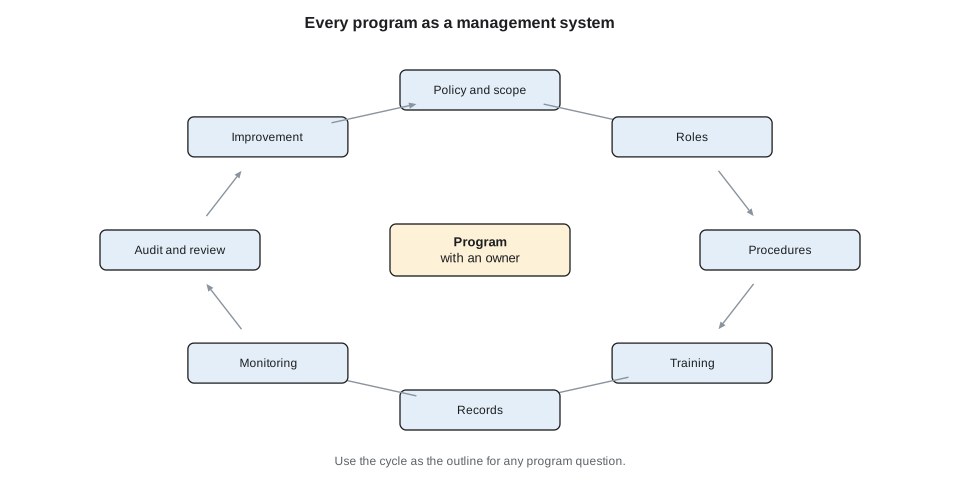
Pilar's answer to Morwenna's first question, "how would you make sure permits to work are being used properly?", described the permit form, the isolations and the sign-offs in detail, which is the shift engineer's view. Anselm's described the permit procedure's owner, the training and authorization of permit issuers, the audit that Pilar herself had led at Cantwell, sampling 20 of 240 permits and finding 3 defective in their closure steps, the redesign of the form that followed, the resample planned three months later, and the management review that would decide whether the change had worked (PWR-420). Both were correct; only the second would earn full marks on a First Class paper.
Safety instrumented systems and process safety
From PWR-420: a safety instrumented function has a safety requirements specification, a target safety integrity level from a hazard and risk assessment such as LOPA, a design whose average probability of failure on demand meets the target, proof tests at set intervals, and controlled bypasses. From PWR-340: process safety management covers process safety information, hazard analysis, operating procedures, training, contractors, pre-startup safety reviews, mechanical integrity, hot work, management of change, incident investigation, emergency planning and compliance audits, and its leading indicators measure the health of the barriers rather than counting injuries.
Worked problem
The deaerator low-low level trip
Cantwell's proposed deaerator low-low level trip uses one transmitter with a dangerous undetected failure rate of 5 × 10⁻⁷ per hour, a certified logic solver with an average probability of failure on demand of 1 × 10⁻⁴, and trip paths to both feed pump starters with a combined dangerous undetected failure rate of 2 × 10⁻⁶ per hour (PWR-420). Estimate the average probability of failure on demand with an annual proof test, and state the safety integrity level it achieves.
Show solution
- \[PFD_{avg} \approx \frac{\lambda_{DU}\,T_I}{2} + PFD_{LS} = \frac{(5 \times 10^{-7} + 2 \times 10^{-6}) \times 8{,}760}{2} + 1 \times 10^{-4} = 0.0110\]
Answer: A PFD of 0.011 lies in the SIL 1 band (0.01 to 0.1), just above the SIL 2 boundary. The trip paths dominate the result, so testing them every six months or adding a second, independent trip path would move the function into SIL 2, as PWR-420 showed. A chief engineer's question is not only whether the function meets its target but whether the plant can actually carry out the proof tests on schedule, record them and manage bypasses, because a PFD calculated on an annual test means nothing if the test is not done.
Morwenna added one point for the examination: a candidate should be able to explain the difference between personal safety and process safety, and why a plant with an excellent injury record can still be heading for a major accident. The 2005 Texas City explosion, which PWR-340 studied, happened at a site that measured its safety largely by injury rates while its process safety barriers decayed.
Emergency planning and the environment
From PWR-420: emergency plans start from a hazard assessment of credible scenarios, set out the organization, notifications, response procedures, resources and communications, and are tested by drills and tabletop exercises with lessons tracked to closure. Plants coordinate with the fire service and the municipality, and with customers like Marrowby whose own emergencies, such as an ammonia release, can affect the plant (PWR-340). Environmental compliance follows the same management system: a register of every approval or permit condition, monitoring and reporting, a schedule of deadlines, and investigation of exceedances.
In Ohio, Keswold holds a Title V operating permit for its air emissions, reports its greenhouse gas emissions to EPA, and discharges cooling tower blowdown and treated wastewater to the city sewer under an industrial user permit with limits on temperature, dissolved solids and phosphorus (PWR-420). The chief engineer, or the responsible official named in the permit, certifies each report and must make sure that its data are complete and accurate.
Reliability and maintenance
From PWR-420 and PWR-510: maintenance strategies range from run to failure through time-based and condition-based maintenance to reliability-centered maintenance, which chooses a strategy for each failure mode by its consequences; the P-F interval sets how often condition monitoring must look; backlog, schedule compliance and the share of planned work measure the maintenance system; and risk-based inspection extends the same logic to pressure equipment. Availability combines how often a system fails with how long it takes to restore.
Worked problem
Availability of the instrument air system
Cantwell's instrument air compressors have run about 30,000 hours with 4 failures and a mean time to repair of 12 hours (PWR-420). Find the mean time between failures and the availability of one compressor, and the availability of a pair in which either can carry the load, assuming independent failures.
Show solution
- \[MTBF = \frac{30{,}000}{4} = 7{,}500 \text{ h} \qquad A = \frac{MTBF}{MTBF + MTTR} = \frac{7{,}500}{7{,}512} = 0.99840\]
- \[A_{pair} = 1 - (1 - A)^2 = 1 - (0.00160)^2 = 0.9999974\]
Answer: One compressor alone would be unavailable about 14 hours a year; the pair, if their failures were truly independent, would be unavailable only seconds a year on average. In practice common causes, such as a shared power supply, a common dryer or the same maintenance error on both machines, dominate the unavailability of redundant systems, which is why Cantwell tests the changeover monthly and why a chief engineer looks for common causes before trusting a redundancy calculation.
Budgets, contracts and people
From PWR-420 and PWR-510: operating budgets separate controllable and uncontrollable costs and are tracked monthly against the plan with explanations for variances; capital projects are justified by net present value, internal rate of return and life cycle cost, and controlled through phases, gates, estimates and earned value; contracts are chosen for the risk they transfer and managed through clear scopes, performance measures and change control; long-term service agreements need active management (lesson 2).
People are the largest part of the chief's job. Keswold's 25 staff work in five crews of three on twelve-hour rotations with a maintenance group, a reliability engineer, an environmental and chemistry lead, a planner and an administrator (PWR-510). Staffing calculations, succession plans, qualification matrices, training budgets, the conduct of operations, performance management and the relationship with the union all belong on the chief's desk. Morwenna's plan for her own succession, with Anselm as chief and Liesl as his successor as shift supervisor, is itself an example of what the examiners want to see: named successors, development plans with dates, and a written record of what each role requires.
Worked problem
An injury rate
Cantwell recorded 2 recordable injuries in about 96,000 hours worked over 12 months (PWR-340). Find the total recordable injury rate on the 200,000-hour basis and comment on what it can and cannot show.
Show solution
- \[TRIR = \frac{2 \times 200{,}000}{96{,}000} = 4.17\]
Answer: The rate looks high only because the plant is small: a single injury changes it by about two points. With so few events, a lagging rate like this cannot show whether safety is improving, and it says nothing about process safety. Leading indicators, such as permits audited, safety walks completed and findings closed, proof tests done on time and near misses reported, give a far better picture for a plant of Cantwell's or Keswold's size.
Regulators, audits and decarbonization
From PWR-420 and PWR-510: a chief engineer keeps a compliance register, prepares for inspections and audits, answers findings and orders promptly and honestly, informs the regulator before a deadline is missed, and builds a relationship of trust. Audits, whether by regulators, insurers, the owner, customers or the plant itself, are opportunities to find weaknesses before an incident does. The decarbonization material of PWR-510, measuring and allocating emissions, efficiency, hydrogen, electrification and capture, appears on the environmental and business papers as questions about strategy: how would you reduce the plant's emissions by a given amount, at what cost, and with what risks.
Contractor management
Contractors do much of the riskiest work in a power plant: outage repairs, chemical cleaning, scaffolding, crane lifts, insulation, welding and specialist testing. Incident statistics across industry show contractors suffering a disproportionate share of serious injuries, often because they are unfamiliar with the site's hazards and systems. A contractor management program follows the same management system elements as any other: prequalification of the contractor's safety record, programs and competence before a contract is let; a site orientation and hazard briefing for every worker; clear assignment of who issues permits, who isolates equipment and who supervises; monitoring of the contractor's work through safety walks and permit audits; and an evaluation at the end of the job that decides whether the contractor is used again. Keswold's fall outage, with its turbine, generator and gas turbine contractors working at once, used a daily coordination meeting at which each contractor's supervisor reported the day's high-risk work, and Morwenna considered it the most valuable fifteen minutes of each outage day (PWR-510).
A model answer outline
To finish the review, Morwenna set Anselm a practice essay question of the kind she expected on the safety and environmental program paper: describe how you would develop and maintain an emergency response plan for an ammonia release at a neighboring industrial site that could affect your plant. Anselm wrote his outline in ten minutes, and Morwenna kept it as an example of the structure she wanted.
- Purpose and scope: protect Keswold's staff and keep the plant safe during a release at Marrowby's ammonia refrigeration plant across the road (PWR-340), including the case where the control room must be kept occupied.
- Hazard assessment: Marrowby's inventory and worst credible release, wind directions, the location of Keswold's air intakes, control room ventilation and assembly points, and what Marrowby's own plan says.
- Organization and roles: who declares the emergency, who leads on site, who communicates with Marrowby, the fire service and the grid operator, and who decides whether to keep the plant running or shut it down safely.
- Response procedures: alarm and notification, shelter in place with ventilation shut down, accounting for people, protective equipment for essential tasks, and criteria for evacuation or a safe shutdown.
- Resources: gas detection at the intakes, escape respirators, communications, and a list of contacts checked quarterly.
- Training and drills: training for all staff, a joint tabletop exercise with Marrowby and the fire service, and a practical drill each year, with lessons tracked to closure.
- Review: after every drill, real event, change at Marrowby's plant or change in Keswold's layout, and at least yearly.
Morwenna's only comment was that the outline should also say how the plan would be kept consistent with Marrowby's, since two plans that each assume the other site will act first are a common failure. Anselm added a line for a joint review with Marrowby's plant engineer each year, and noted that this was something Keswold should actually do, not only something to write in an examination.
Common mistakes
MistakeAnswering a program question with only the procedure's steps.
InsteadCover scope, roles, procedures, training, records, monitoring, audit and improvement.
MistakeTrusting a calculated PFD without checking that the proof tests are done.
InsteadA PFD depends on the test interval actually achieved; audit the test records.
MistakeJudging safety by injury rates alone.
InsteadUse leading indicators of barrier health, especially for process safety.
MistakeAssuming redundancy removes all risk.
InsteadLook for common causes, test changeovers and check shared supports.
MistakeLeaving succession to chance.
InsteadName successors, write development plans and record what each role requires.
MistakeTreating an audit finding as a criticism to defend.
InsteadTreat it as free information and close it with a real corrective action.
Summary and key terms
- Every program can be described and checked with the same management system elements, from scope and roles to audit and improvement.
- Cantwell's proposed deaerator trip reaches a PFD of about 0.011, SIL 1, with annual testing; the trip paths dominate.
- Process safety needs barrier-health indicators; injury rates do not measure it.
- Emergency planning and environmental compliance follow the same management system, with registers, deadlines and drills.
- Availability is MTBF over MTBF plus MTTR; redundancy helps only as far as common causes allow.
- Budgets, contracts and people management are answered as systems with owners, measures and reviews.
- A chief engineer's answer sets up the system, gives it an owner, measures it and improves it.
- Management system
- An organized set of policies, roles, procedures, records, measures and reviews for achieving an objective.
- Safety integrity level
- A band of required risk reduction for a safety instrumented function.
- Leading indicator
- A measure of the condition of barriers and activities before an incident occurs.
- Availability
- The fraction of time a system is able to perform its function.
- Common cause failure
- A single cause that fails two or more redundant components.
- Compliance register
- A list of every legal and permit requirement, with its owner, deadline and evidence.
Practice problems
Work each problem on paper first, then reveal the answer to check.
λDU 1 × 10⁻⁶ per hour, annual test, logic solver 5 × 10⁻⁵. PFD and SIL?
Show answer
About 0.0044, SIL 2.
A pump fails 3 times in 18,000 h with a 24 h MTTR. Availability?
Show answer
About 0.9960.
1 recordable injury in 50,000 h. TRIR?
Show answer
4.0.
Name four elements of a management system.
Show answer
Any four of scope, roles, procedures, training, records, monitoring, audit and improvement.
Lesson quiz · 5 questions
Score 60% or more to complete this lesson.
Create a free account to save your progress, take quizzes and earn a certificate.