
PWR-520 · Lesson 6 of 12 · 23 min
Electrical grid interconnection
▶ Video coming soon A video version of this lesson is on the way.
On the evening of October 28, the grid operator's control room had asked Keswold to raise its reactive output from 4 to 10 Mvar to support voltage, and Liesl had done it from the board in a few minutes (PWR-320). Morwenna used the call as the opening of this session. "That was a two-line log entry," she said. "Behind it there's an interconnection agreement, a set of reliability standards, test reports we file every few years, protection settings we have to coordinate with the transmitter, and a market that pays us or doesn't. A chief engineer signs off on most of that. You'd better know what it says."
This lesson describes how a generating plant connects to the transmission grid and what it must do once connected: the interconnection study process, the agreements and technical requirements, the reliability standards that apply to generators, reactive power capability and voltage control, frequency response, ride-through during disturbances, protection coordination, islanding and black start, and how the wholesale market shapes operation. Two worked examples cover frequency response and reactive capability.
Why interconnection is a process, not a cable
Connecting a generator to the grid changes the grid. It changes power flows, short-circuit levels, voltage profiles and stability margins, and it may require new or upgraded transmission equipment. Before a new plant, or a significant change to an existing one, can connect, the grid operator and the transmission owner study its effects and set the conditions for its connection.
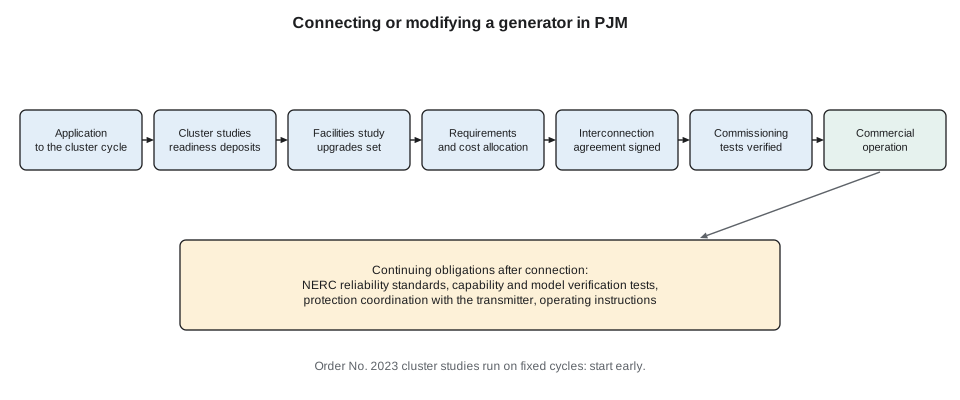
In most of the United States, generator interconnection to the transmission system is governed by FERC's pro forma procedures, which grid operators adopt in their tariffs. FERC Order No. 2023, issued in 2023, moved the country from a first-come, first-served queue to a first-ready, first-served cluster study process, with readiness deposits, site control requirements, firm study deadlines with penalties for the transmission provider, and withdrawal penalties for projects that drop out. PJM, which runs the grid in Ohio, has moved to cycles of cluster studies under its reformed process. The studies set the network upgrades and technical requirements, and the result is a generator interconnection agreement among the generator, PJM and the transmission owner, followed by commissioning tests before commercial operation.
For Keswold's expansion, the package boilers would not change the electrical connection, but an electrode boiler, if it were ever added, would be a large new load of several megawatts, and any change in generator output or auxiliary load above set limits would need to be reported and possibly studied (PWR-510). Morwenna's note to Anselm was simple: talk to the grid operator and the transmitter early, because their timelines are measured in months or years, not weeks.
Reliability standards for generators
Across North America, the North American Electric Reliability Corporation (NERC) develops mandatory reliability standards for the bulk electric system. In the United States they are approved by FERC and enforced by NERC and its regional entities; in Canada, they are made mandatory by provincial authorities, such as the IESO and the Ontario Energy Board in Ontario, often with regional criteria from the Northeast Power Coordinating Council. A generating unit is generally part of the bulk electric system if it is larger than 20 MVA, or a plant larger than 75 MVA in aggregate, and connected at 100 kV or above; Keswold's 56 MVA gas turbine generator and its 115 or 138 kV step-up connection place it in scope. Standards that apply to generator owners and operators include those for:
- Frequency and voltage ride-through: PRC-024 requires synchronous generators' protective relays to be set so that the unit does not trip for frequency and voltage excursions inside defined no-trip zones; a newer standard, PRC-029, sets ride-through performance requirements for inverter-based resources.
- Verification of capability: MOD-025 requires periodic verification, by test or by operating data, of the real and reactive power capability of each unit, so that grid planners know what it can actually deliver.
- Model verification: MOD-026 and MOD-027 require the models of the excitation system, power system stabilizer and governor and load controls to be verified against the unit's measured response, so that grid stability studies use realistic data.
- Protection coordination: standards such as PRC-019 and PRC-025 require generator protection to be coordinated with the excitation limiters and to allow the unit to carry its full capability during disturbances without tripping unnecessarily.
- Communication, telemetry and operating instructions, including following the grid operator's directives and reporting changes in status promptly.
- Critical infrastructure protection (CIP) standards for the cybersecurity of systems that could affect the grid (lesson 5).
Compliance is a management system in its own right: a register of applicable requirements, an owner for each, evidence that each is met, and an internal audit before the regional entity's audit. The tests are done on the plant's own equipment, but they need the grid operator's coordination, and the reports are filed by the chief engineer or a delegate.
Reactive power and voltage control
A synchronous generator produces reactive power when overexcited and absorbs it when underexcited. Grid operators use generators to hold transmission voltages, and connection requirements usually specify a range of reactive output that each unit must be able to supply at rated output, often expressed as a power factor range such as 0.90 lagging to 0.95 leading at the generator terminals or the point of connection (typical). The automatic voltage regulator holds the terminal voltage or a voltage schedule set by the grid operator, and the operator can adjust it, as Liesl did on October 28.
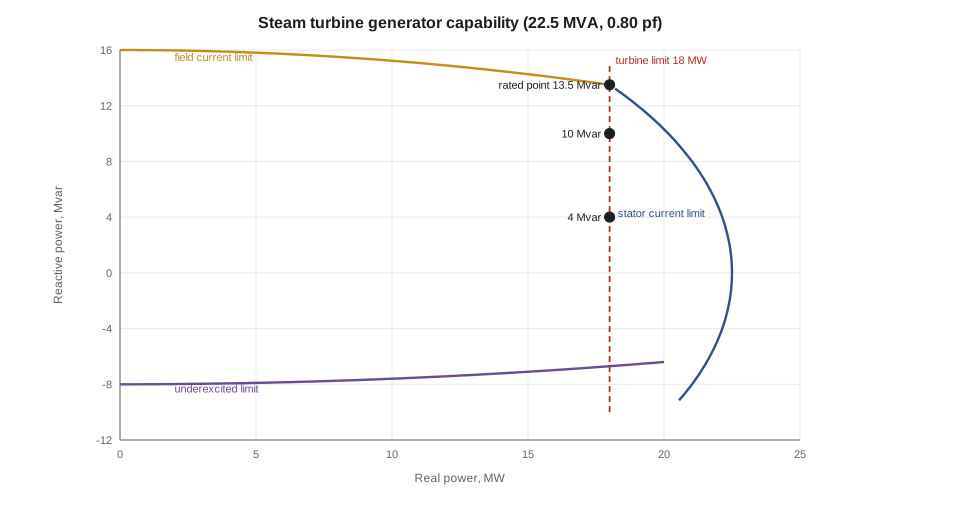
The generator's capability curve shows the limits on real and reactive power at rated voltage: the stator current limit, a circle about the origin; the field current limit, which restricts overexcited output; and the underexcited limit, set by stator end-core heating and steady-state stability. The turbine's maximum output sets a vertical limit on real power.
Worked problem
Reactive capability of the steam turbine generator
Keswold's steam turbine generator is rated 22.5 MVA at 0.80 power factor. Find its real and reactive output at rated MVA and power factor, and the reactive output when it carries 18 MW at 0.95 power factor lagging.
Show solution
- \[P = 22.5 \times 0.80 = 18.0 \text{ MW} \qquad Q = 22.5 \times \sin(\cos^{-1} 0.80) = 22.5 \times 0.60 = 13.5 \text{ Mvar}\]
- \[Q_{0.95} = 18.0 \times \tan(\cos^{-1} 0.95) = 18.0 \times 0.3287 = 5.92 \text{ Mvar}\]
Answer: At its full 18 MW the generator can supply up to 13.5 Mvar before reaching its rated MVA, so a request for 10 Mvar is well within its capability, though the extra reactive output raises the stator and field currents and their heating. When its turbine is at less than full output, the stator current limit allows somewhat more reactive output, up to the field current limit. A generator that is regularly asked for large reactive output in winter evenings may be running close to its field limit, which is one reason MOD-025 tests check what the unit can really deliver.
Frequency response
When a large generator trips, frequency falls and every generator's governor responds according to its droop: the change in speed, as a fraction of rated speed, that produces a change from no load to full load (PWR-320). Keswold's gas turbine runs at 4 in 100 droop and its steam turbine at 5 in 100. Grid operators expect generators to provide this primary frequency response promptly and to sustain it, and some grid codes and NERC guidance set expectations for deadband and droop. A unit at its maximum output, however, cannot increase its output, and a unit whose load controller quickly returns it to its megawatt set point cancels its own governor response; both are common reasons why units do not respond as expected.
Worked problem
Gas turbine response to a frequency drop
Keswold's 45 MW gas turbine has a droop of 4 in 100. Estimate its governor response to a frequency drop of 0.15 Hz on the 60 Hz grid, outside its deadband, and comment on its response on a hot summer afternoon.
Show solution
- \[\Delta P = \frac{0.15 / 60}{0.04} \times 45 = 2.81 \text{ MW}\]
Answer: In cool weather, with the gas turbine below its maximum, it would pick up about 2.8 MW within seconds. On a hot afternoon, when it is already at its temperature-limited maximum of about 40 MW (PWR-320), it has no headroom and gives almost nothing; the steam turbine, held in inlet pressure control, also cannot respond on its own. A plant that wants to provide frequency response, whether because the grid code requires it or because it is paid for it, must operate with headroom and with controls that let the governor response stand.
Grid operators measure each balancing area's aggregate frequency response, and NERC's standard BAL-003 sets an obligation for each area. Inverter-based resources and batteries can be set to provide fast frequency response within a fraction of a second, which is increasingly valuable as system inertia falls (lesson 3).
Ride-through and protection coordination
Generator protection protects the machine, but if it trips the unit for a disturbance that the grid would have recovered from, it turns a small event into a larger one. Several major grid disturbances have been made worse by generators tripping on underfrequency, undervoltage or overexcitation protection set too sensitively. Ride-through standards therefore require that protective relays not operate inside defined frequency-time and voltage-time envelopes. In practice this means checking the settings of underfrequency and overfrequency relays, undervoltage relays on the generator and on the auxiliary system, volts-per-hertz protection, loss of excitation protection and the turbine's own protection against the envelopes, and documenting the result.
Auxiliary systems deserve attention too. A plant whose own motor contactors drop out, or whose variable frequency drives trip, on a brief voltage dip may lose its feed pumps, fans or cooling and trip itself, even though the generator relays were set correctly. Morwenna had Keswold's auxiliary systems checked after the 2022 revision of its ride-through settings, and two drive settings were changed.
Protection must also be coordinated with the transmitter's protection at the point of connection: line protection, breaker failure, transfer trip and reclosing schemes. Reclosing is a particular concern for synchronous generators, because an automatic reclose onto a line while the generator is out of step with the grid can damage the shaft. The settings are agreed with the transmitter and reviewed whenever either side changes its system.
Islanding and black start
If the plant's connection to the grid opens while its generators are running, they may continue to supply a local island of load. For most plants, unintended islanding is not allowed, because it can leave customers on an unsynchronized system with poor voltage and frequency control and endanger utility workers; protection detects the loss of the grid and trips the plant or separates it. Some industrial plants are designed to island deliberately: on loss of the grid, they separate onto their own loads and keep their process running. Keswold could, in principle, supply Marrowby's steam and some of its electrical load in an island, but its arrangement with the transmitter does not include intentional islanding, and adding it would need studies, controls and agreements (a question Anselm added to the list for the expansion study).
Black start units can start without power from the grid, using their own diesel generators or batteries, and energize transmission lines to restore the system after a blackout. Grid operators contract for black start service from selected plants, usually hydroelectric and gas turbine units, and test it periodically. Keswold is not a black start unit, but its restart after a grid blackout depends on its emergency diesel and battery systems and on the grid operator's restoration plan.
The wholesale market
In PJM, energy is priced at locational marginal prices in a day-ahead and a real-time market, capacity is procured through the Reliability Pricing Model auctions years ahead, and ancillary services such as regulation and reserves have their own markets. Generators submit offers day-ahead and are scheduled and paid at the price at their node. For Keswold, whose output depends partly on Marrowby's steam demand, the day-ahead offers must reflect the steam forecast and the duct firing and extraction set points that the optimization package will use. Its capacity obligations also mean that it can be penalized if it is unavailable when the grid is stressed, which makes winter reliability a commercial as well as an operating matter.
Markets turn operating decisions into money. A plant that can ramp, provide reserves and respond to frequency has more ways to earn; a plant that trips during a grid emergency may pay penalties as well as losing revenue. Morwenna's view was that a chief engineer does not need to be a trader, but must understand enough of the market rules to see when an operating practice, such as a long hold at minimum load or a slow startup, is costing the owner money.
Common mistakes
MistakeAssuming a plant modification is purely internal.
InsteadChanges to generator output, auxiliary load or protection may need grid operator and transmitter studies and approvals.
MistakeSetting generator protection only to protect the machine.
InsteadCoordinate with ride-through envelopes and the transmitter's protection, including reclosing.
MistakeForgetting auxiliary drives and contactors in ride-through reviews.
InsteadCheck that auxiliaries stay on through voltage dips; otherwise the plant trips itself.
MistakeExpecting full governor response from a unit at maximum output.
InsteadFrequency response needs headroom and controls that let the response stand.
MistakeTreating MOD and PRC tests as paperwork.
InsteadTests show what the unit really delivers and give planners accurate models.
MistakeLetting the market rules be someone else's problem.
InsteadKnow enough to see when operating practice costs the owner money.
Summary and key terms
- Connecting or changing a generator requires studies by the grid operator and transmitter, agreements, registration and commissioning tests, on timelines of months to years.
- NERC reliability standards apply to generators in the bulk electric system, covering ride-through, capability and model verification, protection coordination, operations and cybersecurity.
- Generators supply and absorb reactive power within their capability curves to hold grid voltage; reactive output raises stator and field heating.
- Primary frequency response follows the droop equation but needs headroom and controls that allow it.
- Ride-through requires generator and auxiliary protection to stay in service inside defined envelopes; protection is coordinated with the transmitter.
- Unintended islanding is prevented; intentional islanding and black start need studies, controls and agreements.
- Locational marginal prices, day-ahead markets and capacity obligations turn operating decisions into revenue or penalties.
- Bulk electric system
- The transmission and generation facilities subject to NERC reliability standards.
- Ride-through
- The ability of a generator to stay connected through frequency and voltage disturbances.
- Capability curve
- The limits of a generator's real and reactive output at rated voltage.
- Primary frequency response
- Automatic governor action that changes output in proportion to frequency deviation.
- Droop
- The fractional speed change that moves a governor from no load to full load.
- Locational marginal price
- The price of energy at a particular node, reflecting congestion and losses.
- Black start
- The ability to start a unit without grid power and energize the grid after a blackout.
- Islanding
- Operation of a generator supplying local load while disconnected from the grid.
Practice problems
Work each problem on paper first, then reveal the answer to check.
A 100 MW unit at 5 in 100 droop sees a 0.10 Hz drop on a 60 Hz grid. Governor response?
Show answer
About 3.33 MW.
A generator carries 40 MW at 0.90 power factor lagging. Reactive output?
Show answer
About 19.4 Mvar.
What does MOD-025 verify?
Show answer
The real and reactive power capability of a generating unit.
Why is automatic reclosing a concern for synchronous generators?
Show answer
Reclosing onto a line while out of step with the grid can damage the generator shaft.
Lesson quiz · 5 questions
Score 60% or more to complete this lesson.
Create a free account to save your progress, take quizzes and earn a certificate.