
PWR-520 · Lesson 5 of 12 · 22 min
Advanced instrumentation and control
▶ Video coming soon A video version of this lesson is on the way.
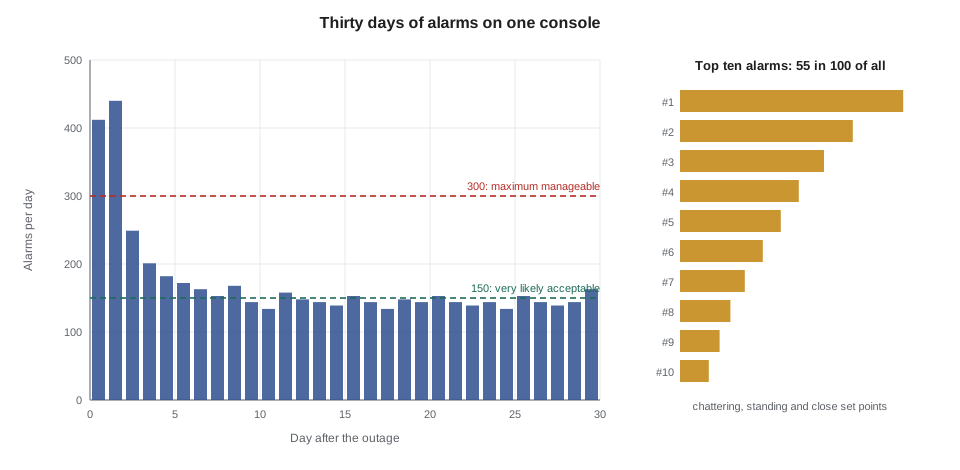
Liesl Brannagan, who will take over Anselm's crew when he becomes chief, came to this session from the control room with a printout: the alarm summary for the console she works at, for the thirty days after the fall outage. She had counted the alarms by hand on one night shift and had been surprised by the total. Morwenna had been waiting for someone on the crews to raise it. "Alarm management is a control problem, a human factors problem and a safety problem all at once," she said. "It's a good place to start the session on advanced control, because it's where the control system meets the people who run it."
PWR-420 covered the distributed control system, advanced regulatory control and safety instrumented systems. This lesson looks at the level above: coordinated control of a boiler and turbine, advanced process control and model predictive control, the alarm management lifecycle set out in ANSI/ISA-18.2, measurement uncertainty and instrument reliability, and the cybersecurity of control systems. Worked examples assess an alarm rate against the standard's benchmarks and estimate the uncertainty of a flow measurement.
Coordinated boiler-turbine control
In a large unit, the boiler and turbine must respond together to a change in load demand. The turbine can change its output in seconds by moving its valves, using the energy stored in the boiler; the boiler takes minutes to change its firing and restore that stored energy. Coordinated control manages the two together. A unit load demand from the grid operator or plant master is sent to both, the turbine valves move to meet the megawatt target while the boiler firing is driven with a feedforward from the same demand, and the throttle pressure error is fed back to both so that neither runs away from the other.
- Boiler-following mode: the turbine controls megawatts and the boiler follows to hold throttle pressure. Load response is fast, but pressure swings are larger.
- Turbine-following mode: the boiler controls megawatts through firing and the turbine valves hold throttle pressure. Pressure is stable, but load response is slow.
- Coordinated mode combines the two, with feedforward from the demand, limits on rate of change and pressure, and sliding pressure operation, in which the throttle pressure is allowed to fall at part load to reduce throttling losses and thermal stress.
Keswold's plant is simpler, because its gas turbine sets the heat available to the HRSG and the steam turbine runs in inlet pressure control with its extraction controlled to Marrowby's demand (PWR-320). The optimization package that sets duct firing and extraction (PWR-420) is a small example of the next level of control: a program that does not control any valve directly but sets the targets for the controllers below it.
Advanced process control and model predictive control
Advanced process control (APC) is the layer of control above the basic regulatory controllers, the PID loops, cascades, ratio and feedforward schemes of PWR-420. Its aim is to hold the plant closer to its constraints and economic optimum than operators and basic loops can. The most common form is model predictive control (MPC).
An MPC controller holds a dynamic model of the process, built from step tests in which each manipulated variable is moved in turn and the responses of every controlled variable are recorded. Every minute or so, it uses the model and current measurements to predict how the process will move over the next hour or so, then calculates the sequence of moves that will keep every controlled variable within its limits and drive the process toward an economic target, such as maximum steam export at minimum fuel. It sends the first move to the basic controllers as new set points, waits, measures and repeats.
- Manipulated variables are the set points the MPC moves, such as duct burner fuel, extraction flow and attemperator spray.
- Controlled variables are the measurements it holds within limits, such as steam temperatures, drum level, stack temperature and NOx.
- Disturbance variables are measured inputs it cannot move but can anticipate, such as gas turbine exhaust flow and ambient temperature.
MPC suits multivariable processes with interactions, constraints and long delays, such as combustion optimization in large boilers, steam temperature control in HRSGs with supplementary firing, and refinery and chemical units. It needs good models, reliable instruments and continuing support: a controller whose model has drifted, or whose operators have switched it off because they do not trust it, gives nothing. Studies of APC across industries typically find that a large fraction of installed controllers are eventually switched off or degraded for want of maintenance (typical), which makes APC as much a people and support decision as a technical one.
Alarm management under ANSI/ISA-18.2
An alarm is an audible or visible means of telling the operator about an equipment malfunction, process deviation or abnormal condition that requires a response. That definition, from ANSI/ISA-18.2, the standard for management of alarm systems in the process industries (2016 edition; the international equivalent is IEC 62682), is the key to alarm management: anything that does not require an operator response is not an alarm, however useful it might be as an event or message. Investigations of major accidents show both sides of the problem: at the 1994 Milford Haven refinery explosion in the United Kingdom, operators were overwhelmed by an alarm flood in the hours before the event, and at the 2005 Texas City refinery explosion, critical level alarms failed or went unheeded during a startup.
The standard sets out an alarm management lifecycle:
- Philosophy: a site document that defines what an alarm is, how priorities are assigned, how alarms are designed and displayed, the performance targets and the roles of the people who manage the system.
- Identification of potential alarms from hazard studies, operating experience and incidents.
- Rationalization: a team of operators, engineers and specialists reviews each alarm, confirms that it needs a response, records its cause, consequence, corrective action and time to respond, and sets its priority and set point. The results go into the master alarm database.
- Detailed design, including deadbands, delays, suppression by plant state and display, followed by implementation and operation.
- Maintenance, monitoring and assessment against performance targets, management of change for every alarm change, and periodic audit.
| Measure | Benchmark in ANSI/ISA-18.2 (approximate) |
|---|---|
| Average annunciated alarms per operator console | About 150 per day (about 6 per hour) very likely acceptable; about 300 per day (about 12 per hour) maximum manageable |
| Alarm flood | More than 10 alarms in 10 minutes |
| Time in flood | Less than about 1 in 100 of the time |
| Top 10 most frequent alarms | About 1 to 5 in 100 of all alarms, with action plans for the rest |
| Priority distribution | Roughly 80 low, 15 medium and 5 high in each 100 alarms configured |
| Chattering and stale alarms | Zero, with action plans for any found |
Worked problem
Liesl's alarm count
Liesl's console annunciated 5,184 alarms in the 30 days after the outage. The ten most frequent alarms accounted for 2,850 of them. Assess the average rate and the contribution of the top ten against the benchmarks.
Show solution
- \[\text{per day} = \frac{5{,}184}{30} = 172.8 \qquad \text{per hour} = \frac{5{,}184}{720} = 7.2 \qquad \text{per 10 min} = 1.2\]
- \[\text{top 10 share} = \frac{2{,}850}{5{,}184} = 0.55\]
Answer: The average rate sits between the very likely acceptable and maximum manageable benchmarks, which is not alarming in itself; but the top ten alarms make up 55 in 100 of the total, far above the benchmark of a few in 100. That pattern is typical: a small number of **nuisance** alarms, chattering on a noisy signal, standing during normal operation or set too close to normal values, make up most of the load. Fixing those ten would cut the rate roughly in half and free the operator's attention for the alarms that matter. Morwenna asked Liesl to lead a rationalization of the top ten with the instrument technician as her first task as shift supervisor, using management of change for each change (a plan).
Alarms on safety instrumented functions and other critical alarms get particular attention in rationalization: an alarm that is credited as an independent protection layer in a LOPA study (PWR-340, PWR-420) must have a defined response, enough time for the operator to complete it, and testing, and it must not be suppressed or shelved without control.
Measurement uncertainty
Every measurement has an uncertainty, a range within which the true value is expected to lie with a stated confidence. A chief engineer needs uncertainties to judge performance tests, custody transfer readings, emissions data and the size of a trend that is real rather than noise. Uncertainties from independent sources combine as the root sum square.
For a differential pressure flow meter such as an orifice, flow is proportional to the square root of the differential pressure, so a given relative uncertainty in differential pressure produces half that relative uncertainty in flow. But transmitter errors are usually stated as a fraction of span, so at low flow, when the differential pressure is a small part of the span, the relative error grows quickly.
Worked problem
Uncertainty of a steam flow measurement
An orifice meter's differential pressure transmitter has an uncertainty of 0.1 in 100 of span, and the meter's discharge coefficient has an uncertainty of 0.6 in 100. Estimate the overall flow uncertainty at full flow and at half flow.
Show solution
- \[\text{Full flow: } \frac{\Delta p}{\Delta p_{span}} = 1.00 \qquad u_{\Delta p} = 0.1 \qquad u_{q,\Delta p} = \tfrac{1}{2}(0.1) = 0.05 \qquad u_q = \sqrt{0.05^2 + 0.6^2} = 0.60\]
- \[\text{Half flow: } \frac{\Delta p}{\Delta p_{span}} = 0.25 \qquad u_{\Delta p} = \frac{0.1}{0.25} = 0.4 \qquad u_{q,\Delta p} = 0.2 \qquad u_q = \sqrt{0.2^2 + 0.6^2} = 0.63\]
Answer: Both results are in units of 1 in 100 of reading. At these flows, the discharge coefficient dominates and the transmitter adds little; at a quarter of full flow, the transmitter's contribution would grow to 0.8 in 100 and dominate. Low-flow measurements on wide-span transmitters are less certain than they look, which is why custody meters use stacked transmitters or other meter types, and why a performance test specifies the instruments, their calibration and the uncertainty of the result (PWR-410).
Instrument reliability is the other half of measurement quality. Critical measurements are often redundant, with two or three transmitters and a selection such as median select so that a single failure is outvoted; their deviation alarms warn when the transmitters disagree. Calibration intervals are set from the measurement's importance and the instrument's drift history, and as-found readings, recorded before any adjustment, show whether the interval is right.
Control system cybersecurity
Modern control systems are networked computers, and they can be attacked or disrupted like any other computer system, with consequences that are physical. The chief engineer is not usually the security specialist, but must make sure that the plant's control and safety systems are protected, because a compromised control system is a process safety hazard. The international series of standards for industrial automation and control system security is ISA/IEC 62443, which organizes the system into zones and conduits and sets security requirements for each; NIST Special Publication 800-82 gives guidance on operational technology security.
- Segmentation: the control network is separated from the business network, with firewalls and a demilitarized zone for data that must pass between them, and no direct internet connection.
- Remote access, such as the LTSA provider's monitoring and vendor support, goes through controlled, logged and time-limited connections with multifactor authentication.
- Least privilege: accounts have only the access their role needs, shared passwords are eliminated and default passwords are changed.
- Patching and backups: patches are tested and applied in a planned way, and controller and system configurations are backed up offline and restored in tests.
- Safety system independence: the safety instrumented system is kept separate from the basic control system, so that a compromise of one does not defeat the other.
- Incident response: the plant has a plan for operating safely if the control system is lost or untrustworthy, including manual operation and safe shutdown.
In the United States, the Cybersecurity and Infrastructure Security Agency (CISA) publishes advisories for industrial control systems, and the NERC critical infrastructure protection (CIP) standards set requirements for generators connected to the bulk electric system, depending on their size and impact.
Common mistakes
MistakeTreating every condition the operator might like to know about as an alarm.
InsteadAn alarm requires an operator response; everything else is an event or message.
MistakeJudging an alarm system only by its average rate.
InsteadLook at floods, the top ten, chattering and stale alarms and the priority distribution.
MistakeChanging alarm set points informally.
InsteadEvery change goes through rationalization records and management of change.
MistakeTrusting a low-range flow reading because the transmitter is accurate.
InsteadSpan-based errors grow at low flow; combine all sources by root sum square.
MistakeInstalling advanced process control and walking away.
InsteadModels, instruments and operator trust need continuing support.
MistakeConnecting the control network to the business network for convenience.
InsteadSegment the networks and control remote access, following ISA/IEC 62443.
Summary and key terms
- Coordinated control drives boiler and turbine together, with feedforward from demand and sliding pressure at part load.
- Model predictive control predicts process behavior and moves set points to keep variables within limits at an economic target, but needs continuing support.
- ANSI/ISA-18.2 defines an alarm as requiring a response and sets a lifecycle of philosophy, rationalization, design, monitoring and management of change.
- Benchmarks include about 6 alarms per hour very likely acceptable, about 12 maximum manageable, floods above 10 in 10 minutes and a small share from the top ten.
- Uncertainties combine by root sum square; span-based transmitter errors grow at low flow.
- Control system security follows ISA/IEC 62443: segmentation, controlled remote access, least privilege, patching, backups and safety system independence.
- Coordinated control
- Control of boiler and turbine together to meet load demand while holding throttle pressure.
- Sliding pressure
- Operation in which throttle pressure is allowed to fall at part load.
- Model predictive control
- Control that uses a dynamic model to predict and optimize future process moves.
- Alarm rationalization
- Systematic review of each alarm to confirm its need, response, priority and set point.
- Alarm flood
- More alarms than an operator can handle, commonly more than 10 in 10 minutes.
- Nuisance alarm
- An alarm that chatters, stands or annunciates without requiring a response.
- Root sum square
- The square root of the sum of squared independent uncertainties.
- Zones and conduits
- The ISA/IEC 62443 model for grouping control system assets and their communication paths.
Practice problems
Work each problem on paper first, then reveal the answer to check.
A console annunciated 9,360 alarms in 30 days. Average per hour?
Show answer
13 per hour, above the maximum manageable benchmark.
Transmitter error 0.1 of span, flow at one third of full scale. Flow uncertainty from the transmitter?
Show answer
About 0.45 in 100 of reading.
Combine uncertainties of 0.3, 0.4 and 1.2 in 100.
Show answer
About 1.30 in 100.
Name the three types of variable in a model predictive controller.
Show answer
Manipulated, controlled and disturbance variables.
Lesson quiz · 5 questions
Score 60% or more to complete this lesson.
Create a free account to save your progress, take quizzes and earn a certificate.