
PWR-320 · Lesson 7 of 12 · 22 min
Condensers and vacuum systems
▶ Video coming soon A video version of this lesson is on the way.
On Saturday, October 3, 2026, the cooling water side of Keswold's condenser was open. The two inlet waterbox doors at the front and the return waterbox doors at the back had been unbolted and swung aside, and a contractor's crew was working along the tube sheet with a high-pressure water lance, firing a cleaning projectile through each tube in turn. Ingeborg Haverlund showed Okonkwo the tube sheet: thousands of tube ends in neat rows, each expanded into its hole, with a few already closed with tapered plugs from earlier years. A second contractor was running an eddy current probe through a sample of tubes to measure their wall thickness.
"The condenser is the biggest heat exchanger in the plant and the one that decides how much power the low-pressure end makes," Ingeborg said. "A few kilopascals of vacuum is worth more than everything else we tune in a year." She had brought the running data from Okonkwo's first visit, on September 18, so that he could work out the condenser's performance.
This lesson explains what a condenser does and why its vacuum matters so much, describes surface, direct contact and air-cooled condensers, follows the cooling water, condensate and air removal systems, and covers vacuum measurement, air in-leakage, tube leaks and condenser performance. It works examples on vacuum, condenser duty, cooling water flow and the effect of vacuum on turbine output.
Why a condenser
A condensing turbine exhausts into a closed vessel cooled by water. The steam condenses on the cold tubes, and because water occupies more than a thousand times less volume than low-pressure steam, the condensing creates and holds a deep vacuum. The exhaust pressure is then set by the temperature at which the steam condenses, which is set by the cooling water temperature. PWR-310 showed that the lower the condenser pressure, the more work each kilogram of steam does; the condenser is what lets a turbine expand steam far below atmospheric pressure.
The condenser also recovers the condensate, pure water that has already been treated, for return to the boiler or HRSG; removes air and other gases that leak into the vacuum; and in many plants receives the drains from heaters, the turbine bypass steam during startups and trips, and the make-up water, which it helps to deaerate.
Measuring vacuum
Condenser pressure is measured in two ways. A vacuum gauge reads how far the pressure is below the local atmospheric pressure. An absolute pressure transmitter reads the pressure above a perfect vacuum, which is what the steam actually experiences. They are related through the barometer:
Because the barometric pressure changes with the weather and the altitude, a vacuum gauge reading alone does not show the condenser's true condition. Performance is always judged on absolute pressure, or on the saturation temperature that goes with it.
Worked problem
Keswold's vacuum on September 18
On September 18 the barometer read 29.80 inHg and the condenser vacuum gauge read 26.75 inHg. Find the absolute pressure in inHg and psia, and the steam saturation temperature. (1 inHg = 0.4912 psi.)
Show solution
- Absolute pressure:
- \[p_{abs} = 29.80 - 26.75 = 3.05 \text{ inHg} = 3.05 \times 0.4912 = 1.50 \text{ psia}\]
- From IAPWS-IF97, the saturation temperature at 1.50 psia:
- \[T_{sat} = 115.6\ ^\circ\text{F}\]
Answer: The steam in the exhaust condenses at about 115.6 °F. Every condenser temperature the operators look at is compared with that number.
Types of condenser
- Surface condensers are shell-and-tube exchangers: cooling water flows through thousands of tubes, and the steam condenses on their outside. The condensate is kept separate from the cooling water and returned to the cycle. Almost all steam power plants use them, including Keswold.
- Direct contact or jet condensers spray cooling water directly into the steam, so the condensate mixes with the cooling water. They are simple and cheap but lose the pure condensate, so they appear mainly in geothermal plants and some older or special installations.
- Air-cooled condensers condense the steam in finned tubes cooled by large fans, with no cooling water at all. They are used where water is scarce or its use restricted. Their vacuum depends on the air temperature, so they lose more output on hot days than a water-cooled condenser does.
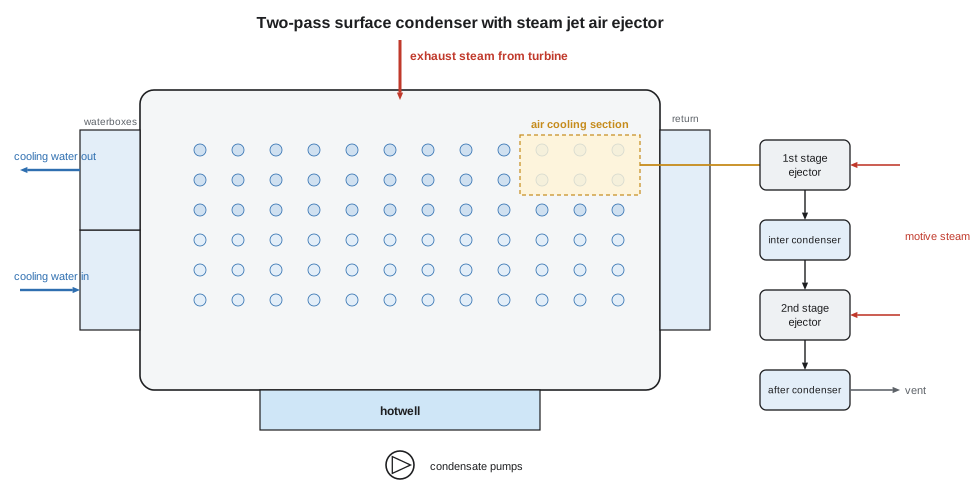
A surface condenser's tubes are commonly stainless steel or titanium in modern plants, with copper alloys in many older ones. They are expanded into tube sheets at each end and held up along their length by support plates. Waterboxes at each end distribute the cooling water; a two-pass condenser, like Keswold's, sends the water through half the tubes and back through the other half, with both waterboxes at the front end on one side. The hotwell at the bottom collects the condensate. Baffles guide the steam through the tube bundle and lead the air and other gases that will not condense to an air cooling section, a part of the bundle shielded from the main steam flow, where the gas mixture is cooled before it is removed so that the air removal equipment handles less steam.
Condenser performance
The heat the condenser removes is the latent heat given up by the exhaust steam, plus a little sensible heat if the condensate leaves below saturation. The cooling water carries it away. Two temperature differences describe how well the condenser is doing:
- The terminal temperature difference (TTD), the difference between the steam's saturation temperature and the cooling water outlet temperature. A clean, well-vented condenser has a small TTD, typically a few kelvins; fouling, air blanketing or low water flow increases it.
- The condensate depression or subcooling, the amount by which the hotwell condensate is colder than the saturation temperature. A little is normal, but a large depression wastes heat and lets the condensate absorb oxygen; it usually means air is collecting in the bundle or the hotwell is flooding the lower tubes.
Worked problem
Keswold's condenser duty
On September 18 the turbine sent 127,000 lb/h of exhaust steam at an enthalpy of 1,008.6 Btu/lb to the condenser at 1.50 psia, where saturated water has h_f = 83.6 Btu/lb. Cooling water entered at 86.0 °F and left at 104.0 °F. Find the condenser duty, the cooling water flow, the TTD, the log mean temperature difference and the overall UA value.
Show solution
- Duty:
- \[Q = 127{,}000 \times (1{,}008.6 - 83.6) = 117.5 \times 10^6 \text{ Btu/h}\]
- Cooling water flow, Q = 500 × gpm × ΔT:
- \[\text{gpm} = \frac{117.5 \times 10^6}{500 \times 18.0} = 13{,}050 \text{ gpm}\]
- TTD:
- \[\text{TTD} = 115.6 - 104.0 = 11.6\ ^\circ\text{F}\]
- Log mean temperature difference, from end differences 29.6 °F and 11.6 °F:
- \[\Delta T_{lm} = \frac{29.6 - 11.6}{\ln(29.6 / 11.6)} = 19.3\ ^\circ\text{F}\]
- UA:
- \[UA = \frac{117.5 \times 10^6}{19.3} = 6.1 \times 10^6 \text{ Btu/h·°F}\]
Answer: The condenser rejects about 117 million Btu/h, nearly twice the turbine's electrical output, and needs about 13,000 gpm of cooling water. The UA value calculated from each day's data, corrected for flow and temperature, is the best trend of condenser cleanliness: when it falls, the tubes are fouling or air is blanketing them.
Okonkwo had seen the same calculation for Cantwell's plate exchangers in PWR-310. The difference, Ingeborg pointed out, was the stakes: Keswold's UA had fallen slowly through the summer as the tubes collected a thin biological slime, which was why they were being cleaned now rather than at the next major outage.
What vacuum is worth
Raising the condenser pressure shortens the expansion in the low-pressure stages. PWR-310 showed the effect on cycle efficiency; at Keswold it shows up directly as lost megawatts.
| Condenser pressure | LP section work | LP section power at full load |
|---|---|---|
| 1.2 psia | 300 Btu/lb | 11.17 MW |
| 1.5 psia | 290 Btu/lb | 10.80 MW |
| 1.8 psia | 282 Btu/lb | 10.50 MW |
| 2.0 psia | 277 Btu/lb | 10.32 MW |
Every 0.3 psi of lost vacuum near Keswold's normal operating point costs roughly 0.3 MW. Over a year that is a large sum, and it is the reason condenser cleanliness, air in-leakage and cooling tower performance are watched daily. The effect is not unlimited in the other direction, though: below a certain pressure the steam's volume becomes so large that the last-stage blades cannot pass it efficiently, the exhaust loss rises, and lower pressure gains little more.
Air removal
Air leaks into every condenser, through gland seals, flanges, valve stems, rupture diaphragms and instrument connections, and other non-condensable gases arrive with the steam. If it were not removed, it would accumulate around the tubes, insulating them, and raise the condenser pressure. Dalton's law of partial pressures (PWR-310) explains the effect: the condenser pressure is the sum of the steam pressure and the air pressure, so any air present means the steam must condense at a lower partial pressure, and therefore a lower temperature, to give the same total. If 0.2 psi of a 1.5 psia condenser pressure is air, the steam condenses at 1.3 psia and about 110.6 °F, not 115.6 °F, and the cooling water must be correspondingly colder to keep the vacuum. In practice the air collects in the air cooling section and is drawn off there.
Air is removed by one of two kinds of equipment:
- Steam jet air ejectors (SJAEs) use a jet of motive steam through a nozzle to entrain the air-steam mixture and compress it. Two stages in series are usual: the first stage discharges into an inter condenser, where its steam is condensed, and the second stage compresses the remaining air to slightly above atmospheric pressure through an after condenser to a vent. The inter and after condensers are cooled by the turbine's own condensate, so the motive steam's heat is recovered. Ejectors have no moving parts and are very reliable, but need a steady supply of motive steam at the right pressure.
- Liquid ring vacuum pumps use an impeller turning eccentrically in a casing partly filled with water; the ring of water forms pockets that draw in and compress the gas. They need no motive steam, which suits plants with intermittent steam supply, but have rotating parts and seal water to look after.
A hogging ejector or pump, much larger than the holding equipment, pulls the initial vacuum quickly at startup, when the condenser and turbine are full of air. Once the vacuum is established, the smaller holding ejectors take over. Keswold has two two-stage steam jet air ejectors, one in service and one on standby, and a hogging ejector, all supplied from the plant's auxiliary steam header.
Finding air leaks
Air in-leakage is measured at the air ejector vent with a flowmeter, usually reported in standard volume per minute, and trended. A rising value means a new leak. Leaks are found while the plant is running by spraying a tracer gas such as helium or sulfur hexafluoride on suspect joints and watching a detector on the ejector vent; or, at shutdown, by filling the steam space with water up to the turbine glands and looking for drips. A simple vacuum decay test, isolating the air removal equipment briefly and timing the rise in pressure, is a common routine check. Large leaks often come from the places that were disturbed most recently: Keswold's procedure includes an air in-leakage measurement on the first day of load after every outage.
Condensate and tube leaks
The condensate pumps draw from the hotwell, where the water is at or near its saturation temperature and under vacuum, so they have almost no NPSH available beyond the height of water above them (PWR-310). They are therefore vertical pumps set in a pit or can well below the hotwell, with their first stage impeller at the bottom. Hotwell level control, by make-up and by recirculating or dumping condensate, protects them from losing suction.
A leaking condenser tube lets cooling water into the condensate, because the cooling water is at a higher pressure than the vacuum. Cooling tower water is full of dissolved salts that the HRSG cannot tolerate. Cation conductivity analyzers on the condensate pump discharge, and often on samples from separate sections of the hotwell, detect a leak within minutes. The response depends on its size: a small leak may be tolerated briefly while the leaking half of the condenser is isolated and its waterboxes opened at reduced load; a large one forces a shutdown before the boiler water is contaminated. Leaking tubes are found by tests with the waterbox open, such as covering tube ends with plastic film or foam while the steam side is under vacuum, and are plugged at both ends.
Okonkwo's Saturday finished at the eddy current contractor's laptop. Two tubes in the lower bundle showed wall thinning near a support plate, worse than the plant's plugging criterion, and were plugged. The cleaned tubes were flushed, the waterboxes closed and the cooling water side refilled. Ingeborg wrote the date on the UA trend chart so that the improvement would show when the turbine returned to service.
Common mistakes
MistakeJudging condenser performance from the vacuum gauge alone.
InsteadUse absolute pressure, p_abs = p_baro − p_vac, or its saturation temperature; the barometer changes.
MistakeThinking air in a condenser only takes up space.
InsteadBy Dalton's law it lowers the steam's partial pressure and so its condensing temperature; it also blankets tubes.
MistakeExpecting condensate pumps to need only ordinary suction head.
InsteadHotwell water is saturated under vacuum; condensate pumps rely on submergence and are set well below the hotwell.
MistakeTreating a rise in condensate cation conductivity as an instrument fault without checking.
InsteadIt usually means a tube leak; confirm quickly and act before the boiler or HRSG water is contaminated.
MistakeAssuming lower condenser pressure always adds output.
InsteadBelow a certain pressure exhaust losses in the last stage rise and the gain flattens.
Summary and key terms
- A condenser creates and holds the vacuum that lets the turbine expand steam far below atmospheric pressure, and recovers the condensate.
- Absolute pressure equals barometric pressure minus vacuum; performance is judged on absolute pressure.
- Surface condensers keep condensate separate from cooling water; direct contact and air-cooled condensers suit special cases.
- TTD, condensate depression and UA show condenser condition; vacuum losses cost output directly.
- Steam jet air ejectors or liquid ring vacuum pumps remove air; hogging equipment raises vacuum at startup.
- Cation conductivity detects tube leaks; air in-leakage is measured at the ejector vent and found with tracer gas.
- Surface condenser
- A shell-and-tube condenser in which steam condenses on tubes carrying cooling water.
- Absolute pressure
- Pressure measured above a perfect vacuum.
- Terminal temperature difference
- In a condenser, the saturation temperature minus the cooling water outlet temperature.
- Condensate depression
- The amount by which condensate leaving the hotwell is below the saturation temperature.
- Steam jet air ejector
- A device that uses a jet of motive steam to remove air and gases from a condenser.
- Hogging ejector
- A large ejector used to draw the initial vacuum at startup.
- Air cooling section
- Part of a condenser bundle where non-condensable gases are cooled before removal.
- Cation conductivity
- Conductivity of a sample after passing through a cation resin, sensitive to contaminant salts.
- Exhaust loss
- Kinetic energy and other losses at a turbine's last stage exit, which rise at very low exhaust pressures.
Practice problems
Work each problem on paper first, then reveal the answer to check.
The barometer reads 29.40 inHg and the vacuum gauge 27.10 inHg. Find the absolute pressure in psia.
Show answer
2.30 × 0.4912 = 1.13 psia.
A condenser receives 95,000 lb/h of steam at 1,012 Btu/lb and discharges condensate at 82 Btu/lb. Find the duty.
Show answer
95,000 × 930 = 88.4 million Btu/h.
For that duty with a 16 °F cooling water rise, find the water flow.
Show answer
88.4 × 10⁶ ÷ (500 × 16) = 11,050 gpm.
Saturation is 109.4 °F and cooling water leaves at 99.5 °F. Find the TTD.
Show answer
9.9 °F.
Lesson quiz · 5 questions
Score 60% or more to complete this lesson.
Create a free account to save your progress, take quizzes and earn a certificate.