
PWR-320 · Lesson 5 of 12 · 24 min
Turbine startup and warming
▶ Video coming soon A video version of this lesson is on the way.
Keswold's rotor went onto turning gear on Wednesday, October 14, 2026, and on Thursday, October 15, Ingeborg Haverlund sat down with Okonkwo at a desk in the turbine hall with the manufacturer's startup curves and Keswold's own startup procedure, a document of forty-odd pages with a signature line beside almost every step. Behind them the rotor turned steadily at a few revolutions per minute, its shaft eccentricity reading on a screen beside the turning gear. The first steam roll after the outage was planned for the following Wednesday.
"Starting a turbine is mostly about heat," Ingeborg said. "The rotor and the casing start cold and end up at four or five hundred degrees, and they don't heat at the same rate. Every hold and every rate limit in that procedure is there to keep the difference small enough that nothing cracks, nothing rubs and nothing bends."
This lesson explains the problems a startup must manage: rotor bow, thermal stress, differential expansion, critical speeds and water induction. It describes the conditions that must be met before steam is admitted, how steam and metal temperatures are matched, why turbines are run up with holds and rate limits, and how cold, warm and hot starts differ. Lesson 12 follows Keswold's actual startup step by step.
Before steam: turning gear and eccentricity
Lesson 2 explained why a hot rotor left standing will bow. A cold rotor that has been standing can also be slightly bowed, from its own weight or from residual stresses. Running it on turning gear for a period before startup lets it straighten, and lets the operators confirm that it has. The confirmation is the eccentricity reading: a proximity probe near the rotor's mid-span, or near a bearing, measures how far the shaft surface moves in and out as the rotor turns slowly. A straight rotor shows a small, steady eccentricity close to its recorded baseline; a bowed rotor shows a larger one.
Keswold's procedure requires at least four hours of continuous turning gear operation before a cold start, and longer after a hot shutdown, with the eccentricity no more than 1 mil above the rotor's recorded baseline, and steady. If it is high, the rotor stays on turning gear until it comes down. Rolling a bowed rotor makes it rub its packing, the rubbing heats one side of the shaft, the heat increases the bow, and the vibration can grow until the turbine trips or is damaged. The heat soak of a rub can permanently bend a rotor.
Turning gear also needs lubrication and jacking oil (lesson 4), and on a condensing turbine, sealing steam should not be applied to the glands of a stationary rotor, because the steam heats one spot of the shaft and bows it. Gland steam is put on only when the rotor is turning.
Conditions for admitting steam
Before the stop valves are opened, a startup procedure confirms a long list of conditions. The main ones are:
- Lubricating, jacking and control oil systems in service, with pumps and trips tested (lesson 6).
- Turning gear in service for the required time, with eccentricity acceptable.
- Condenser in service: circulating water flowing, condensate pump running with recirculation, and vacuum raised first with the hogging ejector or vacuum pump and then held with the main air removal equipment (lesson 7).
- Gland sealing steam applied once the rotor is turning and vacuum is being raised, so that air is not drawn in along the shaft.
- Drains open on the steam lines, valve chests and casing low points, so that condensate formed during warming is removed before it can reach the blades.
- Steam conditions at the stop valves suitable for the start: pressure within range and, above all, enough superheat and a temperature matched to the turbine metal.
- Protection systems armed, including overspeed, vibration, thrust, differential expansion, exhaust temperature and low vacuum trips.
On a combined cycle plant like Keswold, the HRSG and steam turbine are started together, so the steam conditions change during the start. The HRSG produces steam well before the turbine can use it, and that steam is sent through bypass valves with desuperheaters to the condenser until its pressure and temperature suit the turbine. This lets the gas turbine load up without waiting for the steam turbine.
Superheat and water induction
Steam admitted to a turbine must be dry and must stay dry as it meets cold metal in the steam chest and first stages. Water entering a turbine, called water induction, can crack hot casings and rotors by sudden local cooling, erode or break blades, overload the thrust bearing and bend a rotor. Its causes include condensate in undrained steam lines, attemperator or desuperheater sprays left on at low flow, a carried-over drum level, and water backing up from feedwater heaters or extraction lines into the turbine.
Startup procedures therefore require a margin of superheat at the stop valves before rolling, typically in the order of 100 °F or more as the manufacturer specifies, and keep the drains open until the turbine has load. Extraction and heater lines have non-return valves, drains and high-level protection to keep water from returning. Sudden drops in steam temperature, or a falling temperature combined with rising vibration or thrust, are treated as water induction until proven otherwise, and the usual response is to trip the turbine and open its drains.
Steam-to-metal temperature matching
The steam admitted to a cold turbine should not be much hotter than the metal it meets, and the steam admitted to a hot turbine should not be much colder. The difference that matters is between the steam temperature in the first stage shell and the metal temperature there, measured by thermocouples set into the casing wall. Manufacturers publish steam-to-metal mismatch limits and charts relating them to the start type and the turbine's expected life consumption.
Matching is made harder by throttling. Steam passing through partly open governor valves loses pressure without losing enthalpy (PWR-310), and its temperature after the valves is lower than at the stop valve, sometimes much lower. At Keswold's inlet conditions, saturated steam at 880 psia would be at about 529 °F, and steam throttled from the inlet to a low first stage pressure at startup cools considerably. The first stage shell temperature, not the main steam temperature, is what the procedure watches. On HRSG plants, the steam temperature can also be held down at startup by firing the gas turbine at low load and using the attemperators carefully.
Thermal stress in the rotor
When steam heats a rotor, its surface warms first and its center follows. While the surface is hotter it is trying to expand more than the center allows, so the surface is in compression and the center in tension. When the turbine is cooled, by a load reduction or a shutdown, the stresses reverse. The size of the stress depends on the temperature difference between surface and center, which depends on how fast the steam temperature changes.
Worked problem
Stress from a surface-to-bore difference
During a fast start, the surface of Keswold's rotor at the first stage is 108 °F hotter than its center. For the rotor steel E = 29 × 10⁶ psi, α = 6.9 × 10⁻⁶ per °F and Poisson's ratio ν = 0.3. Estimate the thermal stress at the surface, using σ = EαΔT ÷ (1 − ν) for a long cylinder.
Show solution
- Thermal stress:
- \[\sigma = \frac{29 \times 10^{6} \times 6.9 \times 10^{-6} \times 108}{1 - 0.3} = 30{,}900 \text{ psi}\]
Answer: About 30,900 psi, a large fraction of the rotor steel's yield strength at temperature, and added to the stresses from rotation. A rotor can survive this a limited number of times. Each start and each large load change uses up a little of its **low-cycle fatigue** life, and very fast changes use it much faster. That is why the rate of heating, not just the final temperature, is controlled.
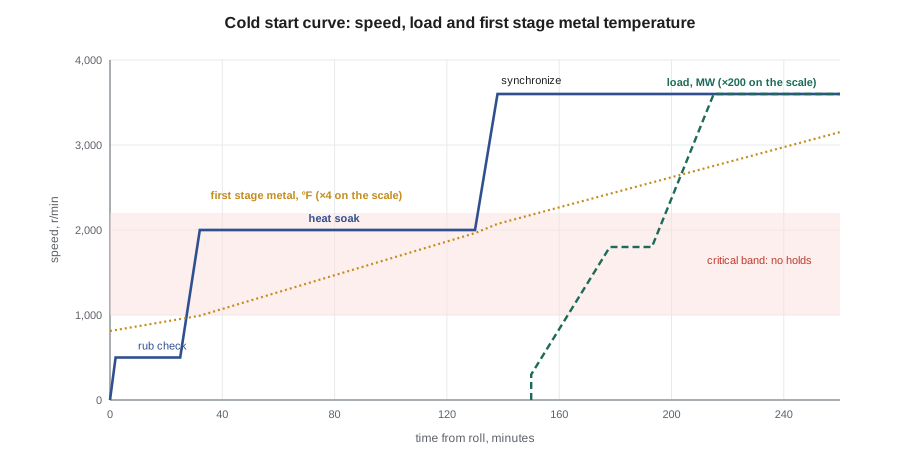
Large modern turbines calculate the rotor stress continuously from measured steam and metal temperatures in a turbine stress evaluator or rotor stress monitor, and the control system limits the speed and load rates to keep the calculated stress within a margin. Smaller turbines like Keswold's rely on the manufacturer's rate charts: so many degrees per minute of first stage metal temperature rise, so many megawatts per minute of loading, and fixed hold times at given speeds. Keswold's cold start curve allows the first stage metal to rise at no more than about 4.5 °F per minute; heating it from 300 °F to 750 °F at that rate takes (750 − 300) ÷ 4.5 = 100 minutes.
Differential expansion
The rotor and the casing both grow as they heat, but not by the same amount at the same time. The rotor is thinner and is swept by steam over its whole surface, so it heats faster than the thick casing; for the same temperature it also grows by about the same amount per meter, but it is fixed axially at the thrust bearing while the casing is fixed at its anchor. The difference between rotor growth and casing growth, measured at the far end from the thrust bearing, is the differential expansion. If the rotor grows too much more than the casing, the moving blades and packing close up on the fixed parts on one side; if it grows too little, on the other.
Worked problem
How far the rotor runs ahead
During warming, Keswold's rotor between the thrust bearing and the exhaust end, a length of 244 in, is on average 81 °F hotter than the casing over the same length. With α = 6.9 × 10⁻⁶ per °F, find the differential expansion.
Show solution
- Difference in growth:
- \[\Delta L = 6.9 \times 10^{-6} \times 244 \times 81 = 0.14 \text{ in}\]
Answer: About 0.14 in, enough to use a large part of the axial clearance at the low-pressure stages. Keswold's differential expansion monitor alarms and trips at settings the manufacturer has set inside the clearances, and the startup rates are chosen to keep the reading well inside them.
Operators influence differential expansion through the steam temperature, the speed and load holds, the rate of loading, the gland steam temperature, which heats or cools the shaft ends, and on large machines by heating the casing flanges with steam so that the casing keeps pace. Differential expansion is often the limit that decides how fast a hot restart can be loaded, because a hot casing with a cooled rotor runs the other way.
Critical speeds
Every rotor has critical speeds: speeds at which the rotation matches a natural frequency of the rotor on its bearings, so that any small unbalance produces a large vibration. A stiff rotor runs below its first critical speed; most large steam turbine and generator rotors are flexible, running between their first and second criticals, so they must pass through the first on every start and stop. The turbine rotor and the generator rotor each have their own criticals, and the coupled shaft line has a set of its own.
The startup procedure lists the critical speed bands to be avoided, and the turbine is accelerated through them without holding. Keswold's turbine rotor has its first critical near 1,850 r/min and the generator rotor near 1,150 r/min; the manufacturer specifies no holds between 1,000 and 2,200 r/min. Vibration will rise as the rotor passes through each critical and fall again above it. The peak amplitude and the speed at which it occurs are recorded on every start, because a change in either shows a change in the rotor's balance or in its support.
Holds and rates
A typical run-up after steam is admitted has a pattern that Keswold's cold start curve follows:
- Roll off turning gear to a low speed, often about 400 to 600 r/min, and hold briefly for a rub check: listen at the glands and bearings with a listening rod, check vibration, eccentricity, bearing temperatures, thrust position and differential expansion. Some procedures trip the turbine at this point and listen to it coast down, because rubs are easiest to hear with no steam noise.
- Accelerate at the specified rate, at Keswold about 200 r/min per minute, through the critical speed bands without holding.
- Heat soak at an intermediate speed above the criticals, at Keswold 2,000 r/min, until the first stage metal temperature, differential expansion and casing growth reach the values on the curve.
- Accelerate to rated speed, check that the governor takes over speed control, and carry out the overspeed trip test if it is due.
- Synchronize, take a block load to avoid running unloaded, then load at the rate the curve allows, with further holds at set loads to let temperatures settle.
Cold, warm and hot starts
The amount of warming a turbine needs depends on how hot it still is. Manufacturers classify starts by the first stage metal temperature, or by the hours since shutdown, with figures such as these, which are typical rather than universal:
| Start type | Typical shutdown time | Typical first stage metal temperature | What governs the start |
|---|---|---|---|
| Cold | More than about 72 h, or after an outage | Below about 300 °F | Heating rates and heat soak holds |
| Warm | About 8 to 72 h | About 300 to 700 °F | Matching steam to a part-warm casing |
| Hot | Less than about 8 h | Above about 700 °F | Raising steam temperature to match a hot casing; differential expansion |
| Very hot | Less than about 1 to 2 h, after a trip | Close to running temperature | Restart quickly before the metal cools; avoid cold steam |
A hot start is not simply a fast cold start. The steam must be hot enough to avoid cooling the casing and rotor, which means the boilers or HRSG must be brought to a high steam temperature before the turbine is rolled; the turbine can then be accelerated and loaded quickly, because little more heating is needed. Cold steam on a hot turbine is one of the most damaging things an operator can do.
Shutdown has its own rules. The load is reduced at the allowed rate, the turbine is tripped or the valves closed, the breaker opens, and the rotor coasts down through its critical speeds. The coast-down time, from trip to stop, is recorded and compared with previous ones: a shorter time suggests rubbing or bearing trouble, a longer one a leaking valve still admitting steam. The turning gear engages, and stays in service until the first stage metal has cooled below the manufacturer's limit, often 300 °F or so, which on a large turbine can take several days.
Okonkwo spent the afternoon marking up his own copy of the procedure with the reason for each hold. When he showed it to Ingeborg she corrected only one: he had written that the heat soak at 2,000 r/min was to warm the bearings. "It's to warm the rotor right through, so it's ready for load," she said. "The bearings take care of themselves."
Common mistakes
MistakeRolling a turbine as soon as eccentricity is below its limit for a moment.
InsteadEccentricity must be within limits and steady after the required turning gear time.
MistakeApplying gland sealing steam to a stationary rotor.
InsteadSeal steam on a stopped shaft heats one spot and bows the rotor; apply it only with the rotor turning.
MistakeHolding speed inside a critical speed band to check vibration.
InsteadPass through critical bands at the specified acceleration; hold only at the speeds the procedure lists.
MistakeUsing the main steam temperature instead of the first stage temperature to judge the mismatch.
InsteadThrottling cools the steam after the governor valves; compare first stage steam with first stage metal.
MistakeThinking a hot start is just a cold start done faster.
InsteadA hot start needs hot steam to match the hot metal; cold steam on a hot turbine causes severe thermal stress.
Summary and key terms
- Turning gear and steady eccentricity confirm a straight rotor before steam is admitted.
- Startup requires oil systems, condenser vacuum, gland sealing, open drains, armed protection and steam with adequate superheat.
- Water induction is prevented by drains, superheat margins and non-return protection on extraction and heater lines.
- Thermal stress depends on the surface-to-center temperature difference, so heating and loading rates are limited.
- Differential expansion between rotor and casing is monitored and controlled by steam temperature, holds and rates.
- Flexible rotors pass through critical speeds without holding; cold, warm and hot starts follow different curves.
- Eccentricity
- The slow-roll runout of a rotor, measured to show whether it is bowed.
- Rub check
- A low-speed hold after rolling a turbine to listen and check readings for signs of rubbing.
- Heat soak
- A hold at an intermediate speed or load to let rotor and casing temperatures catch up.
- Water induction
- The entry of water or cold wet steam into a turbine, with risk of cracking, blade damage and thrust failure.
- Steam-to-metal mismatch
- The difference between the steam temperature admitted to a turbine and the metal temperature it meets.
- Differential expansion
- The difference between rotor growth and casing growth along the shaft.
- Critical speed
- A rotational speed matching a natural frequency of the rotor system, where vibration peaks.
- Flexible rotor
- A rotor whose running speed is above its first critical speed.
- Low-cycle fatigue
- Damage accumulated by repeated large stress cycles such as starts and load changes.
Practice problems
Work each problem on paper first, then reveal the answer to check.
A rotor surface is 72 °F hotter than its center. E = 29 × 10⁶ psi, α = 6.9 × 10⁻⁶ per °F, ν = 0.3. Estimate the surface stress.
Show answer
29 × 10⁶ × 6.9 × 10⁻⁶ × 72 ÷ 0.7 = 20,600 psi.
First stage metal must rise from 250 °F to 720 °F at 3.6 °F per minute. How long does it take?
Show answer
470 ÷ 3.6 = 131 min.
A rotor 197 in long runs 54 °F hotter than its casing, α = 6.9 × 10⁻⁶ per °F. Find the differential expansion.
Show answer
6.9 × 10⁻⁶ × 197 × 54 = 0.073 in.
Why does a shorter coast-down time than usual concern an operator?
Show answer
It suggests extra drag from rubbing or a bearing problem.
Lesson quiz · 5 questions
Score 60% or more to complete this lesson.
Create a free account to save your progress, take quizzes and earn a certificate.