
PRIN-150 · Lesson 5 of 12 · 25 min
Tailoring for large, complex and program-based projects
At the other end of the scale from the makerspace sits Ridgeline Water's treatment plant upgrade: 38 million over four years, several contractors, a regulator who must approve the design and the commissioning, and a plant that has to keep producing safe water every day of construction. Large projects need PRINCE2 tailored up, not down: more stages, more formal assurance, more structure in the project management team and careful links to the organization's program and portfolio management. This lesson works through those adjustments.
The treatment plant upgrade
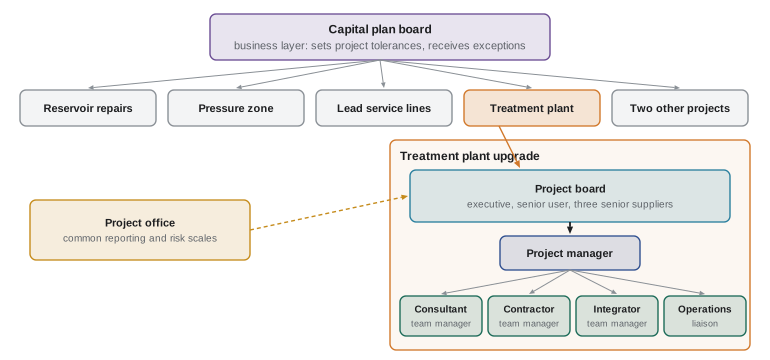
Ridgeline's main treatment plant is 40 years old. The upgrade replaces the filters, adds ultraviolet disinfection, rebuilds the chemical building and upgrades the controls, while the plant stays in service. It is one of six projects in the utility's ten-year capital program, which also includes reservoir repairs, a new pressure zone and the lead service line replacement project in lesson 6. The program is run by a program director who reports to the utility's general manager.
The project uses three main suppliers: an engineering consultant for design and contract administration, a general contractor for construction, and a controls integrator for the new automation system. The utility's own operations staff are heavily involved, because every shutdown of a filter or pump has to be planned with them. The executive is the director of engineering, Samuel Okonkwo. The senior user role is held by the plant superintendent, Helena Wiśniewska. The project manager is Ana Costa, promoted after the outage alert app.
Working inside a program
When a project is part of a program, the program provides much of what PRINCE2 calls the business layer. The program board sets the project's tolerances, appoints or approves the executive and receives exceptions that exceed project tolerance. Benefits are often managed at program level, because several projects contribute to the same outcomes. The project's business case may focus on the project's own costs, risks and outputs and refer to the program business case for the benefits it supports.
| PRINCE2 element | Standalone project | Treatment plant upgrade inside the program |
|---|---|---|
| Business layer | Corporate management | The capital program board, under the general manager |
| Project tolerances | Set by corporate management | Set by the program board: +4 % cost (1.52 million), +3 months |
| Business case | Full investment appraisal by the project | Project costs, risks and outputs; benefits referenced to the program business case |
| Benefits management approach | Owned by the project, handed to the business at closure | Program benefits plan; project records the outputs and capabilities it delivers |
| Project assurance | Appointed by the board | Program assurance team provides part of it |
| Reporting | Highlight reports to the board | Highlight reports to the board, copied to the program office in its standard format |
| Exceptions beyond project tolerance | To corporate management | To the program board |
Inside a program, the project's board must be careful not to duplicate the program's governance. Ana proposes that the program office's standard highlight template replaces the project's own, that the program's risk register shares a common scale with the project's, and that the program assurance team provides the business assurance part of project assurance. The project keeps its own board, because day-to-day direction of a 38 million project needs a focused group with authority, but it reports upward in the program's language.
Several suppliers on one board
PRINCE2 allows the senior supplier role to be shared by more than one person when several suppliers provide resources. On the treatment plant upgrade, each of the three suppliers nominates a senior supplier: the consultant's principal, the contractor's operations manager and the integrator's director. That gives the board direct access to each supplier's commitment. It also brings a risk: suppliers' commercial interests differ from the customer's. The board's terms of reference therefore separate decisions the whole board takes (such as authorizing stages) from commercial decisions the customer takes alone (such as claims and contract variations), and the senior suppliers do not vote on matters where they have a conflict of interest.
Each supplier also has its own project management. The general contractor has a construction manager who runs its work like a project of its own, with its own plans, risks and reports. In PRINCE2 terms, that person is a team manager for the work packages assigned to the contractor, and the contract and the work packages must say the same thing. The project manager coordinates the interfaces between the three suppliers, which is where most large-project problems start: the controls integrator needs the contractor's electrical work finished, the contractor needs the consultant's drawings approved, and operations needs all three to stay inside planned shutdown windows.
Stages for a long project
A four-year project needs many management stages, because the board cannot sensibly commit to four years of work at once. Ridgeline's tier C guide limits stages to about six months. Ana's plan has an initiation stage and eight delivery stages, with boundaries placed at natural decision points: design completion, regulator approval, contract award, completion of each filter train and commissioning.
Management stages are not the same as the technical stages of the work, such as design, procurement, construction and commissioning. Technical stages overlap; management stages do not. Detailed design for the chemical building can still be running when construction of the first filter train starts. Ana places boundaries where the board has a real decision to make, and makes sure each management stage plan includes the parts of each technical stage that fall within it.
technical = {                       # (start month, end month)
    "design": (0, 10), "regulator approval": (9, 13), "procurement": (11, 16),
    "filter trains 1-2": (16, 28), "UV and chemical building": (20, 36),
    "controls": (18, 42), "commissioning": (38, 48),
}
boundaries = [4, 10, 16, 22, 28, 34, 40, 44, 48]      # ends of management stages
start = 0
for n, end in enumerate(boundaries, 1):
    active = [k for k, (a, b) in technical.items() if a < end and b > start]
    print(f"stage {n} (months {start}-{end}): {', '.join(active)}")
    start = end
longest = max(b - a for a, b in zip([0] + boundaries[:-1], boundaries))
print(f"longest management stage: {longest} months")stage 1 (months 0-4): design stage 2 (months 4-10): design, regulator approval stage 3 (months 10-16): regulator approval, procurement stage 4 (months 16-22): filter trains 1-2, UV and chemical building, controls stage 5 (months 22-28): filter trains 1-2, UV and chemical building, controls stage 6 (months 28-34): UV and chemical building, controls stage 7 (months 34-40): UV and chemical building, controls, commissioning stage 8 (months 40-44): controls, commissioning stage 9 (months 44-48): commissioning longest management stage: 6 months
The output shows the overlap clearly. Stage 4, for example, contains construction of the first filter trains, the start of the UV and chemical building and early controls work, so its plan needs work packages for all three suppliers. The longest stage is six months, inside the guide's limit. Placing a boundary at month 10, after design, gives the board a decision point before the regulator's approval and the 30 million construction commitment, which is where the business case is most exposed.
More formal assurance and support
Large projects tailor up their assurance and support. Ridgeline appoints an independent project assurance team: a business assurance lead from the program office, user assurance from the plant's operations engineer, and supplier assurance from an engineer who does not work for any of the contractors. The utility also commissions external gate reviews before the construction contract is awarded and before commissioning. Project support becomes a small project office with a scheduler, a document controller and a cost analyst, and a configuration management procedure controls thousands of drawings, specifications and change orders.
| Area | Standard project | Treatment plant upgrade |
|---|---|---|
| Stages | Two to four | Initiation plus eight, none longer than six months |
| Project assurance | Board members or nominees | Independent assurance team plus external gate reviews |
| Project support | Part-time | Project office: scheduler, document controller, cost analyst |
| Configuration management | Simple register | Formal procedure with document control system and change orders |
| Reporting | Fortnightly highlight | Monthly highlight in program format, weekly dashboard, monthly supplier reports |
| Risk | Register reviewed at boundaries | Quantified risk analysis, contingency held by the program above project tolerance |
Large water infrastructure in the United States is often financed through the Drinking Water State Revolving Fund, which brings federal requirements such as Davis-Bacon prevailing wages and American Iron and Steel provisions, and a treatment plant needs the state drinking water program's approval of plans and specifications before construction and commissioning. These requirements shape the stage boundaries and the quality criteria.
When a project is too big
Sometimes the right tailoring decision is to stop treating the work as one project. If parts of the work have separate justifications, separate users or separate timescales, they may be better run as separate projects within a program. Ridgeline considered splitting the controls upgrade into its own project, because the integrator's work affects every plant system and could slip without delaying the filters. The board decided against it, because the commissioning of the new filters depends completely on the new controls, so one project with a strong interface work package was simpler. The decision and its reasons are recorded in the project approach.
Worked problem
Who decides?
Midway through stage 5, the general contractor submits a claim for 600 thousand for unforeseen rock in the UV building excavation. The current stage has a cost tolerance of 350 thousand and the project's cost tolerance is 1.52 million, of which 400 thousand is already used. The contractor's operations manager sits on the project board as a senior supplier. How should the claim be handled?
Show solution
- A 600 thousand cost exceeds the stage tolerance of 350 thousand, so the project manager raises an exception report to the board.
- The claim is a commercial matter between the utility and the contractor, so the board's terms of reference keep the contractor's senior supplier out of the decision.
- If the claim is accepted, total project tolerance used becomes 1.0 million of 1.52 million, still within project tolerance, so the board can decide without going to the program board.
- The board asks for an exception plan for the rest of stage 5, including the claim and any schedule effect.
- The program office is informed through the normal reporting, because project contingency use affects the program's risk position.
Answer: Exception report to the board; the contractor's senior supplier steps out because of the conflict of interest; the board decides within project tolerance and requests an exception plan; the program office is kept informed.
Keeping a large board effective
A board with an executive, a senior user and three senior suppliers, plus assurance and the project manager in attendance, can become a large meeting that struggles to decide anything. Ridgeline keeps it effective with three habits. Papers go out five working days before each meeting, with a one-page decision summary on top. Routine items such as highlight reports are taken as read unless someone flags a question in advance. And decisions within the board's authority but needing quick action between meetings can be taken by the executive and senior user together, with the decision confirmed at the next meeting. These habits are themselves tailoring, recorded in the board's terms of reference in the PID.
Common mistakes
MistakeDuplicating program governance inside a project.
InsteadUse the program's reporting formats and risk scales, and let the program act as the business layer.
MistakeLetting a supplier's senior supplier vote on that supplier's claim.
InsteadSeparate whole-board decisions from customer-only commercial decisions in the board's terms of reference.
MistakeMaking management stages match technical stages.
InsteadPlace management stage boundaries at decision points; technical stages can overlap them.
MistakeRunning a four-year project in two or three long stages.
InsteadUse more, shorter stages so the board's commitments stay manageable.
MistakeKeeping one project when parts have separate justifications.
InsteadConsider splitting into separate projects within a program and record the decision.
Summary and key terms
- Large and complex projects need PRINCE2 tailored up: more stages, more formal assurance and support, and stronger configuration management.
- Inside a program, the program board usually acts as the business layer and may manage benefits.
- Several people can share the senior supplier role, but commercial conflicts of interest must be managed.
- Suppliers' own project managers act as team managers for their work packages, and contracts and work packages must align.
- Management stages are set at decision points; technical stages can overlap them.
- Very large undertakings may be better split into several projects within a program.
- Program
- A temporary structure for coordinating related projects and activities to deliver outcomes and benefits.
- Technical stage
- A grouping of specialist work by type, such as design or construction, which can overlap others.
- Gate review
- An independent review of a project at a key decision point.
- Configuration management
- Controlling and tracking versions of products and their relationships.
- Conflict of interest
- A situation where a board member's other interests could influence a decision.
- Project office
- A team providing project support functions on a large project.
Practice problems
Work each problem on paper first, then reveal the answer to check.
Who acts as the business layer for the treatment plant upgrade?
Show answer
The capital program board.
What are the project's cost and time tolerances?
Show answer
+4 % cost (1.52 million) and +3 months.
How many senior suppliers are on the board?
Show answer
Three: the consultant, the general contractor and the controls integrator.
Why must the contractor's senior supplier step out of the claim decision?
Show answer
Because the claim is a commercial matter in which the contractor has a conflict of interest.
What is the maximum stage length in Ridgeline's tier C guide?
Show answer
About six months.
What is the difference between management and technical stages?
Show answer
Management stages are sequential decision periods for the board; technical stages group specialist work and can overlap.
Why is there a boundary at month 10?
Show answer
So the board decides after design and before regulator approval and the construction commitment.
Name two forms of tailored-up assurance on this project.
Show answer
An independent assurance team and external gate reviews.
Why was the controls upgrade kept in the same project?
Show answer
Because filter commissioning depends completely on the new controls.
Where are decisions about splitting the work recorded?
Show answer
In the project approach.
Lesson quiz · 5 questions
Score 60% or more to complete this lesson.
Create a free account to save your progress, take quizzes and earn a certificate.