
PRIN-150 · Lesson 9 of 12 · 25 min
Applying the principles in scenarios
The seven principles are the part of PRINCE2 that never changes. Every practice, process and tailoring decision should be traceable to them, which makes them a powerful tool in Practitioner questions. When two options both look reasonable, the one that keeps a principle intact is usually right, and an option that quietly breaks one is usually a distractor. This lesson goes through the principles one at a time, with what each requires, how it shows up in scenarios and how a breach usually looks, then practices them on the Harbor City and Ridgeline projects.
The seven principles at a glance
| Principle | What it requires | Typical evidence in a scenario | Typical breach |
|---|---|---|---|
| Ensure continued business justification | A justification that is documented, approved and checked throughout | Business case updated at boundaries; option to stop if justification fails | Continuing because money has been spent; no business case on a mandatory project |
| Learn from experience | Seek, record and act on lessons throughout | Lessons from earlier projects used in planning; lessons log maintained | Lessons recorded only at closure, or never acted on |
| Define roles, responsibilities and relationships | An agreed structure covering business, user and supplier interests | Executive, senior user and senior supplier named; role descriptions | No user voice on the board; two executives; PM making board decisions |
| Manage by stages | Plan, monitor and control stage by stage, with board decisions at boundaries | Stage boundaries at decision points; next stage planned with current knowledge | One long stage; work in a new stage before authorization |
| Manage by exception | Delegate authority with tolerances; escalate only forecast breaches | Tolerances set at each level; exception reports when breaches are forecast | Board approving every small decision; no tolerances |
| Focus on products | Define and agree products and quality expectations before work | Product descriptions with quality criteria; project product description | Work defined only as activities; acceptance criteria unclear |
| Tailor to suit the context | Adapt the method to the project's environment and needs | Tailoring recorded in the PID and reviewed | Method applied mechanically, or principles dropped |
Continued business justification
This principle asks whether the project is still desirable, viable and achievable, not just whether it was when it started. In scenarios it appears when circumstances change: benefits shrink, costs rise, the organization's strategy shifts or a better option appears. The right response is to update the business case and let the board decide whether to continue. Common distractors argue that the project should continue because most of the money has been spent (sunk cost), or that a mandatory project needs no justification.
Example: midway through the digital card project, the provincial or state library network announces a free shared digital card for all member libraries, launching in eight months. The PM should update the business case with this option and the board should decide whether to continue, change scope (for example, keep only family linking and online sign-up) or close the project. Simply continuing because 60 thousand has been spent breaks the principle.
Learn from experience
Lessons are sought at the start, recorded and applied throughout, and passed on at closure. In scenarios, look for whether lessons from previous projects have been used in planning, whether the lessons log is updated when something goes wrong, and whether lessons are shared with the organization. Ridgeline's lead service line project used the smart metering project's lesson about realistic installation rates; its plan set crew productivity from metered data, not supplier claims. A scenario in which a project repeats a mistake that a previous project recorded points straight at this principle.
Define roles, responsibilities and relationships
The project management team must represent the business, user and supplier interests, with clear accountability and a single executive. In scenarios, this principle catches boards with no user representative, supplier representatives making customer-only decisions, project managers who take decisions reserved for the board, and assurance held by the person being assured. It also covers relationships beyond the team: stakeholders, the business layer, suppliers' own management.
Example: on the treatment plant upgrade, the board wants the plant superintendent to be both senior user and project assurance for users. That is acceptable in principle, since the senior user is responsible for user assurance and may do it personally, but Ridgeline has appointed the operations engineer to do it so that the superintendent's time goes to decisions. Either arrangement keeps the principle. Making the project manager responsible for user assurance would not.
Manage by stages
The project is planned, monitored and controlled stage by stage, with the board deciding at each boundary whether to continue. In scenarios, look for stage boundaries at sensible decision points, detailed plans for the next stage only, and no work in a stage before authorization. A classic distractor suggests starting the next stage's work early to save time, without board authorization. Another proposes fewer, longer stages for convenience on a risky project, which reduces the board's control exactly where it is needed.
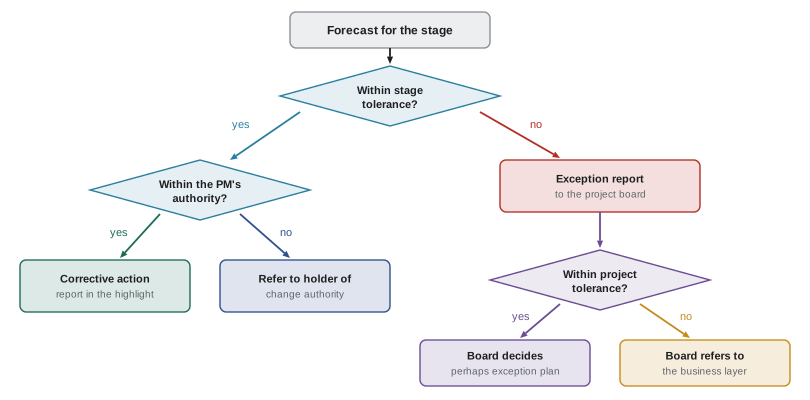
Manage by exception
Authority is delegated through tolerances: the business layer sets project tolerances, the board sets stage tolerances, the project manager sets work package tolerances. Each level escalates only when a breach is forecast. In scenarios, this principle explains why a project manager should not ask the board about small decisions within tolerance and authority, and why the board should not micromanage. It also explains why an exception report is needed when a forecast breach appears, even if the project manager is confident of recovering later.
Focus on products
Projects deliver products, so PRINCE2 defines what is to be delivered, and its quality criteria, before deciding how. In scenarios, look for product descriptions with measurable quality criteria, a project product description agreed with users, and acceptance based on those criteria. The principle catches plans that list only activities, quality criteria that cannot be measured ('easy to use') and disputes that arise because acceptance criteria were never agreed. In agile scenarios, well-written user stories with acceptance criteria satisfy the principle.
Tailor to suit the context
This principle is the subject of the first half of this course. In scenarios, it shows up in two directions. Sometimes a scenario describes a project applying the full method to a small or simple piece of work, and the right answer is to tailor down. Sometimes it describes tailoring that removed something essential, and the right answer is that the tailoring breaks another principle. The test from lesson 1, whether the purpose is still met, settles most of these questions.
evidence = [   # (statement from a scenario, principle it relates to, supports=True / breaches=False)
    ("business case updated after the shared-card announcement", "justification", True),
    ("plan uses crew rates from the previous project's lessons", "learning", True),
    ("vendor's account director approves the vendor's own variation", "roles", False),
    ("team starts stage 3 design before board authorization", "stages", False),
    ("PM handles a 2k overspend within tolerance and reports it", "exception", True),
    ("acceptance criterion for sign-up: 'should be fast'", "products", False),
    ("PID records sprint-based highlight reports", "tailoring", True),
]
from collections import defaultdict
tally = defaultdict(lambda: [0, 0])
for text, p, ok in evidence:
    tally[p][0 if ok else 1] += 1
for p, (good, bad) in tally.items():
    flag = "  <- check" if bad else ""
print(f"{p:<13} supports {good} breaches {bad}{flag}")justification supports 1 breaches 0 learning supports 1 breaches 0 roles supports 0 breaches 1 <- check stages supports 0 breaches 1 <- check exception supports 1 breaches 0 products supports 0 breaches 1 <- check tailoring supports 1 breaches 0
Three statements breach principles: a supplier approving its own variation (roles), work starting before authorization (stages) and an unmeasurable quality criterion (products). In an exam, any option proposing one of these would be a strong candidate for elimination, and any option that fixes one would be a strong candidate for the right answer.
Public-sector scenarios in the United States often add council or board approval steps and local procurement codes. These do not change the principles; they change who the business layer is and how authority is delegated, which affects how manage by exception and defined roles are applied.
Worked problem
Which principle is at stake?
The lead service line project's pilot found that 30 % of suspected lead lines are actually copper, so the true number of lead lines is about 1,700, not 2,400. The project manager proposes to keep the original budget and use the savings to replace water mains on the same streets, 'since the money is already approved'. Which principles are involved, and what should happen?
Show solution
- Continued business justification: the business case was built on 2,400 replacements and must be updated with the new count and costs.
- Focus on products: replacing water mains is a different product, outside the project product description.
- Manage by exception and roles: the PM cannot change the project's scope; a change to the project product needs board approval, and possibly the business layer's.
- Manage by stages: the pilot boundary is the right moment to present the updated business case and plan.
- The water mains idea may be good, but it should be raised as a separate proposal or a formal change, not absorbed quietly.
Answer: Update the business case and plans for about 1,700 replacements and present them at the pilot boundary. Treat the water mains idea as a request for change or a separate project decided by the board or business layer.
Principles in tension
Sometimes two principles seem to pull in different directions, and Practitioner questions like to exploit that. Tailoring to suit the context might suggest fewer stages on a short project, while manage by stages requires at least two. Manage by exception suggests the project manager should handle problems without bothering the board, while continued business justification may require the board's view when benefits shift, even if no tolerance is breached. The resolution is that each principle sets a floor that the others cannot lower. Tailoring can shorten stages but not remove the boundary between initiation and delivery. Manage by exception keeps the board out of routine decisions, but a material change to the business case is not routine and goes to the board through the business case and the boundary process.
| Apparent tension | Resolution |
|---|---|
| Tailor down versus manage by stages | Stages can be fewer and shorter, but there are always at least two |
| Manage by exception versus continued business justification | Routine decisions stay with the PM; material changes to justification go to the board |
| Focus on products versus agile flexibility | Products are defined through user stories and acceptance criteria; scope varies within priorities |
| Defined roles versus small teams | Roles can be combined, but the executive and project manager stay separate |
| Learn from experience versus time pressure | Lessons are captured briefly, in the daily log or team board, and reviewed at boundaries |
In an exam, an option that resolves a tension by abandoning a principle is wrong, however attractive the time saving. The right option usually keeps both principles by changing the form or frequency of something: a shorter boundary review, a lighter business case update or a combined role that still preserves separation where it matters.
A practical way to rehearse this is to take each option in a question and ask which principle it would weaken. If an option weakens none and solves the problem, it is very likely the answer. If every option seems to weaken something, look again at the scenario's stated tailoring and authorities: one option is usually allowed by the specific arrangements the scenario describes.
Common mistakes
MistakeJustifying continuation by the money already spent.
InsteadJudge justification on future costs, benefits and risks.
MistakeThinking learn from experience only applies at closure.
InsteadSeek and apply lessons at the start and throughout.
MistakeLetting a supplier representative approve that supplier's commercial changes.
InsteadKeep customer-only decisions with the customer side of the board.
MistakeStarting next-stage work before authorization to save time.
InsteadWait for the board's authorization, or ask for it early.
MistakeAccepting quality criteria that cannot be measured.
InsteadWrite criteria that can be tested, such as response times or completion rates.
Summary and key terms
- The seven principles are always applied and are the best tool for eliminating distractors.
- Continued business justification means judging the future, not the money already spent.
- Learning from experience applies from the start of a project to its end.
- Defined roles require business, user and supplier representation and a single executive.
- Manage by stages and manage by exception together define when and at what level decisions are made.
- Focus on products requires measurable quality criteria; tailoring must keep every other principle intact.
- Sunk cost
- Money already spent, which should not determine whether to continue.
- Desirable, viable, achievable
- The three tests of business justification: worth doing, affordable and deliverable.
- Customer-only decision
- A decision, such as on a supplier's claim, that the customer takes without the supplier.
- Measurable quality criterion
- A quality criterion that can be objectively checked.
- Escalation
- Passing a forecast breach of tolerance to the next level of management.
- Principle-based elimination
- Removing exam options that would break a principle.
Practice problems
Work each problem on paper first, then reveal the answer to check.
Which principle is broken by continuing because most of the budget is spent?
Show answer
Ensure continued business justification.
What should happen when a free shared digital card is announced?
Show answer
Update the business case and let the board decide whether to continue, change scope or close.
Which principle is at stake when a project repeats a recorded mistake?
Show answer
Learn from experience.
Can the senior user carry out user assurance personally?
Show answer
Yes, or appoint someone to do it, but not the project manager.
Name a typical breach of manage by stages.
Show answer
Starting next-stage work before the board authorizes the stage.
Which two checks decide who acts on a problem?
Show answer
Tolerance and authority.
Why is 'should be fast' a weak quality criterion?
Show answer
It cannot be measured objectively.
What did the lead line pilot find?
Show answer
About 30 % of suspected lead lines were copper, so about 1,700 remain.
Why can the PM not redirect savings to water mains?
Show answer
It changes the project product and scope, which needs board approval.
Which principle is tested when tailoring removes a purpose?
Show answer
Tailor to suit the context, together with whichever principle the removed element served.
Lesson quiz · 5 questions
Score 60% or more to complete this lesson.
Create a free account to save your progress, take quizzes and earn a certificate.