
PRIN-150 · Lesson 3 of 12 · 25 min
Tailoring for small and simple projects
Small projects are where PRINCE2 has its worst reputation. People who have seen the full method applied to a three-month job, with a 40-page initiation document and weekly reports nobody reads, conclude that PRINCE2 is only for large projects. The manual says the opposite: the method is meant to scale down, and a small project run well with PRINCE2 can have its whole management framework on a few pages. This lesson shows how, using Harbor City Libraries' makerspace refit.
The makerspace refit
Harbor City's central branch has a room that used to hold microfilm readers. The library board has approved 85 thousand to turn it into a makerspace with a laser cutter, three 3D printers, two sewing machines, a vinyl cutter and workbenches, ready for a launch in ten weeks. The work involves electrical upgrades and ventilation by the city's facilities department, equipment purchase through the library's normal procurement, furniture, safety signage, staff training and booking rules. The head of branch services, Alicia Fernandes, sponsors the project. Dev Sharma, a branch manager who ran the kiosk pilot in the previous project, will manage it.
On the tailoring factors, the project is small in money and time, has one main supplier (the city's own facilities team, under an internal agreement), uses an experienced project manager and is mostly predictive: the room is designed, built, equipped and opened. Two factors stand out, though. The laser cutter and 3D printers bring real safety risks, from fire and fumes to burns, and the space is used by the public, including children, so accessibility and safeguarding matter. A small project can still have important risks, and good tailoring follows the risk, not just the budget.
Combining processes
On a small project, starting up a project and initiating a project are often combined into one short piece of work. Both purposes are still met: before committing to the work, the board confirms that the project is worthwhile and viable (the purpose of starting up), and the project manager establishes a solid foundation, with plans, approaches and controls agreed (the purpose of initiation). Combining them saves a board meeting and a document, not the thinking.
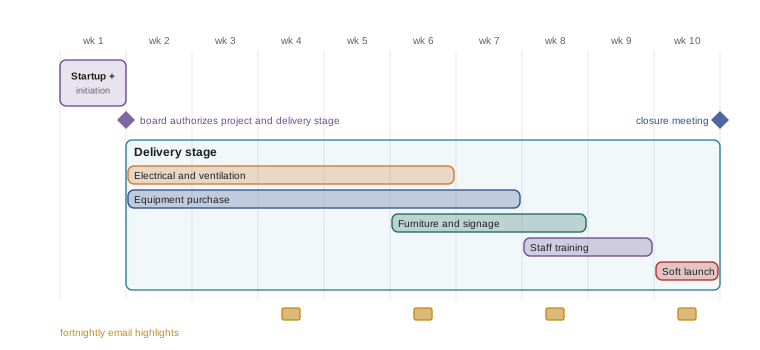
Dev runs a single week of startup and initiation. He interviews Alicia and the facilities manager, reviews the kiosk project's lessons, drafts a combined brief and initiation document and holds one board meeting at the end of the week, where Alicia authorizes both the project and the delivery stage. That one week counts as the initiation stage, so the project still has two management stages: initiation and a nine-week delivery stage. Directing a project continues throughout, but mostly by email and a short fortnightly call.
Combining roles
Role combination is the most powerful tailoring tool on a small project. The rules are few: there must be a single executive; the project manager should not also hold the executive or senior user role, because that removes the separation between directing and managing; and project assurance should not be held by the project manager, because assurance exists partly to check the project manager's work. Within those limits, almost any combination is possible.
| Role | Makerspace refit | Why this works |
|---|---|---|
| Executive | Alicia Fernandes, head of branch services | Owns the budget and the business case |
| Senior user | Alicia Fernandes (combined with executive) | She speaks for the branches and patrons; a user panel advises her |
| Senior supplier | Facilities manager, Kwame Osei | Provides the electrical, ventilation and fit-out resources |
| Project manager | Dev Sharma | Separate from the board roles |
| Team managers | Facilities supervisor for the fit-out; Dev himself for equipment, training and launch | Dev combines project manager and team manager for the simple work packages |
| Project assurance | City safety officer for safety; library finance analyst for cost | Independent of Dev, targeted at the two biggest concerns |
| Project support | Dev, with help from a library assistant | No separate support role needed |
| Change authority | Dev for changes up to 2 thousand; Alicia above that | Keeps small decisions fast |
The project assurance arrangement is a good example of tailoring that follows risk rather than size. A small project would normally rely on the executive for assurance, but Alicia has neither the safety expertise nor the time to check ventilation calculations. She asks the city safety officer to provide assurance on safety, a few hours of reviewing the design and inspecting before launch, and the finance analyst to check spending once a fortnight.
Combining and shortening management products
The makerspace has a short list of management products, most of them merged or shortened. What matters is that someone joining the project could find the business case, the plan, the risks, the issues and the controls within a few minutes.
| Full-method product(s) | Makerspace version | Format |
|---|---|---|
| Project brief and project initiation documentation | One 'project on a page' document plus appendices | Six pages |
| Business case | One page: reasons, options, costs, benefits, key risks | Section of the PID |
| Project plan and stage plan | One plan, since the delivery stage is the project | Gantt chart in the PID |
| Risk, issue and quality registers, lessons and daily log | One workbook with five tabs | Shared spreadsheet |
| Product descriptions | Acceptance checklist for the room, the equipment and the booking rules | One page each |
| Highlight reports | Fortnightly email with five headings | Half a page |
| End stage report and end project report | One end project report, since there is one delivery stage | Two pages |
budget, tolerance = 85.0, 0.05     # thousands; +5 % cost tolerance
plan = [4, 6, 10, 18, 30, 44, 58, 70, 80, 85]          # cumulative plan by week
actual = [4, 6, 11, 20, 33, 48]                         # cumulative actual to week 6
forecast_rest = [plan[i] - plan[5] for i in range(6, 10)]
eac = actual[-1] + forecast_rest[-1] * 1.08             # remaining work 8 % dearer
limit = budget * (1 + tolerance)
print(f"spent to week 6: {actual[-1]:.0f}k vs plan {plan[5]}k")
print(f"estimate at completion: {eac:.1f}k; limit {limit:.2f}k")
print("action:", "raise exception to executive" if eac > limit else "within tolerance; report in highlight")spent to week 6: 48k vs plan 44k estimate at completion: 92.3k; limit 89.25k action: raise exception to executive
At week 6 the refit has spent 48 thousand against a plan of 44, mostly because the ventilation duct needed a longer route. The forecast at completion is about 87.8 thousand, inside the 89.25 thousand limit set by the 5 % cost tolerance. Dev reports the position in his next email highlight and takes corrective action within his authority: he moves the vinyl cutter purchase to the library's equipment budget, as Alicia had already allowed for small items. No exception is needed, but the tolerance did its job: it told everyone in advance when Alicia would need to be involved.
Tailoring the practices to the risks
Most practices on the makerspace are light. Plans are one chart. Issues go to Dev by email and into the workbook. Progress is controlled by the cost and time tolerances and the fortnightly email. Two practices are deliberately heavier than the project's size would suggest. The risk practice includes a proper safety risk assessment for each machine, done with the safety officer, because a fire or injury would close the space and harm patrons. The quality practice includes a formal acceptance inspection of the ventilation and electrical work before any equipment is switched on.
Because the makerspace is a public space, the quality criteria include accessibility: the ADA Standards for Accessible Design set expectations for routes, workbench heights, reach ranges and controls in public facilities. The library's own child safety policy adds rules for youth sessions.
Closing a small project
Closure on a small project is often one meeting and one short report, but the purposes of closing a project still have to be met: confirm acceptance of the products, hand them over to the people who will run them, review the project's performance, record follow-on actions and lessons, and plan any post-project benefits review. The makerspace's end project report notes the cost (87.1 thousand against 85), the launch in week 10, two follow-on actions (a second extraction fan if laser use grows, and weekend staffing) and a benefits review at six months to count bookings and youth sessions.
Worked problem
Too light, or just right?
A colleague reviews the makerspace's tailoring and says: 'Two stages, one assurance person per risk, merged products and email reports. That is fine. But why does a 10-week project have a full machine-by-machine safety assessment and a formal electrical acceptance? Surely that is over-engineering for 85 thousand.' How should Dev respond?
Show solution
- Tailoring follows the context, including risk and importance, not budget alone.
- The laser cutter and printers create fire, fume and injury risks for members of the public.
- A serious incident would cause harm far larger than the project's cost and would close the space.
- Heavier risk and quality practices for these specific products are tailoring up where the context needs it.
- The rest of the method stays light, so the overall overhead is still small.
Answer: The safety assessment and electrical acceptance are proportionate to the risk, not the budget. Tailoring is uneven by design: light where risk is low, heavier where harm is possible.
When a small project grows
Small projects do not always stay small. Halfway through the makerspace refit, the city offered Harbor City a grant of 60 thousand for a second makerspace at a suburban branch, provided both opened in the same quarter. Accepting the grant would have almost doubled the project's cost, added a second site and a second facilities crew, and brought a grant agreement with its own reporting. Dev did not simply bolt the second site onto the existing plan. He raised an issue, described the effect on cost, time, risk and benefits, and asked Alicia whether the change should be handled within this project or as a separate one.
Alicia took the question to the library's leadership team, acting as the business layer, because the grant changed the project's scope beyond the tolerances they had set. They decided to treat the second site as a separate small project, run by another branch manager, using Dev's PID as a starting point. The decision kept the makerspace refit's tailoring intact and avoided stretching a light framework over a larger, more complex job.
| Sign the tailoring no longer fits | Typical response |
|---|---|
| Budget or duration grows well beyond the original tier | Review tailoring at the next boundary, or sooner if tolerances are threatened |
| A second supplier or site is added | Strengthen coordination, work packages and reporting |
| New regulation or a grant agreement applies | Add the required reporting and assurance |
| Stakeholders multiply | Expand the communication management approach |
The lesson for small projects is that light tailoring is a decision for a known context. When the context changes, the tailoring must be reviewed, and sometimes the right answer is a new project rather than a heavier version of the old one.
Common mistakes
MistakeRunning a small project with only one stage to save time.
InsteadKeep at least two stages: initiation, even if short, and delivery.
MistakeMaking the project manager also the executive on a small project.
InsteadKeep the executive and project manager separate; combine other roles instead.
MistakeScaling every practice down in proportion to the budget.
InsteadScale each practice to its own risk; some may need more depth.
MistakeSkipping tolerances because the project is short.
InsteadSet simple tolerances so everyone knows when the executive must be involved.
MistakeClosing a small project by simply stopping work.
InsteadConfirm acceptance, hand over, record follow-on actions and plan benefits review, even briefly.
Summary and key terms
- PRINCE2 is designed to scale down; small projects can have a few pages of management products.
- Starting up and initiating can be combined, provided both purposes are met and there are still two stages.
- Roles can be combined freely, except that the executive is one person, separate from the project manager, and assurance is independent of the project manager.
- Management products can be merged into a short PID, one workbook and brief email reports.
- Practices are scaled to risk, not budget: safety and acceptance may need depth on a small project.
- Closure can be short, but its purposes must still be met.
- Combined startup and initiation
- Running starting up a project and initiating a project together on a simple project, while meeting both purposes.
- Project on a page
- A very short project initiation document for a small project.
- Role combination
- One person holding more than one project management team role.
- Targeted assurance
- Project assurance focused on the project's biggest risks, sometimes by specialists.
- Acceptance checklist
- A short product description listing the criteria a product must meet.
- Proportionate control
- Controls sized to the risks and importance of the work, not just its budget.
Practice problems
Work each problem on paper first, then reveal the answer to check.
How many management stages does the makerspace refit have?
Show answer
Two: a one-week initiation and a nine-week delivery stage.
Which two processes are combined at the start?
Show answer
Starting up a project and initiating a project.
Who is both executive and senior user?
Show answer
Alicia Fernandes, head of branch services.
Why is the city safety officer involved?
Show answer
To provide project assurance on safety, the project's biggest risk.
Why should Dev not also be executive?
Show answer
It would remove the separation between directing and managing the project.
What is the cost tolerance limit?
Show answer
89.25 thousand, which is 85 thousand plus 5 %.
What did Dev do when spending ran ahead at week 6?
Show answer
Reported it and took corrective action within his authority by moving the vinyl cutter to the equipment budget.
Which two practices are heavier than the budget suggests?
Show answer
Risk (safety assessments) and quality (formal electrical and ventilation acceptance).
How are the logs and registers held?
Show answer
In one shared workbook with five tabs.
When is the benefits review planned?
Show answer
Six months after launch.
Lesson quiz · 5 questions
Score 60% or more to complete this lesson.
Create a free account to save your progress, take quizzes and earn a certificate.