
PRIN-120 · Lesson 6 of 12 · 28 min
Leading successful teams
Projects are delivered by temporary teams. People come together from different departments and organizations, often part time, often with other priorities, and are expected to perform quickly. PRINCE2 7 recognizes that leading such teams is different from managing a permanent department. Project managers and team managers usually have limited formal authority over team members, whose line managers remain elsewhere. They must lead through clarity, collaboration and trust. This lesson looks at how the PRINCE2 structures of plans, work packages, team structures and reporting support team leadership. Leadership styles, motivation theory, coaching and conflict are covered in depth in PMP-120; here we apply them through a PRINCE2 lens.
What is different about project teams
A permanent team has a shared history, stable membership and a clear hierarchy. A project team has none of these at the start. Members may never have worked together, may belong to different organizations with different cultures and may be allocated for only part of their time. The team will disband when the project ends, so long-term career incentives often sit outside it. These features make it harder to build commitment, but they also create opportunities: people who choose to join a project may be motivated by the work itself, by learning and by the chance to make a visible difference.
| Feature | Permanent team | Project team | Leadership implication |
|---|---|---|---|
| Duration | Ongoing | Temporary | Build relationships fast; plan for knowledge transfer before disbanding |
| Authority | Clear line management | Matrix: line manager elsewhere | Lead through influence, clarity and agreement |
| Membership | Stable | Changes by stage | Onboard newcomers deliberately |
| Allocation | Usually full time | Often part time | Agree time commitments with line managers |
| Culture | Shared | Mixed across organizations | Agree explicit ways of working |
| Incentives | Career and appraisal within the team | Often outside the team | Recognize contributions and feed back to line managers |
Leading without formal authority
In most projects the project manager does not write team members' performance reviews, set their pay or decide their careers. Team managers from supplier organizations answer to their own company. Even within one organization, specialists often report to functional managers. This means that leadership must rely on other sources of influence: expertise, clarity of purpose, fairness, the quality of relationships and the ability to remove obstacles. PRINCE2's structures help, because they make expectations explicit and agreed rather than imposed.
A work package is a good example. It is not an order handed down; it is an agreement between the project manager and a team manager about what will be produced, to what quality, within what tolerances, by when and how progress will be reported. The team manager can negotiate it before accepting it. That negotiation is itself an act of leadership: it respects the team manager's expertise, surfaces risks early and builds commitment to a plan the team helped shape.
Worked problem
Negotiating a work package estimate
A project manager proposes a work package to build a reporting module in 20 working days with a time tolerance of +2 days. The team manager estimates 18 days optimistic, 24 days most likely and 36 days pessimistic. Using a three-point weighted average (optimistic + 4 × most likely + pessimistic) ÷ 6, what is the expected duration, and what should they agree?
Show solution
- Weighted estimate: (18 + 4 × 24 + 36) ÷ 6 = (18 + 96 + 36) ÷ 6 = 150 ÷ 6 = 25 days.
- Proposed plan of 20 days plus 2 days tolerance gives a limit of 22 days, below the expected 25.
- A plan likely to breach tolerance from the start undermines management by exception and team morale.
- Options: reduce scope, add a person, extend the date to about 25 days with tolerance of +3 days, or accept risk explicitly with the board.
Answer: The expected duration is 25 days. Agreeing to 20 days would set the team up to fail. A negotiated work package of about 25 days with a sensible tolerance, or a reduced scope that fits 20 days, gives a plan the team can commit to.
The trust and delegation relationship
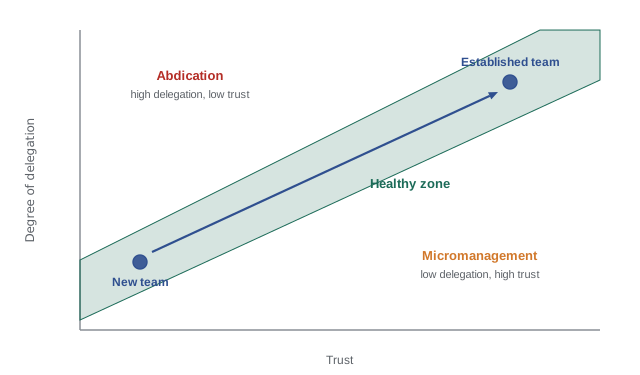
Lesson 1 introduced the link between trust and delegation. Within the team, the same relationship applies. A project manager who trusts a team manager can set wider work package tolerances and lighter reporting. A new or struggling team may need tighter tolerances and more frequent checkpoints at first. The aim is to widen delegation as trust grows, because over-control wastes senior time and demotivates capable people.
Psychological safety
Psychological safety is the shared belief that it is safe to speak up, ask questions, admit mistakes and raise concerns without being embarrassed or punished. Research on teams in many industries has found it to be one of the strongest predictors of team learning and performance. In PRINCE2 terms, psychological safety is what makes the controls work. Team members report forecast breaches early, raise risks honestly, contribute to lessons and challenge poor plans. Without it, checkpoint reports become exercises in looking good.
Leaders build psychological safety through everyday behavior: thanking people for raising problems, admitting their own mistakes, asking for input before giving their own view, responding to bad news calmly and focusing on fixing problems rather than allocating blame. They lose it quickly through public criticism, defensiveness or punishing the messenger.
Worked problem
Reading a psychological safety pulse survey
A team of ten answers three statements from 1 (strongly disagree) to 7 (strongly agree). Averages: 'If I make a mistake, it is not held against me' 4.1; 'I can raise problems and tough issues' 5.8; 'I can ask colleagues for help' 6.2. Last stage the first statement averaged 5.5. What might explain the drop and what should the team manager do?
Show solution
- Two statements are healthy at 5.8 and 6.2.
- The mistakes statement dropped by 1.4 points, a large change for a small team.
- A likely cause is a recent event where a mistake was handled badly, such as public blame in a review.
- The team manager should explore the cause in a retrospective, model a blame-free response and agree how mistakes will be discussed in future.
Answer: The drop signals that people now fear consequences for mistakes. Left unaddressed, it will reduce honest reporting, so the team manager should act before the next stage.
Ways of working
Because project teams combine people from different backgrounds, it helps to agree ways of working explicitly at the start of each stage or when new members join. Ways of working cover how the team will communicate, make decisions, handle disagreement, use tools, hold meetings, share information and support each other. In agile teams this is often called a team charter or working agreement; PMP-120 covers team charters in detail. In PRINCE2 the agreements can be recorded in the project initiation documentation, the team plan or a short appendix to the work package.
| Area | Example agreement |
|---|---|
| Communication | Urgent issues by phone; routine updates in the team channel; email for decisions |
| Meetings | Daily 15-minute stand-up at 9:30; weekly checkpoint review on Thursdays |
| Decisions | Team manager decides within work package tolerance after hearing the team |
| Disagreement | Raise it directly first; escalate to the team manager within two days if unresolved |
| Quality | No product goes to review without a peer check against its quality criteria |
| Wellbeing | No messages expected after 6 p.m. or at weekends except for agreed on-call duty |
Part-time allocation and focus
Many project team members are allocated for a percentage of their time. Allocations look tidy in a resource plan but are hard to protect in practice. Switching between several projects and operational duties carries a cost: time lost reorienting, meetings multiplied and attention divided. Leaders should treat allocations as agreements with line managers, monitor them and raise concerns early when actual availability falls short.
Worked problem
Converting allocations into real capacity
A team has four people allocated at 100 %, 60 %, 50 % and 40 %. Experience on this project shows that each additional concurrent assignment beyond the first reduces a person's effective productivity on each of their assignments by about 10 %. The 100 % person has only this project; the others each have two other assignments. Estimate effective capacity in full-time equivalents.
Show solution
- Person 1: 1.00 with no switching penalty = 1.00 FTE.
- Persons 2 to 4 each have three assignments, so two extra assignments reduce productivity by 20 %.
- Person 2: 0.60 × 0.80 = 0.48. Person 3: 0.50 × 0.80 = 0.40. Person 4: 0.40 × 0.80 = 0.32.
- Nominal capacity: 1.00 + 0.60 + 0.50 + 0.40 = 2.50 FTE.
- Effective capacity: 1.00 + 0.48 + 0.40 + 0.32 = 2.20 FTE, about 12 % less than nominal.
Answer: The team has roughly 2.2 effective FTE rather than 2.5. Plans built on nominal allocations will slip; the project manager should plan on effective capacity or negotiate fewer concurrent assignments.
Teams across organizations and cultures
When teams include people from several organizations, sectors or countries, differences in culture can affect how people communicate, make decisions, treat deadlines and express disagreement. In some cultures direct disagreement with a manager is normal; in others it is avoided. Some organizations expect decisions to be made by consensus; others expect a leader to decide. None of these is wrong, but mismatched expectations cause misunderstanding. The remedy is to discuss differences openly, agree explicit ways of working and check understanding rather than assuming silence means agreement.
Distributed and hybrid teams add another layer. PMP-120 covers time zones and virtual tools in detail. From a PRINCE2 perspective, the key points are that checkpoint and highlight reporting can carry more of the coordination load, that ways of working must be written down rather than absorbed informally, and that deliberate social contact helps build the trust on which delegation depends.
Team performance and PRINCE2 reporting
PRINCE2's reporting structure gives leaders regular evidence about team performance. Checkpoint reports from team managers show progress against work packages, products completed, quality results and issues. Over several reporting periods, patterns emerge. A team that consistently completes work packages within tolerance and passes quality reviews first time is healthy. A team whose estimates repeatedly slip, whose products fail reviews or whose issues pile up may have a capability, capacity or morale problem worth exploring.
| Indicator | Source | What a worrying trend may suggest |
|---|---|---|
| Work packages completed within tolerance | Checkpoint reports, project manager's records | Optimistic estimates or capacity problems |
| First-time pass rate in quality reviews | Quality register | Unclear quality criteria or skills gaps |
| Open issues per work package | Issue register | Unclear scope or poor coordination |
| Unplanned absence | Team manager | Overload or low morale |
| Lessons contributed | Lessons log | Low psychological safety if near zero |
Indicators should prompt conversations, not judgments. A low first-time pass rate might reflect a new team member, ambiguous quality criteria written by someone else or a genuine performance problem. The leader's job is to find out which.
Common mistakes
MistakeIssuing work packages as orders without negotiation.
InsteadAgree work packages with team managers so estimates and risks are shared.
MistakeDelegating widely to a new team before trust is established.
InsteadStart with tighter tolerances and widen them as trust grows.
MistakeReacting to mistakes with public blame.
InsteadBuild psychological safety by focusing on fixing problems and learning.
MistakePlanning on nominal part-time allocations.
InsteadPlan on effective capacity and protect allocations with line managers.
MistakeAssuming silence in a mixed team means agreement.
InsteadAgree explicit ways of working and check understanding.
Summary and key terms
- Project teams are temporary, mixed and often part time, so leadership must adapt.
- Leaders usually rely on influence rather than formal authority.
- Work packages are negotiated agreements, not orders.
- Delegation should grow as trust grows.
- Psychological safety makes PRINCE2's reporting and learning controls work.
- Explicit ways of working reduce friction across organizations and cultures.
- Checkpoint reports and registers provide evidence of team health.
- Matrix structure
- An arrangement where team members report to both a project and a functional manager.
- Work package
- An agreed set of information about products to be delivered by a team manager.
- Psychological safety
- A shared belief that it is safe to speak up and admit mistakes.
- Ways of working
- Explicit agreements on how a team communicates, decides and collaborates.
- Allocation
- The share of a person's time committed to the project.
- Effective capacity
- Productive time available after accounting for switching and other losses.
- Checkpoint report
- A regular progress report from a team manager to the project manager.
- First-time pass rate
- The share of products that pass quality review without rework.
- Three-point estimate
- An estimate combining optimistic, most likely and pessimistic values.
- Abdication
- Delegating authority without the trust or oversight needed to support it.
Practice problems
Work each problem on paper first, then reveal the answer to check.
Optimistic 10, most likely 14, pessimistic 24 days. Weighted estimate?
Show answer
(10 + 56 + 24) ÷ 6 = 15 days.
Is a work package an order or an agreement?
Show answer
An agreement between the project manager and a team manager.
What should happen to delegation as trust grows?
Show answer
It can widen, with looser tolerances and lighter reporting.
Give one behavior that builds psychological safety.
Show answer
Thanking people for raising problems.
Allocations 0.5 and 0.5 with a 20 % switching penalty each. Effective FTE?
Show answer
0.4 + 0.4 = 0.8.
Where can team ways of working be recorded in PRINCE2?
Show answer
In the initiation documentation, team plan or work package.
Which register shows first-time pass rates?
Show answer
The quality register.
What does a near-empty lessons log on a long project suggest?
Show answer
Possibly low psychological safety.
Which course covers leadership styles and conflict in depth?
Show answer
PMP-120.
Why do distributed teams need written ways of working?
Show answer
They cannot absorb norms informally as co-located teams do.
Lesson quiz · 5 questions
Score 60% or more to complete this lesson.
Create a free account to save your progress, take quizzes and earn a certificate.