
PRIN-120 · Lesson 5 of 12 · 29 min
Leading successful change
A project creates outputs; change happens when people start working differently because of them. PRINCE2 7 treats leading successful change as a core part of the people element. It recognizes that the project manager is rarely responsible for the whole organizational change, which usually belongs to the business, but that the project must be designed so that change can happen. That means understanding who will be affected, planning the products that help them change, working with the people who lead change in the business and handing over in a way that supports adoption. This lesson explains how to do that with a PRINCE2 lens. General change theory is covered more fully in BUS-130.
Project management and change management
Project management delivers products within agreed constraints. Change management helps people move from the current state, how they work today, to the target state, how they will work in future. The two overlap but are not the same. A project can be well managed and still fail to produce change if nobody prepares people for it. A change can be well led and still fail if the project delivers late or poorly. Successful initiatives integrate both: change activities are planned as products, scheduled alongside specialist products and reported through the same controls.
| Aspect | Project management | Change management |
|---|---|---|
| Focus | Products, time, cost, quality, scope, risk | People's awareness, ability and willingness to work differently |
| Ends | When products are handed over and the project closes | When the new ways of working are embedded |
| Main leaders | Project manager and team managers | Business leaders, senior users, business change managers, line managers |
| Measures | Products accepted; performance against tolerances | Adoption, proficiency, outcomes and benefits |
| Typical products | Systems, buildings, procedures, documents | Training, communications, support arrangements, redesigned processes |
Current state, transition and target state
Change is often pictured as a journey through three states. The current state is familiar, even if imperfect. The target state is where the organization wants to be. Between them is a transition in which old ways have stopped working and new ways are not yet comfortable. Performance commonly dips during transition as people learn new tools and processes, make mistakes and lose confidence. The depth and length of the dip depend on how well the change is prepared and supported.
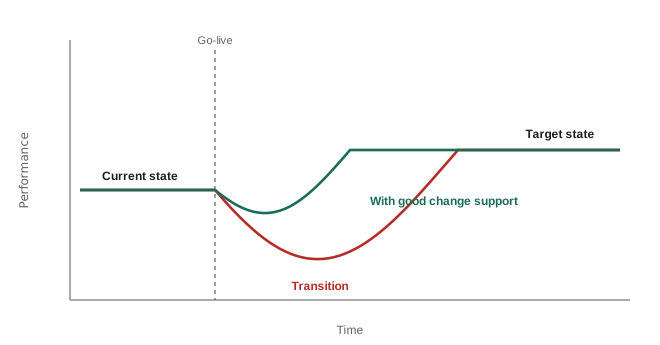
The change curve is a simplification, and some people adopt change quickly with little dip at all. It is still useful for planning, because it reminds the project and the business that benefits rarely start on the day of go-live. Business cases that assume full benefits from day one, with no transition cost, are usually optimistic.
Worked problem
Estimating the cost of a transition dip
A claims team of 30 staff processes 1,200 claims a week. After a new system goes live, productivity is expected to fall by 20 % in week 1, 15 % in week 2, 10 % in week 3 and 5 % in week 4, then recover fully. Each claim not processed must be cleared with overtime at a cost of 18 dollars per claim. Estimate the cost of the dip. How would it change if better training halved each percentage?
Show solution
- Lost claims: 1,200 × (0.20 + 0.15 + 0.10 + 0.05) = 1,200 × 0.50 = 600 claims.
- Cost: 600 × 18 = 10,800 dollars.
- With better training: 1,200 × (0.10 + 0.075 + 0.05 + 0.025) = 1,200 × 0.25 = 300 claims.
- Cost: 300 × 18 = 5,400 dollars, a saving of 5,400 dollars.
Answer: The transition dip costs about 10,800 dollars without extra support and about 5,400 dollars with it. If the extra training costs less than 5,400 dollars, it pays for itself before counting reduced stress and error rates.
Who leads change
PRINCE2 is clear that the business, not the project, owns the outcomes and benefits. The senior user is accountable on the board for making sure the products will meet user needs and that the expected benefits can be realized. In many organizations, particularly those running programs, a business change manager or change lead works within the business to prepare people and embed new ways of working. Line managers are often the most influential people of all, because staff look to their direct manager for signals about whether a change matters.
The project manager's role is to make sure the project supports these leaders. That means involving them in planning, including their change products in the project plan, giving them early sight of products so they can prepare their people, and agreeing clear handover arrangements. A project manager who tries to lead the business change single-handedly, without business leaders visibly owning it, will usually struggle, because staff take their cues from their own management.
| Person | Role in leading change |
|---|---|
| Executive | Explains why the change matters to the organization; secures resources |
| Senior user | Accountable for user needs and benefits; commits user resources to change activities |
| Business change manager | Plans and leads change within the business; prepares people and processes |
| Line managers | Translate change for their teams; model new behavior; address concerns |
| Change champions | Peers who try new ways early and help colleagues |
| Project manager | Integrates change products into plans; coordinates handover; reports readiness |
Change impact assessment
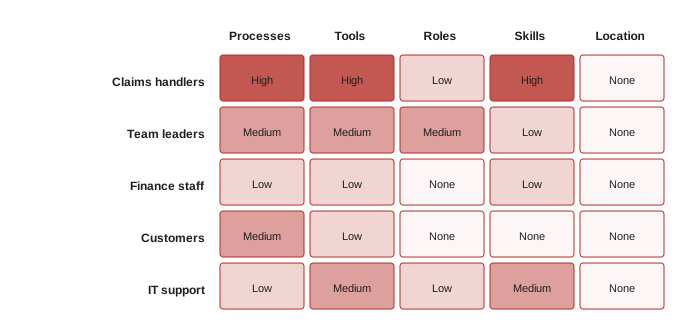
Before planning change activities, the project needs to understand who will be affected and how much. A change impact assessment lists the groups affected, what will change for each, how significant the change is and when it will happen. It draws on the user representatives and the business change manager, and it feeds the plans, the risk register and the communication management approach.
Worked problem
Scoring change impact
A project scores each affected group from 0 (no change) to 3 (major change) on five dimensions: processes, tools, roles, skills and location. Claims handlers score 3, 3, 1, 3, 0; team leaders 2, 2, 2, 1, 0; finance staff 1, 1, 0, 1, 0. There are 120 claims handlers, 12 team leaders and 15 finance staff. Which group needs the most change support, and how might effort be prioritized?
Show solution
- Claims handlers: 3 + 3 + 1 + 3 + 0 = 10 out of 15.
- Team leaders: 2 + 2 + 2 + 1 + 0 = 7.
- Finance staff: 1 + 1 + 0 + 1 + 0 = 3.
- Weighted by headcount: claims handlers 10 × 120 = 1,200; team leaders 7 × 12 = 84; finance 3 × 15 = 45.
Answer: Claims handlers face the greatest change and are the largest group, so most training and support effort belongs there. Team leaders are few but have a high score and also lead the handlers, so they should be prepared first, ahead of their teams.
Readiness and resistance
Readiness is the degree to which people are prepared to adopt a change. It can be assessed through surveys, interviews and observation, and it changes over time. Common dimensions include understanding why the change is happening, believing it is worthwhile, having the skills and tools, having time to learn and feeling supported by managers.
Resistance is a normal response to change, not a sign that people are difficult. People resist for reasons: fear of losing status or competence, doubts that the change will work, poor past experiences, extra workload during transition or simple lack of information. Treating resistance as information is more useful than treating it as opposition. If experienced staff say the new process will not work at month end, they may be right, and their insight could prevent a failure. In PRINCE2 terms, legitimate concerns about products should become issues or risks and be handled through the usual controls.
| Source of resistance | What people may say | Useful response |
|---|---|---|
| Lack of understanding | Nobody has explained why we are doing this | Clear, repeated explanation from leaders |
| Loss of competence | I was an expert in the old system; now I am a beginner | Training, practice time, peer support |
| Doubt about the solution | This will not cope with our busiest week | Treat as a possible issue; test and respond |
| Workload | We cannot learn this and hit our targets | Adjust targets temporarily; plan backfill |
| Past experience | The last three changes failed | Acknowledge history; show what is different; deliver early wins |
Change products in the plan
The most practical way to integrate change into a PRINCE2 project is to treat change activities as products. Training materials, a training schedule, support arrangements, communications, revised process documents, updated role descriptions and a readiness assessment can all be planned as products with product descriptions, quality criteria, owners and dates. They then appear in the product breakdown structure, are estimated, are given to teams as work packages and are tracked through checkpoint and highlight reports.
Worked problem
Planning training capacity
A project must train 120 claims handlers in a 4-hour course before go-live. Classrooms hold 12 people. Each trainer can run two sessions a day, and the operations manager can release no more than 24 handlers on any day. How many sessions and days are needed, and is one trainer enough if there are 10 working days available?
Show solution
- Sessions needed: 120 ÷ 12 = 10 sessions.
- Daily release limit: 24 handlers = 2 sessions a day.
- Days needed: 10 ÷ 2 = 5 days.
- One trainer can run 2 sessions a day, which matches the release limit, so one trainer can finish in 5 days.
- With 10 days available, there are 5 days of slack for absences and refresher sessions.
Answer: Ten sessions over five days with one trainer is feasible. Planning it as a product with dates and owners makes the dependency on operational release visible to the senior user, who must secure it.
Handover and benefits after closure
PRINCE2 projects close when their products are handed over, but change and benefits often continue long afterward. The closing process should confirm that users have accepted the products, that operations and support are ready to take ownership, that follow-on actions are recorded and that the benefits management approach describes how and when benefits will be measured after the project. The people side of handover includes making sure support staff are trained, that super-users and champions remain in place for a period, and that line managers know how to sustain the new ways of working.
A useful test before closure is to ask: if the project team disappeared tomorrow, would people keep working the new way? If the answer is no, more change support may be needed, or follow-on actions must be clearly owned by the business.
Measuring adoption after go-live
Adoption should be measured, not assumed. Useful measures include the share of transactions handled in the new way, the number of people using the new tool each week, help desk calls per user, error rates and user satisfaction. The benefits management approach should say which measures will be used, who will collect them and when. In the first weeks after go-live, the project and the business should review these measures frequently so that support can be targeted at teams or locations that are struggling. A single average can hide a team that has not adopted the change at all.
Common mistakes
MistakeAssuming that delivering products automatically produces change.
InsteadPlan change activities so that people adopt the products.
MistakeHaving the project manager lead business change alone.
InsteadMake sure business leaders, senior users and line managers visibly own the change.
MistakeTreating resistance as obstruction to be overcome.
InsteadTreat resistance as information and respond to its causes.
MistakeAssuming full benefits from the day of go-live.
InsteadAllow for a transition dip and plan to make it shallow and short.
MistakeLeaving training and communications out of the plan.
InsteadPlan change activities as products with owners and quality criteria.
Summary and key terms
- Project management delivers products; change management helps people work differently.
- Change moves from the current state through transition to the target state.
- Performance often dips during transition; good support reduces the dip.
- The business owns outcomes and benefits; the project manager coordinates change support.
- A change impact assessment shows who is affected, how much and when.
- Resistance has causes, and its causes point to the response.
- Change activities should be planned as products and reported through normal controls.
- Change management
- Helping people move from current ways of working to new ones.
- Current state
- How the organization works before the change.
- Target state
- How the organization intends to work after the change.
- Transition
- The period between current and target states, often with a performance dip.
- Business change manager
- A business role that prepares people and embeds new ways of working.
- Change impact assessment
- An analysis of which groups are affected by a change and how much.
- Readiness
- The degree to which people are prepared to adopt a change.
- Resistance
- Reluctance to adopt a change, usually arising from understandable causes.
- Change champion
- A peer who adopts early and helps colleagues through the change.
- Follow-on action
- A recommended action recorded at closure for the business to take forward.
Practice problems
Work each problem on paper first, then reveal the answer to check.
Who owns outcomes and benefits in PRINCE2?
Show answer
The business, represented by the executive and senior user.
Name the three states in a simple change journey.
Show answer
Current state, transition and target state.
Productivity falls 10 %, 5 % and 5 % over three weeks on 1,000 items a week. Items lost?
Show answer
1,000 × 0.20 = 200 items.
A group scores 2, 3, 1, 2, 1 on impact dimensions. Total?
Show answer
9.
90 people, 15 per session, 3 sessions a day. Days needed?
Show answer
6 sessions ÷ 3 = 2 days.
Why prepare team leaders before their teams?
Show answer
They lead and support their teams through the change.
How should a legitimate concern about a product be handled?
Show answer
As an issue or risk through normal PRINCE2 controls.
Give two examples of change products.
Show answer
Training materials and a communication plan, or revised process documents.
Who are often the most influential people in a change?
Show answer
Line managers.
What question tests readiness for closure?
Show answer
Would people keep working the new way if the project team disappeared?
Lesson quiz · 5 questions
Score 60% or more to complete this lesson.
Create a free account to save your progress, take quizzes and earn a certificate.