
PRIN-120 · Lesson 3 of 12 · 27 min
Customer, supplier and commercial relationships
PRINCE2 assumes a customer and supplier environment. Someone specifies what is needed and pays for it; someone else provides the skills and resources to deliver it. Sometimes customer and supplier are departments of the same organization. Sometimes they are separate companies bound by a contract. Often there are several suppliers, each with its own team, culture and commercial interests. This lesson looks at those relationships through a people lens: how the three interests of business, user and supplier are represented, how commercial arrangements shape behavior, and how a project manager builds working relationships across organizational boundaries.
Three interests on every project
PRINCE2 recognizes three primary interests that must be represented on every project. The business interest asks whether the project is a worthwhile investment. The user interest asks whether the products will meet the needs of the people who will use them and whether the benefits will be realized. The supplier interest asks whether the products can be built, to what quality, with what resources. On the project board these interests are held by the executive, the senior user or users, and the senior supplier or suppliers. Balancing them is one of the board's most important duties.
| Interest | Board role | Typical questions | People risks when neglected |
|---|---|---|---|
| Business | Executive | Is this still worth doing? Are costs and benefits balanced? | Projects drift without anyone owning value |
| User | Senior user | Will this work for us? Will we actually change how we work? | Products are built that nobody adopts |
| Supplier | Senior supplier | Can we build this? Do we have the people and skills? | Unrealistic commitments and burnt-out teams |
In people terms, each interest brings a different perspective and often a different personality. Executives tend to focus on money and strategy. Senior users tend to focus on practical impact and disruption. Senior suppliers tend to focus on feasibility and resources. A healthy board has productive tension between these views. A board where one interest dominates, for example a supplier-led board that never hears from users, is likely to make decisions that look sensible on paper and fail in practice.
Internal and external suppliers
When the supplier is internal, such as an in-house IT department, relationships are governed by organizational policy, internal budgets and line management. When the supplier is external, relationships are governed by a contract. Many projects have both. The difference matters because it changes what motivates people and what levers the project manager has.
| Aspect | Internal supplier | External supplier |
|---|---|---|
| Governing arrangement | Organizational policy, service agreements, budgets | Contract with defined scope, price and terms |
| Motivation | Shared organizational goals, career, recognition | Commercial success, reputation, future work |
| Escalation route | Line management within the organization | Contract management and dispute procedures |
| Information sharing | Usually open, subject to internal confidentiality | Limited by commercial confidentiality |
| Changing scope | Negotiated with line managers | Usually requires a contract change and price |
Two sets of management, one project
When a supplier is external, each organization has its own management system. The supplier will have its own project manager or delivery manager, its own reporting, its own risk register and its own commercial targets. PRINCE2 7 recognizes that the supplier's team manager may in fact run a substantial project inside the supplier organization, using whatever method that organization prefers. The customer's project manager does not manage the supplier's staff directly; they manage the relationship through work packages, the contract and the senior supplier on the board.
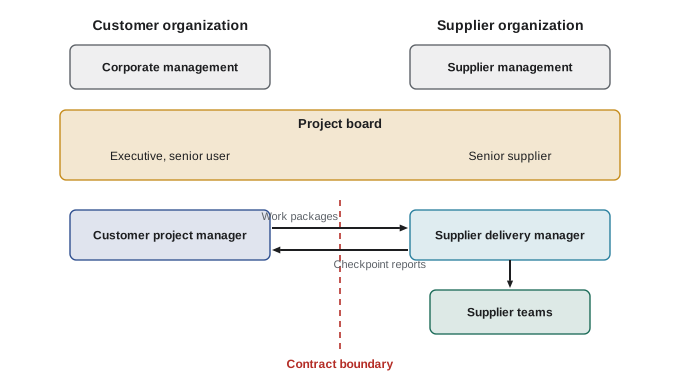
This arrangement creates a common people challenge. The customer project manager may feel responsible for outcomes they cannot directly control, while the supplier's delivery manager may feel caught between the customer's demands and their own company's commercial expectations. Agreeing explicit ways of working early, including how information will be shared, how risks will be jointly managed and how disagreements will be raised, reduces friction later.
How contracts shape behavior
The type of contract changes how people behave. Under a fixed-price contract, the supplier carries the cost risk and has a strong incentive to control scope tightly and to resist changes that are not paid for. Under a time-and-materials contract, the customer carries the cost risk and the supplier has less incentive to be efficient, though reputation and relationship still matter. Target-cost and alliance contracts share risk and reward in an attempt to align interests. None is right in every case, but the project manager must understand which one is in place because it shapes every conversation about change, quality and risk.
| Contract type | Who carries cost risk | Typical supplier behavior | What the project manager should watch |
|---|---|---|---|
| Fixed price | Mostly the supplier | Tight scope control; formal change requests | Hidden quality shortcuts; disputes over what is in scope |
| Time and materials | Mostly the customer | Flexible; responsive to change | Effort growth; weak incentive to finish |
| Target cost with pain and gain share | Shared | Collaborative cost management | Agreeing the target fairly; transparent cost reporting |
| Alliance or integrated delivery | Shared across all parties | Joint decisions; open books | Maintaining trust; clear decision rights |
Worked problem
Pain and gain share under a target-cost contract
A supplier agrees a target cost of 800,000 with a 50:50 share of any underrun or overrun, capped so the supplier's share of an overrun cannot exceed 60,000. Calculate the supplier's position if actual cost is 740,000, and again if it is 980,000.
Show solution
- Underrun case: 800,000 − 740,000 = 60,000 underrun. Supplier gains 50 %, or 30,000, on top of its cost.
- Customer pays 740,000 + 30,000 = 770,000, saving 30,000 against target.
- Overrun case: 980,000 − 800,000 = 180,000 overrun. Supplier's 50 % share would be 90,000, but the cap limits it to 60,000.
- Customer pays 980,000 − 60,000 = 920,000; the customer absorbs 120,000 of the overrun.
Answer: The share gives both parties a reason to control cost, but the cap means the customer still carries much of a large overrun. Both sides need honest, early cost forecasts for the arrangement to work, which is a people issue as much as a commercial one.
Procurement as part of the project context
Procurement rules shape who the suppliers are and how they were chosen, and therefore what relationship the project starts with. A supplier selected through a competitive tender may have bid aggressively and arrive under financial pressure. A supplier selected through a long-term framework may already know the customer's culture well. In the public sector, procurement rules also limit how freely the customer can change scope or extend a contract.
In the US federal government, most acquisitions follow the Federal Acquisition Regulation, with agency supplements, and contracting officers alone have authority to change contracts. States and cities have their own rules. For a PRINCE2 project manager, the practical point is that the contract, and any limits on changing it, are part of the context to be understood at initiation. You do not need to know the procurement rules for the exam.
PRINCE2 does not prescribe procurement procedures, but it does expect that the commercial context is reflected in how the project is organized. The senior supplier role may be held by several people from different suppliers. Work packages may need to mirror contract deliverables. Change control may need to align with contract change procedures. Quality reviews may need contractual acceptance criteria. All of this is tailoring driven by context.
Building relationships across boundaries
Contracts define obligations, but people deliver projects. A project manager who relies only on the contract will find that suppliers do exactly what is required and no more. One who builds genuine relationships will find suppliers raising risks early, suggesting improvements and helping solve problems that fall between contract clauses. Building those relationships takes deliberate effort.
- Hold a joint kickoff where both organizations share objectives, constraints and concerns openly.
- Agree joint ways of working: meeting rhythms, shared tools, how risks and issues will be raised and how decisions will be made.
- Share a single risk register for joint risks where commercial confidentiality allows.
- Recognize good supplier performance publicly, not just poor performance formally.
- Resolve disagreements early at the lowest possible level before they become contract disputes.
- Respect the supplier's need to make a fair profit; a supplier losing money will eventually behave defensively.
Worked problem
A relationship health check
A customer and supplier rate their relationship each month on five statements from 1 (strongly disagree) to 5 (strongly agree): risks are shared early; decisions are timely; information is open; disputes are resolved quickly; we trust each other's estimates. This month the customer scores 4, 3, 4, 3, 4 and the supplier scores 3, 2, 3, 2, 3. What do the scores suggest?
Show solution
- Customer average: (4 + 3 + 4 + 3 + 4) ÷ 5 = 3.6.
- Supplier average: (3 + 2 + 3 + 2 + 3) ÷ 5 = 2.6.
- Gap: one full point; the supplier feels the relationship is weaker than the customer does.
- The largest gaps are on timely decisions and dispute resolution, both scored 3 by the customer and 2 by the supplier.
Answer: The supplier experiences slow decisions and unresolved disputes more acutely. The project manager should discuss those two areas at the next joint meeting, perhaps agreeing decision turnaround times and an escalation ladder before relationships deteriorate further.
The senior supplier role in people terms
The senior supplier represents those who will design, develop, facilitate, procure or implement the products. On the board they are accountable for the quality of what suppliers deliver and for the technical integrity of the project. In people terms, the senior supplier is also the person who can commit supplier resources. When a supplier team is understaffed, the senior supplier is the one who can fix it. When there are several suppliers, each may have a representative on the board, and the board must make sure that collectively they work as a team rather than as competitors.
A common problem is a senior supplier from an external company who attends board meetings as a salesperson rather than as a board member. They defend their company's position rather than helping the board make good decisions. PRINCE2 expects board members to act in the interests of the project. Where a conflict of interest is unavoidable, it should be acknowledged openly, and assurance should be arranged so that the customer gets independent advice on supplier performance.
When relationships break down
Even with good intentions, customer and supplier relationships sometimes deteriorate. Early signs include communication moving from conversations to formal letters, disputes over every change request, missing information in checkpoint reports and key supplier people being moved off the project. Early action is far cheaper than contract disputes. Useful steps include a frank conversation between the executive and the senior supplier about what each side is experiencing, an independent facilitator for a joint review, re-agreeing ways of working and, where the contract allows, adjusting incentives so that both sides benefit from the same outcomes. The goal is to restore enough trust for the project to finish well, because a project that ends in litigation rarely delivers its benefits.
Common mistakes
MistakeLetting one interest dominate the board.
InsteadMake sure business, user and supplier interests are all represented and heard.
MistakeTrying to manage an external supplier's staff directly.
InsteadManage through work packages, the contract and the senior supplier.
MistakeIgnoring the incentives created by the contract type.
InsteadUnderstand who carries risk and how that shapes behavior.
MistakeRelying only on contract clauses for collaboration.
InsteadBuild working relationships with joint ways of working and shared risks.
MistakeExpecting a supplier to absorb unpaid changes indefinitely.
InsteadRespect the supplier's need for a fair commercial outcome.
Summary and key terms
- PRINCE2 assumes a customer and supplier environment with three interests: business, user and supplier.
- The executive, senior user and senior supplier represent those interests on the board.
- Internal and external suppliers create different motivations and escalation routes.
- With external suppliers, two management systems meet at the board and through work packages.
- Contract type shapes behavior: fixed price, time and materials, target cost and alliance.
- Procurement rules are part of the project context and limit flexibility.
- Deliberate relationship-building turns contractual compliance into real collaboration.
- Customer
- The party that specifies the need and pays for the products.
- Supplier
- The party that provides skills and resources to deliver the products.
- Senior supplier
- The board role representing those who design, build and implement the products.
- Senior user
- The board role representing those who will use the products and realize benefits.
- Fixed-price contract
- A contract where the supplier delivers agreed scope for an agreed price.
- Time and materials
- A contract where the customer pays for effort and materials used.
- Target cost
- A contract where overruns and underruns against a target are shared.
- Alliance
- A collaborative arrangement where parties share risk, reward and decisions.
- Ways of working
- Agreed practices for meetings, tools, decisions and escalation.
- Commercial confidentiality
- Limits on sharing information because of business interests.
Practice problems
Work each problem on paper first, then reveal the answer to check.
Name the three primary interests on a PRINCE2 project.
Show answer
Business, user and supplier.
Which board role represents the supplier interest?
Show answer
The senior supplier.
Under which contract type does the supplier mainly carry cost risk?
Show answer
Fixed price.
Target 500,000, actual 450,000, 50:50 share. What does the customer pay?
Show answer
450,000 + 25,000 = 475,000.
Target 500,000, actual 600,000, 50:50 share with supplier cap 30,000. What does the customer pay?
Show answer
600,000 − 30,000 = 570,000.
How does a customer project manager direct an external supplier's work?
Show answer
Through work packages, the contract and the senior supplier.
Give one way to build relationships with a supplier.
Show answer
A joint kickoff, shared risk register or agreed ways of working.
Are procurement rules tested in the Foundation exam?
Show answer
No; they are context for tailoring.
What should happen if a senior supplier has a conflict of interest?
Show answer
Acknowledge it and arrange independent assurance.
Why might a supplier chosen through aggressive tendering behave defensively?
Show answer
It may be under financial pressure from a low bid.
Lesson quiz · 5 questions
Score 60% or more to complete this lesson.
Create a free account to save your progress, take quizzes and earn a certificate.