
PRIN-120 · Lesson 2 of 12 · 27 min
The project context: organizations and management layers
Every project is commissioned by someone, for some purpose, inside some organization. Before a project manager can lead people, they need to understand who those people are, where they sit and what authority they hold. PRINCE2 describes this through the idea of a commissioning organization and four layers of management: business, directing, managing and delivering. This lesson explains those layers in people terms, shows how they connect to the organizational and project ecosystems introduced in lesson 1, and works through the kinds of context questions that appear in exam scenarios.
The commissioning organization
The commissioning organization is the organization that asks for the project and provides its mandate. It may be a single company, a government department, a charity, a joint venture or a group of organizations acting together. Within it, someone with sufficient authority decides that a project is needed and appoints an executive. That person or body sits in the business layer. They are not part of the project management team, but they set the boundaries within which the project operates: the strategic objectives it must support, the standards it must follow, the overall tolerances it is given and the governance it must report to.
In a large organization the business layer might be a portfolio board, an investment committee or a program management office. In a small business it might simply be the owner. In a public body it might include a deputy minister, a cabinet committee or an agency head. Whatever its form, the business layer is the level to which the project board escalates when a project-level tolerance is forecast to be exceeded. It is also the level that receives the project's benefits and that remains in place long after the project has closed.
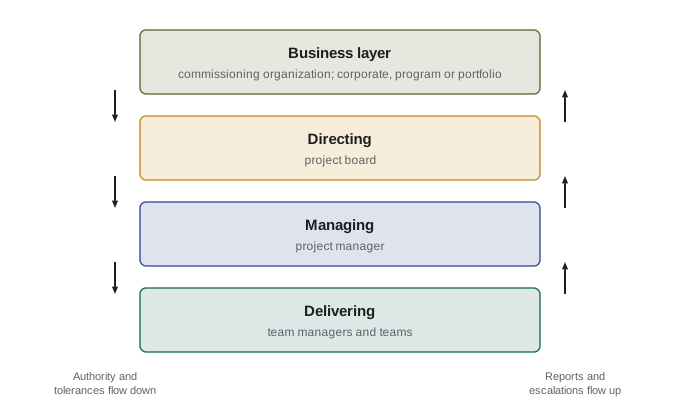
The four layers in people terms
Each layer has a different relationship with the project and different people concerns. Understanding those concerns helps the project manager predict what each layer will want to know and how it will react.
| Layer | Who | Main interest | People concerns |
|---|---|---|---|
| Business | Commissioning organization, portfolio or program management | Strategic fit, overall investment and benefits | Confidence that the project serves strategy; avoiding surprises; competing demands on shared staff |
| Directing | Project board: executive, senior user or users, senior supplier or suppliers | Business justification and key decisions | Clear decisions, honest reporting, enough time for board duties, balance of interests |
| Managing | Project manager, supported by project support | Day-to-day management within stage tolerances | Authority to act, access to resources, relationships with board and team managers |
| Delivering | Team managers and team members, internal or from suppliers | Producing products to agreed quality | Clear work packages, realistic estimates, recognition, workload and wellbeing |
Note that the delivering layer is where most people on a project actually work, yet it is often the layer least represented in governance discussions. PRINCE2 7 encourages project managers to involve team managers and team members in planning and estimating, partly because they know the work best and partly because people who help shape a plan are more committed to delivering it.
Management by exception across the layers
Each layer sets tolerances for the layer below and manages by exception. The business layer sets project tolerances for the board. The board sets stage tolerances for the project manager. The project manager sets work package tolerances for team managers. As long as forecasts stay within tolerance, the lower layer gets on with the work and reports progress. When a forecast breach appears, the issue moves up one layer. This structure is efficient because senior people only need to engage with matters that genuinely require their authority.
Worked problem
Tracing an escalation through the layers
A project has a project cost tolerance of +10 % on a budget of 2,000,000 set by the portfolio board. Stage 3 has a budget of 600,000 with a stage cost tolerance of +8 %. A work package within stage 3 has a budget of 150,000 with a tolerance of +5 %. The team manager forecasts the work package at 162,000; the project manager forecasts stage 3 at 640,000 and the project at 2,180,000. Who must escalate to whom?
Show solution
- Work package limit: 150,000 × 1.05 = 157,500. Forecast 162,000 exceeds it, so the team manager raises an issue with the project manager.
- Stage limit: 600,000 × 1.08 = 648,000. Forecast 640,000 is within it, so no exception report to the board is needed for the stage yet.
- Project limit: 2,000,000 × 1.10 = 2,200,000. Forecast 2,180,000 is within it, so the board does not need to escalate to the business layer.
- The project manager can absorb the work package overrun within the stage tolerance, for example by adjusting another work package or using stage contingency if available.
Answer: Only the work package tolerance is forecast to be breached, so the escalation stops at the project manager. The board and the portfolio board are informed through normal highlight reporting, but no exception is raised above the managing layer.
The people side of this mechanism is easy to overlook. Team managers who fear blame may delay reporting a forecast breach until it has grown. Project managers who want to look capable may absorb problems that should be escalated. Boards that react angrily to exceptions teach the layers below to hide them. The structure works only when each layer treats an escalation as the system working correctly, not as a failure.
The organizational and project ecosystems revisited
Lesson 1 introduced two ecosystems. The four layers help us place people within them. The business layer belongs firmly to the permanent organization. The delivering layer is often made up of people on loan from permanent departments or from supplier organizations. The directing and managing layers sit at the interface, which is why board members and project managers spend so much of their time managing relationships in both directions.
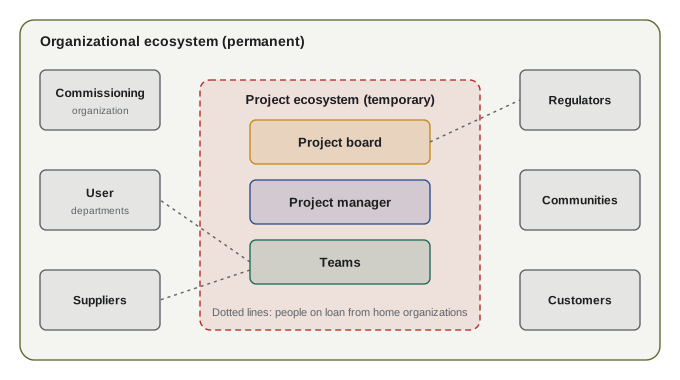
Mapping both ecosystems early is good practice. A simple map lists the organizations involved, the key people in each, their relationship to the project and the channels through which the project will interact with them. That map then feeds the communication management approach, the stakeholder engagement work in lesson 7 and the change impact assessment in lesson 5.
Corporate, program and portfolio context
Many projects are not standalone. They sit within a program, which coordinates several projects to deliver a larger transformation, or within a portfolio, which balances an organization's investment across many initiatives. When a project is part of a program, some responsibilities shift. The program may provide the business case framework, own the benefits, set standards for reporting and supply shared resources. The project executive may be a program manager or a business change manager. PRINCE2 expects these arrangements to be agreed and recorded when the project is initiated.
| Arrangement | Standalone project | Project within a program |
|---|---|---|
| Mandate | From corporate management | From the program, often as a project brief |
| Benefits ownership | Executive and senior users | Often the program, with business change managers |
| Business case | Developed and owned by the project | Contributes to the program business case |
| Standards | Organization's project method | Program standards for reporting, risk and quality |
| Escalation above board | Corporate or portfolio management | Program board |
| Shared people | Negotiated with line managers | Often allocated by the program across projects |
Context in different sectors
The business layer looks different across sectors. In the US federal government, OMB Circular A-11 sets out capital planning and budget expectations, and the Program Management Improvement Accountability Act requires agencies to designate program management improvement officers and follow program and project management standards. States and cities have their own frameworks. In a public company, the board of directors and executive committee form the top of the business layer. In a nonprofit, a volunteer board may play that role, with funders imposing reporting conditions. Each of these shapes who the executive answers to and what tolerances the board receives.
For exam purposes you do not need to know sector-specific frameworks. You do need to recognize that the business layer exists, that it is outside the project management team, that it sets project tolerances and that the board escalates to it when project tolerances are forecast to be exceeded.
Organizational culture as context
Context is not only structure. Each organization has a culture: shared assumptions about how decisions are made, how much risk is acceptable, whether bad news is welcome and how formal communication should be. A project in a hierarchical, risk-averse organization will need more formal approvals and more careful communication than one in a flat, experimental start-up. When several organizations work together, their cultures may clash. A supplier used to fast decisions may become frustrated with a customer whose approvals take weeks.
The project manager cannot change an organization's culture, but can read it and adapt. That might mean scheduling board decisions to fit the commissioning organization's committee calendar, writing reports in the style senior managers expect, or agreeing explicit ways of working when organizations with different cultures form a joint team. These adaptations are part of tailoring, which we return to in lesson 10.
Worked problem
Reading context from a project mandate
A mandate says: 'The regional health authority requires a new patient booking service across its five hospitals. The digital services program will provide funding and standards. Go-live must precede the winter season. The authority's privacy office must approve all data handling.' Identify the business layer, likely board members and two context factors.
Show solution
- Business layer: the regional health authority, with the digital services program providing funding and standards.
- Likely executive: a senior manager accountable to the program for the business case, such as the director of patient access.
- Likely senior users: representatives of the five hospitals' booking and clinical teams.
- Likely senior supplier: the head of the internal digital team or an external supplier's account director.
- Context factors: a fixed seasonal deadline, program standards and a privacy approval gate outside the project.
Answer: Even a short mandate reveals the business layer, the shape of the board and the constraints that will shape tailoring and communication.
Context changes during the project
The context is not fixed at initiation. A reorganization may move the executive to a new role, a program may be paused, a supplier may be acquired or a new regulation may arrive. Each of these changes the layers, the relationships or the constraints. Stage boundaries are the natural time to ask whether the context has shifted: is the business layer still the same, does the executive still hold the authority the role needs, are the suppliers and their key people still in place, and have new stakeholders appeared? Where the answer is no, the project manager should update the context map, the communication management approach and, if needed, the project management team structure, and ask the board to approve the changes.
A change of executive deserves particular care. The new executive inherits a business case they did not write and decisions they did not make. A short handover meeting with the outgoing executive, a review of the business case and tolerances, and a fresh onboarding conversation help the new executive take genuine ownership rather than simply continuing whatever was decided before. Without this, a project can drift for months under an executive who does not feel accountable for it.
Common mistakes
MistakeTreating the business layer as part of the project management team.
InsteadRecognize that the business layer sits above the project board and sets project tolerances.
MistakeEscalating every problem straight to the board.
InsteadEscalate only when the relevant tolerance is forecast to be exceeded.
MistakePlanning without involving the delivering layer.
InsteadInvolve team managers and team members in planning and estimating.
MistakeAssuming a project within a program owns all its benefits.
InsteadAgree benefits ownership with the program during initiation.
MistakeIgnoring organizational culture when planning governance.
InsteadRead the culture and tailor decision-making and communication to it.
Summary and key terms
- The commissioning organization provides the mandate and sits in the business layer.
- PRINCE2 uses four layers: business, directing, managing and delivering.
- Each layer sets tolerances for the layer below and manages by exception.
- Escalations stop at the first layer whose tolerance is not forecast to be breached.
- The project ecosystem sits inside the organizational ecosystem and borrows its people.
- Programs and portfolios change who owns benefits, standards and escalation above the board.
- Organizational culture is part of the context and shapes tailoring.
- Commissioning organization
- The organization that requests the project and provides its mandate.
- Business layer
- Corporate, program or portfolio management above the project board.
- Directing layer
- The project board, which makes key decisions and owns business justification.
- Managing layer
- The project manager, who manages day to day within stage tolerances.
- Delivering layer
- Team managers and teams who produce the products.
- Project mandate
- The trigger from the business layer that starts a project.
- Program
- A temporary structure coordinating related projects to deliver a transformation.
- Portfolio
- The totality of an organization's investment in change, balanced against strategy.
- Project tolerance
- The permitted deviation set by the business layer for the whole project.
- Organizational culture
- Shared assumptions about how work, decisions and risk are handled.
Practice problems
Work each problem on paper first, then reveal the answer to check.
Name the four layers of management.
Show answer
Business, directing, managing and delivering.
Who sets project tolerances?
Show answer
The business layer.
Who sets work package tolerances?
Show answer
The project manager.
Work package budget 80,000 with +5 % tolerance; forecast 85,000. Breach?
Show answer
Yes; the limit is 84,000.
Stage budget 400,000 with +10 %; forecast 430,000. Breach?
Show answer
No; the limit is 440,000.
Is the commissioning organization part of the project management team?
Show answer
No; it sits in the business layer.
When a project is in a program, who often owns benefits?
Show answer
The program, often through business change managers.
Which layer contains most of the people doing the work?
Show answer
The delivering layer.
Give one example of organizational culture affecting a project.
Show answer
A risk-averse culture requiring more formal approvals.
Why should boards treat exceptions calmly?
Show answer
So lower layers keep reporting forecast breaches early instead of hiding them.
Lesson quiz · 5 questions
Score 60% or more to complete this lesson.
Create a free account to save your progress, take quizzes and earn a certificate.