
PMP-131 · Lesson 9 of 12 · 26 min
Conducting and controlling procurements
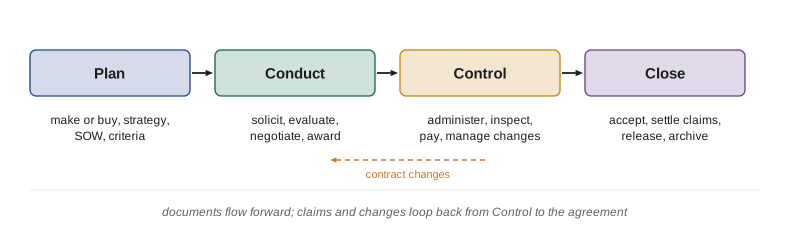
With a strategy, a statement of work and a contract type chosen, the library can go to market. This lesson follows the kiosk and security gate procurement for Project Compass from the request for proposals to award, then covers what happens after signing: administering the contract, inspecting and paying, managing changes and claims, and resolving disputes. Closing procurements is part of project closure in lesson 12. The legal details differ between jurisdictions, and project managers rely on procurement and legal colleagues for them; the exam focuses on the project manager's role and good practice.
Soliciting proposals
Conducting procurements means obtaining seller responses, selecting a seller and awarding a contract. It starts with advertising or inviting sellers according to the procurement rules. Public bodies usually post opportunities on an electronic tendering system; private buyers may invite a shortlist. The library issued its kiosk RFP to the market through its municipality's tendering portal, with four weeks to respond.
A bidder conference (also called a pre-bid meeting, contractor conference or vendor conference) is a meeting with all prospective sellers before proposals are due. It makes sure that every bidder has the same understanding of the requirements and receives the same answers. Questions raised there, or submitted in writing during the bidding period, are answered in written addenda issued to all bidders. The Compass bidder conference included a site visit to the empty unit, so bidders could see where the gates and kiosks would go and where data cabling would run. One bidder asked whether the library would accept refurbished kiosks; the answer, no, went to all bidders in Addendum 2.
Fairness rules apply throughout. The project manager and evaluators do not discuss the procurement with bidders outside the formal channels, do not share one bidder's information with another, and declare any conflicts of interest. These rules protect the integrity of the process and the organization from challenges that could delay award by months.
Evaluating proposals
Evaluation follows the source selection criteria published in the RFP. A typical process has stages: a compliance check against mandatory requirements, individual scoring by each evaluator, a consensus meeting to agree scores, optional presentations or demonstrations from the leading bidders, then price evaluation, often done separately so that price does not influence technical scores.
# Weighted scoring of three proposals for the self-service kiosk package (invented)
criteria = {"Technical fit and accessibility": 0.30, "Integration with library system": 0.20,
            "Support and service levels": 0.15, "Supplier experience and references": 0.10,
            "Price (lifetime cost)": 0.25}
# Non-price scores 1-10 agreed by the evaluation panel after individual scoring
panel = {"Vendor A": [8, 9, 7, 8], "Vendor B": [7, 6, 9, 7], "Vendor C": [9, 7, 6, 5]}
lifetime_cost = {"Vendor A": 352, "Vendor B": 298, "Vendor C": 321}     # $000 over five years
passed_mandatory = {"Vendor A": True, "Vendor B": True, "Vendor C": False}
low = min(c for v, c in lifetime_cost.items() if passed_mandatory[v])
for v, scores in panel.items():
    if not passed_mandatory[v]:
        print(f"{v}: screened out before scoring (no signed security and privacy schedule)")
        continue
    price_score = 10 * low / lifetime_cost[v]           # lowest compliant cost earns 10
    total = sum(w * x for w, x in zip(criteria.values(), scores + [price_score]))
print(f"{v}: price score {price_score:4.1f} weighted total {total:.2f}")Vendor A: price score 8.5 weighted total 8.17 Vendor B: price score 10.0 weighted total 7.85 Vendor C: screened out before scoring (no signed security and privacy schedule)
Vendor C was screened out at the compliance stage because it did not sign the security and privacy schedule, a mandatory requirement: patrons' borrowing records are personal information, and the library cannot use a vendor that will not commit to protecting them. Of the two compliant proposals, Vendor B has the lowest five-year cost and earns the full price score, but Vendor A scores higher on technical fit, integration with the library system and references. Weighted, Vendor A wins with 8.17 against 7.85. This is the logic of best value: price matters, but it is one criterion among several, weighted as the buyer announced in advance.
Weighted scoring is only as sound as the criteria and weights. They must reflect what matters, be set before proposals are opened and be applied consistently. Evaluators should score independently before discussing, so that the most senior person's opinion does not set everyone's scores, and the reasons for each score should be recorded. If a losing bidder asks for a debrief, those records explain the outcome; if it files a complaint, they are the evidence.
Other selection tools include a screening system to remove bidders that fail minimum requirements, a seller rating system based on past performance, reference checks, and an independent cost estimate (lesson 7) to judge whether prices are reasonable. Proposals far below the estimate deserve as much scrutiny as those far above it, because an unrealistically low bid may signal misunderstanding of the work or an intention to recover margin through change orders.
Negotiating and awarding
Negotiation clarifies the structure, requirements and terms of the contract so that both parties reach a mutual understanding before signing. Topics include responsibilities, authority, applicable terms and law, technical and business approaches, proprietary rights, financing, price and schedule, and the processes for changes, payment and acceptance. Public procurement rules often limit negotiation, for example to clarifying details with the top-ranked bidder rather than reopening price. The project manager may not lead negotiations but should take part, because the contract will govern how the project works with the seller.
For the kiosk package, negotiation with Vendor A confirmed the fixed price incentive fee terms from lesson 8 (target cost $300,000, target fee $30,000, share 70/30, ceiling $345,000), the firmware update clause from the pilot lesson, on-site support during opening week (the R07 transfer response from lesson 5), acceptance criteria tied to the soak test, and the library's ownership of transaction data. The outputs of conducting procurements are the selected seller, the signed agreement, resource calendars for the seller's people, change requests if the award changes the plan, and updates to the risk register and lessons learned. Unsuccessful bidders are notified and offered a debrief.
Controlling procurements
Controlling procurements means managing the relationship, monitoring contract performance, making changes and corrections as needed, and closing out contracts. Both buyer and seller administer the contract for their own purposes; the buyer's job is to ensure that the seller's performance meets the contract and that the buyer meets its own obligations, such as providing site access, information and timely payment. Contract administration links procurement to other project processes: quality control of what the seller delivers, integrated change control for contract changes, risk monitoring for supplier risks, and financial management for payments.
| Activity | Purpose | Compass example |
|---|---|---|
| Performance reviews | Structured reviews of progress against scope, quality, schedule and cost | Monthly review with the fit-out contractor; weekly with the kiosk vendor during installation |
| Inspections and audits | Verify that work and processes meet the contract | Architect's site reviews; audit of the vendor's data security controls |
| Payment system | Pay for accepted work according to the contract | Progress payments certified by the architect; kiosk payments on milestones |
| Contract change control | Request, evaluate, approve and document changes to the contract | Change orders for extra data outlets at agreed unit prices |
| Claims administration | Handle contested changes and disputes | Contractor's claim for delay caused by the late permit |
| Records management | Keep the contract file complete | Correspondence, approvals, inspection reports, payment certificates |
Payments in construction follow specific rules. Construction contracts commonly include retainage, a percentage of each progress payment (often 5 % to 10 %) withheld until completion, and most states have prompt payment laws for public projects that set deadlines for paying contractors and subcontractors. Mechanic's lien rights protect contractors on private projects, while payment bonds protect them on many public projects. The library's procurement and legal staff apply the rules for its state; the project manager makes sure that invoices are reviewed promptly against certified progress, because late payment can create claims and supply chain problems.
Contract changes and claims
Changes to a contract follow the change procedure written into it, usually a written change request, a priced proposal from the seller, review by the buyer, and a signed change order or amendment issued by someone with contracting authority. The project manager makes sure that every contract change is also assessed through the project's integrated change control process, because a change to a contract is often a change to scope, schedule or cost baselines. A common exam trap is a seller doing extra work on the strength of a verbal request from a team member: without a change order, the seller may not be paid, and the buyer may be surprised by a claim.
A claim is a request by one party for compensation or an adjustment under the contract that the other party disputes. Contested changes, also called constructive changes, arise when a party believes the other's actions or instructions have changed the work. The Compass fit-out contractor submitted a claim for extended site overheads caused by the late permit. The library accepted that the permit timing was its responsibility under the contract and agreed a figure of $22,000, which was paid from the contingency reserve for R02, as lesson 6 described. Negotiated settlement is always the preferred route for claims.
When negotiation fails, alternative dispute resolution (ADR) offers ways to resolve disputes without going to court. Mediation uses a neutral third party to help the parties reach their own agreement; arbitration uses a neutral arbitrator whose decision is usually binding; adjudication, used in construction payment disputes in several jurisdictions, gives a fast interim decision. Litigation in the courts is the last resort, because it is slow, expensive and damaging to relationships. The contract should specify the dispute resolution steps, often escalating from project-level negotiation to senior management, then mediation, then arbitration.
| Method | Who decides | Binding? | Typical speed |
|---|---|---|---|
| Negotiation | The parties | If they agree | Days to weeks |
| Mediation | The parties, helped by a mediator | Only if they reach and sign an agreement | Weeks |
| Adjudication | An adjudicator | Interim binding decision, can be revisited later | Weeks |
| Arbitration | An arbitrator or panel | Usually binding, limited appeal | Months |
| Litigation | A court | Binding, subject to appeal | Months to years |
Managing the relationship
Contracts set rights and obligations, but projects succeed through working relationships. Regular communication, early warning of problems on both sides, prompt decisions and payments, and fair treatment make sellers more willing to help when things go wrong. A seller that is losing money will look for ways to recover it; a buyer that is unreasonable will find its sellers less flexible. Lesson 1 noted that mutually beneficial partnerships with suppliers are a quality principle; they are also a risk management one. PMP-121's negotiation and stakeholder engagement skills apply directly to sellers, who are key stakeholders.
In adaptive work, the buyer usually participates closely: the library's product owner attends the app team's sprint reviews and planning, and acceptance happens increment by increment. Disputes are less likely when both sides see working software every two weeks, and the contract's right to stop after each release gives the buyer a simple remedy if value is not being delivered.
Worked problem
Handling an unapproved change
Two weeks before opening, the kiosk vendor's installer tells the project manager that a library staff member asked for two extra kiosks to be wired at the children's desk, and the vendor has done the work. The vendor now sends an invoice for $9,600. What should the project manager do?
Show solution
- Check the contract: changes require a written change order signed by the contracting officer; the staff member had no authority.
- Talk to the vendor and the staff member to establish the facts, without accusing anyone.
- Assess the change through integrated change control: is the work useful, within budget and wanted by the sponsor?
- If it is wanted, the contracting officer issues a change order at a fair price; if not, discuss with the vendor how to resolve the work done in good faith, and remind the team who can authorize changes.
Answer: Follow the contract's change process through the person with contracting authority, assess the change on its merits and prevent recurrence by clarifying authority.
Common mistakes
MistakeAnswering one bidder's question privately.
InsteadAnswer through addenda issued to all bidders.
MistakeChoosing the lowest price automatically when the RFP announced weighted criteria.
InsteadEvaluate exactly as the published criteria and weights say.
MistakeLetting team members instruct sellers to do extra work.
InsteadRoute changes through the contract's change procedure and integrated change control.
MistakeGoing straight to litigation over a claim.
InsteadNegotiate first, then use the contract's ADR steps.
MistakeTreating the contract as the only tool for managing a seller.
InsteadBuild the relationship through communication, fair treatment and prompt decisions.
Summary and key terms
- Conducting procurements: solicit, hold bidder conferences, issue addenda, evaluate, negotiate and award.
- Evaluate against published criteria; screen mandatory requirements first; score independently, then reach consensus.
- Best value can favor a higher-priced proposal when it scores better on weighted criteria.
- Controlling procurements: performance reviews, inspections and audits, payments, contract change control, claims and records.
- Contract changes need written change orders by someone with authority and must pass through integrated change control.
- Resolve claims by negotiation first, then ADR (mediation, adjudication, arbitration), with litigation last.
- Bidder conference
- A meeting with prospective sellers to give all of them the same understanding of the procurement.
- Addendum
- A written change or clarification to bid documents issued to all bidders.
- Weighted scoring
- Evaluation that multiplies scores on each criterion by published weights.
- Contract administration
- Managing the agreement and the relationship to ensure both parties meet their obligations.
- Change order
- A written, signed instruction changing the contract scope, price or schedule.
- Claim
- A request for compensation or adjustment under a contract that the other party disputes.
- Alternative dispute resolution
- Methods such as mediation and arbitration that resolve disputes without litigation.
- Holdback or retainage
- A portion of progress payments withheld until completion or a set period afterwards.
Practice problems
Work each problem on paper first, then reveal the answer to check.
What is the purpose of a bidder conference?
Show answer
To give all prospective sellers the same information and understanding.
How are answers to bidders' questions shared?
Show answer
In written addenda to all bidders.
A proposal fails a mandatory requirement. What happens?
Show answer
It is screened out before scoring.
Why score price separately from technical criteria?
Show answer
So price does not influence technical judgments.
Who issues a change order?
Show answer
A person with contracting authority, per the contract.
What is a claim?
Show answer
A disputed request for compensation or adjustment under the contract.
Which ADR method produces a usually binding decision?
Show answer
Arbitration.
In mediation, who decides the outcome?
Show answer
The parties themselves, helped by the mediator.
What should a buyer suspect when a bid is far below the independent estimate?
Show answer
A misunderstanding of the work or a plan to recover margin through changes.
Name two activities in controlling procurements.
Show answer
Performance reviews, inspections, payments, change control, claims, records.
Lesson quiz · 5 questions
Score 60% or more to complete this lesson.
Create a free account to save your progress, take quizzes and earn a certificate.