
PMP-131 · Lesson 10 of 12 · 25 min
Integration: directing work, knowledge and lessons learned
Integration is the project manager's distinctive job. Specialists can estimate costs, test kiosks or negotiate contracts; only the project manager is responsible for making all the pieces work together so that the project delivers its objectives. This lesson covers the execution side of integration: directing and managing the work, managing project knowledge and lessons learned, and monitoring and controlling project work by turning raw data into information and reports that drive decisions. Lesson 11 covers the other central integration activity, controlling changes.
What integration means
Project integration management includes the activities needed to identify, combine, unify and coordinate the various processes and activities of a project. In practice it means making trade-offs between competing objectives, keeping plans consistent with one another, managing dependencies between workstreams and between the project and its environment, and taking decisions with the whole project in view. When the electrician crew risk (R05) is mitigated by booking a second crew, integration is what makes sure the extra cost appears in the budget, the crew appears in the resource plan, the secondary risk of crowding is managed, and the schedule reflects the new dates.
Integration responsibility cannot be delegated. Team members and specialists manage their parts; the project manager remains accountable for the result as a whole. The PMBOK Guide's principles express related ideas: thinking in terms of systems and recognizing interactions, stewardship of resources, and tailoring the approach to the context. In the eighth edition's structure, much of what this lesson covers sits in the governance domain and runs across the executing and monitoring and controlling focus areas.
| Activity | Main purpose | Key outputs |
|---|---|---|
| Develop project charter | Authorize the project and the project manager | Charter, assumption log (PMP-110) |
| Develop project management plan | Combine subsidiary plans and baselines into one plan | Project management plan (PMP-130 and this course) |
| Direct and manage project work | Lead and perform the work and implement approved changes | Deliverables, work performance data, issue log, change requests |
| Manage project knowledge | Use existing knowledge and create new knowledge | Lessons learned register, improved processes |
| Monitor and control project work | Track, review and report progress; recommend actions | Work performance reports, change requests, forecasts |
| Perform integrated change control | Review, approve and manage all changes | Approved change requests, change log, updated plans (lesson 11) |
| Close project or phase | Finalize all activities and transition the product | Final report, transitioned deliverables (lesson 12) |
Directing and managing project work
Directing and managing project work means leading and performing the work defined in the project management plan and implementing approved changes, so that the project produces its deliverables. The project manager, with the team, carries out planned activities, acquires and manages resources, manages sellers through the procurement processes, implements risk responses, collects data on performance, and raises change requests when needed. Approved changes, including corrective actions, preventive actions and defect repairs, are also implemented here.
This activity produces deliverables and work performance data, the raw observations and measurements about the work: which kiosks were installed today, how many tags were encoded, hours worked, costs incurred, test results. It also produces entries in the issue log, change requests and updates to project documents. The project management information system (PMIS), whether a scheduling tool, a shared workspace, a ticketing system or a mix, is where this data is collected and shared.
Leadership is part of directing work. PMP-120 covered the people side: building the team, motivating, coaching and resolving conflict. The point here is that executing the plan is not mechanical. On Project Compass, during kiosk installation, the project manager spends more time unblocking problems, such as a missing network port, a delayed delivery or a staff member who needs training earlier than planned, than reading reports.
Monitoring and controlling project work
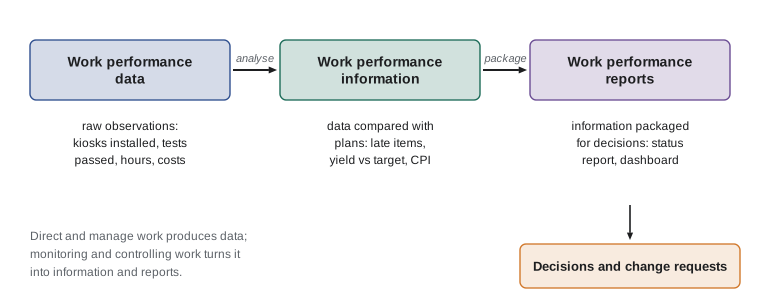
Monitoring and controlling project work means tracking, reviewing and reporting overall progress against the performance objectives in the plan. It turns work performance data into work performance information by comparing it with plans, and packages that information into work performance reports for decision makers. The three terms are easily confused, and the exam uses them.
# From work performance data to work performance information: kiosk installation week 31
data = [  # (kiosk, planned day, installed day or None, tests passed of 12)
    ("K1", 1, 1, 12), ("K2", 1, 2, 11), ("K3", 2, 2, 12), ("K4", 2, 4, 12),
    ("K5", 3, None, 0), ("K6", 3, 3, 9),
]
done = [d for d in data if d[2] is not None]
late = [d[0] for d in done if d[2] > d[1]]
not_started = [d[0] for d in data if d[2] is None]
first_pass = [d[0] for d in done if d[3] == 12]
print(f"Installed {len(done)} of {len(data)} planned by day 4; late: {', '.join(late)}; "
      f"not installed: {', '.join(not_started)}")
print(f"First-pass test yield {len(first_pass)}/{len(done)} = {len(first_pass) / len(done):.0%} "
      f"(target 90 %)")
fails = sum(12 - d[3] for d in done)
print(f"Failed test steps: {fails}, of which {12 - 9} on K6 (card reader) and 1 on K2 (receipt printer)")Installed 5 of 6 planned by day 4; late: K2, K4; not installed: K5 First-pass test yield 3/5 = 60% (target 90 %) Failed test steps: 4, of which 3 on K6 (card reader) and 1 on K2 (receipt printer)
The list of kiosks with planned and actual days and test results is work performance data. The statements that two kiosks were installed late, one is not yet installed and the first-pass test yield is 60 % against a 90 % target are work performance information: they compare data with the plan and the quality metric. The weekly status report to the sponsor, which summarizes the kiosk position alongside the schedule, cost and risk picture and recommends action, is a work performance report.
Monitoring also covers forecasting (the EAC and finish-date forecasts from PMP-130), variance analysis, trend analysis, root cause analysis and the review of risks and issues. Its outputs include change requests: corrective actions to bring performance back in line with the plan, preventive actions to reduce the chance of future problems, and defect repairs. Change requests then go to integrated change control.
Managing project knowledge
Managing project knowledge means using existing knowledge to achieve project objectives and creating new knowledge that contributes to organizational learning. Knowledge comes in two forms. Explicit knowledge can be written down and shared through documents, databases and registers: procedures, specifications, lessons learned. Tacit knowledge is personal and hard to express: the experience, judgment and know-how that lets an experienced fit-out lead see a problem coming. Tacit knowledge is shared mainly through people working together: mentoring, pairing, communities of practice, workshops and storytelling.
| Type | Examples on Project Compass | Ways to share it |
|---|---|---|
| Explicit | Kiosk installation checklist, tag-encoding procedure, lessons learned register, vendor manuals | Shared workspace, registers, templates, search |
| Tacit | The facilities manager's sense of which contractors cut corners; a senior librarian's knowledge of patron habits | Pairing staff, site walks together, communities of practice, informal conversations |
A lessons learned register records challenges, problems, risks and opportunities encountered, and what worked or did not, so that the project and future projects can benefit. Good practice is to capture lessons throughout the project, not only at the end, when memories have faded and people have moved on, and to write them so they can be found and used: specific, actionable and tagged by topic.
# Querying the library's lessons learned register before planning the next stage
register = [
 {"id": "LL-014", "project": "Westfield branch refit", "area": "procurement",
  "lesson": "Tag supplier lead time doubled in December; order by end of October", "tags": {"rfid", "lead time"}},
 {"id": "LL-022", "project": "Central library kiosks", "area": "quality",
  "lesson": "Soak-test kiosks for two weeks with real patrons before opening", "tags": {"kiosk", "testing"}},
 {"id": "LL-031", "project": "Westfield branch refit", "area": "risk",
  "lesson": "Mall landlords restrict noisy work to 7-9 am; confirm in the lease schedule", "tags": {"landlord", "schedule"}},
 {"id": "LL-040", "project": "Library system migration", "area": "integration",
  "lesson": "Freeze the item data mapping before the vendor starts encoding", "tags": {"rfid", "data"}},
 {"id": "LL-047", "project": "Central library kiosks", "area": "procurement",
  "lesson": "Specify card-reader firmware version and update rights in the contract", "tags": {"kiosk", "contract"}},
]
def search(*words):
    hits = [r for r in register if any(w in r["tags"] or w in r["lesson"].lower() for w in words)]
    return hits
for query in (("kiosk",), ("rfid", "tag")):
    print("Query:", " or ".join(query))
    for r in search(*query):
print(f" {r['id']} [{r['area']}] {r['lesson']}")Query: kiosk LL-022 [quality] Soak-test kiosks for two weeks with real patrons before opening LL-047 [procurement] Specify card-reader firmware version and update rights in the contract Query: rfid or tag LL-014 [procurement] Tag supplier lead time doubled in December; order by end of October LL-040 [integration] Freeze the item data mapping before the vendor starts encoding
Before kiosk installation began, the technology lead searched the library's register. Two entries from the central library's earlier kiosk project stood out: soak-test kiosks for two weeks with real patrons before opening, and specify the card-reader firmware version and update rights in the contract. The second had already shaped the Eastgate contract (lesson 9). The first had not been acted on, because lesson 5 chose a contract clause rather than a soak test to deal with R07. The day 4 data, with K6's card reader failing three test steps, made the case: the technology lead raised a preventive change request for a two-week soak test costing $5,000, which became CR-06 in lesson 11. Using knowledge from earlier projects is cheaper than relearning it.
Knowledge management depends on culture as much as tools. People share lessons, especially mistakes, only if they trust that doing so will not be held against them. Retrospectives in agile teams, after-action reviews and blameless post-incident reviews all depend on psychological safety, which PMP-120 discussed. A project manager who reacts to bad news by looking for someone to blame will soon stop hearing it.
Integration in adaptive and hybrid projects
In adaptive projects, much integration is done by the team: the product owner integrates stakeholder needs into a prioritized backlog, and the team integrates work daily through practices such as continuous integration. The project manager or delivery lead focuses on the environment around the team, removing impediments, coordinating with other teams and stakeholders, and making sure that governance requirements are met without slowing the team down.
In a hybrid project, integration includes joining the predictive and adaptive parts. For Project Compass, the integration points are the soft opening, when the app's first release must work with the kiosks, the library system and the branch's network, and the grand opening. The project manager keeps an integration plan that lists dependencies between the fit-out, technology and app workstreams, holds a fortnightly integration meeting with each workstream lead, and reports one status to the board that combines earned value for the predictive parts with release burn-up for the app.
Worked problem
Data, information or report?
Classify each item from Project Compass: (1) the painter logged 34 hours this week; (2) the fit-out is three days behind the baseline on the critical path, with an SPI of 0.94; (3) a one-page dashboard for the board showing overall schedule, cost and risk status, with recommendations; (4) 41 of 46 punch-list paint items are closed.
Show solution
- (1) Hours logged is a raw observation: work performance data.
- (2) Comparing progress with the baseline and calculating SPI produces work performance information.
- (3) The dashboard packages information for decision makers: a work performance report.
- (4) A count of closed items is data; stating that it meets or misses the target for the next walk-through would make it information.
Answer: Data, information, report and data. Information requires comparison with plans or targets; reports package information for decisions.
Common mistakes
MistakeDelegating integration to a team member.
InsteadThe project manager remains accountable for integrating the project as a whole.
MistakeCalling raw measurements work performance information.
InsteadData becomes information only when compared with plans or targets.
MistakeCollecting lessons learned only at the end of the project.
InsteadCapture lessons throughout, and use the register at the start of each stage.
MistakeRelying only on documents to share knowledge.
InsteadTacit knowledge needs people-based methods such as mentoring and communities of practice.
MistakeImplementing changes that have not been approved.
InsteadDirect and manage work implements approved changes only.
Summary and key terms
- Integration coordinates all project processes and trade-offs; the project manager is accountable for it.
- Direct and manage work executes the plan and approved changes and produces deliverables and work performance data.
- Monitor and control work turns data into information and reports and recommends corrective and preventive actions.
- Work performance data are raw observations; information compares them with plans; reports package information for decisions.
- Knowledge is explicit or tacit; the lessons learned register should be used and updated throughout the project.
- Hybrid projects need explicit integration points between predictive and adaptive workstreams.
- Project integration management
- The processes and activities that identify, combine, unify and coordinate project work.
- Work performance data
- Raw observations and measurements identified during the work.
- Work performance information
- Performance data analyzed and compared with plans.
- Work performance report
- A representation of work performance information intended to support decisions.
- Explicit knowledge
- Knowledge that can be codified in words, numbers and pictures.
- Tacit knowledge
- Personal knowledge that is difficult to articulate, such as experience and know-how.
- Lessons learned register
- A document recording knowledge gained during a project for current and future use.
- Project management information system
- The tools and systems used to collect, store and distribute project information.
Practice problems
Work each problem on paper first, then reveal the answer to check.
Which activity produces deliverables and work performance data?
Show answer
Direct and manage project work.
What turns data into information?
Show answer
Comparing it with plans, targets or baselines.
Give an example of tacit knowledge.
Show answer
An experienced manager's judgment about which contractors cut corners.
When should lessons learned be captured?
Show answer
Throughout the project, not just at the end.
Who is accountable for integration?
Show answer
The project manager.
Name the three kinds of change request that result from monitoring.
Show answer
Corrective action, preventive action and defect repair (plus updates).
What is a work performance report?
Show answer
Information packaged for decision makers, such as a status report or dashboard.
How is tacit knowledge best shared?
Show answer
Through people: mentoring, pairing, workshops, communities of practice.
Which document did the technology lead search before kiosk installation?
Show answer
The lessons learned register.
What does direct and manage work implement besides the plan?
Show answer
Approved changes.
Lesson quiz · 5 questions
Score 60% or more to complete this lesson.
Create a free account to save your progress, take quizzes and earn a certificate.