
PLB-330 · Lesson 8 of 12 · 21 min
Special waste: laboratory, acid and hospital drainage
The Ridgeview east wing was not only patient rooms. The ground floor held a clinical laboratory, a sterile processing department with large steam sterilizers, a pharmacy with a compounding room, an imaging suite and a plaster room in the fracture clinic. Each of these produced waste that ordinary drainage could not take. The lab sinks discharged dilute acids, bases and solvents. The sterilizers dumped steam condensate close to boiling. The plaster room produced slurry that would set like concrete in a trap. "In a hospital, the drawings have a whole second drainage system," Raj said, pointing to a set of pipes drawn in a different line type on the ground-floor plan. "Different pipe, different joints, different traps, and a tank at the end that takes the bite out of the waste before it reaches the city's sewer." This lesson covers the special waste systems found in laboratories, hospitals and similar buildings.
Why special waste is kept separate
City sewer-use rules and pretreatment programs limit what may be discharged into a public sewer. Typical limits cover pH, often requiring it to stay between about 6.0 and 10.5 or similar, temperature, often no higher than 140 °F at the point of discharge, and specific substances such as solvents, heavy metals, fuels and radioactive materials. These rules protect the sewer pipes from corrosion and heat damage, protect sewer workers from toxic gases, and protect the treatment plant's biological processes, which can be killed by toxic or very acidic waste.
Building codes add their own requirements. Corrosive waste must be carried in pipe that resists it and must be neutralized or diluted before it enters the building drain. Waste that could harm the drainage system or the public sewer must be treated at the source. Special waste systems are therefore kept separate from the sanitary drainage until the treatment point, and they usually have their own vents, because some of the gases they produce are corrosive too.
Laboratory and acid waste piping
Laboratory waste is unpredictable. Most of the time, a lab sink discharges plain water with traces of chemicals. Occasionally, it receives a splash of concentrated acid, a solvent or a hot solution. The piping must handle the worst case. Common materials for acid waste systems include:
- Polypropylene, often flame-retardant grades, joined by heat fusion or mechanical joints. It resists most acids and bases and is widely used in laboratory buildings.
- PVDF (polyvinylidene fluoride), a higher-performance plastic that handles stronger chemicals and higher temperatures, and has better fire performance, so it is often used where plenums or fire rules limit other plastics.
- Borosilicate glass, which resists almost all chemicals and lets the user see the flow, but is fragile and needs careful support and protection.
- High-silicon cast iron, an older material still found in existing buildings, very resistant to acids but heavy and brittle.
- Some chlorinated plastics such as CPVC, for certain chemical services when the design allows.
Each material has its own joining method, support spacing and expansion behavior, and they cannot be mixed casually. A lab drainage system may change material where the chemical risk drops, for example from PVDF in a fume hood to polypropylene in the main riser, but only with transition fittings the manufacturer and designer approve. Installers who work with these systems often need training from the material's supplier, especially for heat fusion, because a bad fusion joint can look normal and fail later.
Fire is a particular concern. Many acid waste plastics are combustible, and codes restrict combustible pipe in some building types, in return air plenums and through fire separations. Designers solve this with fire-retardant grades, by enclosing the pipe in rated shafts, by using tested firestop systems made for the specific material and size, or by choosing glass or PVDF in sensitive locations. An apprentice should never substitute one firestop product for another on plastic pipe; firestop systems are tested with a specific pipe material.
Traps and vents in lab systems
Lab sinks and cup sinks need traps like any fixture, but the traps are made of the same chemical-resistant material as the piping. Some are designed to be easy to open and clean, because chemicals can form deposits. In some labs, the designer adds a dilution trap, a larger chamber under the sink that holds more water so a splash of acid is diluted before it moves on. Where solids or broken glass are likely, a solids interceptor or a trap with a removable basket may be used.
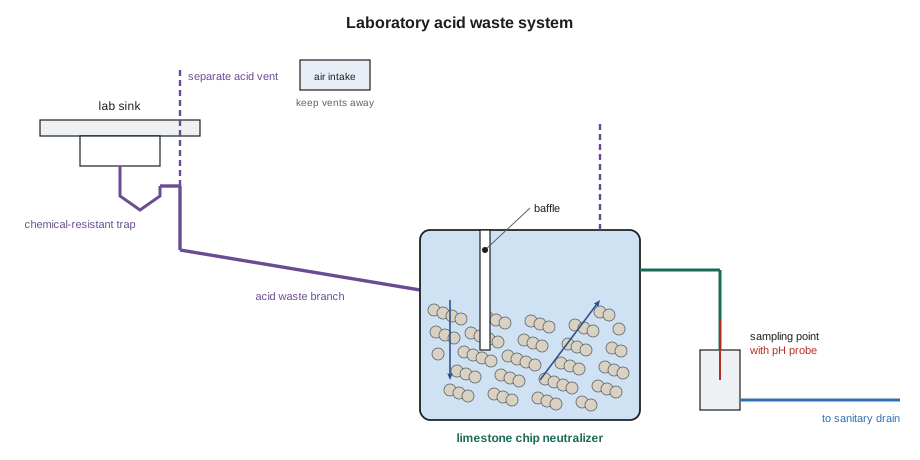
Acid waste vents are separate from the sanitary vents and are made of the same chemical-resistant material, because corrosive fumes rise through them. They are carried through the roof on their own and kept away from air intakes so that fumes do not re-enter the building. On the Ridgeview roof, the acid vent terminations were grouped near the lab exhaust fans, well away from the outdoor air intakes, as the mechanical drawings required.
Neutralization
Before acid waste joins the sanitary drainage, it passes through a neutralizer. The simplest kind is a limestone or marble chip tank: a tank filled with crushed limestone through which the waste flows. The calcium carbonate in the stone reacts with acids, raising the pH. The limestone is slowly consumed, so the tank must be inspected and recharged on a schedule. Limestone neutralizers work well for intermittent dilute acid waste, such as a teaching lab or small clinical lab. For larger or more variable flows, or where bases as well as acids are discharged, designers use active pH neutralization systems: tanks with pH probes, mixers and pumps that add acid or base as needed to bring the waste into range, with recording equipment so the owner can show compliance with the city pretreatment rules.
A sampling point is usually required downstream of the neutralizer so the city can test the effluent. At Ridgeview, the lab drained by gravity to a 250 gal polyethylene neutralization tank with limestone chips, followed by a sampling manhole with a pH probe connected to the building automation system, which sent an alarm to facilities staff if the pH dropped below the set point.
Hot waste: sterilizers and condensate
Steam sterilizers, also called autoclaves, discharge condensate and sometimes steam at close to 212 °F. Commercial dishwashers, boiler blowdown and some lab equipment also discharge very hot water. Most drainage pipe and the sewer itself cannot take sustained flow at those temperatures, and codes or sewer-use rules commonly limit discharge to about 140 °F. Hot waste is therefore cooled before it enters the drainage system. Options include a blowdown or cooling tank that lets the waste cool and mix, a heat exchanger that recovers the heat, and a cold water tempering valve that mixes city water with the hot discharge. Cold water tempering is simple but uses a lot of water, so many owners now prefer recovery or holding tanks.
Sterilizers also need an indirect connection. The sterilizer's drain discharges through an air gap into a funnel drain or floor sink, so that a backup in the drainage system cannot contaminate the sterile chamber. The same principle applies to many hospital fixtures and equipment: anything that holds sterile or food products, such as ice machines, glass washers and some lab equipment, drains indirectly.
# Tempering water needed to cool hot discharge (simple energy balance)
def tempering_flow(q_hot, t_hot, t_limit, t_cold):
    """Cold water flow needed so the mixed discharge is at t_limit."""
    return q_hot * (t_hot - t_limit) / (t_limit - t_cold)

q_hot = 4.0       # gpm condensate from a sterilizer during blowdown
for t_cold in (40, 50, 60):
    q_cold = tempering_flow(q_hot, 210, 140, t_cold)
print(f"cold water at {t_cold} F: {q_cold:.1f} gpm tempering water, mixed flow {q_hot + q_cold:.1f} gpm")cold water at 40 F: 2.8 gpm tempering water, mixed flow 6.8 gpm cold water at 50 F: 3.1 gpm tempering water, mixed flow 7.1 gpm cold water at 60 F: 3.5 gpm tempering water, mixed flow 7.5 gpm
The result shows why tempering uses so much water: to cool condensate from 210 °F to 140 °F with 50 °F city water, the system needs about 80 percent as much cold water as hot discharge. In winter, when city water is colder, it needs less; in late summer, more. A cooling tank that holds the condensate and lets it lose heat to the room, or a heat recovery exchanger that preheats domestic water, avoids most of that waste.
Worked problem
Mixing temperature check
A sterilizer discharges 4.0 gpm at 210 °F. The discharge limit is 140 °F and the cold water is at 50 °F. Find the cold water flow needed and the combined flow the drain must carry.
Show solution
- Energy balance: the heat given up by the hot water equals the heat taken up by the cold water.
- \[q_c = q_h \times \frac{T_h - T_{lim}}{T_{lim} - T_c}\]
- \[q_c = 4.0 \times \frac{210 - 140}{140 - 50} = 4.0 \times 0.78 \approx 3.1\ \text{gpm}\]
- \[q_{mix} = 4.0 + 3.1 = 7.1\ \text{gpm}\]
Answer: About 3.1 gpm of tempering water is needed whenever the sterilizer blows down, and the drain must carry the combined 7.1 gpm.
Plaster, imaging and other hospital wastes
Plaster and casting rooms use plaster traps or plaster interceptors under the sinks, as described in Lesson 5. They let plaster particles settle in a removable bucket instead of hardening in the drain. Without them, plaster sets in traps and in the first few fittings downstream and has to be cut out.
Older imaging departments produced silver-bearing film processing waste, which needed silver recovery units before discharge. Digital imaging has largely eliminated this, but plumbers still find silver recovery units and their drains in renovation work, and the old piping may need special handling during demolition. Dental clinics need amalgam separators, also covered in Lesson 5.
Pharmacy and chemotherapy compounding areas raise a different issue. Hazardous drugs must not be poured down drains at all; they are collected and disposed of as hazardous waste. The plumbing design for these rooms usually includes only hand-washing sinks and eyewash stations, and the plumber's task is to provide the fixtures shown and the indirect drains for equipment, not to provide a path for waste drugs.
Radioactive waste from nuclear medicine and some research labs is controlled by radiation safety rules rather than plumbing codes alone. In some facilities, sinks for radioactive materials drain to holding tanks where the waste decays before release. Plumbers working near these systems follow the facility's radiation safety program and work only under its direction.
Infection control and hospital drainage
Hospital drains can harbor bacteria, including drug-resistant organisms that form biofilms in sink drains and traps. Studies have linked outbreaks to hand-washing sinks where splashing spread bacteria from the drain to the surrounding area. Designers respond with sinks whose outlets are offset from the faucet stream, deeper bowls that limit splash, and no overflow openings, and with rules about where sinks may be placed relative to medication preparation areas. Facilities may also disinfect drains on a schedule.
Construction in a working hospital adds another layer. Work that opens walls or ceilings, or shuts down drains or water, requires an infection control risk assessment and a permit from the facility. Plumbers may need to build dust barriers, use negative air machines, work during set hours and clean up to a hospital standard before the area is returned to use. On Ridgeview, the new wing was connected to the existing tower's drainage at three points, and each tie-in was scheduled overnight with the infection control team and nursing managers.
Documentation and inspection
Special waste systems generate their own paperwork. The installer records the piping material, the joining procedures and test results, and the neutralizer details. The owner keeps maintenance logs for neutralizers, interceptors and pH monitoring, and reports to the city if the pretreatment permit requires it. The inspector may want to see the chemical compatibility data for the piping, the firestop listings for the plastic pipe and the manufacturer's installation certificate for heat-fusion work.
Common mistakes
MistakeConnecting a lab sink to the sanitary drain without neutralization.
InsteadCorrosive waste must pass through a neutralizer and sampling point first.
MistakeUsing a firestop product not listed for the plastic pipe material.
InsteadFirestop systems are tested with specific pipe materials and sizes.
MistakeDraining a sterilizer directly to a drain.
InsteadIt needs an air gap and indirect connection, and the hot waste must be cooled.
MistakeVenting acid waste into the sanitary vent system.
InsteadAcid vents are separate, chemical-resistant and kept away from air intakes.
Summary and key terms
- City pretreatment rules limit pH, temperature and harmful substances; special waste is treated before it joins the sanitary system.
- Acid waste uses chemical-resistant pipe such as polypropylene, PVDF or glass, with matching traps and separate vents.
- Limestone tanks or active pH systems neutralize acid waste, followed by a sampling point.
- Hot waste from sterilizers is cooled to about 140 °F by tanks, heat recovery or tempering water, and sterilizers drain indirectly.
- Plaster traps, amalgam separators and controls on hazardous drugs and radioactive waste handle other hospital wastes.
- Hospital work requires infection control planning and careful scheduling of tie-ins.
- Neutralizer
- A tank that raises or adjusts the pH of acid waste before it enters the sanitary drain.
- PVDF
- A high-performance chemical-resistant plastic used for demanding acid waste systems.
- Dilution trap
- An oversized trap that dilutes a splash of chemical before it moves on.
- Tempering
- Mixing cold water into hot discharge to lower its temperature.
- Indirect connection
- A drain that discharges through an air gap into a receptor rather than connecting directly.
Practice problems
Work each problem on paper first, then reveal the answer to check.
Why are acid waste vents kept separate from sanitary vents?
Show answer
Corrosive fumes rise through them, so they need chemical-resistant pipe and terminations away from intakes.
How does a limestone neutralizer work?
Show answer
Acid waste flows through limestone chips, and the calcium carbonate reacts with the acid to raise the pH.
A dishwasher discharges 2 gpm at 180 °F. With 50 °F water and a 140 °F limit, how much tempering water is needed?
Show answer
2 × 40/90 ≈ 0.9 gpm.
Why do sterilizers drain indirectly?
Show answer
So a drain backup cannot contaminate the sterile chamber.
What should happen to hazardous drugs in a pharmacy?
Show answer
They are collected and disposed of as hazardous waste, never poured down the drain.
Lesson quiz · 5 questions
Score 60% or more to complete this lesson.
Create a free account to save your progress, take quizzes and earn a certificate.