
PLB-330 · Lesson 5 of 12 · 20 min
Oil, sand, solids and other separators
Grease is the separator problem everyone hears about, but Kingsway Tower had four others. The underground parking garage needed oil separators on its floor drains. A small car-wash bay for the residents' building needed a sand interceptor. The dental clinic on the second floor needed an amalgam separator on its suction system. And the fitness center's laundry needed a lint interceptor ahead of the building drain. "Every one of these does the same basic job as a grease trap," Raj said, "slow the water down and let gravity or a screen take something out. But each one has its own rules, because each thing you're catching does different damage." This lesson covers the main kinds of separators and interceptors found in commercial and institutional buildings.
What separators protect
Separators and interceptors exist to keep harmful or troublesome materials out of the building drain and the public sewer. Some of those materials block pipes: sand, grit, hair, lint, plaster and glass. Some are fire or explosion hazards: gasoline and other light fuels that float on water and give off flammable vapor. Some are toxic to sewage treatment or the environment: oils, heavy metals such as mercury from dental amalgam, and solvents. The plumbing code requires separators where these materials are likely, and municipal sewer-use rules set the limits on what may be discharged and give inspectors the power to enforce them.
Most separators work on one of three principles. Gravity separation lets light materials float and heavy materials sink while the water passes through a calm chamber, as in a grease interceptor. Screening catches solids on a basket or mesh. Specialized processes such as sedimentation with long retention, centrifuging or filtration remove fine particles, which is how amalgam separators work. Many devices combine two or more of these.
Oil and flammable-liquid separators
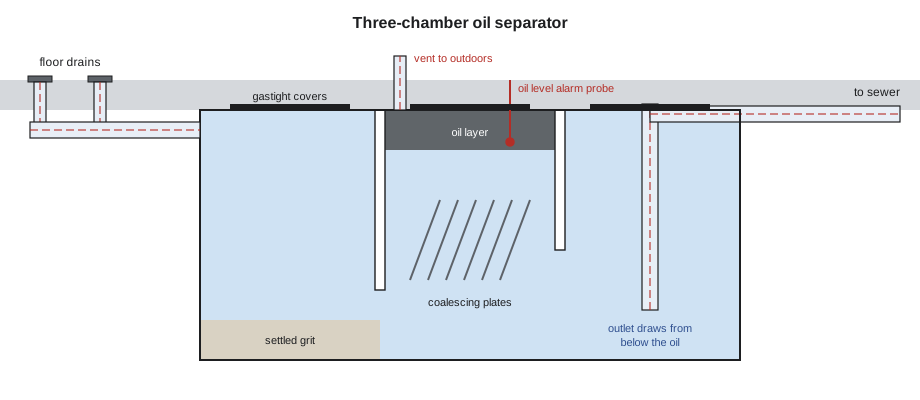
Parking garages, vehicle service areas, loading docks, mechanical rooms with oil-filled equipment and some industrial floors all collect oil and fuel in their floor drainage. The plumbing code requires these drains to pass through an oil interceptor, sometimes called an oil separator or flammable waste trap, before the waste reaches the building drain. The device is a tank in which oil and fuel float to the top and are held, while water leaves from below. Because gasoline vapors can ignite, the separator has its own vent carried to outdoors, separate from the building's sanitary vent system, and the access covers are gastight.
Large oil separators often have three chambers in series. The first slows the flow and lets grit settle. The second holds most of the oil. The third provides a final calm zone before the outlet. Some have an oil storage tank alongside with an automatic skimmer or an oil level alarm, so the operator knows when to pump it out. A separator for a vehicle service area may also include a coalescing pack, a set of plates that helps tiny oil droplets merge into larger ones that rise more quickly.
Garage drainage brings its own decisions. Covered parking levels collect oil, antifreeze and road salt dripping from cars, so their floor drains usually discharge through an oil separator to the sanitary sewer. An open top deck collects rain, and many authorities let it drain to the storm sewer, sometimes through its own oil and grit separator. Ramps that carry rain into a covered level need trench drains that are treated according to where they discharge. The designer and the authority having jurisdiction decide which system each drain belongs to, and the plumber must follow the drawings exactly, because connecting a covered garage drain to the storm sewer can send oil into a creek.
Worked problem
Sizing an oil separator by retention
The Kingsway parking level P1 has 14 floor drains connected to one oil separator. The engineer's practice method for this project assumes a combined design flow of 60 gpm from wash-down and dripping, a retention time of 10 minutes, and an extra 25 percent of volume for oil and grit storage. What working volume does the separator need?
Show solution
- Retention volume: 60 gpm × 10 min = 600 gal.
- Storage allowance: 600 × 0.25 = 150 gal.
- \[V = q\,t\,(1 + s) = 60 \times 10 \times 1.25 = 750\ \text{gal}\]
Answer: About 750 gal. The engineer then chooses a listed separator at least this size and checks it against the local authority's requirements.
# Separator sizing by retention - course PRACTICE method
def working_volume_gal(flow_gpm, retention_min, storage_frac):
    retention = flow_gpm * retention_min
    return retention * (1 + storage_frac)

cases = {
    "P1 garage oil separator": (60, 10, 0.25),
    "car-wash sand interceptor": (40, 15, 0.50),
    "mechanical room oil trap": (15, 10, 0.25),
}
for name, (q, t, s) in cases.items():
print(f"{name:27s} {q:3d} gpm, {t:2d} min, +{int(s * 100):2d}% -> {working_volume_gal(q, t, s):6.0f} gal")P1 garage oil separator 60 gpm, 10 min, +25% -> 750 gal car-wash sand interceptor 40 gpm, 15 min, +50% -> 900 gal mechanical room oil trap 15 gpm, 10 min, +25% -> 188 gal
Sand and grit interceptors
Car washes, vehicle wash bays, some industrial processes and areas where floors are hosed down produce sand and grit that settle in drains and wear out pumps. A sand interceptor is a tank with enough depth and retention for heavy particles to settle before the water leaves. Car-wash interceptors are often multi-chambered concrete tanks that also trap oil, because vehicle washing removes both. They need frequent cleaning, since a wash bay in winter can fill a sand chamber with road grit in weeks.
At Kingsway, the residents' car-wash bay drains to a two-chamber sand and oil interceptor before joining the sanitary building drain. The car-wash supply also has a backflow preventer, because the pressure washer and soap injector are a hazard to the drinking water. That connection was covered in PLB-320.
Solids interceptors: hair, lint, plaster and more
Several kinds of interceptor catch specific solids that would otherwise block drains.
- Hair interceptors on salon and barbershop sinks and on hydrotherapy tubs use a removable basket to catch hair before it forms mats in the drain.
- Lint interceptors on commercial laundries catch fibers and buttons from washing machine discharge. Without them, lint builds up into thick plugs in building drains, especially at changes of direction.
- Plaster interceptors, often called plaster traps, sit under sinks in hospital cast rooms, orthopedic clinics and dental laboratories. Plaster of Paris and casting materials harden in pipes like concrete. The trap has a settling chamber and a removable bucket that catches plaster before it reaches the drain. Lesson 8 returns to these in the hospital context.
- Glass and bottle interceptors and solids separators appear in bottling plants, laboratories and some food processing, catching broken glass and bulk solids.
- Fish, meat and food-solids interceptors protect drains in processing areas and sometimes sit ahead of grease interceptors so that solids do not fill the grease unit.
All of these devices must be accessible, because they work only if someone empties them. A lint basket buried behind a washer or a plaster trap under a sealed cabinet will be ignored until the drain blocks. Good installation puts the cleanout or basket where the operator can reach it, with enough clearance to lift it out without spilling.
Dental amalgam separators
The Kingsway dental clinic brings a special case. Old silver fillings contain mercury bound in an amalgam. When dentists remove or place fillings, fine particles of amalgam go down the chair-side suction and into the vacuum system's wastewater. Mercury is toxic and persistent; once in the sewer it ends up in treatment plant sludge or the environment. The US Environmental Protection Agency's dental effluent rule requires most dental offices that place or remove amalgam to install separators meeting ISO 11143, to inspect and maintain them, and to keep records, and many states and cities add their own requirements.
An amalgam separator is installed in the dental vacuum line, usually near the vacuum pump in the mechanical room. Most use sedimentation in a container where the heavy amalgam particles settle out, sometimes combined with filtration or a centrifuge. The plumber or the dental equipment installer connects it so that all the chair-side waste passes through it before reaching the drain, with an air gap at the drain connection. The container is replaced at intervals set by the manufacturer and the regulations, and the old one is sent for mercury recovery. Plumbers must not bypass a separator during repairs, even temporarily.
Neutralizers and other chemical treatment
Some separators are really treatment devices. Acid neutralizing tanks raise the pH of laboratory waste by passing it through limestone chips. Condensate neutralizers on high-efficiency boilers and furnaces do the same for the mildly acidic condensate those appliances produce. Cooling tower blowdown and some process waste may need temperature control or chemical treatment before discharge. Lesson 8 covers acid waste and neutralization in detail. The common rule is that what enters the public sewer must meet the municipality's limits for pH, temperature, metals and other substances, and the building owner is responsible for meeting them.
Installation, venting and maintenance
Every separator is installed to the manufacturer's instructions and the code. Common requirements include a trap or water seal on the inlet or outlet, a vent sized to the code, access covers that seal and that can be opened without tools being lowered into a confined space, and enough room around the unit for cleaning. Separators handling flammable liquids need gastight covers and independent vents. Units in traffic areas need covers rated for the load. Outdoor units need freeze protection and a sample point. Before the system is put into service, each separator is filled with water and tested for leaks.
Maintenance is where separators succeed or fail. Oil separators are pumped by licensed waste haulers, and the oil goes to recycling or disposal as hazardous waste. Sand interceptors are cleaned out by vacuum truck. Lint and hair baskets are emptied by staff. The owner keeps records, because municipal inspectors may ask for them. The plumber's job at handover is to explain each device to the owner's maintenance staff: what it catches, how full it can get before it stops working, how it is emptied and who is allowed to empty it.
Large separator vaults are confined spaces. Vapor from fuel, hydrogen sulfide from decaying material and low oxygen can all be present. No one enters without atmospheric testing, ventilation, a permit and a standby attendant, and for flammable-liquid separators, without eliminating ignition sources. Maya noticed that the confined space signs on the Kingsway garage separator were installed before the water test, not after.
Installation details that decide whether separators work
Most separator failures come from the installation, not the unit. A separator set out of level does not hold its design water level, so oil or sand escapes over the outlet baffle. A separator set too deep makes cleaning difficult, so it is not cleaned, and it fills with sludge until it stops separating. An inlet connected to the outlet side, which is easier to do than it sounds when the tank is buried, sends untreated waste straight to the sewer. Plumbers check the flow arrows, the inlet and outlet elevations and the level of the unit before backfilling, and they protect the lids and access risers from traffic loads with the covers the design specifies.
Access is the other key. Each separator needs a cover that the maintenance contractor can open, clearance for the pump truck hose, and, for indoor units, enough headroom to lift the baskets or screens. In parking garages, separators are often placed under drive aisles, so their covers must be rated for vehicle loads. On the Kingsway P1 level, the oil separator cover sat in a painted, signed area that was kept clear of parking so the vacuum truck could reach it.
Finally, separators must be recorded. The owner's maintenance plan lists each unit, its capacity, its cleaning interval and the hauler who empties it, and many municipalities ask for cleaning records during inspections. A separator that is not on any list is one that will eventually be forgotten.
Common mistakes
MistakeVenting an oil separator into the building's sanitary vent system.
InsteadFlammable-liquid separators need their own vent carried to outdoors.
MistakeConnecting covered garage drains to the storm sewer.
InsteadCovered garage drains carry oil and usually go through an oil separator to the sanitary sewer; follow the drawings.
MistakeBurying a lint or plaster interceptor where it cannot be emptied.
InsteadSeparators must be accessible, or they will never be cleaned.
MistakeBypassing an amalgam separator during repairs.
InsteadMercury-laden waste must always pass through the separator; plan repairs so it stays in service.
Summary and key terms
- Separators keep materials that block drains, burn, or poison treatment and the environment out of the sewer.
- Oil separators hold floating oil and fuel, with gastight covers and independent vents to outdoors.
- Sand, lint, hair, plaster and solids interceptors catch specific materials and must be accessible for emptying.
- Dental offices that handle amalgam need ISO 11143 separators, maintained and recorded.
- Neutralizers and treatment devices bring discharges within municipal limits.
- Separators are confined spaces when entered, and their success depends on regular maintenance.
- Oil interceptor
- A tank that holds oil and light fuels floating on water before the waste enters the drain.
- Coalescing pack
- Plates that help small oil droplets merge into larger ones that rise faster.
- Sand interceptor
- A settling tank that removes sand and grit before wastewater enters the drain.
- Plaster trap
- An interceptor that catches plaster and casting materials before they harden in pipes.
- Amalgam separator
- A device that removes mercury-containing amalgam particles from dental wastewater.
Practice problems
Work each problem on paper first, then reveal the answer to check.
Using the practice method, size an oil separator for 45 gpm, 10 minutes of retention and 25 percent storage.
Show answer
45 × 10 = 450 gal; 450 × 1.25 ≈ 563 gal.
Why does an oil separator need its own vent?
Show answer
Fuel vapors are flammable and must not enter the sanitary vent system or the building.
Name three solids interceptors and where each is used.
Show answer
Lint for laundries, hair for salons, plaster for cast rooms and dental labs; others include glass and food-solids interceptors.
What standard do dental amalgam separators meet?
Show answer
ISO 11143.
Why are separator vaults confined spaces?
Show answer
Vapors, hydrogen sulfide and low oxygen can build up in a sealed tank.
Lesson quiz · 5 questions
Score 60% or more to complete this lesson.
Create a free account to save your progress, take quizzes and earn a certificate.