
PHYS-430 · Lesson 4 of 12 · 22 min
Distances: parallax, the magnitude system and the distance ladder
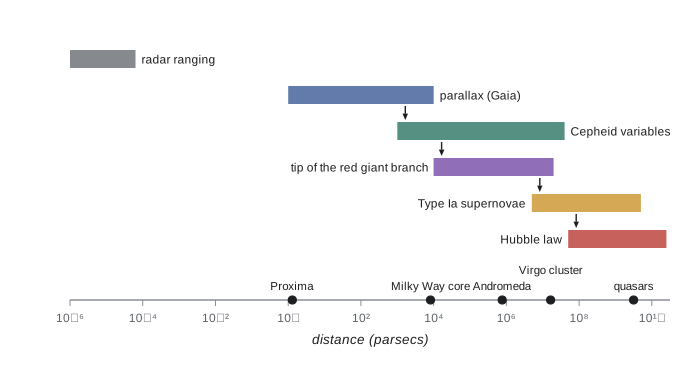
Distance is the hardest quantity to measure in astronomy and the most important. Without it a star's brightness says nothing about its power, an angle says nothing about a size, and a galaxy's speed says nothing about the age of the universe. There is no single method that works from the nearest stars to the most distant galaxies. Instead astronomers build a chain of methods, each calibrated by the one before, called the cosmic distance ladder. This lesson climbs it: first trigonometric parallax, the only direct geometric method for stars, then the magnitude system that astronomers use to express brightness, then the standard candles, Cepheid variables and Type Ia supernovae, that carry the ladder to distant galaxies.
Trigonometric parallax
Hold a finger at arm's length and close each eye in turn: the finger jumps against the background. The same happens to a nearby star as the Earth moves around the Sun. Over six months the Earth moves 2 AU, and the star appears to shift against much more distant background stars, tracing a small ellipse over the year. The parallax angle \(p\) is defined as half the total shift, the angle subtended at the star by 1 AU. Because the angle is tiny, the small-angle formula gives the distance directly: \(d = 1\ \text{AU}/p\) with \(p\) in radians. Writing \(p\) in arcseconds gives the definition of the parsec:
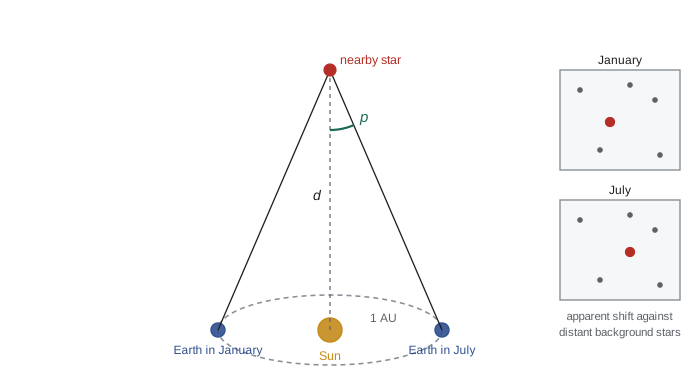
Even the nearest star, Proxima Centauri, has a parallax of only 0.768 arcseconds, about the angle of a coin seen from 5 km away. Astronomers searched for stellar parallax for centuries, partly because its absence was an argument against the Earth moving. Friedrich Bessel finally measured it in 1838, for the star 61 Cygni, finding about 0.31 arcseconds, close to the modern value of 0.286. Within two years Thomas Henderson and Friedrich Struve had measured Alpha Centauri and Vega. For the next 150 years ground-based parallaxes, limited by the atmosphere to about 0.01 arcseconds, gave reliable distances only out to about 30 parsecs, a few hundred stars.
Space changed this. The European Space Agency's Hipparcos satellite, which observed from 1989 to 1993, measured parallaxes to about 0.001 arcseconds for some 118,000 stars. Its successor Gaia, launched in 2013, scanned the whole sky repeatedly until 2025; its third data release in June 2022 listed positions and brightnesses for about 1.8 billion sources and parallaxes for about 1.5 billion, with precisions reaching about 0.02 milliarcseconds for bright stars. Gaia gives geometric distances to good accuracy across a large part of the Milky Way, and it anchors every rung of the ladder above it.
Apparent magnitudes
Astronomers describe brightness with the magnitude scale, a system older than physics. Hipparchus sorted the stars into six classes, the brightest being of the first magnitude and the faintest visible to the eye of the sixth. In 1856 Norman Pogson made the scale precise, noting that first-magnitude stars are about 100 times brighter than sixth-magnitude ones, and defining a difference of five magnitudes as exactly a factor of 100 in flux. One magnitude is then a factor of \(100^{1/5} = 2.512\). Because the eye responds roughly logarithmically, magnitudes are logarithmic, and because bright stars were first, larger magnitudes mean fainter objects. For two objects with fluxes \(F_1\) and \(F_2\),
The zero point is fixed by convention; historically Vega was set close to magnitude zero. Sirius, the brightest star at night, has \(m = -1.46\), Venus can reach about −4.6, the full Moon about −12.7, and the Sun −26.74. The faintest stars visible to the eye under a dark sky are near magnitude 6, the Hubble Space Telescope has reached about 31, and JWST deep fields go fainter still. Magnitudes are measured through filters that pass a limited band of wavelengths, such as the standard U, B and V filters for ultraviolet, blue and visual light. The difference between magnitudes in two filters, for example \(B - V\), is called a color index; it measures how blue or red a star is, and lesson 5 shows that it is a thermometer.
Absolute magnitude and the distance modulus
Apparent magnitude depends on distance. To compare the true power of stars, astronomers define the absolute magnitude \(M\) as the apparent magnitude an object would have at a standard distance of 10 parsecs. Since flux falls as \(1/d^2\), moving a star from 10 pc to distance \(d\) changes its magnitude by \(-2.5 \log_{10}(10/d)^2\), so
The quantity \(m - M\) is called the distance modulus, and astronomers often quote distances this way: a distance modulus of 0 means 10 pc, 5 means 100 pc, 10 means 1 kpc, and every 5 magnitudes is another factor of ten in distance. The Sun has an absolute visual magnitude of 4.83; seen from 10 pc it would be a faint but easily visible star. Absolute magnitude is just luminosity in logarithmic form: \(M_1 - M_2 = -2.5 \log_{10}(L_1/L_2)\) for stars measured in the same band.
Space between the stars is not empty. Dust grains, comparable in size to the wavelength of blue light, absorb and scatter starlight, dimming distant stars and reddening them, because blue light is scattered more than red, the same physics that makes sunsets red. The dimming in magnitudes is called extinction, \(A\), and it adds to the distance modulus: \(m - M = 5 \log_{10} d - 5 + A\). In the plane of the Milky Way \(A_V\) averages roughly one magnitude per kiloparsec, and toward the galactic center it reaches about 30 magnitudes in visible light, which is why the center can be studied only in the infrared, radio and X-rays. Ignoring extinction makes stars seem farther away than they are.
import math
def d_from_parallax(p_mas): return 1000.0 / p_mas          # parsecs
def dist_mod(d_pc, A=0.0): return 5 * math.log10(d_pc) - 5 + A
def d_from_mod(mu, A=0.0): return 10 ** ((mu - A + 5) / 5)
stars = [("Proxima Centauri", 768.07, 11.13), ("Sirius", 379.21, -1.46),
         ("Vega", 130.23, 0.03), ("Betelgeuse", 5.95, 0.42), ("Deneb", 2.31, 1.25)]
print(f"{'star':17s}{'parallax (mas)':>15s}{'d (pc)':>9s}{'m_V':>7s}{'M_V':>7s}{'L/L_sun':>11s}")
for name, p, m in stars:
    d = d_from_parallax(p)
    M = m - dist_mod(d)
    L = 10 ** (-0.4 * (M - 4.83))
    print(f"{name:17s}{p:15.2f}{d:9.1f}{m:7.2f}{M:7.2f}{L:11.3g}")
print("Deneb: Hipparcos parallax; its distance is uncertain, with estimates from about 430 to 800 pc")
# a star with true distance 2000 pc in the galactic plane, extinction 1 mag per kpc
d_true, A = 2000.0, 2.0
m = 1.0 + dist_mod(d_true, A)        # a star with M_V = +1.0
print(f"apparent V = {m:.2f}; ignoring extinction would give d = {d_from_mod(m - 1.0):.0f} pc instead of {d_true:.0f} pc")star parallax (mas) d (pc) m_V M_V L/L_sun Proxima Centauri 768.07 1.3 11.13 15.56 5.12e-05 Sirius 379.21 2.6 -1.46 1.43 22.8 Vega 130.23 7.7 0.03 0.60 49 Betelgeuse 5.95 168.1 0.42 -5.71 1.64e+04 Deneb 2.31 432.9 1.25 -6.93 5.07e+04 Deneb: Hipparcos parallax; its distance is uncertain, with estimates from about 430 to 800 pc apparent V = 14.51; ignoring extinction would give d = 5024 pc instead of 2000 pc
The table shows the enormous range of stellar power: Proxima Centauri emits only about 1/20,000 of the Sun's visible light, while Deneb emits tens of thousands of times more. The visual luminosities here count only light in the V band; lesson 5 adds the bolometric correction that converts to total power. The last line shows that two magnitudes of extinction, ignored, would put a star at 5 kpc instead of 2, an error of a factor of 2.5. Parallaxes, which do not depend on extinction, are what let astronomers measure it.
Standard candles
Beyond the reach of parallax, distances come from standard candles: objects whose luminosity is known from their other properties. If we know \(M\) and measure \(m\), the distance modulus gives \(d\). The idea is only as good as the calibration of \(M\), which must come from examples close enough for a lower rung of the ladder.
The most important standard candles are the Cepheid variables, bright pulsating giant stars named after Delta Cephei, which rise and fall in brightness with periods of about 1 to 100 days. In 1912 Henrietta Swan Leavitt, studying photographic plates of the Small Magellanic Cloud at Harvard College Observatory, found that its brighter Cepheids had longer periods. Because all the stars in the cloud are at essentially the same distance, the relation had to be one between period and true luminosity. Once a few Cepheids were calibrated, measuring a Cepheid's period gives its absolute magnitude, and its apparent magnitude then gives its distance. The physics behind the pulsation, explained by Arthur Eddington and later by Sergei Zhevakin and John Cox, is a valve in the star's outer layers: a zone of partly ionized helium traps heat when compressed and releases it when expanded, driving the oscillation like a heat engine. Bigger, more luminous Cepheids have lower mean densities and so pulsate more slowly, since the period of a self-gravitating body scales as \(1/\sqrt{G\rho}\), the free-fall time of lesson 1.
Edwin Hubble used Cepheids in 1924 to show that the Andromeda nebula is far outside the Milky Way, settling the debate about whether the spiral nebulae are separate galaxies. A modern calibration of the period–luminosity relation in visual light, based on Hubble Space Telescope parallaxes of nearby Cepheids, is approximately
Worked problem
A Cepheid in the Andromeda galaxy
A Cepheid in the Andromeda galaxy has a period of 31.4 days and a mean apparent visual magnitude of 19.6. The extinction toward it is about 0.2 magnitudes. How far away is it?
Show solution
- \(\log_{10} 31.4 = 1.497\), so \(M_V = -2.43 \times 0.497 - 4.05 = -5.26\).
- The distance modulus corrected for extinction is \(19.6 - (-5.26) - 0.2 = 24.66\).
- \(d = 10^{(24.66 + 5)/5} = 10^{5.93} = 8.6 \times 10^5\) pc.
Answer: About 0.86 Mpc, or 2.8 million light years, close to modern estimates of about 0.77 Mpc. Hubble's first estimate in 1924 was about a third of this, because the Cepheid calibration of the time confused two different kinds of pulsating star.
Cepheids are bright enough for the Hubble and Webb telescopes to see in galaxies out to about 40 Mpc. A second method used at similar distances is the tip of the red giant branch: red giants about to ignite helium all reach nearly the same peak luminosity, absolute magnitude about −4 in the near infrared, so the brightest red giants in a galaxy mark a sharp edge in its color-magnitude diagram that serves as a standard candle. It works in old stellar populations, where there are no Cepheids, and is less affected by dust.
Beyond that, the ladder uses Type Ia supernovae, explosions of white dwarfs in binary systems that reach a peak absolute magnitude near −19.3, billions of times the Sun's luminosity, for a few weeks. They are not identical, but brighter ones fade more slowly, and correcting for this relation, discovered by Mark Phillips in 1993, makes them standard to about 6 to 8 per hundred in distance. Type Ia supernovae can be seen across billions of parsecs. They are calibrated by Cepheids or red giants in the few nearby galaxies that have hosted a supernova, and they in turn calibrate the Hubble law, the top rung, in which a galaxy's distance is inferred from its recession velocity.
import math, random
random.seed(430)
# Calibrate the Leavitt law from synthetic "parallax" Cepheids, then measure a distant galaxy.
a_true, b_true = -2.43, -4.05
def M_of_P(P, a, b): return a * (math.log10(P) - 1) + b
calib = []
for i in range(15):                                  # nearby Cepheids with Gaia-quality distances
    P = 10 ** random.uniform(0.5, 1.6)
    M = M_of_P(P, a_true, b_true) + random.gauss(0, 0.10)
    calib.append((math.log10(P) - 1, M))
n = len(calib); sx = sum(x for x, y in calib); sy = sum(y for x, y in calib)
sxx = sum(x * x for x, y in calib); sxy = sum(x * y for x, y in calib)
a = (n * sxy - sx * sy) / (n * sxx - sx * sx); b = (sy - a * sx) / n
print(f"fitted Leavitt law: M_V = {a:.2f} (log P - 1) {b:+.2f}")
# Cepheids in a galaxy at 20 Mpc (distance modulus 31.51), extinction 0.15 mag
mu_true, A = 5 * math.log10(20e6) - 5, 0.15
mus = []
for i in range(25):
    P = 10 ** random.uniform(1.0, 1.8)
    m = M_of_P(P, a_true, b_true) + mu_true + A + random.gauss(0, 0.12)
    mus.append(m - M_of_P(P, a, b) - A)
mu = sum(mus) / len(mus); err = (sum((x - mu)**2 for x in mus) / (len(mus) - 1))**0.5 / len(mus)**0.5
print(f"galaxy distance modulus {mu:.3f} +/- {err:.3f}  ->  d = {10**((mu + 5) / 5) / 1e6:.2f} Mpc (true 20.00)")
print(f"a 0.05 mag error in the zero point shifts every distance by {100 * (10**(0.05 / 5) - 1):.1f} per hundred")fitted Leavitt law: M_V = -2.33 (log P - 1) -4.04 galaxy distance modulus 31.502 +/- 0.024 -> d = 19.97 Mpc (true 20.00) a 0.05 mag error in the zero point shifts every distance by 2.3 per hundred
The last line shows why distance-ladder astronomers fight over a few hundredths of a magnitude. Every rung inherits the calibration errors of the rungs below, so a small systematic error in the parallax zero point or in the extinction correction moves every distance in the universe by the same fraction, and with it the expansion rate of the universe. Lesson 12 returns to this in the Hubble tension.
Common mistakes
MistakeThinking a larger magnitude means a brighter star.
InsteadThe scale runs backward: larger magnitudes are fainter, and the brightest objects have negative magnitudes.
MistakeTreating magnitude differences as ratios.
InsteadMagnitudes are logarithmic: a difference of 5 magnitudes is a flux ratio of 100, and 1 magnitude is 2.512.
MistakeUsing absolute magnitude for how bright a star looks.
InsteadAbsolute magnitude is the brightness at a standard 10 pc; apparent magnitude is what we see.
MistakeForgetting extinction in the distance modulus.
InsteadDust dims stars; ignoring it overestimates distances, sometimes by large factors in the galactic plane.
Summary and key terms
- Trigonometric parallax gives distances directly: \(d = 1/p\) parsecs for \(p\) in arcseconds; Gaia has measured parallaxes for over a billion stars.
- Magnitudes are logarithmic: \(m_1 - m_2 = -2.5 \log_{10}(F_1/F_2)\), with five magnitudes a factor of 100.
- Absolute magnitude is the apparent magnitude at 10 pc; the distance modulus is \(m - M = 5\log_{10} d - 5 + A\).
- Cepheid variables obey a period–luminosity relation discovered by Leavitt in 1912 and are the key standard candles for nearby galaxies.
- The tip of the red giant branch and Type Ia supernovae extend the ladder, and the Hubble law forms its top rung.
- Each rung inherits the systematic errors of those below, so calibration is critical.
- Parallax
- The apparent shift of a nearby star caused by the Earth's orbital motion.
- Apparent magnitude
- A logarithmic measure of observed brightness.
- Absolute magnitude
- The apparent magnitude an object would have at 10 parsecs.
- Distance modulus
- The difference \(m - M\), a logarithmic measure of distance.
- Standard candle
- An object of known luminosity used to measure distance.
Practice problems
Work each problem on paper first, then reveal the answer to check.
A star has a parallax of 0.025 arcseconds. How far away is it?
Show answer
\(1/0.025 = 40\) pc.
Two stars differ by 7.5 magnitudes. What is their flux ratio?
Show answer
\(10^{0.4 \times 7.5} = 10^3 = 1000\).
A star with \(M = 0\) is observed at \(m = 15\) with no extinction. What is its distance?
Show answer
\(10^{(15 + 5)/5} = 10^4\) pc, 10 kpc.
How bright would the Sun appear from 10 pc?
Show answer
Magnitude 4.83, its absolute magnitude, visible to the eye under a dark sky.
A Cepheid has a period of 10 days. What is its absolute visual magnitude by the relation above?
Show answer
\(\log_{10} 10 - 1 = 0\), so \(M_V = -4.05\).
Lesson quiz · 5 questions
Score 60% or more to complete this lesson.
Create a free account to save your progress, take quizzes and earn a certificate.