
PHYS-430 · Lesson 2 of 12 · 21 min
The sky and coordinates: positions, time and the celestial sphere
Before we can study a star we have to find it, and before we can compare observations made on different nights, at different places, by different telescopes, everyone has to agree on how positions in the sky are written down. This lesson builds the coordinate systems astronomers use, explains why the sky turns once in slightly less than a day, and shows how to calculate where a given star will be at any moment from any place on Earth. These ideas are geometry rather than astrophysics, but every later lesson depends on them, and they contain some real physics: the precession of the Earth's axis, the aberration of starlight and the motions of stars across the sky.
The celestial sphere
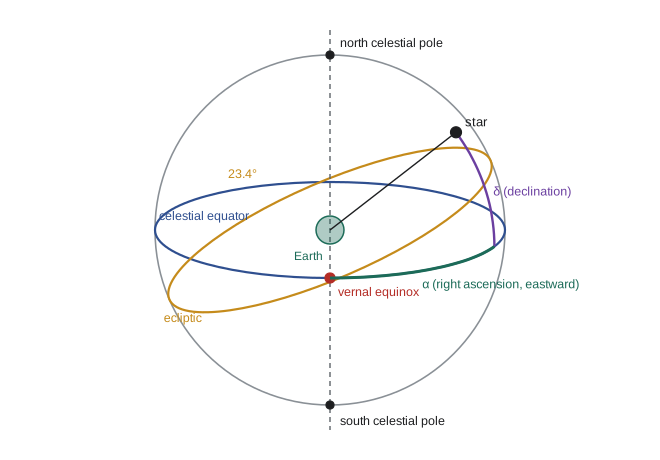
The stars are so far away that, for the purpose of locating them, we can pretend they lie on a huge sphere centered on the Earth. This imaginary celestial sphere has no physical reality, but it is a perfect bookkeeping device: a position on the sky is just a direction, and a direction can be described by two angles, like latitude and longitude on the Earth. The Earth's rotation axis, extended outward, meets the sphere at the north and south celestial poles. The Earth's equator, extended outward, traces the celestial equator. As the Earth turns west to east, the whole sphere appears to turn the other way about the poles once a day, which is why stars rise in the east, cross the sky and set in the west.
The Earth also orbits the Sun, so through the year the Sun appears to move against the background stars along a great circle called the ecliptic. The ecliptic is tilted to the celestial equator by about 23.44 degrees, the tilt of the Earth's axis, and the two circles cross at two points. The Sun crosses the equator going north at the vernal equinox, around 20 March, and going south at the autumnal equinox, around 22 September. The vernal equinox point is the zero of the main astronomical coordinate system, just as Greenwich is the zero of terrestrial longitude.
Horizon coordinates
The most natural way to say where something is in the sky is relative to your own horizon. The altitude is the angle above the horizon, from 0 degrees at the horizon to 90 degrees at the zenith, the point directly overhead. The azimuth is the compass direction, measured from north through east, so east is 90 degrees, south 180 and west 270. These horizon coordinates are what you need to point a telescope on an altitude-azimuth mount or to know whether a tree will block your view. Their drawback is that they change continuously as the Earth rotates, and they are different for every observer. A catalog of stars cannot be written in altitude and azimuth.
Two facts about the horizon system are worth remembering. First, the altitude of the north celestial pole equals the observer's latitude. In Minneapolis, at latitude 45.0 degrees north, Polaris, which lies within a degree of the pole, stands about 45 degrees above the northern horizon. Second, stars close enough to the pole never set: a star with declination greater than \(90^\circ - \phi\), where \(\phi\) is the latitude, is circumpolar. From the North Pole every visible star is circumpolar; from the equator none is, and every star spends half its time below the horizon.
Equatorial coordinates
To catalog stars we need coordinates attached to the sky itself. The equatorial system uses the celestial equator as its base. Declination \(\delta\) is the angle north or south of the celestial equator, from +90 degrees at the north celestial pole to −90 degrees at the south pole, exactly like latitude. Right ascension \(\alpha\) is the angle measured eastward along the equator from the vernal equinox, like longitude. By tradition right ascension is written in hours, minutes and seconds of time rather than degrees, with 24 hours making the full circle, so one hour equals 15 degrees. Vega, for example, is at \(\alpha = 18^\text{h}\,36^\text{m}\,56^\text{s}\), \(\delta = +38^\circ\,47'\).
The reason for using time is practical. As the sky turns, the stars cross the observer's meridian, the north-south line through the zenith, in order of increasing right ascension, one hour of right ascension per hour of sidereal time. The right ascension of the stars on your meridian at any moment is called the local sidereal time. If the local sidereal time is \(18^\text{h}\,37^\text{m}\), Vega is on the meridian and as high as it will get. The angle a star has moved past the meridian is its hour angle, \(H = \text{LST} - \alpha\). Given the hour angle, the declination and the observer's latitude, spherical trigonometry gives the altitude:
A matching formula gives the azimuth. A star is highest when \(H = 0\), when it crosses the meridian, and its maximum altitude is then \(90^\circ - |\phi - \delta|\). The ecliptic coordinate system, based on the ecliptic instead of the equator, is used for the solar system; galactic coordinates, based on the plane of the Milky Way with zero longitude toward the galactic center in Sagittarius, are used for the structure of our galaxy in lesson 10. Converting between systems is a rotation of axes.
Sidereal time and the solar day
A solar day, from one noon to the next, is 24 hours by definition. A sidereal day, the time for a star to return to the meridian, is shorter: 23 hours, 56 minutes and 4.1 seconds. The difference comes from the Earth's orbit. In one day the Earth moves about one degree around the Sun, so after one full rotation relative to the stars it must turn about one degree more to bring the Sun back to the meridian. One degree of rotation takes about four minutes. Over a year the extra turns add up to exactly one: the Earth rotates 366.24 times relative to the stars in 365.24 solar days. This is why the constellations visible at a given clock time drift westward through the year, about two hours of right ascension per month, and why Orion is a winter constellation in the northern evening sky.
Astronomers count days continuously with the Julian date, the number of days since noon on 1 January 4713 BCE in the Julian calendar. Noon on 1 January 2000 is JD 2451545.0, the reference epoch called J2000. A continuous day count makes it easy to compute time intervals and is essential for variable stars and planet transits. The Greenwich mean sidereal time is a simple linear function of the Julian date, and adding the observer's longitude, converted to hours, gives the local sidereal time. The program below uses these relations to find where several bright stars stand on a December evening.
import math
# Where are bright stars tonight? Local sidereal time and altitude/azimuth.
def julian_date(y, m, d, hour_ut):
    if m <= 2: y, m = y - 1, m + 12
    A = y // 100; B = 2 - A + A // 4
    return int(365.25 * (y + 4716)) + int(30.6001 * (m + 1)) + d + B - 1524.5 + hour_ut / 24
def gmst_hours(jd):
    return (18.697374558 + 24.06570982441908 * (jd - 2451545.0)) % 24
def alt_az(ra_deg, dec_deg, lat, lst_h):
    H = math.radians(lst_h * 15 - ra_deg)          # hour angle
    d, p = math.radians(dec_deg), math.radians(lat)
    alt = math.asin(math.sin(d) * math.sin(p) + math.cos(d) * math.cos(p) * math.cos(H))
    az = math.atan2(-math.cos(d) * math.sin(H), math.sin(d) * math.cos(p) - math.cos(d) * math.cos(H) * math.sin(p))
    return math.degrees(alt), math.degrees(az) % 360
CITY, LAT, LON = "Minneapolis", 44.98, -93.27
jd = julian_date(2026, 12, 21, 4.0)                 # 04:00 UT, the evening of 20 December locally
lst = (gmst_hours(jd) + LON / 15) % 24
print(f"JD = {jd:.4f}, GMST = {gmst_hours(jd):.3f} h, local sidereal time in {CITY} = {lst:.3f} h")
stars = {"Polaris": (37.95, 89.264), "Vega": (279.23, 38.78), "Capella": (79.17, 45.998),
         "Betelgeuse": (88.79, 7.41), "Sirius": (101.29, -16.72), "Antares": (247.35, -26.43)}
for name, (ra, dec) in stars.items():
    alt, az = alt_az(ra, dec, LAT, lst)
    state = "up" if alt > 0 else "below the horizon"
    circ = "circumpolar" if dec > 90 - LAT else ""
    print(f"{name:10s} alt {alt:6.1f} deg  az {az:6.1f} deg  {state:17s} {circ}")
print(f"stars with declination above {90 - LAT:.1f} deg never set; below {LAT - 90:.1f} deg never rise")JD = 2461395.6667, GMST = 9.983 h, local sidereal time in Minneapolis = 3.765 h Polaris alt 45.7 deg az 359.7 deg up circumpolar Vega alt 2.2 deg az 328.0 deg up Capella alt 74.1 deg az 78.2 deg up circumpolar Betelgeuse alt 43.2 deg az 133.4 deg up Sirius alt 16.1 deg az 135.4 deg up Antares alt -69.5 deg az 331.2 deg below the horizon stars with declination above 45.0 deg never set; below -45.0 deg never rise
At ten in the evening in late December, Capella is high in the east and climbing toward the zenith, Betelgeuse and Sirius have risen in the southeast, Vega is low in the northwest and about to set, and Antares, a summer star, is far below the horizon. Polaris stays at nearly the same altitude all night, its height equal to the latitude. The program uses J2000 coordinates and ignores precession, refraction and the small motions of the stars, so its altitudes are good to a fraction of a degree, enough to find a star by eye or with binoculars.
Precession and the changing sky
Equatorial coordinates are not fixed forever, because the Earth's axis is not fixed in space. The Sun and Moon pull on the Earth's equatorial bulge, and the resulting torque makes the axis sweep around a cone of half-angle 23.4 degrees, exactly as a spinning top's axis precesses under gravity. Hipparchus discovered the effect around 130 BCE by comparing his star positions with those recorded about 150 years earlier. One full circuit takes about 25,800 years. As the pole moves, the celestial equator and the equinoxes slide along the ecliptic by about 50.3 arcseconds a year, so every star's right ascension and declination slowly change. Catalogs therefore state the epoch of their coordinates, today usually J2000, and software precesses them to the date of observation.
Precession has visible consequences. Polaris is the pole star only by luck of the present era; around 3000 BCE the pole was near Thuban in Draco, and in about 12,000 years it will be near Vega. The vernal equinox has drifted from the constellation Aries, where it was when the zodiac was named, into Pisces. The astrological signs, fixed by tradition, are now about a whole constellation out of step with the stars behind the Sun.
Angles on the sky
Sizes and separations on the sky are angles, and astronomical angles are usually small. A degree is divided into 60 arcminutes and an arcminute into 60 arcseconds. The full Moon and the Sun are each about half a degree, 30 arcminutes, across. The human eye can resolve about one arcminute. Large ground-based telescopes are limited by the turbulent atmosphere to about half an arcsecond to one arcsecond on good nights, and the Hubble Space Telescope resolves about 0.05 arcseconds. For small angles the relation between angular size \(\theta\), physical size \(D\) and distance \(d\) is simply
This small-angle formula is used constantly. A star the size of the Sun at a distance of 10 parsecs would subtend \(2 \times 6.96 \times 10^8 / 3.09 \times 10^{17}\) radians, about one milliarcsecond, far too small to resolve with a single telescope. Only a few dozen nearby giant stars, such as Betelgeuse at about 0.04 arcseconds, have had their discs measured directly, by interferometry.
Worked problem
The height of Vega at transit
What is the greatest altitude of Vega, declination \(+38.8^\circ\), as seen from Minneapolis, latitude 45.0 degrees north? Is it ever overhead?
Show solution
- At transit the hour angle is zero, and the altitude is \(90^\circ - |\phi - \delta|\).
- \(|45.0 - 38.8| = 6.2^\circ\), so the maximum altitude is \(83.8^\circ\).
- A star passes through the zenith only if its declination equals the observer's latitude.
Answer: About 84 degrees, almost overhead; it never quite reaches the zenith from Minneapolis. Vega is also not circumpolar there, since its declination is less than \(90^\circ - \phi\).
Stars on the move
The stars are not truly fixed. Each moves through space, and the component of that motion across the line of sight shifts its position slowly, an effect called proper motion, usually measured in arcseconds or milliarcseconds per year. The record holder is Barnard's star, a nearby red dwarf that moves 10.4 arcseconds a year, the diameter of the full Moon in about 180 years. Most stars move far less, but over tens of thousands of years the shapes of the constellations change. Proper motion \(\mu\) and distance \(d\) give the tangential speed: \(v_t = 4.74\,\mu d\) km/s, with \(\mu\) in arcseconds per year and \(d\) in parsecs. The speed along the line of sight, the radial velocity, comes separately from the Doppler shift of spectral lines, and the two together give the full space velocity.
The Earth's own motion also shifts star positions. Because light has a finite speed, a moving observer sees light arriving from a direction tilted slightly forward, like rain that appears to slant toward a moving car. James Bradley discovered this aberration of starlight in 1729; it moves every star by up to 20.5 arcseconds, the ratio of the Earth's orbital speed of 29.8 km/s to the speed of light, expressed as an angle. Bradley's discovery was the first direct evidence that the Earth moves around the Sun and gave an early value for the speed of light. The much smaller annual shift caused by the Earth's change of position, parallax, gives the distances to the stars and is the subject of lesson 4.
Common mistakes
MistakeThinking right ascension increases westward like the daily motion.
InsteadRight ascension increases eastward; stars cross the meridian in order of increasing right ascension.
MistakeAssuming a sidereal day is 24 hours.
InsteadIt is 23 h 56 m 4 s, because the Earth's orbital motion adds about four minutes to the solar day.
MistakeTreating catalog coordinates as fixed for all time.
InsteadPrecession changes right ascension and declination by tens of arcseconds a year, so the epoch must be stated.
MistakeUsing degrees in the small-angle formula.
InsteadThe formula \(\theta = D/d\) needs radians; one radian is 206,265 arcseconds.
Summary and key terms
- Positions on the sky are directions on an imaginary celestial sphere, described by two angles.
- Altitude and azimuth describe positions relative to the local horizon and change as the Earth turns.
- Right ascension and declination are fixed to the sky, measured from the vernal equinox along the celestial equator.
- Local sidereal time equals the right ascension on the meridian; the hour angle is LST minus right ascension.
- Precession of the Earth's axis every 25,800 years slowly shifts all equatorial coordinates.
- Proper motion, radial velocity, aberration and parallax are small but measurable changes in star positions.
- Celestial equator
- The projection of the Earth's equator onto the sky.
- Right ascension
- The eastward angle from the vernal equinox along the celestial equator, in hours.
- Declination
- The angle north or south of the celestial equator.
- Sidereal time
- Time measured by the rotation of the Earth relative to the stars.
- Precession
- The slow circling of the Earth's rotation axis, period about 25,800 years.
Practice problems
Work each problem on paper first, then reveal the answer to check.
Convert a right ascension of 5 h 30 min to degrees.
Show answer
\(5.5 \times 15 = 82.5^\circ\).
At what declination are stars circumpolar from Minneapolis?
Show answer
Above \(90 - 45.0 = 45.0^\circ\).
Sirius has declination \(-16.7^\circ\). What is its maximum altitude from latitude \(50^\circ\) north?
Show answer
\(90 - |50 + 16.7| = 23.3^\circ\), low in the south.
How much earlier does a given star rise each night?
Show answer
About 3 minutes 56 seconds, the difference between solar and sidereal days.
A star at 20 pc has a proper motion of 0.5 arcseconds per year. What is its tangential speed?
Show answer
\(4.74 \times 0.5 \times 20 = 47\) km/s.
Lesson quiz · 5 questions
Score 60% or more to complete this lesson.
Create a free account to save your progress, take quizzes and earn a certificate.