
PHYS-430 · Lesson 11 of 12 · 24 min
Exoplanets: detection methods, demographics and habitability
For most of history, whether other stars have planets was a question for philosophers. In 1992 the first planets beyond the solar system were confirmed, and the count of known exoplanets now runs into the thousands: the NASA Exoplanet Archive listed 6,147 confirmed planets in March 2026, and the number grows every week. They have overturned expectations. Many planetary systems look nothing like ours, with giant planets closer to their stars than Mercury is to the Sun, and the most common planets in the galaxy, between the sizes of the Earth and Neptune, have no counterpart in the solar system at all. This lesson explains how planets too faint to see directly are found, what the census shows, and how astronomers judge whether a planet might be habitable.
Why planets are hard to see
The difficulty is contrast and separation. Seen from 10 pc, the Sun would outshine Jupiter by a factor of about a billion in visible light and the Earth by about ten billion, and the Earth would lie only 0.1 arcseconds from the Sun, inside the glare of the star's image in any ordinary telescope. So almost all exoplanets have been found indirectly, by their effects on their stars: the tug of the planet's gravity, which makes the star wobble, or the shadow of the planet as it crosses the star's face.
The first confirmed exoplanets, found in 1992 by Aleksander Wolszczan and Dale Frail, orbit a pulsar, revealed by tiny periodic variations in the arrival times of its pulses. A team at the University of British Columbia and the University of Victoria, Bruce Campbell, Gordon Walker and Stephenson Yang, had reported evidence in 1988 for a giant planet around the star Gamma Cephei, confirmed only in 2003. The discovery that changed the field came in 1995, when Michel Mayor and Didier Queloz of Geneva found 51 Pegasi b, a planet of about half Jupiter's mass orbiting a Sun-like star every 4.2 days, twenty times closer than Jupiter is to the Sun. Such hot Jupiters were not predicted by any theory of planet formation. Mayor and Queloz shared the 2019 Nobel Prize in Physics.
The radial velocity method
A planet and its star both orbit their common center of mass, as in the binary stars of lesson 6. The star's orbit is tiny, but its speed along our line of sight can be measured from the Doppler shift of its spectral lines. For a circular orbit of period \(P\) around a star of mass \(M_*\), with planet mass \(m_p \ll M_*\), combining Kepler's law with \(M_* v_* = m_p v_p\) gives the star's velocity semi-amplitude
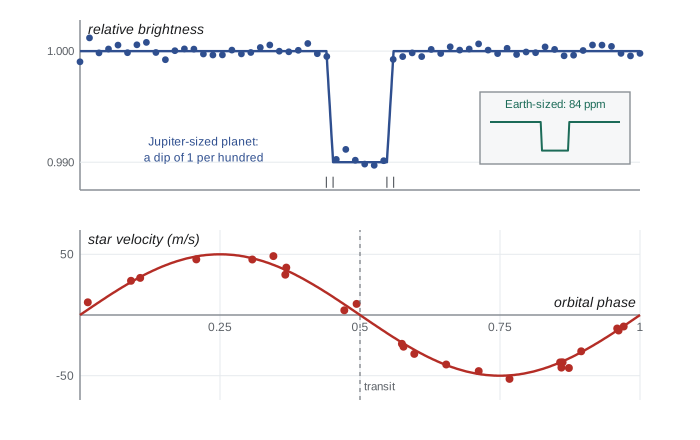
Jupiter makes the Sun wobble at 12.5 m/s with a 12-year period; the Earth makes it wobble at only 9 cm/s. Measuring such shifts means detecting changes of a few parts in a hundred million in the wavelengths of thousands of spectral lines, with spectrographs held at constant temperature and pressure and calibrated against laser frequency combs. Instruments such as HARPS in Chile reach about 1 m/s, and ESPRESSO on the Very Large Telescope about 10 to 30 cm/s, close to what is needed for an Earth around a Sun-like star. The real limit is the star itself: convection, spots and oscillations on its surface produce velocity jitter of a meter per second or more. Like a single-lined binary, the radial velocity method gives only \(m_p \sin i\), a minimum mass, unless the inclination is known.
The transit method
If a planet's orbit is nearly edge-on, it passes in front of its star once per orbit, blocking a small fraction of the light. The fractional dip in brightness, the transit depth, is the ratio of the areas of the two discs:
A Jupiter crossing the Sun dims it by about 1 per hundred, an Earth by about 84 parts per million. The probability that a randomly oriented orbit transits is about \(R_*/a\), only about 1 in 200 for an Earth-like orbit around a Sun-like star, so transit surveys must watch many thousands of stars at once. David Charbonneau and colleagues observed the first transit, of the planet HD 209458 b, in 1999. NASA's Kepler mission stared at a single field of about 150,000 stars in Cygnus and Lyra from 2009 to 2013, with a second phase called K2 until 2018, and found more than 2,600 confirmed planets, most of them smaller than Neptune. The Transiting Exoplanet Survey Satellite, TESS, launched in 2018, surveys nearly the whole sky for planets around bright nearby stars, ideal for follow-up.
Transits and radial velocities together are powerful. The transit gives the inclination, so the radial velocity mass becomes a true mass, and the transit depth gives the radius, so together they give the planet's density, which tells rock from gas. The transit duration, about \((P/\pi)(R_*/a)\) for a central transit, constrains the orbit. And during a transit some starlight filters through the planet's atmosphere, so the depth varies slightly with wavelength according to which gases absorb, the method of transmission spectroscopy. JWST detected carbon dioxide in the atmosphere of the hot Saturn WASP-39 b in 2022, the first unambiguous detection in an exoplanet atmosphere, and has since measured water, methane, sulfur dioxide and other molecules in many planets.
import math
G, Msun, Rsun, AU, Mj, Rj, Me, Re = 6.67430e-11, 1.989e30, 6.957e8, 1.496e11, 1.898e27, 7.149e7, 5.972e24, 6.371e6
yr, day = 3.15576e7, 86400.0
def K_star(mp, P, Ms=Msun, i=90.0):
    return (2 * math.pi * G / P) ** (1 / 3) * mp * math.sin(math.radians(i)) / Ms ** (2 / 3)
def a_of(P, Ms=Msun): return (G * Ms * P**2 / (4 * math.pi**2)) ** (1 / 3)
cases = [("Jupiter around the Sun", Mj, Rj, 11.86 * yr, Msun, Rsun),
         ("Earth around the Sun", Me, Re, 1.0 * yr, Msun, Rsun),
         ("hot Jupiter, 3-day orbit", Mj, 1.3 * Rj, 3 * day, Msun, Rsun),
         ("Earth-mass planet, 11-day orbit around an M dwarf (0.12 M_sun, 0.15 R_sun)", Me, Re, 11.2 * day, 0.12 * Msun, 0.15 * Rsun)]
for name, mp, rp, P, Ms, Rs in cases:
    a = a_of(P, Ms)
    K = K_star(mp, P, Ms)
    depth = (rp / Rs) ** 2
    prob = Rs / a
    dur = P / math.pi * math.asin(min(1.0, Rs / a)) / 3600
    print(f"{name}:")
    print(f"   a = {a / AU:.3f} AU, K = {K:.3g} m/s, transit depth = {depth * 1e6:,.0f} ppm,"
          f" transit probability = {prob:.3g}, central transit duration = {dur:.1f} h")
# detecting an Earth transit with Kepler-like precision: 30 ppm per 6.5 hours of data on a bright star
depth, sigma_6h, dur_h = 84e-6, 30e-6, 13.0
for n in (1, 3, 4):
    snr = depth / sigma_6h * math.sqrt(dur_h / 6.5 * n)
print(f"Earth analogue, {n} transit(s) observed: S/N = {snr:.1f}")Jupiter around the Sun: a = 5.201 AU, K = 12.5 m/s, transit depth = 10,560 ppm, transit probability = 0.000894, central transit duration = 29.6 h Earth around the Sun: a = 1.000 AU, K = 0.0894 m/s, transit depth = 84 ppm, transit probability = 0.00465, central transit duration = 13.0 h hot Jupiter, 3-day orbit: a = 0.041 AU, K = 141 m/s, transit depth = 17,846 ppm, transit probability = 0.114, central transit duration = 2.6 h Earth-mass planet, 11-day orbit around an M dwarf (0.12 M_sun, 0.15 R_sun): a = 0.048 AU, K = 1.17 m/s, transit depth = 3,727 ppm, transit probability = 0.0144, central transit duration = 1.2 h Earth analog, 1 transit(s) observed: S/N = 4.0 Earth analog, 3 transit(s) observed: S/N = 6.9 Earth analog, 4 transit(s) observed: S/N = 7.9
The numbers explain the history of the field. Hot Jupiters were found first because they give large, fast signals in both methods. An Earth analog around a Sun-like star gives a 9 cm/s wobble and an 84 ppm transit lasting about 13 hours once a year; even Kepler needed several transits to detect one with confidence, and only a handful of such candidates exist. Small cool stars change the picture: an Earth-mass planet in a short orbit around a red dwarf gives a radial velocity signal more than ten times larger and a transit more than forty times deeper. That is why the best-studied small planets, such as the seven of TRAPPIST-1, announced in 2017, and Proxima Centauri b, found by radial velocity in 2016, orbit red dwarfs.
Direct imaging, microlensing and astrometry
Three other methods fill in parts of the census the first two miss. Direct imaging blocks the starlight with a coronagraph and uses adaptive optics to see young, hot giant planets far from their stars, which glow in the infrared from the heat of their formation. In 2008 Christian Marois, at the National Research Council's Herzberg institute in Victoria, and colleagues imaged three planets orbiting the star HR 8799, the first image of a multi-planet system; a fourth was found in 2010. Gravitational microlensing uses the general-relativistic bending of light: when a star passes almost exactly in front of a more distant one, it acts as a lens and magnifies the background star for a few weeks, and a planet around the lens adds a brief extra spike. Microlensing finds planets far from their stars and even free-floating planets with no star at all, and NASA's Nancy Grace Roman Space Telescope, launched on 30 August 2026 toward the L2 point, will carry out a large microlensing survey of the galactic bulge. Astrometry measures the star's wobble across the sky; Gaia's precision will reveal thousands of giant planets this way in its final data releases.
The exoplanet census
Each method sees a different slice of the planet population, biased toward large planets and short periods for transits and radial velocities, wide orbits for imaging and microlensing. Correcting for these biases is a major part of the science. The results, mainly from Kepler, show that planets are the rule, not the exception: on average every star in the Milky Way has at least one planet. Hot Jupiters are rare, found around about 1 Sun-like star in 100. The most common planets known are super-Earths and sub-Neptunes, between about 1 and 4 Earth radii, in orbits shorter than about 100 days, a class absent from the solar system. Their radii show a gap near 1.5 to 2 Earth radii, the radius valley identified in 2017: smaller planets are rocky, larger ones have hydrogen envelopes, and planets near their stars seem to have lost their envelopes to stellar radiation or to the heat of their own formation.
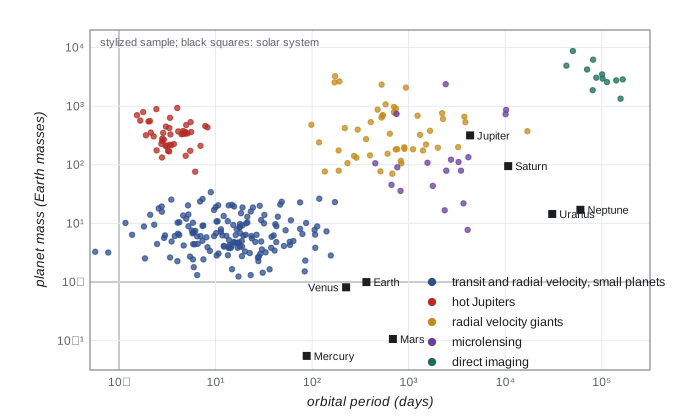
The census also reveals the history of planetary systems. Planets form in the discs of gas and dust around young stars described in lesson 8; ALMA's images of such discs show rings and gaps carved by forming planets. Hot Jupiters cannot have formed so close to their stars, where it is too hot for ices to condense, so they must have migrated inward through interactions with the disc or with other planets. Many planets have eccentric orbits, unlike the near-circular orbits of the solar system, suggesting violent gravitational scattering. The solar system, with its giant planets far out, no planets inside Mercury's orbit and no super-Earth, appears to be somewhat unusual, though not unique.
Habitability
A planet's temperature depends on how much starlight it absorbs and how well its atmosphere traps heat. Ignoring the atmosphere, a planet at distance \(a\) from a star of luminosity \(L\), with albedo \(A\), the fraction of light it reflects, reaches an equilibrium temperature at which it radiates as much as it absorbs. Balancing absorbed power \((1 - A) L \pi R_p^2/4\pi a^2\) against emitted power \(4\pi R_p^2 \sigma T^4\) gives
For the Earth this gives 255 K, 33 degrees colder than the actual mean surface temperature of 288 K; the difference is the greenhouse effect you met in thermal physics. The habitable zone is the range of distances where a rocky planet with a suitable atmosphere could keep liquid water on its surface. Its inner edge is set by a runaway greenhouse, in which evaporating oceans trap more heat and boil away, as may have happened on Venus; its outer edge by the point where even a thick carbon dioxide atmosphere cannot keep water liquid. Climate models put the Sun's conservative habitable zone at roughly 0.95 to 1.7 AU. Because the edges scale as \(\sqrt{L}\), the habitable zone of a red dwarf lies very close in, at a few hundredths of an AU, where planets are likely to be tidally locked, always turning the same face to their star, and are exposed to intense flares.
import math
sigma, Lsun, AU = 5.670374419e-8, 3.828e26, 1.496e11
def T_eq(L, a, A=0.3): return ((1 - A) * L / (16 * math.pi * sigma * a**2)) ** 0.25
# Habitable zone edges scale with sqrt(L); conservative solar values about 0.95 and 1.70 AU (they also depend slightly on T_star)
def hz(L_rel): return 0.95 * math.sqrt(L_rel), 1.70 * math.sqrt(L_rel)
print(f"Earth (A = 0.30): T_eq = {T_eq(Lsun, AU):.0f} K; actual mean surface temperature 288 K")
print(f"Venus (A = 0.76): T_eq = {T_eq(Lsun, 0.723 * AU, 0.76):.0f} K; actual surface about 737 K, a runaway greenhouse")
print(f"Mars  (A = 0.25): T_eq = {T_eq(Lsun, 1.524 * AU, 0.25):.0f} K")
print()
print(f"{'star':26s}{'L/L_sun':>9s}{'HZ inner (AU)':>15s}{'HZ outer (AU)':>15s}{'period at HZ middle':>21s}")
for name, L, M in (("A star like Sirius A", 25.4, 2.06), ("Sun", 1.0, 1.0), ("K dwarf", 0.3, 0.75),
                   ("M dwarf (0.4 M_sun)", 0.03, 0.4), ("Proxima Centauri", 0.00155, 0.122), ("TRAPPIST-1", 0.00055, 0.09)):
    lo, hi = hz(L)
    mid = (lo + hi) / 2
    P_days = math.sqrt(mid**3 / M) * 365.25
    print(f"{name:26s}{L:9.4g}{lo:15.3f}{hi:15.3f}{P_days:17.1f} days")
for name, a_AU, L in (("Proxima b", 0.0485, 0.00155), ("TRAPPIST-1 e", 0.0293, 0.00055)):
print(f"{name}: T_eq = {T_eq(L * Lsun, a_AU * AU):.0f} K for albedo 0.3")Earth (A = 0.30): T_eq = 255 K; actual mean surface temperature 288 K Venus (A = 0.76): T_eq = 229 K; actual surface about 737 K, a runaway greenhouse Mars (A = 0.25): T_eq = 210 K star L/L_sun HZ inner (AU) HZ outer (AU) period at HZ middle A star like Sirius A 25.4 4.788 8.568 4391.4 days Sun 1 0.950 1.700 557.1 days K dwarf 0.3 0.520 0.931 260.8 days M dwarf (0.4 M_sun) 0.03 0.165 0.294 63.5 days Proxima Centauri 0.00155 0.037 0.067 12.5 days TRAPPIST-1 0.00055 0.022 0.040 6.7 days Proxima b: T_eq = 229 K for albedo 0.3 TRAPPIST-1 e: T_eq = 228 K for albedo 0.3
A habitable zone is a starting point, not a guarantee. Mars sits inside the Sun's zone yet is frozen, having lost most of its atmosphere; Venus sits just inside the inner edge. Whether a planet is habitable also depends on its mass, atmosphere, magnetic field, geology and history. The next step is to read the atmospheres of rocky planets in their habitable zones and look for biosignatures, combinations of gases such as oxygen and methane that are hard to sustain without life. JWST has begun to probe the atmospheres of the TRAPPIST-1 planets, and so far finds the inner ones to be bare rock or to have thin atmospheres at most. In 2025 a team reported tentative evidence, at about three standard deviations, for dimethyl sulfide, a gas made on Earth by marine life, in the atmosphere of K2-18 b, a sub-Neptune in its star's habitable zone; independent reanalyses did not confirm it, and the claim remains disputed. Detecting life beyond the solar system is likely to require dedicated future telescopes, such as NASA's proposed Habitable Worlds Observatory, able to image Earth-like planets directly.
Worked problem
Finding a planet's density
A planet transits a Sun-like star with a depth of 400 ppm, and radial velocities give a minimum mass of 8 Earth masses. Find its radius and density.
Show solution
- \(R_p/R_* = \sqrt{400 \times 10^{-6}} = 0.020\), so \(R_p = 0.020 \times 109\ R_\oplus = 2.2\ R_\oplus\).
- Because it transits, \(\sin i \approx 1\) and the true mass is about 8 Earth masses.
- Density \(= 5.51\ \mathrm{g/cm^3} \times 8/2.2^3 = 4.1\ \mathrm{g/cm^3}\).
Answer: About 2.2 Earth radii and 4.1 g/cm³, less dense than the Earth. It lies just above the radius valley and is probably a rocky core with a thin hydrogen envelope or a large fraction of water, a typical sub-Neptune.
Common mistakes
MistakeThinking most exoplanets were found by taking pictures of them.
InsteadNearly all were found indirectly, by transits or radial velocities; only a few dozen have been imaged directly.
MistakeTreating a radial-velocity mass as the true mass.
InsteadIt is \(m_p \sin i\), a minimum mass, unless the planet also transits or the inclination is otherwise known.
MistakeAssuming a planet in the habitable zone must have liquid water.
InsteadThe zone only marks where water could be liquid with a suitable atmosphere; Mars lies in the Sun's zone but is frozen.
MistakeThinking the transit depth gives a planet's mass.
InsteadIt gives the ratio of radii; the mass comes from radial velocities or transit timing.
Summary and key terms
- Thousands of exoplanets are known, more than 6,100 confirmed by March 2026; 51 Pegasi b in 1995 was the first around a Sun-like star.
- The radial velocity method measures the star's wobble, \(K_* \propto m_p \sin i\, P^{-1/3}\); Jupiter moves the Sun at 12.5 m/s, the Earth at 9 cm/s.
- Transits give \((R_p/R_*)^2\); combined with radial velocities they give densities, and transmission spectra probe atmospheres.
- Direct imaging, microlensing and astrometry find planets in wide orbits; each method has its own biases.
- Most stars have planets; super-Earths and sub-Neptunes are the most common type, and hot Jupiters are rare.
- Habitable zones scale as \(\sqrt L\); tentative biosignature claims such as K2-18 b remain unconfirmed.
- Exoplanet
- A planet orbiting a star other than the Sun.
- Radial velocity method
- Detecting a planet from the Doppler wobble of its star.
- Transit
- The passage of a planet in front of its star, dimming it slightly.
- Hot Jupiter
- A giant planet orbiting very close to its star, with a period of days.
- Habitable zone
- The range of orbital distances where liquid water could exist on a rocky planet's surface.
Practice problems
Work each problem on paper first, then reveal the answer to check.
What transit depth would a Neptune-sized planet (3.9 Earth radii) give on a Sun-like star?
Show answer
\((3.9/109)^2 = 1.3 \times 10^{-3}\), about 0.13 per hundred.
If a planet's period is eight times longer, how does its radial-velocity amplitude change, for the same mass?
Show answer
\(K \propto P^{-1/3}\), so it halves.
What is the probability that an orbit at 0.05 AU around a Sun-like star transits?
Show answer
\(R_*/a = 0.00465/0.05 = 0.093\), about 1 in 11.
A star has 4 times the Sun's luminosity. Where is the middle of its habitable zone?
Show answer
The zone scales as \(\sqrt L\), so about twice as far as the Sun's, near 2.6 AU.
Why do red dwarfs make it easier to find Earth-sized planets?
Show answer
The star is smaller and less massive, so the transit is deeper and the wobble larger, and the habitable zone is close in, giving short periods.
Lesson quiz · 5 questions
Score 60% or more to complete this lesson.
Create a free account to save your progress, take quizzes and earn a certificate.