
PHYS-430 · Lesson 12 of 12 · 24 min
Capstone: cosmology in brief — expansion, the cosmic microwave background and open questions
This course has moved outward from the Sun to the stars, from stars to galaxies. The last step is the universe as a whole: its size, its age, what it is made of and how it began. Cosmology is the subject of the later course on general relativity and cosmology, which develops the Friedmann equations properly. This capstone draws on everything in this course to tell the observational story: how the distance ladder of lesson 4 revealed that the universe is expanding, how the blackbody radiation of thermal physics survives as the cosmic microwave background, how the light elements and the dark matter of lesson 10 fit together, and why some of the deepest questions in physics, including the nature of dark energy and a stubborn disagreement over the expansion rate, are open right now.
A dark night sky
Why is the sky dark at night? If the universe were infinite, unchanging and filled evenly with stars, every line of sight would eventually end on the surface of a star, and the whole sky would blaze as bright as the Sun's surface. The flux from each star falls as \(1/d^2\), but the number of stars in a shell of radius \(d\) grows as \(d^2\), so every shell contributes equally and the total diverges. This argument, named Olbers' paradox after Heinrich Olbers who discussed it in 1823, though Kepler and others had raised it earlier, has a profound answer: the universe is not both infinitely old and unchanging. Light from stars beyond a certain distance has not had time to reach us, because the universe has a finite age, and expansion redshifts and dims the light of distant sources. The darkness of the night sky is evidence that the universe had a beginning.
The expanding universe
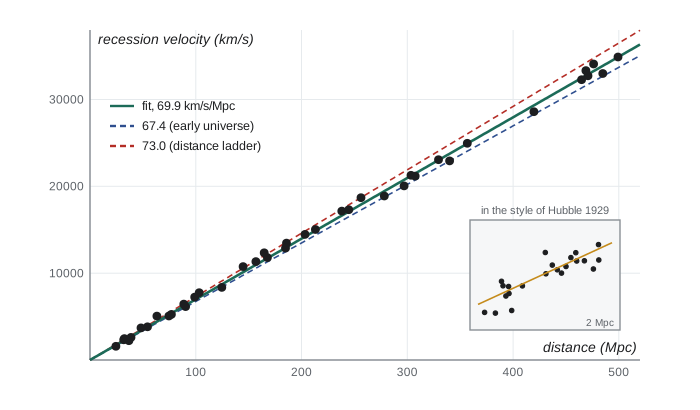
In the 1910s Vesto Slipher at Lowell Observatory measured the Doppler shifts of spiral nebulae and found that most were moving away from us, some at hundreds of kilometers per second. Once Hubble's Cepheids showed that the nebulae are distant galaxies, he combined their distances with Slipher's velocities and in 1929 announced that more distant galaxies recede faster, in proportion to their distance:
Georges Lemaître, a Belgian priest and physicist, had derived exactly this relation from general relativity and estimated its slope from published data in 1927, two years earlier, in a paper in a little-read journal; the International Astronomical Union recommended in 2018 that it be called the Hubble–Lemaître law. The constant \(H_0\), the Hubble constant, is now measured to be about 67 to 73 km/s per megaparsec. Hubble's own value, about 500, was far too large, because of the calibration errors in the distance ladder of lesson 4.
The law has a simple meaning: the universe is expanding uniformly. Every galaxy, apart from small local motions, is moving away from every other, and an observer in any galaxy would see the same law. Picture dots drawn on a balloon being inflated: every dot moves away from every other, faster for more distant dots, and no dot is the center. In general relativity it is space itself that expands, stretching the wavelengths of light traveling through it. The redshift \(z\) is defined by \(1 + z = \lambda_\text{obs}/\lambda_\text{emit}\), and it equals the factor by which the universe has expanded since the light was emitted. For small redshifts \(v \approx cz\), but the most distant galaxies JWST has seen have \(z\) above 14, light emitted when the universe was about one fifteenth of its present size.
import math, random
random.seed(12)
c = 299792.458                      # km/s
H_true = 70.0
data = []
for i in range(40):                 # Type Ia supernova host galaxies, 20 to 500 Mpc
    d_true = random.uniform(20, 500)
    v = H_true * d_true + random.gauss(0, 250)           # peculiar velocities of a few hundred km/s
    d_obs = d_true * 10 ** (random.gauss(0, 0.07) / 5)   # 0.07 mag scatter in distance modulus
    data.append((d_obs, v))
# least-squares slope through the origin
H = sum(d * v for d, v in data) / sum(d * d for d, v in data)
resid = [v - H * d for d, v in data]
s = math.sqrt(sum(r * r for r in resid) / (len(data) - 1))
err = s / math.sqrt(sum(d * d for d, v in data))
print(f"fitted H0 = {H:.1f} +/- {err:.1f} km/s/Mpc (true value used: {H_true})")
Mpc_km, Gyr_s = 3.0857e19, 3.156e16
for h in (67.4, 70.0, 73.0):
    print(f"H0 = {h}: Hubble time 1/H0 = {Mpc_km / h / Gyr_s:.2f} billion years")
# critical density 3 H^2 / (8 pi G)
G = 6.67430e-11
for h in (67.4, 73.0):
    Hs = h / Mpc_km
    rho = 3 * Hs**2 / (8 * math.pi * G)
print(f"critical density for H0 = {h}: {rho:.2e} kg/m^3 = {rho / 1.6735575e-27:.1f} hydrogen atoms per m^3")fitted H0 = 69.9 +/- 0.3 km/s/Mpc (true value used: 70.0) H0 = 67.4: Hubble time 1/H0 = 14.51 billion years H0 = 70.0: Hubble time 1/H0 = 13.97 billion years H0 = 73.0: Hubble time 1/H0 = 13.39 billion years critical density for H0 = 67.4: 8.53e-27 kg/m^3 = 5.1 hydrogen atoms per m^3 critical density for H0 = 73.0: 1.00e-26 kg/m^3 = 6.0 hydrogen atoms per m^3
The inverse of the Hubble constant, the Hubble time, is about 14 billion years: if galaxies had always moved apart at their present speeds, they would all have been together that long ago. The real age depends on how the expansion has changed, which depends on what the universe contains. The critical density, \(3H_0^2/8\pi G\), is the density for which gravity would just halt the expansion in a universe of ordinary matter; it is equivalent to only about five hydrogen atoms per cubic meter. Cosmologists express the density of each component as a fraction \(\Omega\) of the critical density.
The cosmic microwave background
If the universe is expanding, it was denser and hotter in the past. Going back far enough, it must have been a hot, dense plasma of nuclei, electrons and radiation, opaque like the inside of a star. As it expanded and cooled to about 3000 K, roughly 380,000 years after the beginning, electrons combined with nuclei to form neutral atoms, an event called recombination, and the universe became transparent. The light released then has traveled freely ever since, and the expansion has stretched its wavelengths by a factor of about 1100, cooling it from 3000 K to a few kelvins. George Gamow, Ralph Alpher and Robert Herman predicted this relic radiation in 1948, estimating a temperature of about 5 K.
In 1965 Arno Penzias and Robert Wilson, testing a sensitive horn antenna at Bell Laboratories in New Jersey, found a persistent microwave noise coming equally from every direction, corresponding to a temperature of about 3.5 K. A group at Princeton led by Robert Dicke, who were building an instrument to search for exactly this signal, recognized it at once. Penzias and Wilson shared the 1978 Nobel Prize in Physics. The radiation's spectrum, measured by the FIRAS instrument on NASA's COBE satellite in 1990, is the most perfect blackbody ever observed, at a temperature of 2.725 K, exactly as a hot early universe requires. COBE's DMR instrument found in 1992 that its temperature varies across the sky by about one part in 100,000, the seeds from which galaxies later grew; John Mather and George Smoot shared the 2006 Nobel Prize in Physics.
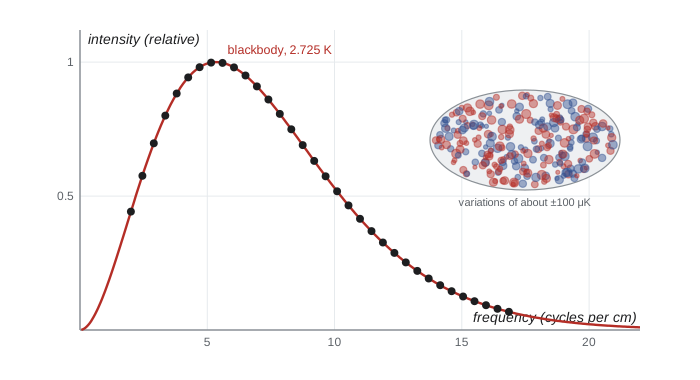
Later satellites, NASA's WMAP from 2001 and the European Space Agency's Planck from 2009 to 2013, mapped these fluctuations in detail. Their statistical pattern, a series of peaks in the power spectrum set by sound waves in the early plasma, is one of the most powerful measurements in science. It fixes the age of the universe at 13.8 billion years and its composition: about 4.9 per hundred ordinary matter, 26.5 dark matter and 68.5 dark energy, in a universe whose geometry is flat to within a fraction of a per hundred. This standard model of cosmology is called Lambda-CDM, for the cosmological constant \(\Lambda\) and cold dark matter.
The first three minutes
In the first few minutes, when the temperature was about a billion kelvins, the universe was a fusion reactor. Protons and neutrons combined into deuterium and then into helium-4, with traces of helium-3 and lithium-7, until expansion cooled the universe too much for further fusion. The calculation, begun by Alpher and Gamow in 1948 and refined since, predicts that about one quarter of the ordinary matter by mass ended up as helium, regardless of stellar processing later. That is what we find: the oldest stars and the most pristine gas clouds contain about 24 to 25 per hundred helium by mass, far more than stars could have made. The amount of deuterium is a sensitive measure of the density of ordinary matter, and it agrees with the 4.9 per hundred found from the microwave background, which is why we know that dark matter cannot be ordinary matter.
import math
# Age and lookback time in a flat Lambda-CDM universe: t = integral of da / (a H(a))
Mpc_km, Gyr_s = 3.0857e19, 3.156e16
def H(a, H0, Om, Ol, Or=9.1e-5):
    return H0 / Mpc_km * math.sqrt(Or / a**4 + Om / a**3 + Ol)
def age(a_end, H0, Om, Ol, n=20000):
    # integrate in ln a with the midpoint rule from a = 1e-8
    lo, hi = math.log(1e-8), math.log(a_end)
    h = (hi - lo) / n
    return sum(1 / H(math.exp(lo + (i + 0.5) * h), H0, Om, Ol) for i in range(n)) * h / Gyr_s
for label, H0, Om, Ol in (("Planck 2018 (H0 = 67.4)", 67.4, 0.315, 0.685),
                          ("same matter density, H0 = 73.0", 73.0, 0.315, 0.685),
                          ("matter only, no dark energy, H0 = 67.4", 67.4, 1.0, 0.0)):
    print(f"{label:40s} age = {age(1.0, H0, Om, Ol):.2f} billion years")
print()
t0 = age(1.0, 67.4, 0.315, 0.685)
for z in (0.1, 0.5, 1, 3, 6, 10, 14, 1100):
    a = 1 / (1 + z)
    t = age(a, 67.4, 0.315, 0.685)
    print(f"z = {z:6g}: universe {t * 1e3:9.1f} million years old, light travelled {t0 - t:6.2f} billion years,"
f" background temperature {2.725 * (1 + z):7.1f} K")Planck 2018 (H0 = 67.4) age = 13.79 billion years same matter density, H0 = 73.0 age = 12.73 billion years matter only, no dark energy, H0 = 67.4 age = 9.67 billion years z = 0.1: universe 12439.7 million years old, light traveled 1.35 billion years, background temperature 3.0 K z = 0.5: universe 8580.3 million years old, light traveled 5.21 billion years, background temperature 4.1 K z = 1: universe 5840.4 million years old, light traveled 7.95 billion years, background temperature 5.5 K z = 3: universe 2138.3 million years old, light traveled 11.65 billion years, background temperature 10.9 K z = 6: universe 926.8 million years old, light traveled 12.86 billion years, background temperature 19.1 K z = 10: universe 470.1 million years old, light traveled 13.32 billion years, background temperature 30.0 K z = 14: universe 294.8 million years old, light traveled 13.49 billion years, background temperature 40.9 K z = 1100: universe 0.4 million years old, light traveled 13.79 billion years, background temperature 3000.2 K
With the Planck parameters the universe is 13.8 billion years old, comfortably older than the 11 to 13 billion years of the oldest globular clusters of lesson 8. A universe of matter alone with the same Hubble constant would be only about 9.7 billion years old, younger than its oldest stars, one of several reasons cosmologists had suspected something beyond matter even before 1998. The table also shows why JWST is such a powerful machine for cosmology: galaxies at redshift 10 to 14 are seen less than 500 million years after the beginning, and at \(z = 1100\) the background radiation was at 3000 K, as hot as the surface of a cool star.
Dark energy and the accelerating universe
In 1998 two teams, the Supernova Cosmology Project led by Saul Perlmutter and the High-Z Supernova Search Team led by Brian Schmidt and Adam Riess, used Type Ia supernovae, the standard candles of lesson 4, to measure how the expansion rate has changed. They expected to find it slowing under gravity. Instead, distant supernovae were about 20 to 25 per hundred fainter than expected, farther away than a decelerating universe would put them: the expansion is accelerating. Perlmutter, Schmidt and Riess shared the 2011 Nobel Prize in Physics. The cause is called dark energy. The simplest explanation is Einstein's cosmological constant, an energy of empty space with negative pressure that stays constant as the universe expands, so that it now dominates, but its observed value is smaller by an enormous factor than naive estimates from quantum field theory, one of the deepest unsolved problems in physics.
Recent surveys have begun to test whether dark energy is really constant. The Dark Energy Spectroscopic Instrument, DESI, on the 4 m Mayall telescope at Kitt Peak, maps tens of millions of galaxies and quasars to measure the imprint of the early universe's sound waves, called baryon acoustic oscillations, as a standard ruler. Its second data release in March 2025, combined with the microwave background and supernovae, favored a dark energy that weakens with time over a pure cosmological constant, with a significance of roughly three to four standard deviations depending on which supernova sample is used, short of the five usually required for a discovery. The European Space Agency's Euclid telescope, launched in 2023, made its first quick data release on 19 March 2025, and its full survey, with Rubin's ten-year survey in the south, will sharpen these tests over the coming decade.
The Hubble tension
The distance ladder of lesson 4 and the microwave background of this lesson measure the Hubble constant in completely different ways, and they disagree. Planck's fit of Lambda-CDM to the microwave background gives \(H_0 = 67.4 \pm 0.5\) km/s/Mpc. The SH0ES team, led by Adam Riess, calibrating Type Ia supernovae with Cepheids anchored by geometric distances, finds about \(73.0 \pm 1.0\). The two differ by about five standard deviations. JWST has confirmed that the Cepheid measurements are not biased by crowding of stars in their host galaxies, as some had suspected. But a second ladder team, the Chicago–Carnegie Hubble Program led by Wendy Freedman, using the tip of the red giant branch and other methods with JWST, finds about 70, between the two. Whether the tension reflects remaining errors in the distance ladder or new physics in the early universe, such as an extra form of energy before recombination, is one of the liveliest questions in cosmology.
Worked problem
What would the age be if H0 were 73?
With the same composition, the age of a Lambda-CDM universe scales as \(1/H_0\). If Planck's 13.8 billion years corresponds to 67.4 km/s/Mpc, what age does 73.0 imply?
Show solution
- \(t \propto 1/H_0\), so \(t = 13.8 \times 67.4/73.0\).
- \(t = 12.7\) billion years.
Answer: About 12.7 billion years, as the program above also found, uncomfortably close to the ages of the oldest stars. The tension is not just about one number; it touches the whole consistency of the cosmological model.
Open questions
The picture that emerges from this course is remarkable. With laboratory physics, gravity, thermodynamics, atomic and nuclear physics, applied to light gathered by telescopes, we can trace the history of the universe from its first seconds through the formation of the light elements, the release of the microwave background, the growth of galaxies, the birth and death of stars that made the elements of our bodies, to planets like the Earth around ordinary stars. Yet the same picture says that about 95 per hundred of the universe is made of dark matter and dark energy, neither of which we understand. We do not know why the universe contains more matter than antimatter, what drove the very earliest expansion, whether dark energy is constant, how the first supermassive black holes grew so quickly, or whether life exists elsewhere. Each of these questions will be addressed by observations in the coming years, from Rubin, Euclid, Roman and JWST to neutrino detectors, gravitational-wave observatories and laboratory searches for dark matter. Astrophysics remains what this course began by calling it: the universe as a physics laboratory, still producing results that physics on Earth did not predict.
Common mistakes
MistakeThinking the Big Bang was an explosion from a center into empty space.
InsteadSpace itself expands everywhere; every observer sees galaxies receding, and there is no center.
MistakeInterpreting cosmological redshift as an ordinary Doppler shift at all distances.
InsteadAt large \(z\), \(1 + z\) is the expansion factor of space, and \(v = cz\) no longer holds.
MistakeAssuming the microwave background comes from a particular region of space.
InsteadIt fills all space; we see the part released at recombination at a distance set by light travel time.
MistakeTreating dark energy and dark matter as the same thing.
InsteadDark matter clumps and pulls; dark energy is smooth and drives the acceleration of the expansion.
Summary and key terms
- The dark night sky implies a universe of finite age; the Hubble–Lemaître law \(v = H_0 d\) shows that it is expanding.
- The Hubble time \(1/H_0\) is about 14 billion years; redshift \(1 + z\) measures how much the universe has expanded.
- The cosmic microwave background is a 2.725 K blackbody released at recombination 380,000 years after the beginning; its fluctuations fix the cosmic parameters.
- Big Bang nucleosynthesis made about 25 per hundred helium; ordinary matter is about 5 per hundred of the total, dark matter 27 and dark energy 68.
- Type Ia supernovae revealed accelerating expansion in 1998; DESI's 2025 results hint that dark energy may evolve.
- The Hubble tension between about 67 and 73 km/s/Mpc remains unresolved.
- Hubble constant
- The present expansion rate of the universe, \(H_0\), in km/s per Mpc.
- Redshift
- \(z = \lambda_\text{obs}/\lambda_\text{emit} - 1\), equal to the expansion factor minus one.
- Cosmic microwave background
- Blackbody radiation at 2.725 K left over from the hot early universe.
- Dark energy
- The unknown component, about 68 per hundred of the total, driving accelerated expansion.
- Lambda-CDM
- The standard cosmological model with a cosmological constant and cold dark matter.
Practice problems
Work each problem on paper first, then reveal the answer to check.
A galaxy recedes at 7000 km/s. With \(H_0 = 70\) km/s/Mpc, how far is it?
Show answer
\(7000/70 = 100\) Mpc.
A spectral line emitted at 121.6 nm is observed at 729.6 nm. What is the redshift?
Show answer
\(729.6/121.6 - 1 = 5.0\).
What was the temperature of the microwave background at \(z = 9\)?
Show answer
\(2.725 \times 10 = 27\) K.
Why does the age of the universe depend on its contents and not only on \(H_0\)?
Show answer
Matter decelerates the expansion and dark energy accelerates it, so the past expansion rate differed from today's.
What fraction of the universe is ordinary matter, according to Planck?
Show answer
About 4.9 per hundred.
Lesson quiz · 5 questions
Score 60% or more to complete this lesson.
Create a free account to save your progress, take quizzes and earn a certificate.