
PHYS-373 · Lesson 5 of 12 · 22 min
Atoms and solids: helium, the periodic table and free-electron gases
Lesson 4 established the rule that the wave function of identical fermions must be antisymmetric. This lesson applies it to the three systems where it matters most for the everyday world. Helium, the simplest atom with more than one electron, shows how the symmetry of the spatial wave function, tied to the total spin, produces two separate families of energy levels. Heavier atoms show how filling single-particle orbitals one or two electrons at a time builds the periodic table. And the electrons in a metal, treated as a gas of free fermions in a box, explain why metals conduct, why their electrons contribute so little to the heat capacity, and why a white dwarf star can hold itself up against gravity.
Helium: the Hamiltonian
With the nucleus fixed at the origin, the helium Hamiltonian is
Without the last term, the electron–electron repulsion, the problem separates into two hydrogen-like atoms with nuclear charge \(Z = 2\), and the energies are \(E = -54.4\ \text{eV}\,(1/n_1^2 + 1/n_2^2)\). The repulsion couples the electrons and has never been handled exactly, but much can be learned by treating it as a correction to the separated solutions, which lesson 6 will justify as first-order perturbation theory.
Parahelium and orthohelium
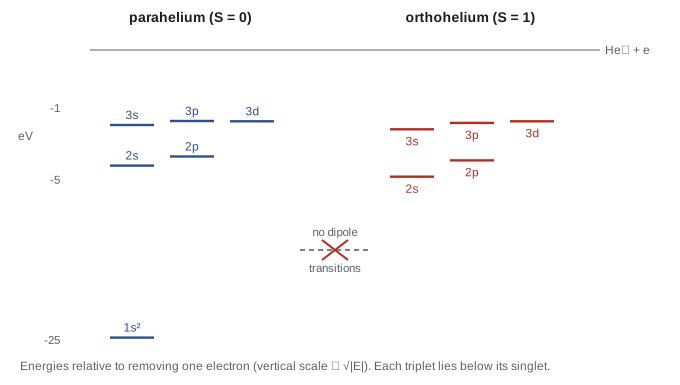
Consider the excited configuration \(1s2s\), one electron in each of the orbitals \(\psi_{100}\) and \(\psi_{200}\). The spatial wave function must be symmetric or antisymmetric, \(\psi_\pm = [\psi_{100}(\mathbf r_1)\psi_{200}(\mathbf r_2) \pm \psi_{200}(\mathbf r_1)\psi_{100}(\mathbf r_2)]/\sqrt2\), and lesson 4 showed that the symmetric one goes with the spin singlet and the antisymmetric one with the triplet. The expectation value of the repulsion in these states is
The direct integral \(J\) is the classical electrostatic energy of two charge clouds. The exchange integral \(K\) has no classical counterpart; it arises only because the wave function is symmetrized, and for these orbitals it is positive. So the singlet, with its symmetric spatial wave function, lies higher by \(2K\) than the triplet. The physical reason is the exchange effect of lesson 4: in the antisymmetric spatial state the electrons avoid each other and their repulsion is smaller. This is the origin of Hund's first rule, that among the levels of a configuration the one with the largest total spin usually lies lowest.
Because the electric-dipole interaction with light does not act on spin, transitions between singlet and triplet states are almost forbidden. Helium's spectrum therefore splits into two nearly independent systems, which nineteenth-century spectroscopists took for two different elements, parahelium (singlets) and orthohelium (triplets). The ground state \(1s^2\) has both electrons in the same orbital, so its spatial wave function must be symmetric and it exists only as a singlet. The lowest triplet, \(1s2s\,{}^3S_1\), cannot decay to the ground state by emitting a photon and survives for about two hours, the longest-lived excited state of any neutral atom.
The program computes \(J\) and \(K\) for the \(1s2s\) configuration with unscreened \(Z = 2\) hydrogenic orbitals and compares the result with the measured levels. It also, in its second part, evaluates the free-electron model of metals described later in the lesson.
import math
# Part 1: helium 1s2s with unscreened hydrogenic orbitals (Z = 2), atomic units (hartree, bohr)
Z = 2.0
R10 = lambda r: 2 * Z ** 1.5 * math.exp(-Z * r)
R20 = lambda r: (Z / 2) ** 1.5 * 2 * (1 - Z * r / 2) * math.exp(-Z * r / 2)
N, rmax = 4000, 30.0
h = rmax / N
rs = [(i + 0.5) * h for i in range(N)]

def two_electron(fa, fb, fc, fd):
    """Monopole (k = 0) Slater integral: int int fa(1) fb(1) fc(2) fd(2) / r_> r1^2 r2^2, valid for s orbitals."""
    inner = [0.0] * N; acc = 0.0                       # running integral of fc fd r^2 from 0 to r
    for i, r in enumerate(rs): acc += fc(r) * fd(r) * r * r * h; inner[i] = acc
    outer = [0.0] * N; acc = 0.0                       # running integral of fc fd r from r to infinity
    for i in range(N - 1, -1, -1): r = rs[i]; acc += fc(r) * fd(r) * r * h; outer[i] = acc
    return sum(fa(r) * fb(r) * r * r * (inner[i] / r + outer[i] - fc(r) * fd(r) * r * h) * h for i, r in enumerate(rs))

J = two_electron(R10, R10, R20, R20)
K = two_electron(R10, R20, R10, R20)
Ha = 27.211386
print("Helium 1s2s, unscreened Z = 2 orbitals")
print(f"  Coulomb integral J  = {J:.4f} hartree (exact 17/81 Z = {17 / 81 * Z:.4f}) = {J * Ha:.2f} eV")
print(f"  exchange integral K = {K:.4f} hartree (exact 16/729 Z = {16 / 729 * Z:.4f}) = {K * Ha:.2f} eV")
E0 = (-Z ** 2 / 2 - Z ** 2 / 8) * Ha
print(f"  without repulsion: {E0:.2f} eV; singlet {E0 + (J + K) * Ha:.2f} eV, triplet {E0 + (J - K) * Ha:.2f} eV")
print(f"  predicted singlet-triplet splitting 2K = {2 * K * Ha:.2f} eV (measured 2 1S - 2 3S: 0.80 eV)")
print()
# Part 2: free-electron Fermi energies
hbar, me, e, kB = 1.054571817e-34, 9.1093837e-31, 1.602176634e-19, 1.380649e-23
metals = {'Na': 2.65e28, 'Cu': 8.47e28, 'Al': 18.1e28}   # conduction-electron densities per m^3
print("Free-electron gas")
for name, n in metals.items():
    kF = (3 * math.pi ** 2 * n) ** (1 / 3)
    EF = hbar ** 2 * kF ** 2 / (2 * me)
    vF = hbar * kF / me
    P = (2 / 5) * n * EF
print(f" {name}: E_F = {EF / e:5.2f} eV T_F = {EF / kB:8.0f} K v_F = {vF / 1e6:.2f} Mm/s P = {P / 1e9:6.1f} GPa")Helium 1s2s, unscreened Z = 2 orbitals Coulomb integral J = 0.4198 hartree (exact 17/81 Z = 0.4198) = 11.42 eV exchange integral K = 0.0439 hartree (exact 16/729 Z = 0.0439) = 1.19 eV without repulsion: -68.03 eV; singlet -55.41 eV, triplet -57.80 eV predicted singlet-triplet splitting 2K = 2.39 eV (measured 2 1S - 2 3S: 0.80 eV) Free-electron gas Na: E_F = 3.24 eV T_F = 37612 K v_F = 1.07 Mm/s P = 5.5 GPa Cu: E_F = 7.03 eV T_F = 81612 K v_F = 1.57 Mm/s P = 38.2 GPa Al: E_F = 11.67 eV T_F = 135399 K v_F = 2.03 Mm/s P = 135.3 GPa
The integrals agree with the exact values \(J = 17Z/81\) and \(K = 16Z/729\) hartree, and the predicted splitting has the right sign, but at 2.39 eV it is three times the measured 0.80 eV. The orbitals are the culprit: the outer \(2s\) electron is partly screened by the inner one and sees an effective charge closer to 1 than 2, which makes its orbital larger and its overlap with the \(1s\) orbital, and hence \(K\), smaller. Lesson 8 shows how the variational method builds screening in.
The periodic table
For heavier atoms the central-field approximation is the starting point. Each electron is assumed to move in a spherically symmetric average potential produced by the nucleus and all the other electrons. Near the nucleus an electron feels the full charge \(Ze\); far outside, it feels a net charge of about \(e\), because the other electrons screen the rest. In a central field, angular momentum is still conserved, so single-particle states are still labeled by \(n\), \(\ell\), \(m_\ell\) and \(m_s\). But the degeneracy in \(\ell\) that made hydrogen special is lifted. States with low \(\ell\) penetrate closer to the nucleus, where screening is weaker, and are more tightly bound. So for a given \(n\), \(s\) lies below \(p\), which lies below \(d\).
The ground state of an atom is built by filling these orbitals in order of energy, two electrons per spatial orbital, \(2(2\ell + 1)\) per subshell, a procedure called the Aufbau principle. The empirical order, known as the Madelung rule, fills subshells in increasing \(n + \ell\), and for equal \(n + \ell\) in increasing \(n\): \(1s, 2s, 2p, 3s, 3p, 4s, 3d, 4p, 5s, 4d, 5p, 6s, 4f, 5d, 6p, 7s, 5f\). The rows of the periodic table end each time a \(p\) subshell is completed, at the noble gases, because the next electron must go into a new, much less tightly bound \(s\) orbital. That is why the noble gases have the largest ionization energies in each row and the alkali metals the smallest, the pattern PHYS-271 introduced. The \(4s\) orbital filling before \(3d\) creates the first transition series, from scandium to zinc, and the \(4f\) filling creates the lanthanides. There are exceptions, such as chromium (\(3d^5 4s^1\)) and copper (\(3d^{10} 4s^1\)), where half-filled or filled \(d\) subshells are favored.
Within a configuration, the arrangement of electrons among the \(m_\ell\) and \(m_s\) values is decided by Hund's rules, found empirically by Friedrich Hund in 1925. The level with the largest total spin \(S\) lies lowest (the exchange effect again); for that \(S\), the largest total \(L\) lies lowest; and the total \(J\) is \(|L - S|\) for less than half-filled shells and \(L + S\) for more than half-filled shells. Carbon, \(1s^2 2s^2 2p^2\), thus has ground term \({}^3P_0\), and oxygen, \(2p^4\), has \({}^3P_2\). The magnetism of iron and of rare-earth magnets in electric motors comes from the large spins that Hund's first rule produces in partly filled \(d\) and \(f\) shells.
The free-electron gas
In a metal, the outer electrons of each atom are not bound to any one atom. The simplest model, due to Arnold Sommerfeld in 1927, treats them as noninteracting fermions in a box of volume \(V\), ignoring the ions except for the box walls. With periodic boundary conditions, the single-particle states are plane waves \(e^{i\mathbf k\cdot\mathbf r}\) with wave vectors on a grid of spacing \(2\pi/L\), so each allowed \(\mathbf k\) occupies a volume \((2\pi)^3/V\) of \(k\)-space, and each holds two electrons. In the ground state the \(N\) electrons fill all states with \(|\mathbf k| < k_F\), a sphere in \(k\)-space called the Fermi sphere. Counting states,
where \(n = N/V\) is the electron density. The Fermi energy \(E_F\) is the energy of the highest occupied state. Integrating the kinetic energy over the sphere gives a total \(E = \tfrac35 N E_F\), and because \(E \propto V^{-2/3}\) at fixed \(N\), the gas exerts a pressure \(P = -\partial E/\partial V = \tfrac25 nE_F\), the degeneracy pressure. It has nothing to do with temperature; it would be there at absolute zero. It arises because squeezing the electrons forces them, by the exclusion principle, into states of higher momentum.
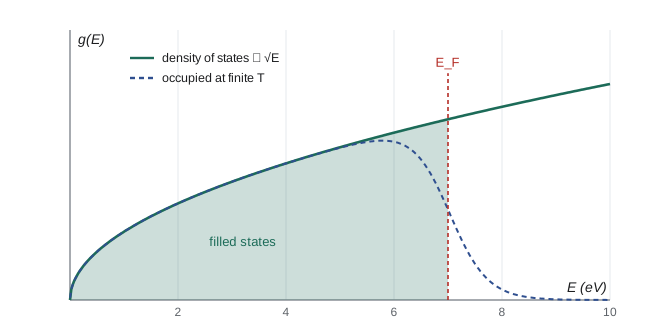
For copper, with one conduction electron per atom and \(n = 8.47 \times 10^{28}\ \text{m}^{-3}\), the program gives \(E_F = 7.0\) eV, a Fermi temperature \(E_F/k_B\) of 82,000 K and a Fermi speed of \(1.6 \times 10^6\) m/s, about 1/190 of the speed of light. The degeneracy pressure is 38 GPa, nearly 400,000 atmospheres; it is balanced by the attraction of the electrons to the positive ions. Because the Fermi temperature is so much larger than room temperature, the electron gas in a metal is cold in the quantum sense: almost all electrons are locked deep inside the Fermi sphere, unable to absorb small amounts of energy because the states just above them are full. Only the fraction of order \(k_BT/E_F \approx 1/300\) near the surface of the sphere can be thermally excited. This explains a long-standing puzzle of classical physics, that the electrons in a metal contribute almost nothing to its heat capacity, and it is why electrical conduction is carried by electrons near the Fermi energy. Lattice effects, studied in PHYS-410 Solid State Physics, modify the free-electron picture by opening gaps in the allowed energies, which distinguishes metals from semiconductors and insulators.
Degenerate stars
The same physics on a stellar scale explains white dwarfs. When a star like the Sun exhausts its nuclear fuel, its core contracts until the electrons are packed at densities of order \(10^{36}\) per cubic meter, about \(10^6\) grams per cubic centimeter. Their degeneracy pressure, not thermal pressure, then balances gravity. Balancing \(P \propto n^{5/3}\) against gravity gives a radius that shrinks as the mass increases, roughly the size of the Earth for a solar-mass white dwarf. At higher densities the electrons become relativistic, the pressure grows only as \(n^{4/3}\), and above the Chandrasekhar mass, about 1.4 solar masses, no equilibrium exists. In more massive collapsing cores, electrons combine with protons to make neutrons, and neutron degeneracy pressure, together with nuclear forces, supports neutron stars about 20 km across. Astrophysics, PHYS-430, follows these stars further.
Worked problem
Fermi energy of sodium
Sodium has density 971 kg per cubic meter, molar mass 23.0 g, and one conduction electron per atom. Find its Fermi energy.
Show solution
- Atoms per cubic meter: \(n = 971/0.0230 \times 6.022 \times 10^{23} = 2.54 \times 10^{28}\ \text{m}^{-3}\) at room temperature; the program uses the low-temperature value \(2.65 \times 10^{28}\).
- \(k_F = (3\pi^2 n)^{1/3} = (7.85 \times 10^{29})^{1/3} = 9.2 \times 10^9\ \text{m}^{-1}\) for \(n = 2.65 \times 10^{28}\).
- \(E_F = \hbar^2k_F^2/2m = (1.055 \times 10^{-34})^2 (9.2 \times 10^9)^2/(2 \times 9.11 \times 10^{-31}) = 5.2 \times 10^{-19}\ \text{J}\).
Answer: About 3.2 eV, the program's value. Measured photoemission spectra of sodium show an occupied band about 3 eV wide, close to the free-electron prediction.
Common mistakes
MistakeExpecting the helium singlet to lie lower because spins are paired.
InsteadFor excited configurations the triplet lies lower; its antisymmetric spatial wave function keeps the electrons apart.
MistakeAssigning the helium ground state to orthohelium.
InsteadBoth electrons are in \(1s\), so the spatial state is symmetric and the spin must be the singlet.
MistakeUsing hydrogen's \(\ell\)-degeneracy in many-electron atoms.
InsteadScreening makes low-\(\ell\) orbitals more tightly bound, so \(2s\) lies below \(2p\).
MistakeTreating degeneracy pressure as a thermal effect.
InsteadIt exists at absolute zero; it comes from the exclusion principle.
MistakeAssuming all conduction electrons can absorb small energies.
InsteadOnly those within about \(k_BT\) of the Fermi energy can; the rest are blocked by filled states.
Summary and key terms
- The helium repulsion energy for a configuration \(ab\) is \(J \pm K\); the triplet lies below the singlet by \(2K\).
- Spin selection rules split helium into parahelium (singlets) and orthohelium (triplets); the ground state is a singlet.
- The central-field approximation and screening order subshells as \(1s, 2s, 2p, 3s, 3p, 4s, 3d, \dots\), producing the periodic table.
- Hund's rules give the ground term of a configuration: maximum \(S\), then maximum \(L\), then \(J\) by shell filling.
- A free-electron gas fills a Fermi sphere with \(E_F = (\hbar^2/2m)(3\pi^2 n)^{2/3}\), about 7 eV for copper, and exerts degeneracy pressure \(\tfrac25 nE_F\).
- Exchange integral
- The quantum term \(K\) in the energy of symmetrized states, with no classical counterpart.
- Aufbau principle
- Building ground-state configurations by filling orbitals in order of energy.
- Hund's rules
- Empirical rules for the lowest term of a configuration.
- Fermi energy
- The energy of the highest occupied single-particle state of a fermion system at absolute zero.
- Degeneracy pressure
- Pressure of a cold fermion gas caused by the exclusion principle.
Practice problems
Work each problem on paper first, then reveal the answer to check.
Write the ground-state configuration of silicon (\(Z = 14\)).
Show answer
\(1s^2 2s^2 2p^6 3s^2 3p^2\).
Which helium level, \(1s2p\,{}^1P_1\) or \(1s2p\,{}^3P\), lies lower, and why?
Show answer
The triplet, because its antisymmetric spatial wave function reduces the repulsion.
By what factor does \(E_F\) change if the electron density is doubled?
Show answer
By \(2^{2/3} = 1.59\).
Estimate the fraction of copper's conduction electrons that can be thermally excited at 300 K.
Show answer
About \(k_BT/E_F = 0.026/7.0 \approx 0.004\).
Use Hund's rules to find the ground term of nitrogen, \(2p^3\).
Show answer
\(S = 3/2\), \(L = 0\), \(J = 3/2\): \({}^4S_{3/2}\).
Lesson quiz · 5 questions
Score 60% or more to complete this lesson.
Create a free account to save your progress, take quizzes and earn a certificate.