
PHYS-244 · Lesson 9 of 12 · 23 min
Scattering and the Rutherford cross-section
Much of what we know about the very small comes from throwing things at it and watching where they go. Ernest Rutherford discovered the atomic nucleus this way in 1911, and the same method, scaled up to particle accelerators, revealed quarks inside the proton and the Higgs boson. The mathematics of scattering is classical mechanics of unbound orbits: a particle comes in from far away, is deflected by a force, and leaves in a new direction. This lesson defines the quantities used to describe scattering, the impact parameter and the differential cross-section, computes them for hard spheres and for the Coulomb force, and checks Rutherford's formula against a Monte Carlo simulation of his experiment.
The Geiger–Marsden experiment
In 1909 Hans Geiger and Ernest Marsden, working in Rutherford's laboratory in Manchester, fired alpha particles from a radium source at a thin gold foil and counted the flashes they made on a zinc sulfide screen. According to J. J. Thomson's plum-pudding model, in which an atom's positive charge is spread through its whole volume, the alphas should have been deflected by at most a degree or so. Instead about one in several thousand bounced back by more than \(90^\circ\). Rutherford later said it was as if a 15-inch shell fired at tissue paper had come back and hit you. In 1911 he explained the result: the positive charge, and nearly all the mass, of an atom is concentrated in a tiny nucleus, and an alpha particle passing close to it feels an enormous Coulomb repulsion. He derived the angular distribution of the scattered alphas from classical mechanics, and Geiger and Marsden confirmed it in 1913.
Impact parameter and scattering angle
Picture a particle approaching a fixed scattering center along a straight line. The impact parameter \(b\) is the perpendicular distance between that line and the center: how far the particle would miss if there were no force. After the encounter the particle leaves along another straight line at the scattering angle \(\theta\) from its original direction. For a given force law and energy, \(\theta\) is a definite function of \(b\): head-on collisions (\(b = 0\)) bounce straight back, and distant passes (\(b\) large) are barely deflected.
Real experiments do not aim individual particles. A beam of uniform intensity \(I\) (particles per unit time per unit area) falls on the target, and particles arrive at every impact parameter. Those passing through a thin ring between \(b\) and \(b + db\), of area \(2\pi b\,db\), are scattered into a cone between \(\theta\) and \(\theta + d\theta\), of solid angle \(d\Omega = 2\pi\sin\theta\,d\theta\). The differential cross-section is the ratio
It has units of area per steradian. Its meaning: the number of particles scattered per second into a small detector of solid angle \(\Delta\Omega\) is \(I\,(d\sigma/d\Omega)\,\Delta\Omega\). The cross-section is the effective target area that sends particles in a given direction. Integrating over all directions gives the total cross-section \(\sigma\), the effective area of the target for any scattering at all.
Hard-sphere scattering
The simplest case is a small ball bouncing elastically off a fixed hard sphere of radius \(R\). A particle with impact parameter \(b < R\) strikes the surface at an angle \(\alpha\) from the normal with \(\sin\alpha = b/R\), and reflects with equal angles, so the scattering angle is \(\theta = \pi - 2\alpha\). Then \(b = R\cos(\theta/2)\) and \(|db/d\theta| = \tfrac12R\sin(\theta/2)\). The differential cross-section is
Hard-sphere scattering is isotropic: equal numbers go into every solid angle. Integrating over the full \(4\pi\) steradians gives \(\sigma = \pi R^2\), the geometric cross-section of the sphere, exactly as intuition expects. This is a useful sanity check on the formula, and the model is a good first description of collisions between gas molecules, where it underlies the kinetic theory estimates of mean free path and viscosity.
The Rutherford formula
Now let a particle of charge \(zq_e\) and kinetic energy \(E\) pass a fixed nucleus of charge \(Zq_e\). The force is repulsive and inverse-square, \(F = k/r^2\) with \(k = zZq_e^2/4\pi\varepsilon_0\), and by lesson 8 the path is a hyperbola with the nucleus at the outer focus. The scattering angle can be found from the orbit equation, but a shorter route uses impulse. Let the particle come in along the \(x\) direction. By symmetry the net change in momentum is along the line bisecting the incoming and outgoing directions, with magnitude \(\Delta p = 2p\sin(\theta/2)\), where \(p = \sqrt{2mE}\) is unchanged by the elastic encounter. The impulse along that bisector is \(\int F\cos\psi\,dt\), where \(\psi\) is the angle between the particle's position and the bisector. Since angular momentum \(\ell = mbv = mr^2\dot\psi\) is conserved, \(dt = mr^2\,d\psi/\ell\), and
The \(r^2\) cancels, which is what makes the inverse-square case tractable. Setting \(2mv\sin(\theta/2) = (2k/vb)\cos(\theta/2)\) and using \(mv^2 = 2E\),
Here \(d\) is the distance of closest approach in a head-on collision, where all the kinetic energy has turned into potential energy \(k/d\). Differentiating, \(|db/d\theta| = (d/4)/\sin^2(\theta/2)\), and with \(\sin\theta = 2\sin(\theta/2)\cos(\theta/2)\) the cross-section becomes Rutherford's formula,
Three predictions follow, each checked by Geiger and Marsden: the rate falls as \(1/\sin^4(\theta/2)\), it is proportional to \(Z^2\) of the target, and it is proportional to \(1/E^2\). The steep angular dependence means large deflections are rare but not impossible, which is what Thomson's model could not explain. Remarkably, a full quantum-mechanical calculation of Coulomb scattering gives exactly the same formula, a coincidence special to the \(1/r\) potential that saved Rutherford from an error he could not have known about in 1911.
Testing the formula
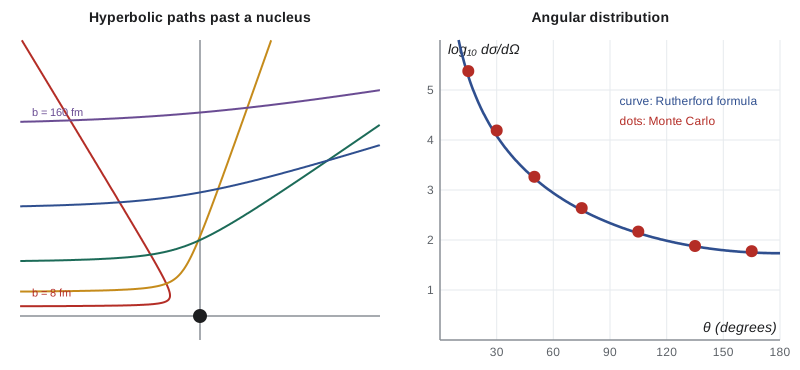
The program takes Rutherford's own case, 7.7 MeV alpha particles (from polonium-214, the source Geiger and Marsden used) on gold. The distance of closest approach is 29.5 fm. The nucleus of gold has a radius of about 7 fm, so even a head-on alpha stops more than 20 fm short of the nuclear surface, and only the Coulomb force acts. That is why the formula worked; at higher energies, when alphas reach the nucleus, the strong force adds to the scattering and the formula fails, which is how nuclear radii were first measured.
The program first checks the formula for a single trajectory by integrating the motion numerically. Then it simulates the experiment: 400,000 alphas arrive at random positions spread uniformly over a disk of radius 200 fm around the nucleus, and each is assigned its scattering angle from the formula for \(b\). Counting how many land in each angular bin, and dividing by the beam density and the solid angle, measures the cross-section.
import math, random

# Alpha particles (7.7 MeV, z = 2) on gold (Z = 79). Energies in MeV, lengths in fm.
ke2 = 1.44                                   # e^2 / (4 pi eps0) in MeV fm
z, Z, E = 2, 79, 7.7
k = z * Z * ke2                              # coefficient of the Coulomb potential k / r
d = k / E
print(f"head-on distance of closest approach d = {d:.1f} fm (gold nucleus radius about 7 fm)")
theta = lambda b: 2 * math.atan(d / (2 * b))   # Rutherford: tan(theta/2) = d / (2b)

# 1. Check the formula by integrating one trajectory (nucleus fixed, starting 100,000 fm away)
def numeric_angle(b):
    m = 1.0; v0 = math.sqrt(2 * E / m)
    x, y, vx, vy = -1.0e5, b, v0, 0.0
    def acc(x, y):
        r3 = (x * x + y * y) ** 1.5
        return k * x / (m * r3), k * y / (m * r3)
    ax, ay = acc(x, y)
    near = False
    while not near or math.hypot(x, y) < 1.0e5:
        near = near or math.hypot(x, y) < 1.0e4
        dt = 0.002 * math.hypot(x, y) / v0          # small steps near the nucleus, large far away
        x += vx * dt + 0.5 * ax * dt * dt; y += vy * dt + 0.5 * ay * dt * dt
        nax, nay = acc(x, y)
        vx += 0.5 * (ax + nax) * dt; vy += 0.5 * (ay + nay) * dt; ax, ay = nax, nay
    return math.atan2(vy, vx)
for b in (10.0, 30.0):
    print(f"b = {b:4.0f} fm: integrated angle {math.degrees(numeric_angle(b)):6.2f} deg, formula {math.degrees(theta(b)):6.2f} deg")

# 2. Monte Carlo: fire 400,000 particles at random points of a disk of radius 200 fm
random.seed(1911)
N, bmax = 400_000, 200.0
edges = [10, 20, 40, 60, 90, 120, 150, 180]
counts = [0] * (len(edges) - 1)
for _ in range(N):
    b = bmax * math.sqrt(random.random())     # uniform over the disk area
    th = math.degrees(theta(b))
    for i in range(len(counts)):
        if edges[i] <= th < edges[i + 1]:
            counts[i] += 1; break
flux = N / (math.pi * bmax ** 2)              # particles per fm^2
print(" angle bin     measured dsigma/dOmega   Rutherford (fm^2/sr)")
for i, c in enumerate(counts):
    t1, t2 = math.radians(edges[i]), math.radians(edges[i + 1])
    dOmega = 2 * math.pi * (math.cos(t1) - math.cos(t2))
    mid = 0.5 * (t1 + t2)
    # the average of the formula over the bin, for a fair comparison
    n = 200; avg = sum((d / 4) ** 2 / math.sin(0.5 * (t1 + (j + 0.5) * (t2 - t1) / n)) ** 4 * math.sin(t1 + (j + 0.5) * (t2 - t1) / n) for j in range(n)) * (t2 - t1) / n * 2 * math.pi / dOmega
    print(f" {edges[i]:3d}-{edges[i + 1]:3d} deg   {c / flux / dOmega:14.1f}        {avg:12.1f}")
sigma90 = sum(counts[4:]) / N * math.pi * bmax ** 2
print(f"cross-section for scattering beyond 90 deg: Monte Carlo {sigma90:.0f} fm^2, exact pi (d/2)^2 = {math.pi * (d / 2) ** 2:.0f} fm^2")
n_gold, t_foil = 5.90e28, 0.40e-6               # atoms per m^3, foil thickness in m
P = sigma90 * 1e-30 * n_gold * t_foil
print(f"chance of a backward bounce in a {t_foil * 1e9:.0f} nm gold foil: {P:.1e}, about 1 in {1 / P:,.0f}")head-on distance of closest approach d = 29.5 fm (gold nucleus radius about 7 fm) b = 10 fm: integrated angle 111.81 deg, formula 111.81 deg b = 30 fm: integrated angle 52.43 deg, formula 52.44 deg angle bin measured dsigma/dOmega Rutherford (fm^2/sr) 10- 20 deg 238456.6 238233.0 20- 40 deg 15471.2 15470.0 40- 60 deg 1835.2 1865.9 60- 90 deg 433.6 436.5 90-120 deg 147.4 145.5 120-150 deg 75.8 78.0 150-180 deg 59.7 58.5 cross-section for scattering beyond 90 deg: Monte Carlo 688 fm^2, exact pi (d/2)^2 = 686 fm^2 chance of a backward bounce in a 400 nm gold foil: 1.6e-05, about 1 in 61,616
The integrated trajectories agree with the formula to within \(0.01^\circ\). The simulated cross-section follows the Rutherford curve across all seven bins, from about 240,000 fm²/sr near \(15^\circ\) to about 60 fm²/sr near \(165^\circ\); the scatter in the backward bins is the statistical noise of a few thousand counts. The cross-section for scattering beyond \(90^\circ\) equals \(\pi b_{90}^2\), the area of the disk of impact parameters that lead to deflections larger than \(90^\circ\). Since \(b_{90} = (d/2)\cot45^\circ = d/2\), it is \(\pi d^2/4 = 686\ \mathrm{fm}^2\), and the simulation gives 688.
Multiplying that cross-section by the number of gold nuclei per unit area of a 400 nm foil gives the chance that one alpha bounces back: about \(1.6\times10^{-5}\), or one in 62,000. Geiger and Marsden's foils and sources differed, and they counted all large-angle events including multiple small deflections, but the order of magnitude is right: rare, yet far too common for the plum-pudding atom, in which a backward bounce would be essentially impossible.
The total cross-section diverges
Integrating the Rutherford cross-section over all angles gives infinity: the integrand behaves as \(\theta^{-4}\) near \(\theta = 0\), and \(\int\theta^{-4}\cdot\theta\,d\theta\) diverges. Physically, the Coulomb force has infinite range, so every particle in the beam, however far it passes, is deflected by some small amount. In a real atom the electrons screen the nucleus beyond about \(10^{-10}\) m, cutting off the force and making the total cross-section finite. Experiments always measure at angles large enough that the screening does not matter.
Laboratory and center-of-mass frames
The analysis above assumed a fixed scattering center. When the target recoils, the problem is solved in the center-of-mass frame using the reduced mass, as lesson 7 showed, and the angle found there must be converted to the laboratory. For a projectile of mass \(m_1\) on a stationary target \(m_2\), the angles are related by
For alphas on gold, \(m_1/m_2 = 0.020\) and the correction is tiny. For equal masses, such as a proton scattering off a proton, \(\theta_{\text{lab}} = \theta_{\text{cm}}/2\), so no particle can be scattered by more than \(90^\circ\) in the laboratory. This is the familiar billiard-ball result that two equal balls leave a glancing elastic collision at right angles to each other. When the projectile is heavier than the target (\(m_1 > m_2\)), there is a maximum laboratory angle, \(\sin\theta_{\max} = m_2/m_1\): a bowling ball cannot be turned back by a ping-pong ball.
Worked problem
Closest approach and back-scattering
A 5.0 MeV proton (\(z = 1\)) is fired at a silver nucleus (\(Z = 47\)). Find the distance of closest approach in a head-on collision and the impact parameter that gives a \(60^\circ\) deflection. Use \(q_e^2/4\pi\varepsilon_0 = 1.44\ \mathrm{MeV\,fm}\).
Show solution
- \(k = zZ(1.44) = 67.7\ \mathrm{MeV\,fm}\), so \(d = k/E = 13.5\ \mathrm{fm}\).
- \(b = (d/2)\cot30^\circ = 6.77\times1.732 = 11.7\ \mathrm{fm}\).
Answer: Head-on, the proton stops 13.5 fm from the center; a \(60^\circ\) deflection needs \(b \approx 11.7\ \mathrm{fm}\). Silver's nuclear radius is about 5.7 fm, so at this energy the scattering is still purely Coulomb.
Common mistakes
MistakeThinking the differential cross-section is a probability.
InsteadIt is an area per unit solid angle; multiply by the beam intensity and solid angle to get a rate.
MistakeForgetting the factor \(\sin\theta\) in \(d\Omega = 2\pi\sin\theta\,d\theta\).
InsteadSolid angle, not plane angle, measures the detector's acceptance.
MistakeExpecting a finite total Coulomb cross-section.
InsteadThe force has infinite range; only screening makes \(\sigma\) finite.
MistakeUsing the Rutherford formula when the projectile reaches the nucleus.
InsteadThen the strong force acts too; check that the closest approach exceeds the nuclear radius.
MistakeComparing a fixed-target calculation directly with laboratory data for comparable masses.
InsteadConvert from the center-of-mass angle using the reduced mass.
Summary and key terms
- Scattering is described by the impact parameter \(b\), the scattering angle \(\theta(b)\), and \(d\sigma/d\Omega = (b/\sin\theta)|db/d\theta|\).
- Hard spheres scatter isotropically with \(d\sigma/d\Omega = R^2/4\) and \(\sigma = \pi R^2\).
- For the repulsive Coulomb force, \(b = (d/2)\cot(\theta/2)\) with \(d = k/E\), the head-on closest approach.
- Rutherford's formula: \(d\sigma/d\Omega = (d/4)^2/\sin^4(\theta/2)\), proportional to \(Z^2/E^2\).
- The Coulomb total cross-section diverges at small angles; atomic electrons screen it in practice.
- Center-of-mass and laboratory angles differ when the target recoils; for equal masses \(\theta_{\text{lab}} \le 90^\circ\).
- impact parameter
- The distance by which an incoming particle would miss the target if there were no force.
- differential cross-section
- The effective target area per unit solid angle for scattering into a given direction.
- total cross-section
- The integral of the differential cross-section over all directions, the effective area for any scattering.
- solid angle
- The two-dimensional angle subtended by a detector, area over distance squared, measured in steradians.
- distance of closest approach
- For a head-on Coulomb collision, the separation at which all kinetic energy has become potential energy.
- screening
- The cancellation of a nucleus's field at large distances by the atom's electrons.
Practice problems
Work each problem on paper first, then reveal the answer to check.
For 7.7 MeV alphas on gold, what impact parameter gives a \(90^\circ\) deflection?
Show answer
\(b = (d/2)\cot45^\circ = 14.8\ \mathrm{fm}\).
By what factor does the Rutherford rate into a fixed detector change if the alpha energy is doubled?
Show answer
It falls by a factor of 4, since \(d\sigma/d\Omega \propto 1/E^2\).
Compare the rate at \(30^\circ\) with the rate at \(150^\circ\) for Rutherford scattering.
Show answer
\(\sin^4(75^\circ)/\sin^4(15^\circ) = 0.870/0.00449 = 194\).
A gold target is replaced by aluminum (\(Z = 13\)). By what factor does the rate at a fixed angle change?
Show answer
\((13/79)^2 = 0.027\), about 37 times lower.
Show that hard-sphere scattering gives \(\sigma = \pi R^2\) by integrating \(R^2/4\) over all solid angles.
Show answer
\(\int d\Omega = 4\pi\), so \(\sigma = 4\pi R^2/4 = \pi R^2\).
An alpha particle (4 u) scatters elastically from a stationary helium nucleus (4 u). What is the largest laboratory scattering angle?
Show answer
Equal masses: \(\theta_{\text{lab}} = \theta_{\text{cm}}/2 \le 90^\circ\).
Lesson quiz · 5 questions
Score 60% or more to complete this lesson.
Create a free account to save your progress, take quizzes and earn a certificate.