
PHYS-244 · Lesson 2 of 12 · 24 min
Newton's laws revisited: frames, forces and momentum
Newton's three laws are short enough to memorize in a minute, but each one hides a subtle idea. The first law defines a special class of reference frames. The second law turns forces into motion. The third law, applied to a system of many particles, is what makes momentum and angular momentum conserved and lets us treat a thrown hammer, a galaxy or a car crash as if it were a single particle located at its center of mass. This lesson states the laws carefully, derives the conservation laws for systems, and shows when the third law needs repair.
Inertial frames and the first law
The first law says that a body on which no net force acts moves in a straight line at constant speed. This cannot be true in every frame: on a turning merry-go-round a ball rolled outward follows a curved path even with no horizontal force on it. The first law is therefore best read as a definition. An inertial frame is one in which free particles move with constant velocity, and the first law asserts that such frames exist. The second and third laws are then statements about motion seen from an inertial frame.
Any frame moving at constant velocity relative to an inertial frame is also inertial. If frame \(S'\) moves with velocity \(\mathbf V\) relative to \(S\), and their origins coincide at \(t = 0\), positions are related by the Galilean transformation
Differentiating twice gives \(\ddot{\mathbf r}' = \ddot{\mathbf r}\): accelerations are the same in both frames. Since forces depend on the relative positions and velocities of bodies, which are also unchanged, Newton's second law has the same form in every inertial frame. This is Galilean relativity, the statement that no mechanical experiment can detect uniform motion. Galileo illustrated it with butterflies and dripping water in the cabin of a smoothly moving ship. Einstein kept the principle in 1905 but replaced the Galilean transformation by the Lorentz transformation, which reduces to it when \(V \ll c\).
Is the surface of the Earth an inertial frame? Not exactly. It rotates once per sidereal day, giving accelerations of up to \(\Omega^2 R \approx 0.034\ \mathrm{m/s^2}\) at the equator, and it orbits the Sun with an acceleration of about \(0.006\ \mathrm{m/s^2}\). For most laboratory experiments these are negligible beside \(g\), but they produce measurable effects in large-scale motion, and lesson 10 treats them properly. A frame fixed relative to the distant galaxies is as close to inertial as we can find.
The second law and what counts as a force
The second law, in the form Newton actually wrote, says that force equals the rate of change of momentum, \(\mathbf F = d\mathbf p/dt\) with \(\mathbf p = m\mathbf v\). For a body of constant mass this is \(\mathbf F = m\mathbf a\). Forces are interactions: each force on a body is exerted by some other identifiable body or field. Gravity, the electromagnetic forces of contact (normal force, friction, tension, drag, spring forces, which are all electromagnetic at the atomic scale) and, in nuclei, the strong and weak forces exhaust the list. A force that cannot be traced to another body, such as the centrifugal force felt on a merry-go-round, is a sign that you are working in a non-inertial frame.
Mass in the second law is inertial mass, the resistance to acceleration. Mass in the law of gravitation is gravitational mass, the strength of the gravitational coupling. Experiments show they are proportional to better than one part in \(10^{15}\) (the MICROSCOPE satellite reported this precision in 2022), which is why all bodies fall with the same acceleration. In Newtonian mechanics this equality is a coincidence; in general relativity it becomes the starting point.
The third law and systems of particles
The third law says that if body \(j\) exerts force \(\mathbf F_{ij}\) on body \(i\), then body \(i\) exerts \(\mathbf F_{ji} = -\mathbf F_{ij}\) on body \(j\). Consider \(N\) particles with masses \(m_i\) and positions \(\mathbf r_i\). Each feels external forces \(\mathbf F_i^{\text{ext}}\) from outside the system and internal forces from the other particles:
Add these equations over all particles. In the double sum every pair appears twice, as \(\mathbf F_{ij} + \mathbf F_{ji}\), which vanishes by the third law. What remains is
where \(M = \sum m_i\) is the total mass and \(\mathbf R = \sum m_i\mathbf r_i/M\) is the center of mass. The total momentum changes only because of external forces, and the center of mass moves exactly like a single particle of mass \(M\) acted on by the total external force. Internal forces, however violent, cannot move the center of mass. If the external force is zero, total momentum is conserved.
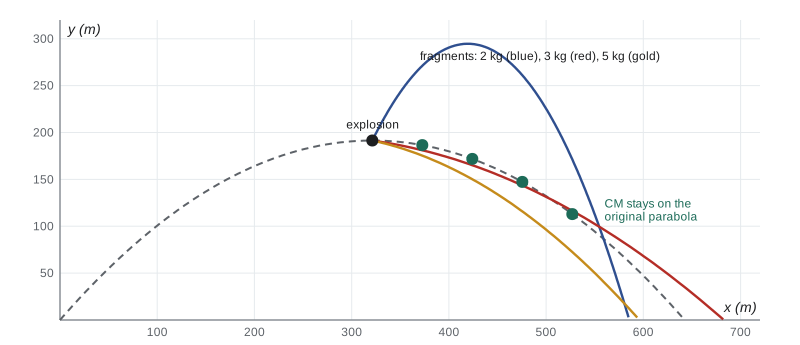
The program below tests this with a shell that explodes at the top of its flight. The explosion delivers impulses to the three fragments that sum to zero, because they are internal. After the explosion each fragment follows its own parabola, but the center of mass carries on exactly as if the shell had never burst.
import math

# A shell explodes at the top of its flight into three fragments. Internal forces cannot move the CM.
g = 9.81
m = [2.0, 3.0, 5.0]                       # fragment masses (kg)
v0, ang = 80.0, math.radians(50)
vx, vy = v0 * math.cos(ang), v0 * math.sin(ang)
t_top = vy / g
x_top, y_top = vx * t_top, vy * t_top - 0.5 * g * t_top ** 2
# explosion adds momentum kicks that sum to zero (internal forces)
kicks = [(-60.0, 90.0), (50.0, -30.0), (10.0, -60.0)]   # impulses in N s
assert abs(sum(k[0] for k in kicks)) < 1e-12 and abs(sum(k[1] for k in kicks)) < 1e-12
frag = [[x_top, y_top, vx + kx / mi, 0.0 + ky / mi] for mi, (kx, ky) in zip(m, kicks)]

M = sum(m)
def cm(states):
    return (sum(mi * s[0] for mi, s in zip(m, states)) / M, sum(mi * s[1] for mi, s in zip(m, states)) / M)

for tau in (0.0, 1.0, 2.0, 3.0):
    states = [[s[0] + s[2] * tau, s[1] + s[3] * tau - 0.5 * g * tau ** 2] for s in frag]
    X, Y = cm(states)
    Xp, Yp = x_top + vx * tau, y_top - 0.5 * g * tau ** 2        # unexploded shell
    px = sum(mi * s[2] for mi, s in zip(m, frag))
    print(f"t_top + {tau:.0f} s: CM ({X:7.2f}, {Y:6.2f}) m, unexploded shell ({Xp:7.2f}, {Yp:6.2f}) m")
print(f"total horizontal momentum before {M * vx:.2f}, after {sum(mi * s[2] for mi, s in zip(m, frag)):.2f} kg m/s")

# kinetic energy released by the explosion (it comes from chemical energy, not from momentum)
KE_before = 0.5 * M * vx ** 2
KE_after = sum(0.5 * mi * (s[2] ** 2 + s[3] ** 2) for mi, s in zip(m, frag))
print(f"kinetic energy at the top: before {KE_before:.0f} J, after {KE_after:.0f} J, released {KE_after - KE_before:.0f} J")t_top + 0 s: CM ( 321.24, 191.42) m, unexploded shell ( 321.24, 191.42) m t_top + 1 s: CM ( 372.67, 186.52) m, unexploded shell ( 372.67, 186.52) m t_top + 2 s: CM ( 424.09, 171.80) m, unexploded shell ( 424.09, 171.80) m t_top + 3 s: CM ( 475.51, 147.28) m, unexploded shell ( 475.51, 147.28) m total horizontal momentum before 514.23, after 514.23 kg m/s kinetic energy at the top: before 13222 J, after 17083 J, released 3862 J
The center of mass and the unexploded shell agree to every printed digit, and the total horizontal momentum is unchanged at 514.23 kg m/s. The kinetic energy, on the other hand, jumps by 3862 J: the explosion converts chemical energy into motion. Momentum is conserved in every collision and explosion, but kinetic energy is conserved only in elastic collisions. The agreement holds only until the first fragment hits the ground, at which point the ground exerts an external force.
Angular momentum of a system
The angular momentum of particle \(i\) about the origin is \(\mathbf L_i = \mathbf r_i \times m_i\dot{\mathbf r}_i\). Differentiating, \(\dot{\mathbf L}_i = \dot{\mathbf r}_i \times m_i\dot{\mathbf r}_i + \mathbf r_i \times m_i\ddot{\mathbf r}_i = \mathbf r_i \times \mathbf F_i\), since the cross product of a vector with itself vanishes. The rate of change of angular momentum equals the torque. For the whole system,
Pair up the internal terms: \(\mathbf r_i \times \mathbf F_{ij} + \mathbf r_j \times \mathbf F_{ji} = (\mathbf r_i - \mathbf r_j)\times\mathbf F_{ij}\). This vanishes only if the force between two particles points along the line joining them. That is the strong form of the third law: forces are equal, opposite and central. Gravity and electrostatic forces satisfy it, so for them
and with no external torque the total angular momentum is conserved. This is why a skater spins faster when she pulls in her arms, why a cat can land on its feet while keeping zero total angular momentum, and why the planets all orbit in nearly the same plane: the cloud of gas they formed from had a definite total angular momentum.
A useful split separates the motion of the center of mass from motion about it. Writing \(\mathbf r_i = \mathbf R + \mathbf r_i'\), one finds
Both angular momentum and kinetic energy separate into a part for the center of mass moving as one particle and a part for the motion relative to it. The cross terms vanish because \(\sum m_i\mathbf r_i' = 0\) by the definition of the center of mass. This decomposition is what lets us treat the Earth as a point when computing its orbit and as a spinning body when computing its rotation.
When the third law fails
The third law is not a law of nature in full generality. Two moving charges exert magnetic forces on each other that are not equal and opposite: a charge moving along the \(x\) axis toward a second charge moving along the \(y\) axis feels a magnetic force from it, while the second charge, at that instant, feels none from the first. Momentum is still conserved, but some of it is carried by the electromagnetic field, which has momentum density \(\varepsilon_0\mathbf E \times \mathbf B\). Conservation of momentum is the deeper law; the third law is the special form it takes when no field carries momentum. For the mechanical systems in this course, with contact forces, gravity and static electric forces, the strong form holds.
Impulse and collisions
Integrating the second law over a short interval gives the impulse–momentum theorem, \(\Delta\mathbf p = \int\mathbf F\,dt = \mathbf J\). In a collision lasting milliseconds the contact forces are enormous compared with gravity or friction, so the external impulse during the collision is negligible and total momentum is conserved across it. The coefficient of restitution \(e\), the ratio of relative speeds after and before a head-on collision, measures how much kinetic energy survives: \(e = 1\) for an elastic collision and \(e = 0\) when the bodies stick together.
Worked problem
A ballistic pendulum
A 10.0 g bullet embeds itself in a 2.00 kg wooden block hanging from light cords. The block swings up through a height of 8.0 cm. Find the bullet's speed and the fraction of its kinetic energy lost.
Show solution
- After the collision the block and bullet rise 8.0 cm, so their common speed was \(V = \sqrt{2gh} = \sqrt{2(9.81)(0.080)} = 1.253\ \mathrm{m/s}\).
- Momentum is conserved during the brief collision: \(mv = (m + M)V\), so \(v = (2.010/0.010)(1.253) = 252\ \mathrm{m/s}\).
- The kinetic energy before is \(\tfrac12(0.010)(252)^2 = 317\ \mathrm{J}\); after, \(\tfrac12(2.010)(1.253)^2 = 1.58\ \mathrm{J}\).
- The fraction kept is \(m/(m + M) = 0.0050\), so 99.5% is lost to heat, sound and deformation.
Answer: \(v \approx 252\ \mathrm{m/s}\), and more than 99% of the kinetic energy is lost. Energy conservation alone would give a badly wrong answer; momentum is the conserved quantity across a perfectly inelastic collision.
Two-body collisions in the center-of-mass frame
Collisions are simplest in the frame where the center of mass is at rest. There the total momentum is zero, so the two bodies approach with equal and opposite momenta and leave with equal and opposite momenta. In an elastic collision energy conservation then forces the magnitudes to be unchanged: each momentum simply rotates through the same scattering angle. All the physics of the collision is contained in that one angle, which lesson 9 calculates for a repulsive inverse-square force. To return to the laboratory frame, add the center-of-mass velocity back to each particle.
The reduced mass \(\mu = m_1m_2/(m_1 + m_2)\) appears naturally here. The kinetic energy available in the center-of-mass frame, the part that can be converted into heat or used to create new particles, is \(\tfrac12\mu v_{\text{rel}}^2\), where \(v_{\text{rel}}\) is the relative speed. When a light particle hits a heavy one, \(\mu\) is close to the light mass and nearly all the kinetic energy is available; when equal masses collide, only half is.
Common mistakes
MistakeIncluding internal forces when finding the acceleration of the center of mass.
InsteadInternal forces cancel in pairs; only external forces change the total momentum.
MistakeAssuming kinetic energy is conserved in every collision.
InsteadMomentum is conserved whenever external impulses are negligible; kinetic energy only in elastic collisions.
MistakeTreating the centrifugal force as a real interaction.
InsteadIt appears only in rotating frames; no other body exerts it.
MistakeForgetting that angular momentum conservation needs central internal forces.
InsteadThe strong form of the third law is required; with magnetic forces, field angular momentum must be included.
MistakeApplying momentum conservation across the landing of a fragment.
InsteadThe ground exerts an external force, so the total momentum changes from that moment on.
Summary and key terms
- Inertial frames are those in which free particles move uniformly; Newton's laws hold in all of them, related by Galilean transformations.
- For a system of particles, \(d\mathbf P/dt = \mathbf F^{\text{ext}}\): the center of mass moves like one particle carrying the total mass.
- With central internal forces, \(d\mathbf L/dt = \boldsymbol\tau^{\text{ext}}\), so angular momentum is conserved when there is no external torque.
- Angular momentum and kinetic energy split into a center-of-mass part and a part relative to the center of mass.
- Momentum is conserved in all collisions with negligible external impulse; kinetic energy only in elastic ones.
- Magnetic forces can violate the third law; momentum conservation survives because the field carries momentum.
- inertial frame
- A reference frame in which a body with no net force on it moves at constant velocity.
- Galilean transformation
- The rule relating positions and times in two frames in uniform relative motion, valid when speeds are much less than c.
- center of mass
- The mass-weighted average position of a system, which moves as if all external forces acted on the total mass there.
- strong third law
- The statement that the forces between two particles are equal, opposite and directed along the line joining them.
- impulse
- The time integral of a force, equal to the change in momentum it produces.
- reduced mass
- The combination m1 m2 over m1 plus m2 that governs relative motion of two bodies.
Practice problems
Work each problem on paper first, then reveal the answer to check.
A 60 kg person stands at one end of a 40 kg canoe 4.0 m long, at rest on still water. She walks to the other end. How far does the canoe move?
Show answer
The center of mass stays fixed. If the canoe moves \(d\) backward, \(60(4.0 - d) = 40d\), so \(d = 2.4\ \mathrm{m}\).
A 0.40 kg ball moving at 6.0 m/s hits a wall and rebounds at 4.0 m/s. Contact lasts 5.0 ms. Find the average force.
Show answer
\(\Delta p = 0.40(6.0 + 4.0) = 4.0\ \mathrm{kg\,m/s}\), so \(\bar F = 4.0/0.0050 = 800\ \mathrm{N}\).
A 1500 kg car moving east at 20 m/s collides with a 2500 kg truck moving north at 15 m/s, and they lock together. Find the speed just after.
Show answer
\(p_x = 30{,}000\), \(p_y = 37{,}500\), so \(p = 48{,}000\ \mathrm{kg\,m/s}\) and \(V = 48{,}000/4000 = 12.0\ \mathrm{m/s}\).
Show that the kinetic energy available in the center-of-mass frame when mass \(m\) moving at \(v\) hits a stationary mass \(M\) is \(\tfrac12\mu v^2\).
Show answer
The CM moves at \(V = mv/(m + M)\). Subtracting \(\tfrac12(m + M)V^2\) from \(\tfrac12mv^2\) leaves \(\tfrac12 v^2 mM/(m + M)\).
A frame accelerates at \(a\) relative to an inertial frame. What extra force appears on a mass \(m\) described in it?
Show answer
A fictitious force \(-m\mathbf a\), opposite to the frame's acceleration.
A spinning skater has moment of inertia 3.0 kg m² and spins at 2.0 rev/s. She pulls in her arms to 1.2 kg m². Find her new spin rate and the change in kinetic energy.
Show answer
\(L\) is conserved: \(\omega = 2.0(3.0/1.2) = 5.0\ \mathrm{rev/s}\). \(T = L\omega/2\) grows by the factor 2.5, the extra energy coming from the work her muscles do pulling inward.
Lesson quiz · 5 questions
Score 60% or more to complete this lesson.
Create a free account to save your progress, take quizzes and earn a certificate.