
PHOT-440 · Lesson 11 of 12 · 28 min
Hybrid photo and video jobs
Knowing how to shoot and edit video is only half of hybrid work. The other half is running jobs profitably and professionally: scoping what the client actually needs, choosing a staffing model, planning gear, power and schedules, securing locations and insurance, pricing shooting and editing time, licensing usage, writing contracts that cover video-specific issues and managing deliverables and revisions. PHOT-410 covers the business of photography in general, including cost of doing business, pricing strategy, licensing, contracts, taxes and insurance. This lesson builds on it with what changes when video is added to a photo job.
Scoping: from brief to treatment
Clients often ask for "a video" without knowing what they need. A scoping conversation turns that into a defined product. Ask what the video is for, who will watch it, where it will appear, how long each version should be, what action the viewer should take, which people and places must appear, what brand guidelines apply, when it is needed, what budget range is available and how the photographs relate to it. Then write a short treatment, a one-page description of the piece's concept, tone, structure, key scenes, style references and deliverables. The treatment confirms that you and the client imagine the same thing before you quote in detail.
Scope creep is the biggest profit killer in hybrid work. A client who agreed to a 90-second brand film may ask for "a quick vertical version", "one more interview" or "the raw footage for our team". Each request may be reasonable, but each costs time. Define deliverables precisely and price additions as change orders.
Staffing models
Hybrid jobs can be staffed in several ways. A solo hybrid shooter handles stills and video alone; this is cheapest and suits small jobs with separable time windows, but carries the most risk on events with unrepeatable moments. A lead photographer with a video shooter covers both fully at once and suits weddings, conferences and launches. A small crew might add a sound recordist for interview-heavy work, an assistant for lighting and gear, and an editor for post-production. On larger jobs, a producer manages schedules, permits, releases and client communication.
| Model | Best for | Risks or limits |
|---|---|---|
| Solo hybrid shooter | Small brand shoots, social packages, headshots plus clips | Missed moments when switching; limited audio |
| Photographer plus video shooter | Weddings, events, launches | Two people to coordinate and pay |
| Photographer, video shooter and sound recordist | Interview-heavy corporate and non-profit work | Higher cost; worth it when dialogue matters |
| Crew with producer and editor | Multi-location brand campaigns | Requires production management skills |
When you hire other people, decide whether they are contractors or employees under tax and employment rules, agree rates and rights in writing, and make sure your contract with the client lets you subcontract. PHOT-410 lesson 11 covers hiring and contractor status in detail.
Gear, power and data planning
Hybrid kits are heavier than stills kits. A typical solo hybrid kit includes two bodies (one set up for stills, one for video), lenses, a video tripod, a gimbal or monopod, an LED key with softbox and stand, a reflector, a wireless lavalier kit, a shotgun, a recorder, headphones, ND filters, many batteries, a power bank, cards, a laptop or portable SSD for offloads, sandbags and cases. Write a packing list per job type and check it.
Batteries run down much faster in video than in stills. Estimate camera runtime from the battery's watt-hours and the camera's power draw while recording, which manufacturers sometimes list and which you can measure by timing a full battery. Cold weather can halve capacity.
Worked problem
How many camera batteries for a wedding?
Your video body uses a 16 Wh battery and draws about 7 W while recording 4K with stabilization, and about 3 W on standby with the screen on. On a wedding day you expect 3 hours of recording and 6 hours of standby. How many batteries do you need, and how does a USB-C power bank change the plan?
Show solution
- Recording energy: \( 3 \times 7 = 21 \) Wh. Standby energy: \( 6 \times 3 = 18 \) Wh. Total: 39 Wh.
- Batteries: \( 39 / 16 \approx 2.4 \), so three batteries at minimum.
- Add a safety margin of about 50 percent for cold, aging batteries and unexpected events: about 58 Wh, or four batteries.
- A 99 Wh USB-C power bank that can run the camera during the locked-off ceremony and speeches covers most of the load and keeps the batteries for handheld work.
Answer: Four camera batteries, or three plus a power bank for locked-off shots. Charge everything the night before and label batteries so you rotate them.
Schedules, call sheets and run sheets
For anything beyond a single location, write a schedule and share it. A call sheet lists the date, locations with addresses and parking, start times for each person, contacts, weather, the shot list or sequences for each block and safety notes. For events, a run sheet aligns your coverage with the event program: when speeches start, when the product is revealed, when the cake is cut. Include buffer time; video setups take longer than photo setups, especially interviews, which often need 30 to 45 minutes of setup for 20 minutes of recording.
Locations, permits and insurance
Filming on public property often needs a permit when you use tripods, lights or crews, block sidewalks or work in parks, even if handheld photography is unrestricted. Many cities have film offices that issue permits and require proof of liability insurance naming the city as additional insured. Private locations need the owner's permission, preferably in a written location agreement covering access, dates, any fee, care of the property and use of the location in the final work.
Insurance needs grow with video. Equipment insurance must cover the added gear and its replacement value. Commercial general liability insurance covers injury to others and damage to property; city permits and venues commonly ask for certificates showing at least $2 million of coverage, though requirements vary. Some productions add errors and omissions insurance, which covers claims such as copyright infringement, defamation or invasion of privacy arising from content; broadcasters and distributors often require it. Talk to a broker who understands media work.
Pricing video work
Video pricing should cover four things: shooting time, editing and finishing time, expenses and usage. Shooting time is usually priced by the day or half day per person, with video operators often priced similarly to or above photographers in the same market because of added equipment and post-production. Editing and finishing time can be priced by the hour or day, or estimated per finished minute or per deliverable based on your own tracked times (lesson 9). Expenses include crew, gear rental, music licenses, travel, permits and insurance certificates. Usage covers the client's rights to use the work.
Many hybrid shooters quote packages that hide the arithmetic but rest on it: for example, a "brand story" package with one shoot day, one 90-second film, three vertical cutdowns and 40 edited photographs. Build packages from your cost of doing business (PHOT-410 lesson 3) and your tracked editing times, and review them each year.
Worked problem
Building a hybrid quote
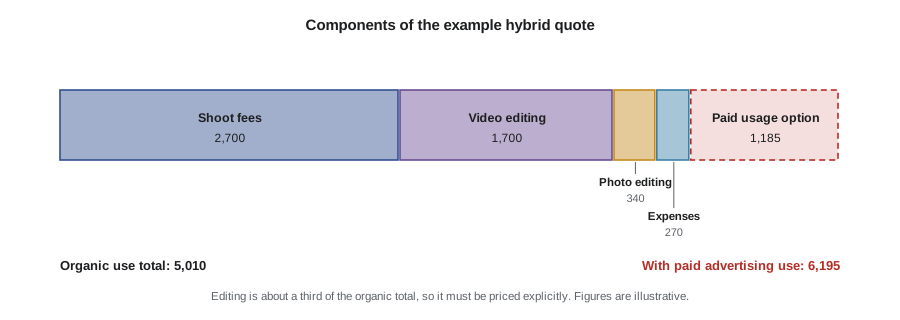
A café wants 40 edited photos, a 90-second brand film and three 30-second vertical clips. Illustrative rates: your shoot day as a hybrid shooter $1,800; a second shooter for video $900; editing at $85 per hour with 14 hours for the film and 2 hours per vertical clip; photo editing 4 hours at $85; production music license $120; equipment rental $150; usage for the client's own channels and organic social media for three years included at no extra fee; paid advertising use at 25 percent of creative fees. What is the total, with and without paid advertising use?
Show solution
- Shoot: \( 1800 + 900 = 2700 \).
- Video editing: \( (14 + 3 \times 2) \times 85 = 20 \times 85 = 1700 \).
- Photo editing: \( 4 \times 85 = 340 \).
- Expenses: \( 120 + 150 = 270 \).
- Subtotal without paid use: \( 2700 + 1700 + 340 + 270 = 5010 \).
- Paid advertising use: 25 percent of creative fees (shoot plus editing) \( = 0.25 \times (2700 + 1700 + 340) = 0.25 \times 4740 = 1185 \).
Answer: About $5,010 before taxes for organic use and about $6,195 with paid advertising use. Present it as a package with clear deliverables and an option for paid use, and add sales tax as applicable.
def quote(shoot, edit_hours, photo_edit_hours, rate, expenses, paid_usage_pct=0.0):
    edit = edit_hours * rate
    photo = photo_edit_hours * rate
    creative = shoot + edit + photo
    usage = creative * paid_usage_pct
    return creative + expenses + usage, creative, usage
for label, pct in [('organic only', 0.0), ('with paid ads', 0.25), ('paid ads, broad', 0.5)]:
    total, creative, usage = quote(2700, 20, 4, 85, 270, pct)
print(f'{label:16s} creative {creative:6.0f} usage {usage:6.0f} total {total:6.0f}')organic only creative 4740 usage 0 total 5010 with paid ads creative 4740 usage 1185 total 6195 paid ads, broad creative 4740 usage 2370 total 7380
Usage licensing for video
Video usage is licensed much like photo usage (PHOT-410 lesson 4), with some additional terms. Define the media (client website, organic social, paid social, connected TV, broadcast, cinema, trade shows), the territory, the duration and any exclusivity. Paid social use, where the client pays a platform to promote the video, is usually priced higher than organic posting. Whitelisting, where the client runs ads through a creator's or subject's account, needs specific permission from the account holder. Talent releases and music licenses must cover the same media and duration as the client's license; a music license limited to web use does not cover a television broadcast, and an interviewee's release limited to the website does not cover paid advertising.
Raw footage, revisions and other contract terms
Clients sometimes ask for raw footage. Raw footage represents your creative work and shows mistakes and private moments, and it can be re-edited in ways that misrepresent subjects. Decide your policy: many hybrid shooters decline, some offer selected raw clips for a fee with usage terms, and some provide all raw footage on corporate jobs where the client needs an archive. Put the policy in the contract.
A hybrid contract should address, in addition to standard photography terms: the list of deliverables with lengths, shapes and captions; the number of review rounds at rough cut and fine cut and the rate for extra rounds; the schedule for delivery after the shoot and after each round of feedback; music selection and licensing responsibility; releases for people and locations and who obtains them; raw footage policy; archive period; credit lines; use of AI tools and any disclosure; cancellation, rescheduling and kill fees; deposits and payment schedule; and liability limits. Deposits of 30 to 50 percent are common for video because of the larger commitment of time and crew.
| Clause | What it says | Why it matters |
|---|---|---|
| Deliverables | Exact versions, lengths, shapes, captions | Prevents scope creep |
| Review rounds | Number of rounds and turnaround | Protects schedule and fee |
| Music | Who chooses and licenses music, for which media | Avoids infringement claims |
| Releases | Who gets talent and location releases | Makes usage lawful |
| Raw footage | Whether raw footage is provided, and terms | Protects work and subjects |
| Archive | How long project files are kept | Sets expectations for re-edits |
| AI use | What AI tools may be used and disclosed | Builds trust and meets policies |
Sales tax on hybrid services
Sales tax on photography and video services differs between the two countries, and sometimes between video and stills deliverables.
In the United States, sales tax on photography and video services and digital deliverables varies widely by state: some states tax photography and digital products, others tax only tangible items such as prints, and some exempt services entirely. Economic nexus thresholds, often $100,000 of sales into a state, determine where you must register. PHOT-410 lesson 9 explains registration and nexus in more detail.
Delivering and following up
Deliver through a reliable platform with a branded gallery or review page, provide download links for each deliverable and caption file, and include a short usage summary and the music license details. A week after delivery, check that the client has what they need and ask how the videos performed; performance data helps you sell future work, and a satisfied client is the best source of referrals. Add the strongest pieces to your portfolio if the contract allows, and ask the client for permission when it does not.
Common mistakes
MistakeQuoting video by shooting days only
InsteadPrice shooting, editing and finishing, expenses and usage separately or in tested packages.
MistakeAccepting "small" extra versions and raw-footage requests without a change order
InsteadDefine deliverables precisely and price additions as change orders.
MistakeFilming in a city park with lights and a tripod without checking permit rules
InsteadContact the film office, get permits and provide insurance certificates as required.
MistakeLicensing a client for paid ads while the music and talent releases cover web use only
InsteadAlign music licenses and releases with the client's licensed media and duration.
MistakeRunning out of power on a long event
InsteadCalculate watt-hours needed, add a margin and bring a USB-C power bank.
Summary and key terms
- Scope the job through questions and a one-page treatment before quoting.
- Choose a staffing model that matches the risk of missed moments and the importance of sound.
- Plan gear, batteries, data and schedules; video setups take longer than photo setups.
- Permits, location agreements and liability and errors-and-omissions insurance become more important with video.
- Price shooting, editing, expenses and usage, and build packages from tracked times.
- Video usage licenses must align with music licenses and talent releases.
- Contracts should cover deliverables, review rounds, music, releases, raw footage, archive and AI use.
- Treatment
- A one-page description of a video's concept, tone, structure and deliverables.
- Scope creep
- Gradual expansion of a project beyond the agreed deliverables.
- Change order
- A written agreement to add work and fees to a contract.
- Call sheet
- A document listing times, locations, contacts and plans for a shoot day.
- Run sheet
- A timeline of an event used to plan coverage.
- Location agreement
- A written permission to film on private property.
- Errors and omissions insurance
- Insurance covering content-related claims such as infringement or defamation.
- Whitelisting
- Running paid ads through a creator's or subject's social account with permission.
- Paid social use
- Promoting content with paid platform advertising.
- Kill fee
- A fee paid when a client cancels a commissioned project.
Practice problems
Work each problem on paper first, then reveal the answer to check.
What two energy figures do you need to estimate camera battery needs?
Show answer
Recording power and standby power multiplied by their durations.
A camera draws 8 W for 2 hours and 3 W for 4 hours. Total energy?
Show answer
28 Wh.
Why write a treatment before quoting?
Show answer
To confirm a shared vision of the concept and deliverables.
Name two staffing models for hybrid work.
Show answer
Solo hybrid shooter; photographer plus video shooter; crew with sound and producer.
Why might a city film office require insurance?
Show answer
To protect against injury and property damage during filming in public spaces.
In the example, what is 25 percent of creative fees of $4,740?
Show answer
$1,185.
Why must music licenses match the client's usage license?
Show answer
Using music beyond its licensed media or duration infringes rights.
Give two reasons to be cautious about supplying raw footage.
Show answer
It shows unpolished work and private moments and can be re-edited to misrepresent subjects.
What is the GST/HST small-supplier threshold in Canada?
Show answer
$30,000 over four consecutive calendar quarters.
What common threshold triggers economic nexus in many US states?
Show answer
About $100,000 of sales into the state.
Lesson quiz · 5 questions
Score 60% or more to complete this lesson.
Create a free account to save your progress, take quizzes and earn a certificate.