
PHOT-430 · Lesson 8 of 12 · 35 min
Publishing, distribution and funding
A printed book is not yet a published book. Publishing means making the work available to readers: registering it, describing it so shops and libraries can find it, pricing it, getting it into hands through sales and distribution, and paying for all of this. Photobooks rarely make large profits, so funding and realistic planning are as important as design. This lesson compares publishing models, explains contracts with publishers, covers ISBNs, barcodes, metadata and legal deposit in Canada and the United States, shows how to set a retail price and understand trade discounts, outlines distribution channels including book fairs, and examines crowdfunding and other funding sources. VIS-410 covered grants, residencies and public funding for creative careers in general; here the focus is on financing a specific publication. Fees, rules and programs were checked in October 2026 and should be confirmed before you rely on them.
Publishing models
Photographers bring books into the world in several ways, and the line between them has blurred.
| Model | Who pays production | Who controls design and sequence | Who handles distribution | Typical outcome for the artist |
|---|---|---|---|---|
| Trade publisher | Publisher | Shared; publisher has final say on format and price | Publisher's sales force and distributor | Royalties, usually modest; wide reach |
| Independent photobook publisher | Often shared; artist may contribute funds or presales | Close collaboration | Publisher's network, fairs, specialist shops | Credibility, curated list, some copies |
| Co-publishing or partnership | Artist and publisher or institution share costs | Negotiated | Publisher | Artist recovers investment through copies or sales |
| Museum or gallery | Institution | Institution with artist | Institution and its distributor | Catalog tied to an exhibition |
| Self-publishing | Artist | Artist | Artist, with optional distributor | Full control and full risk |
| Collective or artist-run press | Members or grants | Collective | Members, fairs, shops | Community and shared costs |
Many independent photobook publishers ask artists to contribute part of the production cost, sometimes a substantial sum, raised through grants, presales or private funds. This is not necessarily a vanity arrangement: the publisher contributes editorial expertise, design, reputation and distribution, and photobook economics rarely allow a publisher to carry all the risk. However, ask what the publisher provides in return, how many copies you receive, who keeps the income from sales, and whether the publisher's books are actually stocked in shops and reviewed. Speak to other artists who have published with them.
Publishing agreements
If you publish with a publisher, the agreement sets out rights and money. Read it carefully and, for significant contracts, have it reviewed by a lawyer or an organization that offers contract advice to artists. Key clauses include the following.
- Grant of rights: which rights you license (print, ebook, translation, territories) and for how long. Keep copyright in the photographs; license publication rights.
- Financial contribution: any amount you must pay or raise, and when.
- Royalties: a percentage of the list price or of net receipts, often in the range of about 7 to 10 percent for photobooks, sometimes paid partly or wholly in copies.
- Author's copies: free copies on publication and the discount for buying more.
- Approvals: your right to approve the sequence, cover, text, proofs and print quality.
- Print run, price and format: who decides and whether you are consulted.
- Reversion of rights: when rights return to you if the book goes out of print.
- Subsidiary use: whether the publisher can use images for promotion and on what terms.
Royalty percentages sound small, and photobooks seldom sell enough copies to earn large amounts. For many photographers, the more important terms are the number of author's copies, the right to buy more at a deep discount for resale at exhibitions and talks, and approval over quality.
Worked problem
What does a royalty earn?
A publisher prints 1,000 copies of a monograph at a list price of $55. The contract pays a royalty of 8 percent of the list price on copies sold. If 650 copies sell in the first two years, what royalty does the photographer earn? How does that compare with receiving 100 author's copies to sell at $55 at her own events?
Show solution
- Royalty: \( 650 \times 55 \times 0.08 = \$2860 \).
- Author's copies, if all sold at list: \( 100 \times 55 = \$5500 \) in revenue.
- Selling them takes effort and may require discounts, but the income per copy is far higher.
Answer: About $2,860 in royalties, compared with up to $5,500 from selling 100 author's copies. Negotiating more author's copies, or a deep discount on additional copies, can matter more than the royalty rate.
ISBNs and barcodes
An International Standard Book Number (ISBN) is a 13-digit identifier for a specific edition and format of a book. Shops, distributors and libraries use ISBNs to order and track books. A hardcover, softcover and ebook of the same title each need their own ISBN. You do not need an ISBN to print and sell a book yourself, for example at fairs and exhibitions, but you need one to sell through most bookshops, distributors and online retailers.
In the United States, the official ISBN agency is Bowker, which sells ISBNs directly. At the time of writing, a single ISBN costs about $125 and a block of 10 about $295, so buying a block is far cheaper per number if you plan more than one edition or book. Some print-on-demand services offer free ISBNs, but they list the service rather than you as the publisher.
The barcode on the back cover encodes the ISBN as an EAN-13 symbol, usually with a five-digit price add-on for the US market; the add-on 90000 indicates no suggested price. Barcodes can be generated with layout software or free tools; check that the barcode prints in solid black on a light background at an adequate size.
Metadata
Metadata is the information that describes a book to the trade: title, contributors, ISBN, format, dimensions, extent, price, publication date, subject categories, description and cover image. Distributors and online retailers exchange metadata electronically, usually in the ONIX format, and subject categories use schemes such as BISAC in North America and Thema internationally. Good metadata helps a book appear in searches, in library catalogs and in retailer databases. Write a concise description of about 100 to 200 words, a short author biography, and choose accurate subject categories, for example photography collections and monographs, together with the subject of the work.
Libraries use cataloging data. In Canada, Library and Archives Canada offers Cataloging in Publication (CIP) data to eligible Canadian publishers; check its current eligibility rules. In the United States, the Library of Congress CIP program excludes self-published works, but its Preassigned Control Number (PCN) program assigns a Library of Congress Control Number to titles outside CIP; check whether your book is eligible before applying.
Legal deposit
Both countries require publishers to deposit copies of published works with the national library or copyright office, so that national publishing is preserved.
| Item | Canada | United States |
|---|---|---|
| Who receives copies | Library and Archives Canada | The Copyright Office, for the Library of Congress |
| Legal basis | Library and Archives of Canada Act, section 10, and the Legal Deposit of Publications Regulations | Copyright Act, 17 U.S.C. section 407 |
| Number of copies | Generally two; one if fewer than 100 copies are produced; works of fewer than 4 copies only on request | Two copies of the best edition |
| Deadline | Within 7 days of the publication being made available | Within three months of publication |
| Cost | At the publisher's expense; follow current submission instructions | At the publisher's expense |
| Notes | Applies to publications made available in Canada | Separate from copyright registration, though the deposit can satisfy both if done together |
Legal deposit is a small cost that places your book permanently in the national collection, where researchers can find it. Build the copies into your print run and send them promptly. Follow the current instructions of Library and Archives Canada or the Copyright Office, because procedures and addresses change.
Setting a retail price
The retail price must cover production, the share taken by shops and distributors, and some margin for you. A common rule of thumb in trade publishing is a retail price of four to six times the unit production cost; photobooks often end up closer to three to four times because higher prices would put them beyond buyers' reach. Compare prices of similar books in shops and online: size, extent, binding and reputation all shape what buyers expect to pay.
When a bookshop buys a book, it pays the publisher the retail price minus a trade discount, typically about 40 percent for independent bookshops and higher, often 50 to 55 percent, through distributors and large retailers. A distributor also takes a fee or share, so the publisher may receive as little as 35 to 45 percent of the retail price.
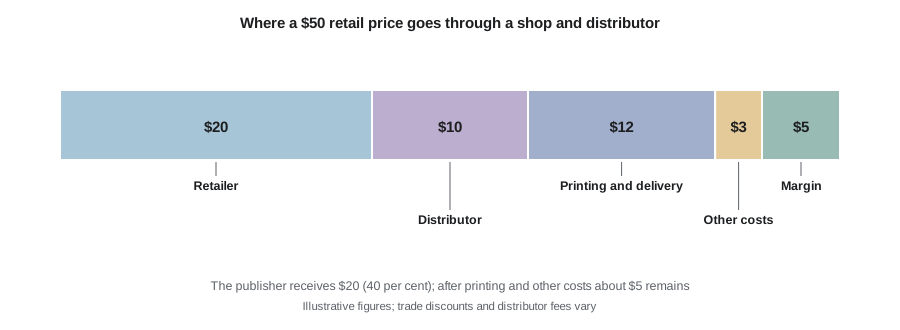
Worked problem
From unit cost to retail price
A self-published book costs $12 per copy to print and deliver. The photographer will sell through a distributor that pays her 40 percent of the retail price, and directly at events. What retail price gives at least $8 margin per copy through the distributor? What is the margin on direct sales at that price, ignoring payment fees?
Show solution
- Distributor income per copy: \( 0.40 \times R \).
- Margin condition: \( 0.40R - 12 \ge 8 \), so \( R \ge 50 \).
- At \$50, direct sale margin: \( 50 - 12 = \$38 \).
Answer: A retail price of $50 yields $8 per copy through the distributor and $38 per copy sold directly. The large difference explains why many photobook makers rely heavily on direct sales at fairs, launches and online.
Distribution channels
Photobooks reach readers through several channels, each with different margins and effort.
| Channel | Typical share to artist or publisher | Effort | Notes |
|---|---|---|---|
| Direct online store | Retail price minus payment fees and shipping | High: packing and posting | Highest margin per copy; shipping costs can deter buyers |
| Launches, talks and exhibitions | Retail price minus payment fees | Moderate | Strong sales when the work is in front of people |
| Book fairs | Retail price minus table fee and travel | High | Meet buyers, shops, curators and publishers |
| Consignment with bookshops | Often 60 to 65 percent of retail, paid when sold | Moderate: tracking and collecting | Common for specialist and independent shops |
| Wholesale to shops | About 55 to 60 percent of retail | Low per order | Shops buy outright, often in small numbers |
| Distributor | About 35 to 45 percent of retail after discounts and fees | Low | Access to many shops and libraries; returns possible |
| Online retailers via POD distribution | Small margin per copy | Low | Listings in large catalogs; little visibility without promotion |
| Libraries and institutions | Retail or library supplier discount | Low to moderate | Collections, often through library suppliers |
Photobook and art book fairs have become central to the independent photobook world. Examples include the New York Art Book Fair organized by Printed Matter, the LA Art Book Fair, the Toronto Art Book Fair and Montreal's Expozine, as well as international fairs such as Polycopies and Offprint, held in Paris around the Paris Photo fair. Fairs let you sell directly, meet bookshop buyers and publishers, see what others are making and enter dummy awards. Budget for table fees, travel, shipping stock and accommodation, and estimate how many copies you must sell to cover them.
Worked problem
Will a book fair pay for itself?
A table at an art book fair costs $350. Travel, accommodation and shipping stock cost $900. Books sell at $45 and cost $11 each to produce. How many copies must be sold to cover the costs, and what other benefits might justify attending?
Show solution
- Fixed costs: \( 350 + 900 = \$1250 \).
- Margin per copy: \( 45 - 11 = \$34 \).
- Copies to break even: \( 1250 / 34 \approx 36.8 \), so 37 copies.
Answer: About 37 copies. Even if sales fall short, contacts with shops, publishers, curators and press may justify the trip, but track results so you can decide which fairs to return to.
Returns and consignment
In the trade, bookshops can often return unsold books for credit, sometimes months later. Distributors pass returns back to the publisher, and returned copies may be shopworn. Factor a return rate into forecasts; for small press books it can be substantial. Consignment means the shop pays only when a copy sells. Keep a simple record of which shops hold how many copies, when you delivered them and when to check in. Ask for sales reports and payment at regular intervals, and collect unsold copies after an agreed period.
Crowdfunding and presales
Crowdfunding platforms let supporters pledge money in advance in exchange for rewards, such as a copy of the book, a signed print or a special edition. Presales through your own website work similarly without a platform. Crowdfunding can raise production funds, test demand and build an audience before the book exists. It also creates obligations: you must deliver what you promised, and backers expect regular updates.
Platform and payment fees reduce what you receive. On Kickstarter, at the time of writing, the platform takes 5 percent of funds raised and payment processing typically adds about 3 percent plus a small fixed fee per pledge, with a different rate for very small pledges; other platforms differ. Rewards also cost money to produce and ship. Set a target that covers the net amount you need after fees and reward costs.
Here \( T \) is the funding target, \( N \) is the net amount needed for production, \( R \) is the cost of producing and shipping rewards, and \( f \) is the total percentage of fees as a decimal.
Worked problem
Setting a crowdfunding target
A photographer needs $9,000 toward printing. Rewards, mainly copies of the book and prints, will cost $3,200 to produce and ship. Platform and payment fees total about 8 percent. What target should she set?
Show solution
- Total to cover: \( 9000 + 3200 = \$12\,200 \).
- Target: \( 12\,200 / (1 - 0.08) = 12\,200 / 0.92 \approx \$13\,261 \).
- A rounded target of \$13,500 adds a small buffer.
Answer: A target of about $13,300, rounded up to $13,500. Setting the target at $9,000 would leave her more than $3,000 short once fees and rewards are paid.
Grants, sponsorship and other funding
Public arts funding can support publication, either through programs for individual artists or through support for publishers. In Canada, the Canada Council for the Arts and provincial and municipal arts councils fund many photobook projects and art publishers. In the United States, federal arts funding for individual visual artists is limited, but state and local arts agencies, private foundations and some photography organizations offer grants, fellowships and publication prizes. VIS-410 discussed writing applications and finding programs; for a publication grant, be ready to provide a project description, a dummy or sample spreads, a budget, printer quotes, a distribution plan and a schedule.
Other sources include sponsorship from businesses linked to the subject of the work, partnerships with institutions that buy copies for their members, collector's editions sold at a higher price with a signed print, and prizes for dummies or self-published books. Combining several modest sources is common.
Sales tax on books
Selling books means collecting and remitting sales taxes where required. PHOT-410 covered registration thresholds and filing. Book-specific rules differ by jurisdiction.
In the United States, most states with a sales tax apply it to books, and online sales may require collection in states where you meet economic nexus thresholds, as discussed in PHOT-410. Marketplace platforms often collect sales tax for you in many states. A few states have no general sales tax. Check each state's rules or use a tax service if you sell widely.
Common mistakes
MistakeAssuming a royalty rate is the most important term in a publishing contract
InsteadAlso negotiate author's copies, discounts on extra copies and approval rights.
MistakeUsing one ISBN for the hardcover and softcover
InsteadAssign a separate ISBN to each edition and format.
MistakeForgetting legal deposit after publication
InsteadBuild deposit copies into the run and send them within the required period.
MistakePricing from production cost without allowing for trade discounts
InsteadPrice so the book still earns a margin after the retailer's and distributor's shares.
MistakeSetting a crowdfunding target equal to production cost
InsteadGross up the target for fees and reward costs.
Summary and key terms
- Publishing models range from trade and independent publishers to co-publishing, institutions and self-publishing.
- Key contract terms include rights, financial contributions, royalties, author's copies and approvals.
- ISBNs are free in Canada through Library and Archives Canada and sold by Bowker in the United States.
- Legal deposit requires copies for Library and Archives Canada within 7 days, or for the Library of Congress within three months.
- Trade discounts of 40 to 55 percent mean publishers receive well under half the retail price through distributors.
- Direct sales at launches, fairs and online give the highest margin per copy.
- Crowdfunding targets must cover production, rewards and platform fees.
- ISBN
- A 13-digit identifier for a specific edition and format of a book.
- EAN-13
- The barcode symbol used to encode ISBNs on book covers.
- Metadata
- Descriptive information about a book exchanged with the trade.
- ONIX
- A standard format for exchanging book metadata electronically.
- Legal deposit
- The requirement to deposit copies of publications with a national institution.
- Trade discount
- The percentage off the retail price given to bookshops and distributors.
- Consignment
- An arrangement in which a shop pays only when a book sells.
- Royalty
- A percentage of price or receipts paid to the author on sales.
- Author's copies
- Free copies given to the author by the publisher.
- Crowdfunding
- Raising money from many supporters in advance, usually for rewards.
Practice problems
Work each problem on paper first, then reveal the answer to check.
A book lists at $60 with a 10 percent royalty on list. What does 400 copies sold earn?
Show answer
\( 400 \times 60 \times 0.10 = \$2400 \).
Does a softcover and hardcover of the same book share an ISBN?
Show answer
No; each format needs its own ISBN.
How many copies are generally deposited with Library and Archives Canada, and by when?
Show answer
Two copies (one if fewer than 100 produced), within 7 days.
How many copies go to the Library of Congress, and by when?
Show answer
Two copies of the best edition within three months.
Unit cost $10; distributor pays 45 percent; target margin $8. What retail price is needed?
Show answer
\( (10 + 8) / 0.45 = \$40 \).
Fixed fair costs $800, margin $30 per copy. Copies to break even?
Show answer
\( 800 / 30 \approx 26.7 \), so 27.
Need $6,000 net plus $2,000 rewards with 9 percent fees. Target?
Show answer
\( 8000 / 0.91 \approx \$8791 \).
What does consignment mean?
Show answer
The shop pays only when the book sells.
Name three items to include in a publication grant application.
Show answer
Description, dummy or spreads, budget, quotes, distribution plan, schedule.
Why are direct sales important for photobooks?
Show answer
They give a much higher margin per copy than trade sales.
Lesson quiz · 5 questions
Score 60% or more to complete this lesson.
Create a free account to save your progress, take quizzes and earn a certificate.