
PHOT-430 · Lesson 5 of 12 · 32 min
Paper, binding and materials
A photobook is a physical object, and its materials shape the reader's experience before a single image registers: the weight in the hands, the sound of a page turning, the way the book opens, the sheen or softness of the paper, the smell of ink. Materials also determine how images reproduce, how much the book costs to make and ship, and how long it lasts. PHOT-301 covered inkjet papers for fine prints; book papers for offset and digital presses are a different family, with different specifications and trade-offs. This lesson covers coated and uncoated book papers, how paper weight and thickness are specified in metric and North American systems, opacity, shade and grain, coatings and finishes, the main binding methods and cover options, and how to calculate spine width and book weight.
Coated and uncoated papers
Book papers fall into two broad families. Coated papers have a surface layer, usually of clay or calcium carbonate, that holds ink on the surface. This keeps ink dots sharp and produces rich blacks, saturated color and fine detail. Uncoated papers absorb ink into the fibers, so dots spread, colors look softer and blacks are less deep, but the paper feels natural, warm and tactile.
| Surface | Character | Typical use in photobooks |
|---|---|---|
| Gloss coated | High sheen, deepest blacks and most saturated color; reflections can distract | Commercial and color-heavy books, less common in art photobooks |
| Silk or satin coated | Low sheen, good detail and blacks, fewer reflections | The most common choice for monographs |
| Matte coated | Little sheen, good detail, slightly softer blacks | Monographs, especially with much text |
| Uncoated | Natural feel, softer images, visible ink absorption | Zines, photo-text books, books with a documentary or archival feel |
| Specialty uncoated (textured, colored, newsprint) | Strong material character | Artist's books, inserts, covers |
Choosing paper is a balance between reproduction quality and feel. A project of subtle tonal landscapes may need silk coated paper to hold shadow detail; a project about memory may gain meaning from a soft uncoated stock even if some detail is lost. Many books combine papers, for example silk for the plates and uncoated for an essay section. Always see printed samples on the actual paper; printers and paper merchants provide sample books and printed swatches.
Paper weight in grams and pounds
In Canada, Europe and most of the world, paper weight is given in grams per square meter (gsm or g/m²), a direct measure of mass per area. In the United States, and still widely in Canadian printing, paper is also described by basis weight in pounds: the weight of 500 sheets of the paper's basic sheet size. The basic size differs by grade, which is why a "100 lb text" paper and a "100 lb cover" paper are very different. Text papers use a basic sheet of 25 × 38 in; cover papers use 20 × 26 in.
| Metric weight | Text basis weight | Cover basis weight | Typical use |
|---|---|---|---|
| 90 gsm | 60 lb text | — | Uncoated text pages, zines |
| 120 gsm | 80 lb text | — | Light photobook interiors |
| 150 gsm | 100 lb text | — | Common photobook plates |
| 170 gsm | 115 lb text | 63 lb cover | Heavier plates |
| 200 gsm | 135 lb text | 74 lb cover | Heavy plates, light covers |
| 300 gsm | — | 111 lb cover | Softcover covers |
| 350 gsm | — | 130 lb cover | Heavy softcover covers |
Weight is not the same as thickness. Two papers of the same weight can differ in thickness, depending on fiber and surface; uncoated and bulky papers are thicker for their weight than coated papers. Thickness, called caliper, is measured in micrometers (µm) or millimeters in metric specifications and in thousandths of an inch, sometimes called points or mils, in North America.
Worked problem
Converting paper weights
A Canadian printer quotes a 157 gsm silk paper for the plates and a 300 gsm cover. A US designer asks for the basis weights. What are they approximately?
Show solution
- Text: \( 157 / 1.48 \approx 106 \) lb text.
- Cover: \( 300 / 2.70 \approx 111 \) lb cover.
Answer: About 106 lb text for the plates (often described as roughly 100 lb text) and about 111 lb cover. Because rounding conventions vary, always confirm the exact paper by name and caliper rather than by weight alone.
Opacity, shade and show-through
Opacity is how much a paper blocks light. Low-opacity paper lets images on the reverse side show through, which is distracting in photobooks with dark images. Heavier, coated and bulkier papers tend to be more opaque. Paper specifications list opacity as a percentage; above about 94 percent is usually comfortable for photographic books with images on both sides of a leaf. If images print on only one side, as in books with blank versos, lower opacity may be acceptable, though the image can still ghost through to the blank page.
Shade is the color of the paper itself. Bright blue-white papers make colors look crisp and contrasty; natural or cream papers look warmer and softer. Many bright papers contain optical brightening agents, which fluoresce under ultraviolet light and can make the paper look different under daylight and gallery lighting. PHOT-301 discussed brighteners for inkjet papers; the same consideration applies to book papers, though books are usually viewed under mixed light at home.
Grain direction
Paper fibers line up along the direction the paper traveled through the papermaking machine. This is the grain direction. Paper folds and bends more easily along the grain, and it expands and contracts more across the grain with humidity. In a well-made book, the grain runs parallel to the spine. Cross-grain pages resist turning, crack when folded, and can cause the book to warp or the pages to wave. Printers manage grain direction when choosing press sheets, but custom sizes or unusual sheet layouts can force cross-grain pages. Ask your printer to confirm grain direction, especially for heavy papers and covers.
Coatings, varnishes and finishes
Printed pages and covers can be finished with coatings for protection or effect.
- Aqueous coating: a water-based clear coating applied on press that protects ink from scuffing and speeds drying.
- Varnish: an oil-based or UV-cured coating, either over the whole sheet (flood) or only on selected areas (spot), to add sheen or protection.
- Spot UV: a glossy, raised coating on selected areas, often used on covers for contrast with a matte background.
- Lamination: a thin plastic film bonded to the cover for durability, in gloss, matte or soft-touch finishes. Lamination adds plastic to the book, which some publishers now avoid for environmental reasons.
- Foil stamping, embossing and debossing: metallic or colored foil pressed into the cover, or raised and recessed shapes made with a die, common on cloth hardcovers.
Finishes should support the work. A soft-touch laminated cover feels luxurious but scuffs and shows fingerprints over time; an uncoated cover with a debossed title ages gracefully but marks more easily. Many photobooks use a simple uncoated cover or a cloth case with a printed tipped-on image, because these suit the reader's expectation of a crafted object.
Binding methods
Binding holds the pages together and determines how the book opens, how durable it is and how much it costs.
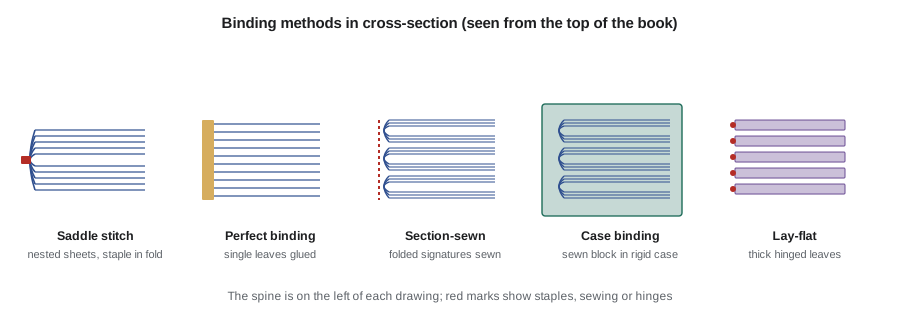
| Binding | How it works | Opens flat? | Durability | Relative cost |
|---|---|---|---|---|
| Saddle stitch | Folded sheets nested and stapled through the fold | Nearly | Low to moderate | Lowest |
| Perfect binding (hot-melt glue) | Single leaves glued at the spine edge | No | Moderate; pages can loosen | Low |
| PUR perfect binding | As above with polyurethane adhesive | Better | Good | Low to moderate |
| Section-sewn softcover | Signatures sewn together, then glued into a soft cover | Reasonably | Very good | Moderate |
| Swiss or exposed-spine binding | Sewn block attached to the cover at the back only; spine visible | Yes | Very good | Moderate |
| Case binding (hardcover) | Sewn or glued block attached to a rigid board case by endpapers | Fairly, if sewn | Excellent | Higher |
| Lay-flat photo binding | Thick leaves joined at hinges, often mounted back to back | Fully | Good | Highest per copy; common in digital photo books |
| Japanese stab, coptic, screw post | Hand or specialty bindings | Varies | Varies | Handwork; small runs |
Saddle stitching suits zines up to about 64 pages on light paper; beyond that the fold becomes bulky. Perfect binding suits inexpensive softcovers but is the weakest choice for photobooks that need to open flat; PUR adhesive improves both strength and opening. Section sewing, where folded signatures are stitched together through the fold before gluing, is the traditional quality method and allows spreads to open well. Case binding produces a hardcover that protects the book and signals value. Swiss binding, where the cover is attached only at the back and the sewn spine is exposed, opens beautifully and has become popular in independent photobooks. Lay-flat bindings, common in print-on-demand photo books, open completely flat so images can cross the gutter without loss.
Covers and cases
Softcovers use a single heavy sheet, usually 250 to 350 gsm, scored and folded around the book block. French flaps, where the cover extends and folds inward at the front and back, add substance and a place for text. Hardcovers use rigid boards, commonly 2 to 3 mm thick, covered with printed paper (paper-over-board), cloth or other materials, with endpapers connecting the case to the book block. A dust jacket adds protection and a second layer of design, often carrying the title and blurb while the cloth case beneath stays simple. Slipcases, boxes and wraparound bands are used for special editions.
Each layer adds cost and weight. A cloth-covered hardcover with foil stamping, printed endpapers and a jacket may cost several times more to bind than a softcover. For a first self-published book, a well-made sewn softcover or Swiss binding often gives most of the quality at a fraction of the cost of a hardcover.
Calculating spine width
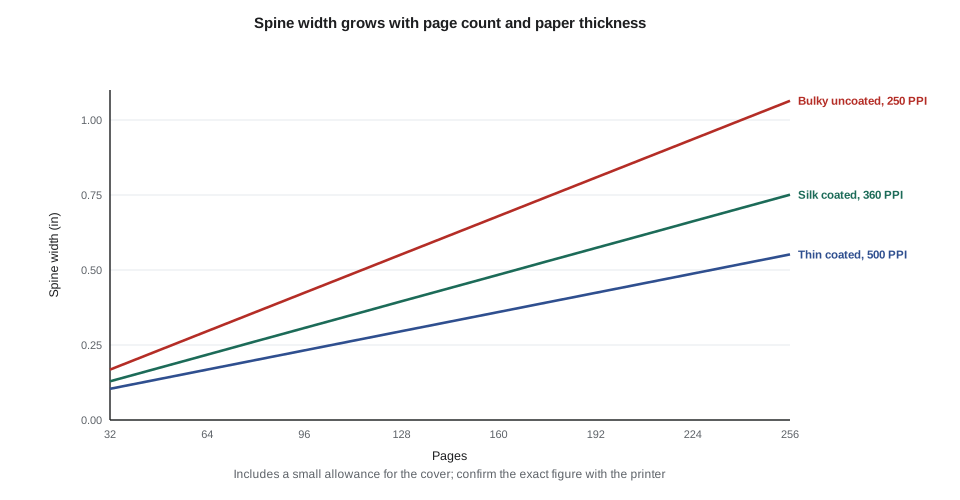
The spine width must be known before the cover can be designed, because the cover wraps around it. For a softcover, spine width is roughly the thickness of the book block plus a small allowance for the cover; for a hardcover, the case spine also allows for the boards and the rounding of the block. Printers supply exact figures after they choose the paper, but you can estimate early.
Here \( P \) is the number of pages, \( t \) is the caliper of one leaf (a leaf is two pages, front and back), and \( a \) is an allowance for cover and glue, typically about 0.5 to 1 mm for softcovers. North American printers often specify paper by pages per inch (PPI), the number of pages, counting both sides, in one inch of thickness. Then spine width in inches is approximately pages divided by PPI.
Worked problem
Estimating spine width
A 128-page softcover is printed on silk paper rated at 360 PPI, with a 0.04 in allowance for the cover. What is the approximate spine width? What if the same book were printed on an uncoated paper rated at 250 PPI?
Show solution
- Block thickness on silk: \( 128 / 360 \approx 0.356 \) in.
- Spine on silk: \( 0.356 + 0.04 \approx 0.40 \) in.
- On uncoated: \( 128 / 250 + 0.04 \approx 0.55 \) in.
Answer: About 0.40 in on silk and about 0.55 in on the uncoated paper. The thicker spine on uncoated paper makes the book feel more substantial and gives more room for spine type, but it also adds weight and shipping cost.
Book weight and shipping
Weight matters because shipping is a large part of the cost of selling books, especially across the border between Canada and the United States and to international buyers. Postal services and couriers price by weight and size bands, and a book that is slightly too heavy or thick can jump to a more expensive band. You can estimate the weight of the book block from the page area and paper weight.
Here \( A_{\text{page}} \) is the trimmed page area in square meters and \( g \) is the paper weight in grams per square meter. Add the cover and, for a hardcover, the boards and endpapers.
Worked problem
Estimating book weight
A 128-page book has a trim of 9.5 × 12 in (about 0.074 square meters per page) and is printed on 150 gsm paper, roughly 100 lb text. The hardcover case, endpapers and jacket add about 11 oz. What does the book weigh, and what does a carton of 12 copies weigh before packaging?
Show solution
- Page area: about 0.074 m². Leaves: 64.
- Block weight: \( 64 \times 0.074 \times 150 \approx 710 \) g, or about 25 oz.
- Book weight: \( 25 + 11 = 36 \) oz, about 2.25 lb. Carton of 12: about 27 lb.
Answer: About 2.25 lb per book and about 27 lb per carton. Mailing single copies will usually go as a parcel, for example USPS Media Mail for qualifying books or Ground Advantage, so check current rates before setting shipping prices.
Sustainability and certification
Paper is the largest material component of a book, so paper choice matters most for environmental impact. Certifications such as the Forest Stewardship Council (FSC) and the Program for the Endorsement of Forest Certification (PEFC) indicate that fiber comes from responsibly managed sources; recycled papers reduce the use of virgin fiber. A printer must hold chain-of-custody certification to use the FSC logo on the book. Other choices include avoiding plastic lamination and shrink-wrap, using vegetable-based inks, and choosing a size and weight that reduce freight. Print the run you can realistically sell or distribute; unsold books that are pulped waste all the materials and energy that went into them.
Testing materials before committing
Before finalizing materials, ask the printer for a blank dummy: an unprinted copy made with your exact paper, extent, binding and cover. Hold it, open it, check how it lies on a table, feel its weight and see the spine width. Ask for printed samples of similar images on your chosen paper, ideally from books the printer has produced. If possible, visit a bookshop or library and handle books made with the papers and bindings you are considering. Materials that look good in a swatch book can feel different in a finished object.
Common mistakes
MistakeComparing paper weights in pounds without checking whether they are text or cover grades
InsteadConfirm the grade and compare in grams per square meter or by caliper.
MistakeChoosing low-opacity paper for a book with dark images on both sides
InsteadCheck opacity and choose paper above about 94 percent for double-sided images.
MistakeIgnoring grain direction on heavy papers and covers
InsteadAsk the printer to confirm the grain runs parallel to the spine.
MistakeUsing standard perfect binding for a book with images across the gutter
InsteadChoose section sewing, Swiss binding, PUR or lay-flat binding so spreads open.
MistakeDesigning the cover before the spine width is known
InsteadEstimate the spine early and confirm with the printer's figure before final cover files.
Summary and key terms
- Coated papers give sharper detail and deeper blacks; uncoated papers feel natural and soften images.
- Paper weight is given in gsm or basis weight in pounds, which depends on grade.
- Weight is not thickness; caliper or PPI determines spine width.
- Opacity, shade and brighteners affect show-through and how images look.
- Grain should run parallel to the spine to avoid stiff, warping pages.
- Bindings range from saddle stitch and perfect binding to section sewing, case binding and lay-flat.
- Spine width and book weight can be estimated from page count, caliper, page area and paper weight.
- Coated paper
- Paper with a surface layer that holds ink on the surface for sharp detail.
- Uncoated paper
- Paper without a surface coating, which absorbs ink and feels natural.
- gsm
- Grams per square meter, the metric measure of paper weight.
- Basis weight
- The weight in pounds of 500 sheets of a paper's basic size.
- PPI (pages per inch)
- The number of pages in one inch of thickness, used to calculate spine width.
- Opacity
- The degree to which paper blocks light and prevents show-through.
- Grain direction
- The alignment of fibers in paper, which should run parallel to the spine.
- Section sewing
- Binding in which folded signatures are stitched together through the fold.
- Case binding
- Hardcover binding in which the book block is attached to a rigid case.
- Swiss binding
- A binding where the cover attaches only at the back, leaving the sewn spine exposed.
Practice problems
Work each problem on paper first, then reveal the answer to check.
Convert 120 gsm to approximate text basis weight.
Show answer
\( 120 / 1.48 \approx 81 \) lb text.
Convert 100 lb cover to gsm.
Show answer
\( 100 \times 2.70 = 270 \) gsm.
A 96-page book on 0.12 mm paper has a 1 mm cover allowance. Estimate the spine.
Show answer
\( 48 \times 0.12 + 1 \approx 6.8 \) mm.
A 160-page book on 400 PPI paper: estimate the block thickness.
Show answer
\( 160 / 400 = 0.4 \) in.
Why should grain run parallel to the spine?
Show answer
Pages turn and fold easily and resist warping.
Which binding opens fully flat?
Show answer
Lay-flat photo binding (Swiss binding also opens very well).
What opacity is comfortable for double-sided dark images?
Show answer
Above about 94 percent.
Estimate the block weight of 64 pages, 0.05 m² per page, 130 gsm.
Show answer
\( 32 \times 0.05 \times 130 = 208 \) g.
Name two cover finishes and one drawback of each.
Show answer
Soft-touch lamination, scuffs and adds plastic; spot UV, cost; uncoated, marks easily.
What is a blank dummy, and why request one?
Show answer
An unprinted copy with real paper and binding, to test weight, opening and spine.
Lesson quiz · 5 questions
Score 60% or more to complete this lesson.
Create a free account to save your progress, take quizzes and earn a certificate.