
PHOT-430 · Lesson 7 of 12 · 34 min
Printing and production
With a designed book, prepared files and a provisional specification, you are ready to choose how and where to print. This decision affects quality, cost, schedule, risk and even the environmental footprint of the book. This lesson compares offset, digital and print-on-demand production; explains the economics of fixed and variable costs and how unit cost falls with run length; shows how to request and compare quotes; describes press checks and how to behave at one; and covers delivery, inspection, storage and the business terms printers use. Example prices are illustrative and rounded; real quotes vary with paper prices, exchange rates and the printer's workload, so collect current quotes for your own project.
The main printing processes
Photobooks are printed by three main routes, each with different strengths.
| Process | How it works | Strengths | Limitations |
|---|---|---|---|
| Sheetfed offset lithography | Ink transferred from plates via a rubber blanket to sheets of paper | Highest quality and consistency, any paper, special inks, low unit cost at volume | High setup costs; uneconomic for very short runs |
| Digital press (liquid toner or production inkjet) | Prints directly from files without plates | Short runs, variable data, quick turnaround, good quality on suitable papers | Higher unit cost at volume; paper choice can be limited |
| Print-on-demand (POD) services | Digital printing of single copies as orders arrive | No inventory, no upfront run, global fulfillment by some services | Highest unit cost, limited papers and bindings, variable consistency |
High-end digital presses, such as those using liquid electrophotography, now rival offset for many photographic images on coated paper, and are widely used for short-run photobooks and zines. Offset remains the standard for monographs in runs of several hundred copies or more, especially when the book uses uncoated papers, duotones or special inks. Print-on-demand suits books with uncertain demand, proof copies, and photographers who want to avoid storing and shipping stock themselves.
Fixed and variable costs
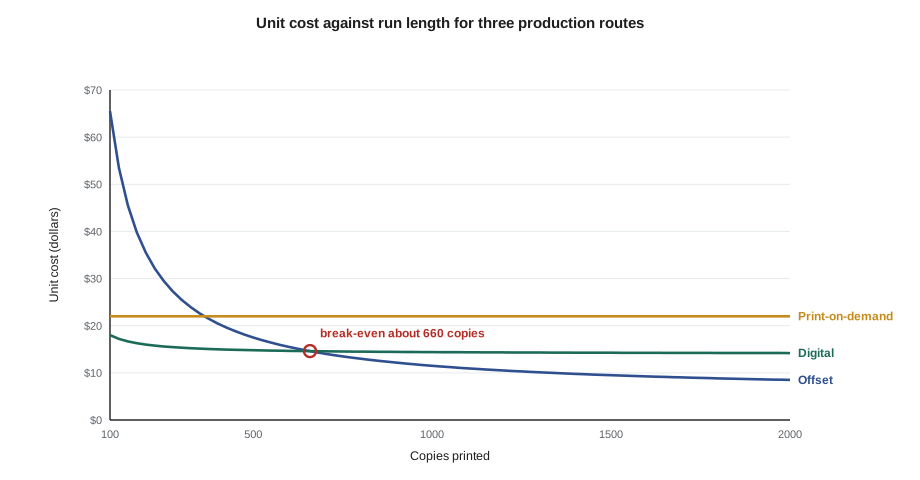
The economics of printing depend on the split between fixed costs, which are paid once regardless of run length, and variable costs, which are paid for every copy. In offset printing, fixed costs include prepress, plates, makeready (setting up the press and running waste sheets until color is correct) and binding setup. Variable costs include paper, ink, press time and binding per copy. Digital printing has very low fixed costs but higher variable costs.
Here \( F \) is the fixed cost, \( n \) is the number of copies and \( v \) is the variable cost per copy. As \( n \) grows, the fixed cost is spread over more copies and the unit cost falls toward \( v \). This is why printers quote several run lengths and why the extra cost of 500 more copies is often surprisingly small. But a lower unit cost is only valuable if you can sell or distribute the copies; unsold books still cost money to print, store and eventually recycle.
Worked problem
Comparing offset and digital
An offset quote for a 112-page softcover has fixed costs of $6,000 and a variable cost of $5.50 per copy. A digital quote has fixed costs of $400 and a variable cost of $14 per copy. Above what run length is offset cheaper, and what is the unit cost of each at 300 and 1,000 copies?
Show solution
- Break-even when costs are equal: \( 6000 + 5.5n = 400 + 14n \), so \( 5600 = 8.5n \) and \( n \approx 659 \) copies.
- At 300 copies: offset \( 6000/300 + 5.5 = \$25.50 \); digital \( 400/300 + 14 \approx \$15.33 \).
- At 1,000 copies: offset \( 6000/1000 + 5.5 = \$11.50 \); digital \( 400/1000 + 14 = \$14.40 \).
Answer: Offset becomes cheaper above about 660 copies. At 300 copies, digital costs about $15 per copy against $25.50 for offset; at 1,000 copies, offset costs $11.50 against $14.40. The decision also depends on paper choice, binding options and quality requirements.
import numpy as np
routes = {"offset": (6000, 5.50), "digital": (400, 14.00), "print-on-demand": (0, 22.00)}
runs = np.array([100, 300, 500, 1000, 2000])
for name, (F, v) in routes.items():
    unit = F / runs + v
    print(f"{name:16s}", "  ".join(f"{n}: ${u:6.2f}" for n, u in zip(runs, unit)))
(Fo, vo), (Fd, vd) = routes["offset"], routes["digital"]
print(f"offset beats digital above {int(np.ceil((Fo - Fd) / (vd - vo)))} copies")
print(f"digital beats print-on-demand above {int(np.ceil(Fd / (22.00 - vd)))} copies")offset 100: $ 65.50 300: $ 25.50 500: $ 17.50 1000: $ 11.50 2000: $ 8.50 digital 100: $ 18.00 300: $ 15.33 500: $ 14.80 1000: $ 14.40 2000: $ 14.20 print-on-demand 100: $ 22.00 300: $ 22.00 500: $ 22.00 1000: $ 22.00 2000: $ 22.00 offset beats digital above 659 copies digital beats print-on-demand above 50 copies
The table makes clear that print-on-demand, with no fixed cost, is cheapest for tiny quantities but quickly loses to a short digital run. For each route, remember to add freight, storage and fulfillment, which can change the comparison significantly.
Requesting quotes
A printer can quote accurately only if you give a complete specification. Prepare a request for quotation (RFQ) that lists all the following, and send the same specification to each printer so quotes are comparable.
- Title and contact details; target delivery date and location.
- Trim size, orientation and extent (pages, including any blanks).
- Paper for the text block, with weight and preferred stock or equivalent; any inserts on different paper.
- Colors: for example 4/4 (four colors both sides), tritone, spot colors, varnish.
- Binding: saddle stitch, PUR, section-sewn softcover, Swiss binding or case binding, with details.
- Cover: material, printing, finishes, flaps, jacket, endpapers, foil or embossing.
- Run lengths: ask for two or three, for example 500, 750 and 1,000.
- Proofs: type and number; whether a press check is wanted.
- Packing: shrink-wrapping or not, copies per carton, palletizing.
- Delivery: address, freight terms and whether the printer arranges shipping.
Ask printers to state what is included and what is extra, for example proofs, file corrections, samples, freight and duties. Request printed samples of similar books they have made, ideally on the paper you plan to use.
Worked problem
Comparing quotes with freight
Printer A, in Canada, quotes $11,400 for 1,000 copies including delivery. Printer B, overseas, quotes $8,200 for the same specification plus sea freight of $1,500, a customs broker fee of $250 and local trucking of $450. Printer B's schedule is six weeks longer. Which is cheaper per copy, and what else should the photographer weigh?
Show solution
- Printer A: \( 11\,400 / 1000 = \$11.40 \) per copy.
- Printer B total: \( 8200 + 1500 + 250 + 450 = \$10\,400 \), or \$10.40 per copy.
- Saving with B: \( 11\,400 - 10\,400 = \$1000 \), or 9 percent.
Answer: Printer B is about $1 per copy cheaper after freight. The photographer should weigh the six-week delay, the ease of attending a press check, exchange-rate and payment risk, duties and trade rules, which changed several times in 2025 and 2026, and the environmental cost of freight. Confirm current duties with the printer's freight agent or a customs broker.
Overs, unders and terms of trade
In book printing, the exact number of copies delivered can differ slightly from the number ordered because of spoilage and setup waste. Printing trade customs in North America and Europe commonly allow a tolerance, often up to 5 to 10 percent over or under the ordered quantity for short runs, with overs billed and unders credited at the per-copy rate. Check the quote and contract for the printer's policy, and specify if you need an exact minimum quantity, for example to fulfill crowdfunding rewards.
Other terms to check include deposits (often 30 to 50 percent on order), payment schedule, ownership of files and plates, storage charges for finished books, responsibility for damage in transit, and what happens if color does not match approved proofs. Printers often state that slight variation from proofs is normal; the definition of acceptable variation should be discussed before printing, not after.
Worked problem
Billing for overs
A photographer orders 800 copies at a quoted price of $9,600. The printer's terms allow up to 10 percent overs or unders, billed or credited at $5.20 per copy. The printer delivers 846 copies. What is the final bill?
Show solution
- Overs: \( 846 - 800 = 46 \) copies, within the 10 percent tolerance of 80.
- Extra charge: \( 46 \times 5.20 = \$239.20 \).
- Final bill: \( 9600 + 239.20 = \$9839.20 \).
Answer: $9,839.20. If the photographer cannot use extra copies, she should negotiate a cap on overs before printing.
Press checks
A press check is a visit to the printer while the job is on press, to approve the first good sheets of each signature before the run continues. Many photographers consider it the most valuable step in producing a book, because color and density can be adjusted on the spot. It is also expensive in time and travel, especially with overseas printers, and some printers offer remote approval using photographs, measurements or digital viewing booths.
At a press check, you view sheets under a standard viewing booth next to the approved contract proofs. Look at the following.
- Overall match to proofs: color balance, density and contrast of each image.
- Neutrality of black-and-white images and gray tones.
- Shadow detail and highlight dots.
- Registration: all color plates aligned so edges are crisp.
- Defects: hickeys (small specks or rings caused by debris), scratches, streaks, ghosting and set-off.
- Consistency across the sheet: images on the same sheet share ink settings, so improving one may affect another.
Remember that press operators control ink in zones across the sheet. Increasing magenta for one image affects others in the same zone. Prioritize the most important images and accept small compromises elsewhere. Speak clearly and respectfully with the press operator and the printer's representative, explain what you want in plain language, and sign the approved sheet. Then let the press run: each stop costs time and paper.
Production schedule
A self-published offset book has a typical production schedule that can be planned backward from the date you need copies.
| Stage | Typical duration |
|---|---|
| Request quotes and choose printer | 2 to 4 weeks |
| Paper ordering (if special stock) | Can run in parallel; 2 to 8 weeks |
| File delivery and printer preflight | 1 week |
| Contract proofs produced and delivered | 1 to 2 weeks |
| Corrections and second proofs | 1 to 2 weeks |
| Printing and press check | 1 to 2 weeks |
| Binding and finishing | 1 to 3 weeks |
| Packing and dispatch | Under 1 week |
| Freight: domestic truck | Days |
| Freight: sea from Europe or Asia | 4 to 8 weeks including customs |
Build in slack. Paper shortages, proof rounds and freight delays are common. If a book must arrive for a launch, festival or exhibition opening, set the file delivery date at least three to four months before the launch for a domestic printer, and five to six months for an overseas printer.
Worked problem
Working backward from a launch
A book must be available at a photobook fair on 15 May. The printer is overseas: proofs take 2 weeks, corrections and second proofs 2 weeks, printing and binding 4 weeks, and sea freight plus customs 7 weeks. The photographer wants 2 weeks of slack. When must files be delivered?
Show solution
- Total: \( 2 + 2 + 4 + 7 + 2 = 17 \) weeks.
- Seventeen weeks before 15 May is about 16 January.
Answer: Files should be delivered by about mid-January. Delivering in February would leave no slack and risk missing the fair.
Delivery, inspection and storage
When books arrive, inspect them promptly. Open several cartons from different pallets and check a sample of copies for binding faults, misprinted or missing pages, color variation, damaged covers and incorrect counts. Report problems to the printer in writing with photographs within the period stated in the contract, often a few weeks. Reputable printers reprint defective copies or offer credits.
Store books flat in cartons, off the floor, in a dry space with stable temperature and humidity. Damp basements and hot attics warp covers and pages. Keep cartons sealed until needed, and keep track of stock as you sell or give away copies. If storage space is limited, distributors, fulfillment services and some printers offer warehousing for a fee.
Worked problem
Cartons and storage space
A printer packs 14 copies per carton. A carton measures 16 × 12 × 10 in. How many cartons are needed for 1,000 copies, and what volume do they occupy?
Show solution
- Cartons: \( 1000 / 14 \approx 71.4 \), so 72 cartons, the last one partly filled.
- Volume per carton: \( 16 \times 12 \times 10 = 1920 \) in³, which is \( 1920 / 1728 \approx 1.11 \) ft³.
- Total: \( 72 \times 1.11 \approx 80 \) ft³.
Answer: 72 cartons occupying about 80 cubic feet, roughly a stack 4 ft by 3.3 ft by 6 ft high on a pallet. That fits in a small storage unit or a dry corner of a studio.
Print-on-demand in more detail
Print-on-demand services let you upload files and print copies as orders arrive, either sold through the service's own store, through online retailers via distribution programs, or ordered by you in small batches. Advantages include no upfront run, no storage and easy updates. Disadvantages include high unit costs, limited paper and binding choices, color variation between print sites, and trimming and binding tolerances that are looser than in offset. Some services specialize in photobooks with lay-flat bindings and photographic papers; others focus on trade books distributed through retail catalogs.
POD is valuable for producing dummies and proof copies, for testing demand before a larger offset run, and for keeping a book in print after the offset edition sells out. Order a printed proof copy before making a POD book available for sale, and order again occasionally to check that quality remains consistent.
Common mistakes
MistakeChoosing the longest run because the unit cost is lowest
InsteadChoose a run you can realistically sell or distribute; unsold copies still cost money.
MistakeSending different specifications to different printers
InsteadSend one complete RFQ so quotes are comparable.
MistakeComparing quotes without freight, duties and fees
InsteadAdd freight, broker fees, duties and local delivery to get a landed cost per copy.
MistakeAsking for repeated changes at a press check without priorities
InsteadPrioritize key images and remember that ink zones affect several images.
MistakeLeaving books unopened and unchecked after delivery
InsteadInspect samples from several cartons promptly and report defects in writing.
Summary and key terms
- Offset suits runs of several hundred or more; digital suits short runs; print-on-demand suits uncertain demand.
- Unit cost equals fixed cost divided by run length plus variable cost.
- Break-even run length is where fixed and variable costs of two methods balance.
- A complete request for quotation makes quotes comparable.
- Landed cost per copy includes freight, broker fees, duties and local delivery.
- Press checks allow color adjustments but must respect ink zones and priorities.
- Schedules should be planned backward with slack, especially for overseas printing.
- Offset lithography
- Printing in which ink is transferred from plates to a blanket and then to paper.
- Makeready
- Setting up a press and running sheets until color and registration are correct.
- Fixed cost
- A cost paid once regardless of the number of copies.
- Variable cost
- A cost paid for each copy.
- Print-on-demand
- Printing copies individually or in small batches as orders arrive.
- Request for quotation
- A document specifying a job so printers can quote.
- Overs and unders
- Copies delivered above or below the ordered quantity within an agreed tolerance.
- Press check
- A visit to approve sheets on press before the run continues.
- Hickey
- A small speck or ring on a printed sheet caused by debris.
- Landed cost
- The total cost of goods delivered, including freight, duties and fees.
Practice problems
Work each problem on paper first, then reveal the answer to check.
Fixed cost $5,000, variable cost $6, run 500. What is the unit cost?
Show answer
\( 5000/500 + 6 = \$16 \).
Offset F = $4,500, v = $5; digital F = $300, v = $12. Find the break-even run.
Show answer
\( 4200 / 7 = 600 \) copies.
Name four items in a complete RFQ.
Show answer
Trim and extent, paper, colors, binding, cover, run lengths, proofs, packing, delivery.
A quote of $7,000 plus $1,200 freight and $300 fees for 700 copies: landed cost per copy?
Show answer
\( 8500 / 700 \approx \$12.14 \).
An order of 600 copies with 10 percent tolerance: what range is acceptable?
Show answer
540 to 660 copies.
Why are ink zones important at a press check?
Show answer
Adjusting ink for one image affects others in the same zone.
A schedule totals 15 weeks before a 1 October launch. When must files go?
Show answer
About mid-June.
1,200 copies at 12 per carton: how many cartons?
Show answer
100 cartons.
Give two advantages of print-on-demand.
Show answer
No upfront run, no storage, easy updates, global fulfillment.
What should you do on receiving books?
Show answer
Inspect samples from several cartons and report defects in writing promptly.
Lesson quiz · 5 questions
Score 60% or more to complete this lesson.
Create a free account to save your progress, take quizzes and earn a certificate.