
PHOT-340 · Lesson 9 of 12 · 27 min
Corporate events, conferences and concerts
Not every event is a wedding. Businesses, associations, non-profits, universities and governments hold conferences, trade shows, product launches, awards nights, retreats and holiday parties, and they need images for marketing, reports, media and internal communications. Concerts, festivals and theater productions need photographers too, for artists, venues, promoters and publications. These events share the core skills of wedding work, anticipation, low-light technique and discretion, but differ in clients, priorities, access rules, delivery speed and how images may be used. This lesson covers corporate and conference coverage, speakers and panels, trade shows and branding, fast delivery, concerts and live performance, venue and access rules, and the privacy and consent questions that arise when attendee images are used for marketing.
Corporate clients and their priorities
Corporate clients hire photographers to support business goals: showing a well-attended, energetic event; featuring speakers, executives, sponsors and partners; capturing branded spaces and products; and providing images for social media during the event, press releases afterwards and promotion of next year's event. Before the event, get the run of show, a list of key people with photos if possible, sponsor obligations (for example, a sponsor whose logo must appear in a set number of images), brand guidelines, and the delivery schedule. Identify one contact person on site who can make decisions and help find people.
Corporate events often have a dress code and a culture of discretion; dress like a professional attendee, usually business casual in dark colors, and move quietly. Name badges, a lanyard and a contact on the organizing team help access.
Conferences: sessions, speakers and panels
Conference coverage combines several kinds of image:
- Speakers on stage. Tight and wide images with expressive gestures, the slide or branded backdrop visible, and the audience in some frames. Stage lighting is often bright on the speaker and dark on the audience, with large LED screens behind that can overexpose; expose for the speaker's face.
- Panels. Several people seated, often in a line; vary between the whole panel, pairs in conversation and individuals, and catch the moderator interacting.
- Audience and engagement. People listening, laughing, asking questions, taking notes or networking. Clients value images that show engagement and diversity of attendees.
- Breakouts and workshops. Smaller rooms with poor light, where bounce flash or high ISO is needed.
- Networking, meals and receptions. Candid conversation, handshakes, booth visits, badges and branded elements.
- Headshot stations. Many conferences offer attendees free headshots at a booth with a fixed setup, a popular and efficient service (lesson 6).
Multi-track conferences schedule parallel sessions, so a photographer cannot cover everything. Agree on priorities with the client and plan a route through the schedule.
Worked problem
Planning conference coverage
A one-day conference runs from 9:00 to 17:00 with a keynote at 9:00 (45 min), three parallel breakout tracks in four time slots of 50 minutes, a lunch, a panel at 15:30 and a reception from 17:00 to 18:30. The client wants every keynote and panel speaker, at least 10 minutes in each breakout session, and same-day social media selects at 12:30 and 17:30. Is one photographer enough?
Show solution
- Breakouts: 3 tracks × 4 slots = 12 sessions. At 10 minutes each with 5 minutes walking between rooms, one slot of 50 minutes allows about 3 sessions: \( 3 \times (10 + 5) = 45 \) min.
- So one photographer can visit all 3 tracks in each slot, just barely, with no buffer.
- Same-day selects need about 20 to 30 minutes each to download, choose and lightly edit 15 to 20 images, which collides with lunch coverage and the reception start.
- The keynote, panel and reception are covered in addition.
Answer: One photographer can do it only with no slack and with selects squeezed into breaks. A second photographer, or an on-site editor who receives files and posts selects, makes the plan reliable. Many conference photographers quote a second shooter or editor for multi-track events with same-day delivery.
Trade shows, launches and branding
At trade shows and product launches, the client wants booths full of visitors, staff engaging with customers, products in use, and branding visible. Photograph booths before the doors open for clean views and again at peak traffic. Use wide lenses to show scale and long lenses for candid engagement across busy halls. For product launches, coordinate with the communications team on the reveal moment, stage lighting and press positions.
Branding matters: logos should be readable, not cut off or blocked by heads; signage should be straight; and sponsors should appear as agreed. Keep a running list of sponsors photographed.
Fast delivery
Corporate clients increasingly expect same-day or next-day images, for social media during the event and press releases the following morning. Fast-delivery workflows include tethering or wireless transfer from camera to phone or laptop, shooting JPEG alongside raw for quick selects, using presets for consistent edits (lesson 11), and delivering through a shared online folder or the client's digital asset management system. Price fast delivery as a separate service, because it takes extra time and sometimes an extra person.
Concerts and live performance
Concert photography combines difficult light, fast movement, limited access and strict rules. Lights change color and intensity constantly, often with saturated reds and blues that are hard to expose and correct, and haze or smoke adds atmosphere and reduces contrast. Performers move unpredictably, and photographers must anticipate peak moments, such as a guitarist's jump, a singer's expression or the band against a burst of light.
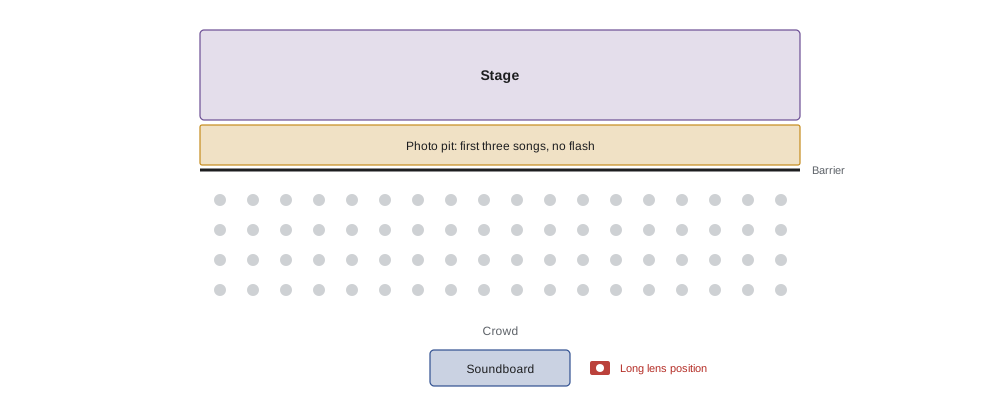
Access is controlled by the artist's management and the venue. Many shows allow accredited photographers in the pit, the space between the stage and the crowd barrier, for only the first three songs, without flash; some allow only shooting from the soundboard at the back, and some require photographers to sign a release giving the artist rights to approve or use images. Media photographers usually need accreditation through a publication. Read photo releases carefully, because some ask photographers to transfer copyright or limit use severely; many photographers and publications decline those terms.
Typical concert technique: fast lenses (70-200 mm f/2.8 in the pit, a wider lens for crowd and stage views, and a long lens for the soundboard), shutter speeds of 1/250 s or faster for movement, high ISO, spot or center-weighted metering on the performer's face, and manual exposure adjusted as lights change. Shoot in bursts during peak moments, and watch the lighting cues, which often repeat in each song.
Worked problem
Exposure under stage lights
In the pit, the photographer meters a singer's face under a white spotlight at 1/250 s, f/2.8, ISO 1,600. When the lights change to deep blue, the face meters 2 stops darker. How should the photographer adjust, and what is the trade-off?
Show solution
- Two stops darker requires two stops more exposure.
- Option 1: ISO 6,400 at 1/250 s and f/2.8, keeping motion frozen but adding noise.
- Option 2: 1/60 s at ISO 1,600, which risks motion blur from a moving singer.
- Option 3: wait for the lights to change back for key images and use blue moments for silhouettes and atmosphere.
Answer: Raise ISO to about 6,400, or wait for better light for close portraits and use the blue light for mood. Saturated blue light also makes faces lose detail, so many photographers time their portrait images to white or warm lights.
Venue and access rules
Every venue and production has rules that photographers must follow. Corporate venues may restrict where photographers can stand, prohibit photography in certain rooms or of certain screens with confidential content, and require insurance certificates (lesson 4). Theaters may allow photography only at dress rehearsals or photo calls, because shutter noise and flash disturb audiences and actors; silent shutters help but rules still apply. Sports venues require accreditation and positions in designated areas. Unions in some venues, such as stage technicians, may control certain spaces; coordinate through the client.
Privacy, consent and marketing use
Attendees at public or semi-public events generally expect to be photographed in crowd and general images, but using an identifiable person's image in advertising or marketing raises privacy and consent questions, especially if it implies endorsement. Organizers usually handle consent through registration terms that tell attendees they may be photographed and how images will be used, signs at the venue, and options to opt out, such as a colored lanyard or sticker that tells photographers not to feature that person.
In the United States, there is no general federal privacy law covering event photographs, but many states recognize a right of publicity that prevents commercial use of a person's name or likeness without consent, through statutes such as New York's Civil Rights Law §§ 50 and 51 and California Civil Code § 3344, or through common law. Editorial and newsworthy uses are generally protected, but advertising and endorsements usually need consent. Some states also have biometric privacy laws, such as Illinois' Biometric Information Privacy Act, that matter if images are processed with facial recognition. Organizers usually handle consent through registration terms and signs, and photographers should follow opt-out signals and avoid featuring people who decline. Minors require parental consent for most marketing uses.
| Use | Typical consent approach | Notes |
|---|---|---|
| General event coverage and reports | Registration terms and signs | Editorial uses generally protected |
| Featured person in advertising | Written release | Right of publicity statutes and common law |
| Children and youth | Parent or guardian consent | Extra care with schools and youth events |
| Opt-out attendees | Colored lanyards or stickers | Photographers avoid featuring them |
Licensing corporate and performance images
Corporate images are usually licensed for the client's internal and marketing use, with terms covering duration, media and whether partners and sponsors may also use them; some clients ask for broad or exclusive licenses, which should be priced accordingly, as in PHOT-310. Concert images taken under a photo release may be limited to editorial use in the accredited publication, and commercial use, such as selling prints of an artist, may require the artist's permission because of trademark and publicity rights.
Sports events
Sports events at the community, school or amateur level share many features with concerts: fast action, mixed light and restricted positions. Arena and gym lighting is often dim and can flicker under some fixtures, so test electronic shutters and use mechanical shutters if banding appears. Shutter speeds of 1/500 s to 1/1,000 s freeze most action; long lenses and fast apertures allow those speeds indoors at high ISO. Learn the sport well enough to anticipate key plays, and stand where the action comes toward you. Organizers of youth sports often have specific consent rules for photographing minors and publishing names, so ask before the event and follow their guidance. Professional and college sports require credentials and set strict positions and usage rules.
Delivering to corporate clients
Corporate clients often need images in specific formats and sizes: web-ready JPEG files for social media, high-resolution files for print, and sometimes files named or tagged by session, speaker or sponsor so their team can find them quickly. Ask for these requirements in advance, along with any naming conventions and the platform they use, so delivery fits their workflow and they can use the images immediately.
Common mistakes
MistakeCovering a conference without asking about sponsors and key people.
InsteadGet the run of show, VIP list, sponsor obligations and brand guidelines in advance.
MistakeExposing for the large LED screen behind a speaker.
InsteadMeter for the speaker's face and let the screen be bright.
MistakeUsing flash in the concert pit.
InsteadFollow the artist's rules, usually first three songs and no flash.
MistakeSigning any concert photo release without reading it.
InsteadCheck whether it transfers copyright or limits use, and decide accordingly.
MistakeFeaturing an attendee wearing an opt-out lanyard in marketing images.
InsteadFollow opt-out signals and leave consent processes to the organizer.
Summary and key terms
- Corporate clients want energy, speakers, sponsors, branding and fast delivery for marketing.
- Conferences need speakers, panels, audience engagement, breakouts, networking and sometimes headshots.
- Multi-track conferences and same-day delivery often need a second photographer or on-site editor.
- Concerts combine changing light, movement and strict access, often three songs without flash.
- Venues, theaters and productions set rules that photographers must follow.
- State right of publicity laws affect marketing use of attendee photos; editorial use is generally protected.
- Licenses for corporate and concert images should match intended uses.
Practice problems
Work each problem on paper first, then reveal the answer to check.
List three things to get from a corporate client before the event.
Show answer
Run of show, VIP list, sponsor obligations, brand guidelines or delivery schedule (any three).
How should you expose for a speaker in front of a bright LED screen?
Show answer
Meter for the speaker's face.
Why might a multi-track conference need two photographers?
Show answer
Parallel sessions and same-day delivery exceed one person's time.
What is the usual access rule for the concert pit?
Show answer
First three songs, no flash.
A face meters 1/250 s, f/2.8, ISO 1,600 in white light and 2 stops darker in blue. What ISO keeps 1/250 s?
Show answer
ISO 6,400.
Why read concert photo releases carefully?
Show answer
Some transfer copyright or limit use severely.
Who usually manages attendee consent at events?
Show answer
The organizer, through registration terms, signs and opt-out options.
Name a US state statute on right of publicity.
Show answer
California Civil Code § 3344 or New York Civil Rights Law §§ 50–51.
When are booths best photographed?
Show answer
Before doors open for clean views and at peak traffic.
How should fast delivery be priced?
Show answer
As a separate service, because it takes extra time and sometimes extra staff.
Lesson quiz · 5 questions
Score 60% or more to complete this lesson.
Create a free account to save your progress, take quizzes and earn a certificate.