
PHOT-340 · Lesson 1 of 12 · 25 min
The event and wedding photography market
Event photography records things that happen once. A wedding ceremony, a retirement speech, a product launch, a graduation, a gala, a concert or a championship game will not be repeated for the camera, and the people who hire a photographer are paying for the confidence that the important moments will be captured well, whatever the light, weather or schedule does. That makes event work different from the studio and location work in PHOT-310 and PHOT-311, where the photographer controls the pace. At an event, the photographer works inside someone else's day, anticipates instead of directs, and solves technical problems in seconds. This lesson maps the market: the main kinds of events, the clients behind them, the styles photographers sell, how the work is paid for, and the skills and temperament the work demands. Later lessons go into contracts, planning, gear, ceremonies, groups, flash, receptions, corporate and concert work, teams, post-production and the business.
Why events are different
Three features shape almost every decision in event photography. The first is no second chance: the first kiss, the cutting of a ribbon or a winning goal happens once, and the photographer must be in the right place with the right settings before it happens. The second is limited control: the timeline belongs to the client, the planner or the venue, and the light is whatever the room provides, from bright noon sun to a dim banquet hall lit by candles and colored LED uplights. The third is people: event photographers work among guests, families, officiants, performers, security staff and other vendors, and their manner affects the day as much as their pictures do. A photographer who is calm, discreet and well prepared becomes part of a good experience; one who is pushy or flustered can spoil it.
These features reward preparation over improvisation. Experienced event photographers know the order of a typical ceremony, scout or research the venue, carry backups of everything critical, and decide in advance how they will light dark rooms. They still improvise, but from a plan.
Kinds of events
The event market is broad. Most photographers specialize in a few segments, because each has different clients, rhythms and price levels.
- Weddings and elopements. Usually the highest-value private events, covering a full day or several days, with intense emotional stakes and long post-production. Elopements and micro-weddings with a handful of guests have grown in popularity and often involve travel to scenic locations.
- Cultural and religious ceremonies. Bar and bat mitzvahs, quinceañeras, christenings, naming ceremonies, Diwali and Lunar New Year celebrations, and multi-day South Asian weddings each have their own order of events and customs, covered in lesson 5.
- Corporate events. Conferences, trade shows, product launches, award dinners, holiday parties and executive headshots on site. Clients are businesses, budgets are set in advance, and images are used for marketing, so usage rights matter.
- Galas and fundraisers. Charity dinners and auctions, where sponsors and donors must appear in the pictures and images are delivered quickly for social media and thank-you reports.
- Concerts and performances. Music, theater, dance and comedy, often with strict access rules and very difficult light (lesson 9).
- Sports events. From school tournaments to professional leagues, with fast action, long lenses and accreditation.
- Community and school events. Graduations, proms, festivals and parades, often sold to many participants rather than one client.
- Private parties. Milestone birthdays, anniversaries, engagement parties and baby showers, usually shorter and simpler than weddings.
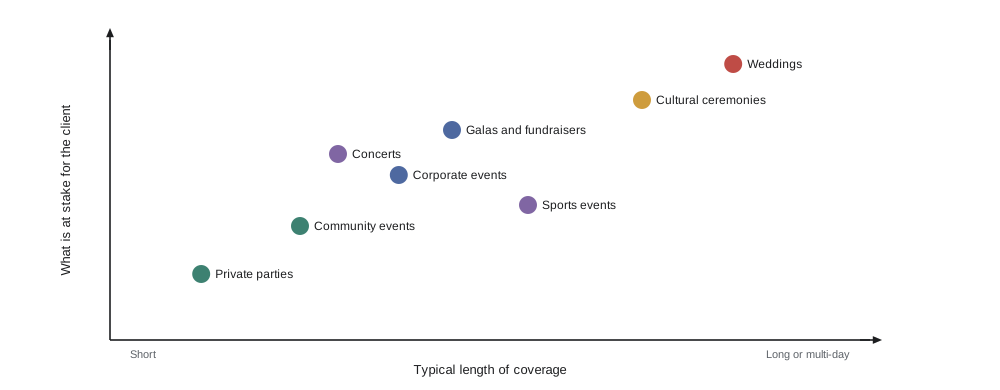
Who hires event photographers
Understanding the buyer explains how each segment works. Couples hire wedding photographers directly, usually many months in advance, after comparing portfolios, reviews and prices, and often with input from parents who may be paying. Wedding planners and venues refer photographers they trust, so relationships with other vendors matter. Corporate clients book through marketing, communications or events staff, sometimes through agencies or event-management companies, and expect invoices, insurance certificates and clear licenses. Non-profits want value and fast turnaround. Bands, venues, promoters and publications hire concert photographers or grant them access; much concert photography is done on assignment for media or for the artist's team. Schools and sports organizations may contract a photographer for an entire season or sell images to families.
Each buyer measures success differently. A couple judges emotion, beauty and completeness of the story; a corporate client judges whether the images show the brand, the sponsors and the speakers clearly and arrive on time; a promoter judges energy and the look of the artist. Asking what success looks like for the client, in their words, is the first step of every booking.
Styles
Wedding and event photographers describe their work by style, and clients choose partly on style. Most photographers blend several.
- Documentary or photojournalistic. The photographer observes and records events as they unfold with minimal direction, much as in PHOT-320. The goal is authentic moments and story.
- Traditional or classic. Posed portraits and formal groups with careful lighting and composition, covering every expected shot. Many families still want these images even when the couple prefers documentary work.
- Editorial or fine art. Inspired by fashion and magazine photography: styled portraits, strong design, deliberate light, sometimes film or film-like processing.
- Candid lifestyle. Lightly directed situations that look natural, such as prompting a couple to walk and talk rather than posing them.
Style also includes processing: bright and airy, warm and filmic, true-to-life, moody, or black and white. A consistent style helps clients recognize a photographer's work and sets expectations; lesson 11 covers how to keep editing consistent across thousands of images.
| Style | Photographer role | Strengths | Risks |
|---|---|---|---|
| Documentary | Observer | Authentic moments, little disruption | May miss formal images families expect |
| Traditional | Director | Complete, predictable coverage | Can feel stiff and slow the day |
| Editorial | Director and designer | Striking, distinctive portraits | Needs time and good locations |
| Candid lifestyle | Prompter | Natural look with some control | Can still feel staged if overdone |
How the work is paid for
Event photography is usually priced by coverage and deliverables rather than by the hour alone. Wedding photographers sell packages defined by hours of coverage, number of photographers, delivery format, and products such as albums and prints. Corporate work is often priced as a half-day or day rate plus usage license and expenses, closer to the commercial model in PHOT-310. Community and sports photographers may earn mainly from print and download sales to participants. Concert photographers working for media are paid per assignment or per image licensed, often modestly, and many build careers by working with artists directly.
Income is seasonal. In Canada and the northern United States, weddings cluster from May to October, with a peak on summer Saturdays; corporate events cluster in spring and autumn, and holiday parties in December. Photographers smooth the year by adding corporate, portrait and winter events, teaching, or selling albums and prints from earlier work. Lesson 12 turns these patterns into a pricing and business plan.
Worked problem
Seasonal booking capacity
A wedding photographer can shoot one wedding each Saturday and, at most, one other event on a Friday or Sunday in peak season. The peak season runs from mid-May to mid-October, about 22 weekends. The photographer wants to keep four of those weekends free and expects to fill 80 percent of the remaining Saturdays with weddings and 30 percent of the remaining Fridays or Sundays with smaller events. How many weddings and smaller events should the photographer plan for in peak season?
Show solution
- Available weekends: 22 − 4 = 18.
- Weddings: 0.80 × 18 = 14.4, so about 14.
- Smaller events: 0.30 × 18 = 5.4, so about 5.
Answer: About 14 weddings and 5 smaller events. Because each wedding also brings about 30 to 40 hours of planning, editing and delivery (lesson 11), 14 weddings alone can mean 500 hours of work spread over the season and the autumn editing backlog.
Skills and temperament
Event photography demands a combination of technical and human skills. Technically, the photographer must handle fast-changing light, flash in dim rooms, moving subjects, and large volumes of files, without the time to check every frame. Humanly, the photographer must read a room, anticipate reactions, direct groups of strangers quickly and kindly, stay invisible during quiet moments, and stay calm when things go wrong: a late bride, rain on an outdoor ceremony, a missing family member or a venue that bans flash.
Physical stamina matters too. A wedding can mean ten or twelve hours on your feet carrying several kilograms of gear, often without a proper meal unless the contract provides one. Many photographers use harness systems to spread weight, plan breaks, and set a meal clause in their contracts.
Professional conduct ties everything together: dressing appropriately for the event, arriving early, communicating clearly with the client and other vendors, respecting religious and cultural rules, protecting guests' privacy, and delivering what was promised on time. Reputation in this field spreads by word of mouth and reviews, so every event is also marketing.
Ethics and respect at events
Event photographers see people at their most emotional and sometimes most vulnerable: tears at a ceremony, grief at a memorial, guests who have had too much to drink. Good practice is to photograph with dignity, avoid publishing unflattering or compromising images, and remember that guests did not hire you and may not want to be photographed. Children, people who ask not to be photographed, and guests at religious ceremonies deserve particular care. Lesson 9 covers privacy law for attendee photos, and lesson 2 covers model releases.
A career path
Many event photographers start as second shooters or assistants to established photographers, which teaches the order of events, how to move through a venue, and how a busy photographer manages a day, without the pressure of being the lead. Others start with community events and portraits and build a portfolio. Professional associations such as the Professional Photographers of Canada (PPOC), the Professional Photographers of America (PPA) and wedding-focused groups offer education, certification and insurance options. Lesson 10 covers second shooters and teams.
How this course is organized
Lesson 2 covers clients, consultations and contracts. Lesson 3 covers planning, timelines and shot lists. Lesson 4 covers gear and backups. Lesson 5 covers ceremonies and cultural sensitivity. Lesson 6 covers portraits and groups. Lesson 7 covers flash and low light. Lesson 8 covers receptions, speeches and dancing. Lesson 9 covers corporate events, conferences and concerts. Lesson 10 covers second shooters and teams. Lesson 11 covers post-production and delivery. Lesson 12 covers pricing, marketing and insurance and finishes with a capstone coverage plan.
A day in the life
A typical full wedding day shows how these skills combine. The photographer arrives at the getting-ready location an hour or so before the ceremony, photographs details while hair and makeup finish, captures the dressing and the first emotional moments with family, then travels ahead of the couple to the ceremony venue to meet the officiant and check positions. After the ceremony come family groups, wedding party images and couple portraits on a tight schedule, then the reception: room details, entrances, speeches, dances and candids, often until late evening. Throughout the day the photographer changes cards and batteries at quiet moments, checks that a second shooter is in position, and keeps track of the timeline. The next morning, before anything else, the files are backed up.
Common mistakes
MistakeTreating an event like a studio shoot and trying to control everything.
InsteadWork inside the client's timeline, anticipate moments and direct only when it helps.
MistakeChoosing a style without asking what the client values.
InsteadAsk what success looks like for this client and balance documentary, traditional and editorial coverage.
MistakeBooking every peak weekend without counting editing time.
InsteadPlan capacity for shooting and post-production together.
MistakeAssuming guests have agreed to be photographed because they attended.
InsteadPhotograph with dignity and respect requests not to be photographed.
MistakeIgnoring stamina and meals on long days.
InsteadPlan breaks, use comfortable carrying systems and include a meal clause in contracts.
Summary and key terms
- Event photography records moments that happen once, with limited control and many people involved.
- Segments include weddings, cultural ceremonies, corporate events, galas, concerts, sports, community events and private parties.
- Buyers differ: couples judge emotion and story, businesses judge brand coverage and turnaround.
- Styles include documentary, traditional, editorial and candid lifestyle, often combined.
- Pricing is by package or day rate plus usage and products, and income is seasonal.
- The work needs technical speed, people skills, stamina and professional conduct.
- Many photographers start as second shooters or assistants.
Practice problems
Work each problem on paper first, then reveal the answer to check.
Name the three features that make event photography different from studio work.
Show answer
No second chance, limited control and working among many people.
Which client type usually needs insurance certificates and clear licenses?
Show answer
Corporate clients.
What is the main risk of a purely documentary wedding style?
Show answer
Missing formal images that families expect.
How are corporate events usually priced?
Show answer
A half-day or day rate plus usage license and expenses.
A photographer has 20 peak weekends, keeps 2 free and expects to fill 75 percent of Saturdays. How many weddings?
Show answer
0.75 × 18 = 13.5, about 13 or 14.
Why do event photographers carry backups of critical gear?
Show answer
Because moments cannot be repeated if equipment fails.
What does a second shooter learn?
Show answer
The order of events, movement through venues and how a lead manages a day.
Give two ways photographers smooth seasonal income.
Show answer
Add corporate and winter events, portraits, teaching or product sales.
What should a photographer do if a guest asks not to be photographed?
Show answer
Respect the request and avoid photographing or publishing that person.
Name two professional associations for photographers.
Show answer
The Professional Photographers of Canada and the Professional Photographers of America.
Lesson quiz · 5 questions
Score 60% or more to complete this lesson.
Create a free account to save your progress, take quizzes and earn a certificate.