
PHOT-340 · Lesson 7 of 12 · 27 min
Flash and low light
Many of the most important event moments happen in poor light: a candlelit dinner, a speech in a dim ballroom, a first dance under colored uplights, a ceremony in a dark stone church, or a winter wedding when the sun sets at 4:30 p.m. Event photographers must produce clean, natural-looking images in all of these, often without time to set up. This lesson covers the choices available in low light: high ISO and fast lenses, bounce flash, off-camera flash, dragging the shutter to keep ambient atmosphere, matching flash color to the room with gels, and handling mixed and colored light. Flash fundamentals, such as the inverse-square law and guide numbers, are introduced in PHOT-220 and PHOT-310; this lesson applies them to events.
Ambient light first
Before reaching for flash, consider whether the existing light can work. Modern full-frame cameras produce usable images at ISO 6,400 and often higher, especially with noise reduction in post-processing, and fast primes at f/1.4 to f/2 gather four times as much light as f/2.8 zooms. Ambient light preserves the atmosphere of a room, does not disturb guests, and is allowed where flash is not, such as during many ceremonies. Its limits are motion blur, shallow depth of field at wide apertures, and unflattering light from above or behind. Many photographers work in layers: ambient light whenever it is good enough, flash when it is not, and a combination of both to balance subject and background.
| Approach | Strengths | Limits |
|---|---|---|
| High ISO and fast lens | Natural look, silent, allowed in ceremonies | Noise, shallow focus, blur from movement |
| On-camera bounce flash | Soft, quick, follows the photographer | Needs a light, low ceiling or wall |
| Off-camera flash on stands | Shape, rim light, consistent results | Setup time, stands in guests' way |
| Flash plus slow shutter (drag) | Keeps room glow, freezes subject | Ghosting if the ambient is too strong |
| Video or LED light | Continuous, what you see is what you get | Low output, distracting for guests |
Bounce flash
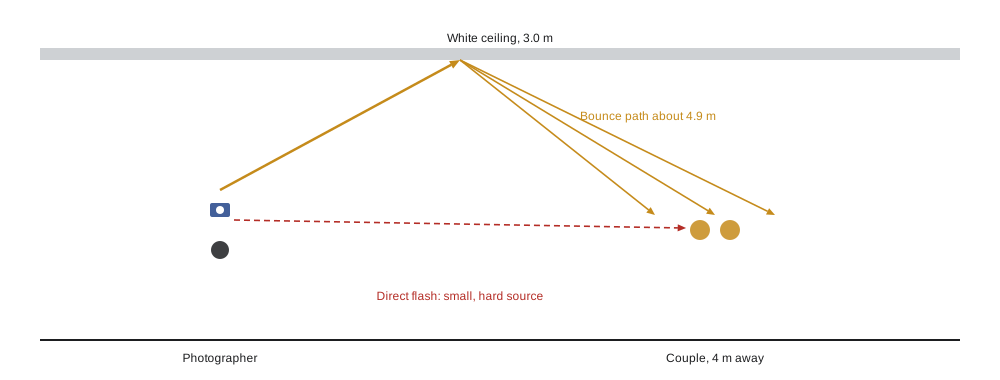
Bouncing an on-camera flash off a ceiling or wall turns a small, harsh light into a large, soft one. The light reaches the subject from above or the side, like window light, rather than flat from the camera. Bounce works best with light-colored ceilings and walls about 2.5 to 4 m high; dark, colored or very high surfaces absorb light or tint it. Common techniques include bouncing off the ceiling behind the photographer for soft frontal light, bouncing off a wall to the side for directional light, and using a small card on the flash head to add a catchlight in the eyes.
Bounced light travels farther than direct light and loses some energy at the surface, so it needs more flash power. The guide number relationship from PHOT-220 still applies, with the bounce path in place of the direct distance and an allowance for absorption:
where \( d_{\text{bounce}} \) is the total path from flash to surface to subject and \( k \) is a loss factor, about 0.5 for a white ceiling (one stop of aperture lost to absorption and spread, often more) and much less for dark surfaces.
Worked problem
Bounce flash power at distance
A flash has a guide number of 60 at ISO 100 in meters (about 197 in feet). The photographer, holding the flash at 5.2 ft (1.6 m), bounces off a white ceiling 9.8 ft (3.0 m) high onto a couple 13 ft (4 m) away, at ISO 800. Estimate the bounce path, the aperture full power would give, and the power setting needed for f/2.8, using a loss factor of 0.5.
Show solution
- The ceiling point is halfway between photographer and couple: 2 m across and 1.4 m up.
- Bounce path: \( 2 \times \sqrt{2^2 + 1.4^2} ≈ 2 \times 2.44 = 4.9 \) m (about 16 ft).
- Guide number at ISO 800: \( 60 \times \sqrt{8} ≈ 170 \).
- Full-power aperture: \( 170 / 4.9 \times 0.5 ≈ 17 \), about f/16.
- For f/2.8, light can be reduced by \( (17 / 2.8)^2 ≈ 37 \) times, about 5 stops, so roughly 1/32 power.
Answer: About 1/32 power at f/2.8 and ISO 800. In practice, TTL flash would set this automatically, but the estimate shows why bounce works well in normal rooms and why it fails under very high or dark ceilings, where the path and losses grow.
Off-camera flash
Placing one or more flashes on stands, triggered by radio, gives light that does not depend on the ceiling and adds shape and depth. At receptions, a common setup places one or two flashes on stands in corners of the dance floor, pointing toward the center, often with a slight upward angle and diffusers. The on-camera flash or a bounce provides fill, and the off-camera flashes provide rim or side light that separates people from the dark background. For speeches and first dances, an off-camera flash behind the subject creates a dramatic glowing rim; for portraits outdoors at night, a flash in a small softbox creates studio-quality light anywhere.
Off-camera flash takes setup time and space, and stands must be secured and kept out of guests' paths with sandbags or tape to avoid trips, a liability concern covered in lesson 4. Agree on positions with the planner and DJ, who may be using the same corners for speakers and lights.
Dragging the shutter
Flash exposure depends on aperture, ISO and flash power, but ambient exposure also depends on shutter speed. With flash freezing the subject, a slower shutter speed, called dragging the shutter, lets more ambient light record, so the room's candles, string lights and uplights glow instead of falling to black. The balance between flash and ambient is a creative choice.
- At 1/200 s, the ambient may be several stops below the flash, making the background dark: clean but stark.
- At 1/30 s or 1/15 s, the room's light records, giving warmth and context, while the flash still freezes the main subject.
- Too slow, and moving subjects show ghosting: a sharp flash image overlaid with a blurred ambient trail. On the dance floor, some photographers use this deliberately for a sense of motion, with rear-curtain sync so trails follow behind movement.
Worked problem
Balancing flash and room light
At a reception, the photographer uses f/2.8 and ISO 1,600. The room's ambient light meters at 1/15 s for a normal exposure. The photographer wants the background about one stop darker than normal, with flash lighting the couple. What shutter speed should they use, and what happens if they use 1/125 s instead?
Show solution
- One stop darker than 1/15 s is 1/30 s.
- At 1/30 s, the background records one stop under, glowing but darker than the subject, while the flash freezes the couple.
- At 1/125 s, the background is three stops under 1/15 s, so it falls nearly to black.
Answer: About 1/30 s for a warm background one stop under. 1/125 s makes the background nearly black, which can suit a dramatic look but loses the room's atmosphere. Hand-holding at 1/30 s works with flash because the flash freezes the subject, as long as the ambient on the subject itself is low.
Color of light and gels
Flash is balanced for daylight, about 5,500 K, while event rooms are often lit by warm tungsten or LED light at about 2,700 to 3,200 K. Mixing the two makes faces look cold against a warm background, or the background very orange if white balance is set for flash. A CTO gel (color temperature orange) on the flash converts its light toward tungsten, so white balance can be set for the room and everything matches. A full CTO shifts about +130 to +160 mireds (PHOT-311), half CTO about half that, and quarter CTO is common for slightly warmer rooms.
Colored uplights in purple, blue or red, common at receptions, create strong color casts. When light on faces is mostly colored, skin tones are hard to correct; flash provides neutral light on faces while the color remains in the background. Black and white conversion is another option for difficult color.
Autofocus in the dark
Low light challenges autofocus. Modern mirrorless cameras with eye detection can focus in very dim conditions, but contrast and light still matter. Techniques include focus-assist lights on flashes or triggers, a small LED held by an assistant, focusing on high-contrast edges, and switching to manual focus with focus peaking for static subjects. Turn off the camera's bright AF-assist lamp during ceremonies if it distracts.
When flash is not allowed
Ceremonies, some performances and some venues prohibit flash. In these conditions, rely on fast primes, high ISO, image stabilization and careful timing, shooting when subjects are still. Expose to the right where possible without clipping highlights, because underexposed high-ISO files become noisy when brightened. Accept some grain: a slightly noisy image of a key moment is far better than a missed one. Lesson 11 covers modern noise reduction.
Flash etiquette
Flash can distract guests, performers and officiants. Avoid firing directly into faces during emotional moments, use bounce rather than direct flash where possible, and never use flash during moments where it is prohibited. Fire as few frames as needed with flash during speeches. Be aware that repeated flash can affect people with light sensitivity; adapt if asked.
High-ISO practice and noise
Modern noise reduction, including machine-learning tools in raw processors, can clean up files at ISO 12,800 and beyond while keeping fine detail, which has changed how event photographers work in dim rooms. Noise is lowest when the exposure is correct in camera: brightening an underexposed ISO 3,200 file by two stops in editing usually looks worse than shooting at ISO 12,800 in the first place, because the shadows carry less signal. Test your own cameras by photographing the same scene at a range of ISO settings, processing the files as you would for a client, and printing or viewing them at the sizes clients use. Decide in advance the highest ISO you accept for each kind of image, perhaps ISO 12,800 for documentary candids and ISO 6,400 for portraits that may be printed large.
A reception lighting plan
A simple, reliable plan for most receptions combines three layers. First, an on-camera flash bounced off the ceiling or a wall, gelled to match the room, for general coverage. Second, one or two off-camera flashes on stands in corners of the dance floor, set at low power and triggered by radio, to add rim light and depth. Third, a dragged shutter of about 1/15 s to 1/30 s to record the room's own light. Test the setup before guests arrive by photographing an assistant or a willing staff member in each part of the room, and note the settings that work. When the lights change for the first dance, adjust the shutter speed rather than the flash, because the ambient light changed but the flash distance did not.
Keep the plan written on a small card in your pocket so you can reset quickly after a battery change or a move to a new room.
Common mistakes
MistakePointing the flash straight at subjects in every situation.
InsteadBounce off ceilings or walls, or use off-camera light, for softer, natural results.
MistakeBouncing off a dark wooden ceiling and wondering why the flash cannot keep up.
InsteadBounce off light surfaces or switch to direct diffused or off-camera flash.
MistakeShooting receptions at 1/200 s and losing all room atmosphere.
InsteadDrag the shutter to record the ambient light behind flash-lit subjects.
MistakeMixing daylight-balanced flash with warm room light without gels.
InsteadGel the flash with CTO and set white balance for the room.
MistakeLeaving off-camera stands unsecured on a crowded dance floor.
InsteadPlace stands in safe corners, weigh them down and tape cables.
Summary and key terms
- Use ambient light with high ISO and fast lenses when it is good enough and flash is not allowed.
- Bounce flash makes a soft source from ceilings and walls but needs more power than direct flash.
- Estimate bounce aperture with the guide number, bounce path and a loss factor.
- Off-camera flash on stands adds shape and consistency at receptions, with safe placement.
- Dragging the shutter balances flash on subjects with glowing ambient backgrounds.
- CTO gels match flash to warm room light; colored uplights need neutral flash on faces.
- Respect flash bans and use flash discreetly during emotional moments.
Practice problems
Work each problem on paper first, then reveal the answer to check.
Name two strengths of ambient light at events.
Show answer
It keeps atmosphere and is allowed where flash is not.
Why does bounce flash need more power than direct flash?
Show answer
The path is longer and some light is absorbed and spread at the surface.
Guide number 60 at ISO 100: what is it at ISO 400?
Show answer
60 × √4 = 120.
Bounce path 5 m, GN 120, loss 0.5: full-power aperture?
Show answer
120/5 × 0.5 = 12, about f/11.
What does dragging the shutter do?
Show answer
Lets more ambient light record while flash freezes the subject.
Ambient meters 1/15 s; you want it two stops darker. Shutter speed?
Show answer
1/60 s.
What gel matches flash to tungsten light?
Show answer
A CTO (color temperature orange) gel.
How can you keep skin natural under purple uplights?
Show answer
Light faces with neutral flash, or convert to black and white.
What causes ghosting?
Show answer
Strong ambient light recording a moving subject during a slow shutter with flash.
What should you do when flash is not allowed?
Show answer
Use fast primes, high ISO, stabilization and timing; accept some grain.
Lesson quiz · 5 questions
Score 60% or more to complete this lesson.
Create a free account to save your progress, take quizzes and earn a certificate.