
PHOT-340 · Lesson 8 of 12 · 27 min
Receptions, speeches and dancing
After the ceremony and portraits, the reception is where the event relaxes and the story becomes about people: the entrance of the couple, the speeches that make the room laugh and cry, the first dance, parents dancing with their children, the cake cutting, the dance floor at its peak, and the send-off. Corporate galas and parties have similar moments: welcome remarks, award announcements, a keynote, a band and a packed floor. Reception coverage tests anticipation, low-light technique and stamina, often late at night after ten hours of work. This lesson covers the structure of a reception, preparing the room, photographing entrances, speeches and reactions, first dances and special dances, the dance floor, details and décor, candids, and knowing when coverage is complete.
The structure of a reception
Receptions vary, but a typical wedding sequence is: cocktail hour while the couple finish portraits; guests seated; grand entrance of the wedding party and couple; welcome and dinner; speeches before, during or after dinner; cake cutting; first dance and parent dances; open dancing; special events such as a bouquet toss, cultural dances or a surprise performance; and a send-off or late-night snack. Corporate and gala events follow a run of show with timed speeches, awards, presentations and entertainment. Get a copy of the reception timeline or run of show from the planner or DJ, and confirm cues: the DJ or emcee can give the photographer a nod before each key moment.
Preparing the room
Before guests enter, photograph the room and details while it is empty and untouched: table settings, floral arrangements, place cards, the head table, the cake, the décor and lighting. These images matter to the couple, who spent months planning them, and to vendors who will want to see their work (under the license discussed in lesson 2). This is also the moment to set up off-camera flashes (lesson 7), check the light at the head table and podium, identify where speeches will happen, and agree with the DJ and videographer on positions.
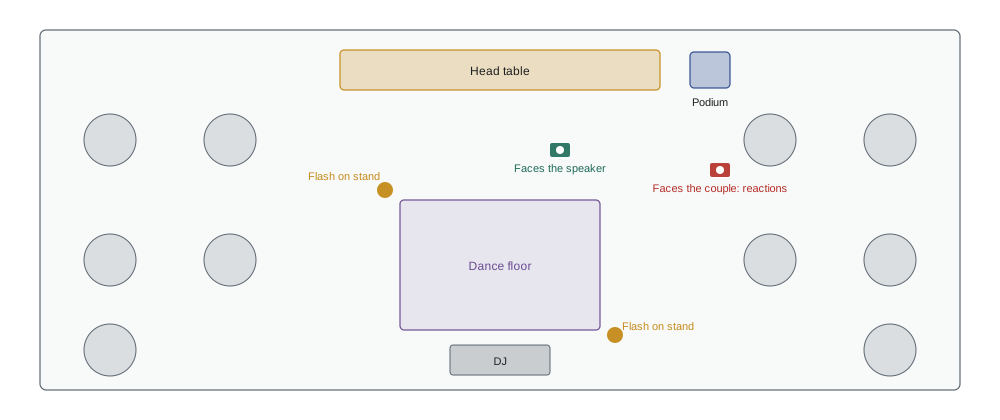
Entrances
Grand entrances happen quickly: the wedding party and couple may dance, wave or run into the room, often under spotlights or colored light. Position yourself where you can see them coming through the doorway and fill the frame as they enter, with the guests reacting behind. Use flash or high ISO to freeze movement, and shoot a short burst. A second photographer can cover the guests' reactions or a wide view of the room.
Speeches and reactions
Speeches produce some of the most emotional images of the day, but the important picture is often not the speaker; it is the reaction of the couple, the parents or the person being toasted. Cover both. With one photographer, find a position where you can photograph the speaker and then quickly turn to the head table; with two, one photographer covers the speaker and the other covers reactions. A telephoto lens lets you stay at a distance and avoid blocking guests' views.
Speakers often stand in poor light, at a podium with a microphone covering their face, or in front of a bright window. Ask the planner to position the podium where the light is reasonable and where the speaker faces the room. Avoid photographing speakers mid-word with mouths open or while eating; wait for gestures, laughter and pauses. Many photographers shoot speeches without flash for a natural look, and use flash only when the light is extremely dim, to avoid distracting the speaker.
Worked problem
Settings for speeches without flash
A speaker stands 8 m from the photographer in a dim room. The photographer uses a 70-200 mm f/2.8 lens at 200 mm. Subject movement during speech gestures requires at least 1/200 s. The meter reads 1/60 s at f/2.8 and ISO 3,200. What ISO is needed, and is it practical?
Show solution
- From 1/60 s to 1/200 s is \( \log_2(200/60) ≈ 1.7 \) stops.
- ISO needed: \( 3{,}200 \times 2^{1.7} ≈ 3{,}200 \times 3.3 ≈ 10{,}600 \).
- Round to ISO 10,000 to 12,800.
Answer: About ISO 10,000 to 12,800. Many current full-frame cameras handle this acceptably, especially with modern noise reduction, but the image will be noisier. Options include moving closer and using a fast 85 mm f/1.8 prime (gaining about 1.3 stops), waiting for still moments to allow 1/125 s, or using bounce flash if the speaker is comfortable with it.
First dances and special dances
The first dance usually happens in a cleared dance floor with the room watching, often under a spotlight or dimmed lights. Plan in advance: ask the couple about the song and any choreography or surprises, and ask the DJ about lighting. Cover a mix of wide images showing the room and guests watching, medium images of the couple dancing, close images of faces and hands, and reactions of parents and friends. Off-camera flash behind the couple can create a glowing rim and separate them from a dark background; a second flash or bounce adds fill on faces.
Parent dances, such as father-daughter, mother-son or other family combinations, and cultural dances such as the hora, where the couple is lifted on chairs, or line dances at many celebrations, deserve the same attention. The hora moves fast and can be dangerous for photographers who get too close; stay on the edge with a wide lens and flash.
The dance floor
Open dancing creates energy and fun images but challenging conditions: fast movement, crowded spaces, colored and flashing lights, and people who may have been drinking. Techniques that work well:
- Use a wide lens, such as 16-35 mm or 24 mm, close to the action, so people fill the frame and the photographer is part of the crowd.
- Use flash, on-camera bounce or off-camera, to freeze movement, and drag the shutter to capture colored lights and motion.
- Shoot from a raised position, such as a chair (safely), to show the crowd, or from low angles for drama.
- Look for the people the couple care about most: grandparents dancing, friends from childhood, children on the floor.
- Be kind: avoid photographing guests in unflattering or compromising situations, and delete images that would embarrass people.
Worked problem
Can ambient light freeze dancers?
A dancer moves at about 1.5 m/s, 3 m from the camera, photographed with a 35 mm lens. For the blur on the sensor to stay below 0.03 mm, how fast must the shutter be? The room meters at 1/30 s at f/2 and ISO 6,400.
Show solution
- Image speed on the sensor: \( v_{\text{img}} = v \times f / d = 1{,}500 \text{ mm/s} \times 35 / 3{,}000 = 17.5 \) mm/s.
- Maximum time: \( t = 0.03 / 17.5 ≈ 0.0017 \) s, about 1/580 s.
- From 1/30 s to 1/580 s is \( \log_2(580/30) ≈ 4.3 \) stops, so ISO 6,400 would need to rise to about ISO 125,000.
Answer: About 1/580 s, impractical with ambient light alone, which is why dance floors are usually lit with flash: the flash duration, often 1/1,000 s or shorter at moderate power, freezes the dancers while the shutter can stay slow enough to show the room's lights.
Cake cutting, toasts and traditions
The cake cutting is short and often happens in an awkward corner with poor light. Position yourself so you can see both faces and the cake, and ask the couple to pause and look at you briefly after cutting. Toasts with glass clinks, bouquet and garter tosses, money dances, sparkler exits, and cultural traditions such as a dollar dance or a jaggo procession at some Punjabi weddings each need anticipation and sometimes a quick word with the emcee about timing.
Details, décor and candids
Between key moments, the reception is full of small stories: children playing under tables, grandparents talking, friends laughing at a table, a guest wiping away tears during a speech, a server carrying the cake. Documentary candids make the gallery feel complete. Photograph each table at least once if the couple wants it, but avoid table shots during eating, which few people like; instead, catch tables during speeches or after the main course.
Pacing and when coverage ends
Contracts define coverage hours, and lesson 2 explains overtime clauses. Within the hours, pace yourself: eat when the couple eats (if speeches do not start then), keep water nearby, and save energy for the dance floor. As coverage ends, make sure the key moments in the contract are covered, photograph a final wide view of the dance floor at its peak, and say goodbye to the couple and planner. Many photographers set up a short staged exit, such as a sparkler send-off or a last dance with guests surrounding the couple, before leaving, if the couple's real send-off is after coverage ends.
| Moment | Lens | Light | Key image |
|---|---|---|---|
| Grand entrance | 24-70 mm | Flash or high ISO | Couple through the door, guests behind |
| Speeches | 70-200 mm or 85 mm | Ambient, flash if needed | Speaker and reactions |
| First dance | 24-70 mm and 70-200 mm | Off-camera rim plus fill | Wide room and close faces |
| Cake cutting | 35 mm or 50 mm | Bounce flash | Both faces and cake |
| Dance floor | 16-35 mm | Flash and dragged shutter | Energy and people the couple love |
Corporate receptions and galas
At corporate events, the equivalent moments are arrivals and networking, sponsor displays, welcome remarks, keynotes, award presentations, entertainment and the party. The client's priorities often include photographing sponsors and executives, branded backdrops and signage, and guests engaged with the brand. Agree on a list of must-have people and moments, and ask organizers for help identifying VIPs. Lesson 9 covers conferences and corporate events in detail.
Safety and alcohol
Late in an evening, guests may be intoxicated. Keep gear close, avoid placing light stands where people can trip or knock them over, and step back from situations that become unsafe. Photographers who drink at events risk their judgment and reputation; most professionals do not drink while working.
Reading the room
Experienced event photographers develop a sense for where the next moment will come from. Watch the people closest to the couple: a mother who reaches for a tissue, a best friend leaning in to whisper, a grandfather who stands up to dance. Listen to the emcee and the music, which often signal what comes next. Keep moving quietly around the room instead of staying in one spot, and return regularly to the head table and the dance floor. When nothing seems to be happening, look for small stories, such as children asleep on chairs or staff preparing the cake, that will make the gallery feel complete.
Working with other cameras
Guests with phones, the videographer and sometimes a photo booth all compete for the same moments. During speeches and dances, guests may step into the aisle or onto the dance floor with phones raised. Position yourself so phones are not between you and the couple, use a longer lens to shoot over heads, and, if needed, ask the emcee to remind guests to stay seated for key moments. Coordinate with the videographer so their lights and your flash do not create unwanted shadows or flare in each other's work.
Late in the evening, as guests leave, check the contract list once more for any moment or person not yet covered.
Common mistakes
MistakePhotographing only the speaker during speeches.
InsteadCapture the speaker and the reactions of the people being toasted.
MistakeTrying to freeze the dance floor with ambient light alone.
InsteadUse flash to freeze movement and drag the shutter for atmosphere.
MistakeTaking a meal break without asking when speeches start.
InsteadConfirm the run of show and cues with the planner and DJ.
MistakePhotographing guests while they eat.
InsteadPhotograph tables during speeches or after the main course.
MistakePublishing embarrassing late-night images of guests.
InsteadPhotograph and select with kindness and protect guests' dignity.
Summary and key terms
- Receptions follow a sequence of entrances, dinner, speeches, cake, dances and send-off; get the run of show.
- Photograph the room and details before guests enter, and set up flashes and positions early.
- Cover speeches and reactions, often with telephoto lenses and high ISO.
- Plan first dances and special dances with the couple and DJ, using flash for rim and fill.
- Freeze the dance floor with flash; ambient light cannot stop fast movement in dim rooms.
- Capture candids, traditions and details, and photograph tables at good moments.
- Pace yourself, protect guests' dignity and work safely late at night.
Practice problems
Work each problem on paper first, then reveal the answer to check.
What should you photograph before guests enter the reception?
Show answer
The room, table settings and details.
During speeches, which images are often more important than the speaker?
Show answer
Reactions of the couple and family.
Meter reads 1/60 s at ISO 3,200; you need 1/250 s. What ISO?
Show answer
About two stops more: ISO 12,800.
Why use off-camera flash behind a couple during the first dance?
Show answer
To create a rim of light that separates them from a dark background.
Dancer at 2 m/s, 4 m away, 24 mm lens: image speed on the sensor?
Show answer
2,000 × 24 / 4,000 = 12 mm/s.
What shutter speed keeps blur under 0.03 mm at 12 mm/s?
Show answer
0.03/12 = 1/400 s.
When should you photograph guest tables?
Show answer
During speeches or after the main course, not while eating.
Give two dance floor techniques.
Show answer
Wide lens close to the action; flash with a dragged shutter.
Why stay on the edge during a hora?
Show answer
It moves fast and can be dangerous up close.
What might a staged exit solve?
Show answer
Capturing a send-off when the real exit is after coverage ends.
Lesson quiz · 5 questions
Score 60% or more to complete this lesson.
Create a free account to save your progress, take quizzes and earn a certificate.