
PHOT-311 · Lesson 8 of 12 · 27 min
Flash, flambient and exposure blending
Interiors with windows and exterior scenes with deep shade often contain more contrast than a single exposure can hold. Architectural photographers have developed several solutions: high dynamic range (HDR) brackets merged in software, manual exposure blending with masks, flash to lift the interior to the level of the window view, and the hybrid technique known as flambient, which combines flash and ambient frames. This lesson explains each method, how many brackets you need, how to calculate flash power for bounced light and how to choose the right approach for the job and the budget.
Measuring the problem
Dynamic range is the span between the darkest and brightest tones that matter, measured in stops. A modern sensor records perhaps 12 to 14 stops at base ISO in laboratory tests, but the usable range, with clean shadows and color that holds up under editing, is closer to 9 to 11 stops. An interior with a sunlit view can easily span 12 to 16 stops from the darkest corner to the brightest cloud, plus specular highlights from lamps and chrome.
Use the camera's spot meter, or take test frames and read the histogram, to estimate the range. Meter the darkest area where you want detail and the brightest area where you want detail; the difference in exposure values is the scene's useful range.
HDR brackets
Bracketing means taking several exposures of the same scene at different shutter speeds, keeping aperture and ISO constant. HDR software then merges them, aligning frames and combining the best-exposed parts of each. Most architectural photographers bracket in steps of one to two stops.
The number of frames depends on how far the scene's range exceeds what one frame can hold:
where \( R_{\text{scene}} \) is the scene's range in stops, \( R_{\text{frame}} \) the usable range of one frame and \( s \) the step between frames. The brackets symbol means rounding up.
Worked problem
How many brackets?
A kitchen's darkest cabinet interior meters at EV 3 and the sunlit garden through the window at EV 15 (both at ISO 100). The camera holds about 9 usable stops. How many brackets are needed at two-stop spacing, and at one-stop spacing?
Show solution
- Scene range: 15 − 3 = 12 stops.
- Excess over one frame: 12 − 9 = 3 stops.
- Two-stop spacing: N = ⌈3 / 2⌉ + 1 = 2 + 1 = 3 frames.
- One-stop spacing: N = ⌈3 / 1⌉ + 1 = 3 + 1 = 4 frames.
- Add one extra frame for specular highlights from lamps if they matter.
Answer: Three frames at two-stop spacing or four at one-stop spacing, plus one more if lamps and reflections need detail. Many photographers simply shoot five frames two stops apart to be safe.
HDR merging is fast and handles complex scenes, but it has pitfalls. Heavy tone mapping produces flat, gray images with halos around windows and unnatural, oversaturated color, the 'HDR look' that many clients now dislike. Mixed light remains mixed: HDR does not correct color casts, so window light may look blue against warm interior light. Moving objects, such as trees outside or people, produce ghosts. Use natural settings, deghosting and careful color correction.
Manual exposure blending
Exposure blending combines selected areas of different frames using masks in an editing program, rather than automatic merging. A typical blend starts with a base frame exposed for the interior, then masks in the window view from a darker frame, and perhaps lamp detail from an even darker frame. Masks can be painted by hand, built from luminosity selections that target bright or dark tones, or drawn with geometric selection tools along window frames.
Blending gives more natural results and more control than automatic HDR, at the cost of time. It is standard in high-end architectural work.
Flash in interiors
Flash adds light that the photographer controls. In interiors, it can lift the room's brightness to match the window view, clean up color casts by overpowering mixed sources, add light to dark corners and give crisp definition to surfaces. Speedlights, small battery strobes and larger monolights are all used, usually bounced off ceilings and walls to create soft, natural light rather than pointed directly at the scene.
Flash exposure is controlled by the flash power, the distance the light travels and the aperture, not the shutter speed (within the sync speed). Ambient exposure is controlled by shutter speed. This separation is what makes flash useful: the photographer can set the window exposure with aperture and flash, and the interior ambient level with shutter speed, independently.
Guide numbers and bounced flash
A flash's power is described by its guide number (GN), the product of distance and f-number for correct exposure at a given ISO, usually ISO 100:
Guide numbers are quoted in meters or feet, and only for direct flash at a particular zoom setting. The GN scales with the square root of ISO: doubling ISO multiplies the GN by about 1.41. Bouncing off a white ceiling or wall loses a lot of light, typically two to three stops, depending on the surface color and distance, and the path length is the full distance from flash to bounce surface to subject.
Worked problem
Can one speedlight light the room?
A speedlight has a guide number of 118 ft at ISO 100. The photographer shoots at f/8 and ISO 200 and bounces the flash off a white ceiling; the light path is about 16 ft and the bounce loses about two stops. Is one flash at full power enough?
Show solution
- ISO 200 multiplies GN by about 1.41: 118 × 1.41 ≈ 167 ft.
- Two stops of bounce loss halve the GN (each stop is a factor of 1.41 in GN): 167 / 2 ≈ 83 ft.
- Maximum distance at f/8: 83 / 8 ≈ 10.4 ft, but the path is 16 ft.
- Shortfall: (16 / 10.4)² ≈ 2.4 times the light, about 1.3 stops.
- Solutions: open to f/5.6 (one stop), raise ISO to 400 (one stop), use two or three flashes, or a stronger strobe.
Answer: No. One speedlight is about 1.3 stops short. Raising ISO to 400 and adding a second flash, or opening to f/5.6, solves it. This is why interior photographers carry several flashes or a battery strobe.
The flambient technique
Flambient, a blend of flash and ambient, is the dominant technique in mid- and high-end real estate photography and is also widely used in architectural work. The photographer takes, from the same tripod position:
- An ambient frame, or a short bracket, exposed for the room with its own lights, capturing mood and natural light.
- A flash frame, usually one or two bounced flashes from near the camera, exposed so that the interior is clean, neutral and bright, and the window view is close to correct.
- Optional window frames: a darker exposure for the view, and sometimes a flash frame aimed at window frames.
In post-production, the flash frame is used as a base for its clean color and contrast, and the ambient frame is blended over it at partial opacity, often in luminosity mode, to bring back natural light, shadows and the glow of lamps without their color cast. The window view is masked in from the darker frame. The result is bright and clean yet still looks natural.
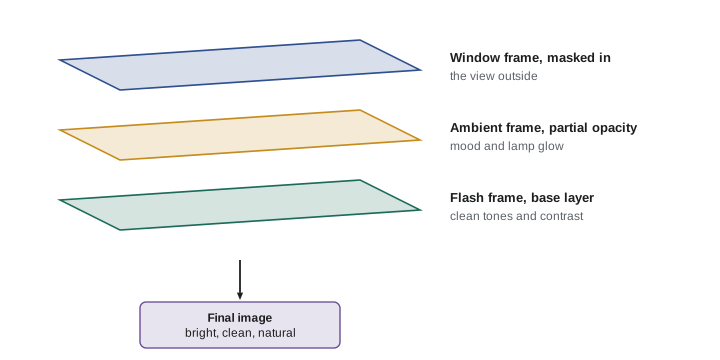
Flambient is efficient: three to five frames per view, an editing process that can be standardized and outsourced, and results that hold up across a house. Its weaknesses are that bounced flash can look flat if overused, and the blend needs care around windows and lamps.
Multi-flash or light-painted interiors
At the top end of architectural photography, a single view may be built from 10 to 30 frames: an ambient base, then individual frames in which a flash is placed out of view to light one part of the room at a time, such as a sofa, a countertop, a ceiling, a hallway or a piece of art. Each lit area is then masked into the final image. This gives complete control over light and shadow, like lighting a film set, but it takes hours per image. It suits magazine covers, hotel campaigns and award submissions.
Choosing the technique
The choice depends on the client, the budget and the look required.
- Real estate on a tight budget: HDR brackets with natural settings, or simple flambient.
- Mid-range real estate and hospitality: flambient with window pulls.
- Architectural and interior design: manual blending of ambient brackets, with selective flash to clean color and add definition.
- Magazine or campaign hero images: multi-flash light painting.
Whatever the technique, the goal is the same: an image that looks the way the space feels to a person standing in it, with natural light, believable windows and true color.
| Technique | Frames per view | Strengths | Weaknesses |
|---|---|---|---|
| HDR brackets | 3 to 7 | Fast, simple capture | Gray look, color casts, ghosts |
| Manual blending | 3 to 7 | Natural, controlled | Slow editing |
| Flambient | 3 to 5 | Clean color, efficient, consistent | Can look flat if overdone |
| Multi-flash | 10 to 30 | Total control, film-like light | Hours per image |
Building an editing system
Whatever technique you use, consistency comes from a system. Shoot every view in the same order: ambient brackets, then flash frames, then window and detail frames. Name and group files so that frames belonging to one view stay together. Build templates or actions in editing software for repetitive steps such as layer setup, blend modes and masks. Many real estate photographers outsource editing to specialist companies that follow written style guides; the photographer's job is then to deliver correctly captured frames and review results.
Checking blends for errors
Blended images can hide errors that only appear at full size or in print: halos around window frames, mismatched reflections, ghosted leaves outside windows, color fringes where masks meet and shadows that point in two directions because flash and daylight came from different sides. Check every image at 100 percent, especially around windows, lamps and edges of furniture. Compare the blend with the ambient frame to confirm that the room still looks like itself.
Flash safety and logistics
Flashes get hot after repeated full-power firing, and batteries drain quickly. Allow cooling time, carry spare batteries and avoid placing flashes near curtains or flammable materials. When hiding flashes behind furniture for multi-flash work, protect surfaces with a cloth and never stand on furniture. Radio triggers make multi-flash work faster; check that their channels do not conflict with other equipment in commercial buildings.
Learning from the ambient frame
Even when you plan to use flash, study the ambient frame carefully. It shows how the architect intended the space to be lit, where the natural light falls and which areas are naturally dark. A good final image usually keeps the character of the ambient light while cleaning its color and lifting its shadows, rather than replacing it entirely with flat flash light.
Matching technique to budget
Clients often ask why one interior image costs ten times more than another. The answer lies in the technique: a three-frame HDR merge with automatic settings takes minutes, while a multi-flash composite can take hours of setup and editing. Explaining the difference, and showing examples of each, helps clients choose the level of finish their project needs and justifies higher fees for hero images.
Common mistakes
MistakeTone mapping HDR merges heavily.
InsteadUse natural settings and correct color separately.
MistakePointing flash directly at the scene.
InsteadBounce off ceilings and walls for soft light, or hide flashes out of frame.
MistakeForgetting that bounce loses two to three stops.
InsteadInclude bounce loss and path length in power calculations.
MistakeMoving the tripod between frames to be blended.
InsteadLock the camera so every frame aligns.
MistakeUsing full-opacity ambient in a flambient blend with mixed color.
InsteadBlend ambient at partial opacity, often in luminosity mode.
Summary and key terms
- Interiors and shaded exteriors often exceed the usable dynamic range of one frame.
- The number of brackets needed is \( \lceil (R_{\text{scene}} - R_{\text{frame}}) / s \rceil + 1 \).
- HDR merging is fast but can look gray and does not fix color casts.
- Manual blending with masks gives natural results at the cost of time.
- Flash power depends on guide number, distance, aperture and ISO; bounce loses two to three stops.
- Flambient combines a clean flash frame, a partial ambient frame and a window frame.
- Multi-flash light painting gives total control for hero images.
Practice problems
Work each problem on paper first, then reveal the answer to check.
Scene range 14 stops, frame 10 stops, two-stop steps. Brackets?
Show answer
⌈4 / 2⌉ + 1 = 3.
Scene range 13 stops, frame 9 stops, one-stop steps. Brackets?
Show answer
⌈4 / 1⌉ + 1 = 5.
GN 131 ft at ISO 100, f/8 direct. Maximum distance?
Show answer
131 / 8 ≈ 16 ft.
How does doubling ISO change the guide number?
Show answer
It multiplies it by about 1.41.
How much light does a white ceiling bounce typically lose?
Show answer
About two to three stops.
What controls ambient exposure when using flash?
Show answer
Shutter speed.
Name the three frames of a basic flambient.
Show answer
Ambient, flash and window frames.
Why blend the ambient frame at partial opacity?
Show answer
To keep mood and lamp glow without their color casts.
What is a common flaw of heavy HDR?
Show answer
Flat, gray images with halos and oversaturated color.
When is multi-flash light painting worth the time?
Show answer
For hero images such as covers, campaigns and awards.
Lesson quiz · 5 questions
Score 60% or more to complete this lesson.
Create a free account to save your progress, take quizzes and earn a certificate.