
PHOT-311 · Lesson 7 of 12 · 25 min
Interiors and mixed light
Interiors are where architectural photography becomes truly technical. A room is lit by daylight through windows, by its own lamps and fixtures, sometimes by screens and signs, and by light bouncing off colored walls and floors. Each source has its own intensity and color. The eye adapts to all of them and sees a comfortable, neutral room; the camera records them as they are, so a photograph can show blue windows, orange lamps, green fluorescent tubes and a muddy mixture in between. This lesson explains how to read the light in an interior, how color temperature and mireds work, how to correct mixed light with gels, lamp changes and post-production, and how to expose for rooms with bright windows.
Reading an interior
Before setting up, look at the room with the camera's eye. Which sources light it? Where are the brightest and darkest areas? What color is each source? Turn lights on and off to see their contribution. Check for:
- Daylight through windows and skylights: bluish in shade and on overcast days, more neutral in direct sun, and changing through the day.
- Warm interior lamps: typically 2,700 to 3,000 K for residential LED and halogen lamps.
- Neutral or cool fixtures: 3,500 to 5,000 K in offices, kitchens and commercial spaces.
- Fluorescent and some cheap LED sources with a green or magenta tint.
- Colored bounce from walls, floors and furniture, such as green light from a lawn outside or warm light from a timber floor.
- Screens, signs and display cases, which may flicker or be much brighter or cooler than everything else.
Note whether lamps are the same color. In a renovated home, it is common to find 2,700 K, 3,000 K and 4,000 K lamps in the same room. In a commercial building, decorative and general lighting may differ by design.
Color temperature and the mired scale
Color temperature, measured in kelvin (K), describes the color of a light source along the warm-to-cool line: lower numbers are warmer (more orange), higher numbers cooler (more blue). Candlelight is around 1,900 K, household tungsten 2,700 K, studio tungsten 3,200 K, midday sun about 5,500 K, electronic flash about 5,500 to 6,000 K, overcast daylight 6,500 to 7,500 K and open shade or blue sky 8,000 to 10,000 K or more.
Equal steps in kelvin do not represent equal visual changes. A change from 2,700 to 3,200 K is obvious; a change from 6,500 to 7,000 K is barely visible. The mired scale solves this. A mired (micro reciprocal degree) value is:
where \( T \) is the color temperature in kelvin. Filters and gels are rated by the mired shift they produce, which is roughly constant regardless of the starting color. Positive shifts warm the light (orange gels); negative shifts cool it (blue gels).
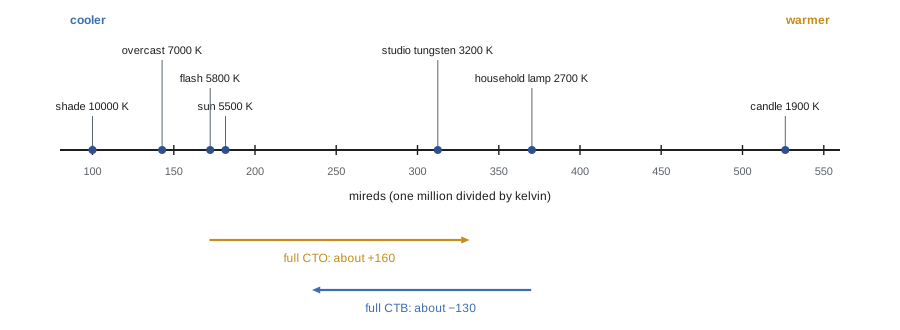
Typical gel strengths vary by manufacturer. A full color temperature orange (CTO) gel shifts flash or daylight by roughly +130 to +160 mireds, close to tungsten. Half and quarter CTO give about half and a quarter of that. A full color temperature blue (CTB) gel shifts tungsten by about −130 to −140 mireds toward daylight, but absorbs more than a stop of light. Plus-green and minus-green (magenta) gels correct the green tint of fluorescent and some LED sources.
Worked problem
Choosing a gel for flash in a warm room
A living room is lit by lamps at 2,700 K and dimmed daylight at about 6,000 K. The photographer wants to add flash that blends with the lamps but not completely, aiming at about 3,500 K. Flash is 5,600 K. What mired shift is needed, and which gel gives it?
Show solution
- Flash: 10⁶ / 5,600 ≈ 179 mireds.
- Target: 10⁶ / 3,500 ≈ 286 mireds.
- Shift needed: 286 − 179 ≈ +107 mireds.
- A half CTO (about +70 to +80 mireds) is not quite enough; a three-quarter CTO (about +100 to +120) is close. Two quarter CTOs plus a half would also work.
- Set the camera white balance near 3,500 K so that gelled flash looks neutral, lamps slightly warm and daylight slightly cool.
Answer: About +107 mireds, roughly a three-quarter CTO. The flash then sits between the lamps and the daylight, so the room looks natural with warm lamps and cool windows.
Strategies for mixed light
There are several ways to handle mixed light, usually in combination.
- Choose a dominant source and set white balance for it. In most residential interiors with lamps, set white balance for the lamps and let windows go slightly blue; in daylight-filled rooms, set for daylight and let lamps glow warm. A moderate contrast between warm and cool often looks natural; extreme contrast looks wrong.
- Change the lamps. Replace mismatched lamps with a consistent color temperature, ideally high color rendering lamps. Many architectural photographers carry a box of 2,700 K and 3,000 K high-CRI LED lamps for this reason. Ask permission and put the originals back.
- Turn sources off. If a fluorescent fixture or a cheap LED strip contaminates the scene, turn it off during the main exposure and photograph it separately for its appearance, then blend.
- Gel the lights. Gel flash to match the room, or in film and commercial work gel windows with large sheets of CTO or neutral density, though this is rare in still photography today.
- Expose and correct separately. Take one frame balanced for the windows and one for the interior, then blend and apply local white balance corrections in post-production (lesson 8).
- Use flash to overpower. Strong flash makes the room's own light a minor component, which neutralizes mixed color; this risks a flat, artificial look, so the ambient light is usually mixed back in.
Color rendering
Color temperature only describes the color of white light along one line. Two lamps at 3,000 K can render colors very differently. The color rendering index (CRI) and the newer TM-30 metrics describe how faithfully a source renders a range of colors compared with a reference. Lamps with CRI above about 90 render wood, skin and fabrics well; cheap lamps with CRI around 80 can make reds look dull and create odd shifts that are hard to correct. The television lighting consistency index (TLCI) is designed for cameras. In architectural interiors, poor color rendering is a common source of color that will not correct cleanly.
Some LED and fluorescent lamps also flicker at twice the mains frequency (120 Hz on 60 Hz mains, the standard in both Canada and the United States). At short shutter speeds, frames can show different brightness or bands; at the long exposures typical of interiors, flicker averages out.
Daylight in interiors
Daylight changes through the day. A room with east windows has direct sun in the morning, often too contrasty, and soft light in the afternoon. North-facing rooms receive even skylight all day. Direct sun patches on floors and walls can be beautiful, showing how light enters a space, or distracting, creating hot spots and deep shadows. Many architectural photographers plan interiors for when the windows receive no direct sun, or use sheer curtains or diffusion on windows to soften it.
The view through the window matters. Architects often want the view visible because the window frames a landscape or a city. Showing the view requires balancing the exterior and interior exposures, which is usually done with flash, exposure blending or both.
Exposure for interiors
Interiors usually need long exposures at base ISO: shutter speeds of 1/4 s to several seconds at f/8. Use a tripod, a remote release and mirror lock-up or electronic first curtain if available. Check the histogram for each frame and use highlight warnings.
The contrast between a window and the interior can be large. A sunlit view might meter at EV 14 or 15 while a room's darker corners meter at EV 3 or 4, a range of ten stops or more, before considering specular highlights from lamps. No single exposure records this well. Lesson 8 explains how flash, flambient techniques and exposure blending handle it.
Practical lights
Practical lights, the lamps, pendants and fixtures visible in the frame, are part of the design. Their exposure is a balance: too bright and they become blown-out blobs; too dim and the room looks dull. Dimming lamps, if possible, often helps. For a balanced appearance, the lamp itself should be bright but show some detail in its shade or diffuser. A frame exposed specifically for the practicals can be blended in.
Exposed bulbs and LED strips can produce flare. Clean the lens, use a lens hood or flag the lens, and check for ghosts, especially with ultra-wide lenses.
Styling and preparation of interiors
Clean surfaces, align chairs, smooth bedding and cushions, straighten rugs, clear counters and remove personal items such as photographs, mail and toiletries. Add fresh flowers, fruit or books sparingly. For design work, the interior designer or a stylist usually leads styling. Hide cables. Set blinds to the same height and angle. Turn off ceiling fans or photograph them stopped. Turn screens off or display a neutral image.
| Source | Typical color temperature | Notes |
|---|---|---|
| Candle | About 1,900 K | Very warm, dim |
| Household LED or tungsten | 2,700 to 3,000 K | Warm; check CRI |
| Office and kitchen fixtures | 3,500 to 5,000 K | May have green tint |
| Direct sun | About 5,500 K | Hard light, moving patches |
| Flash | 5,500 to 6,000 K | Gel to match the room |
| Overcast or skylight | 6,500 to 10,000 K | Cool, especially in shade |
Light from outside: green and color bounce
Light entering a room is colored by what it reflects from outside. A lawn or trees outside a window can add a green tint to walls and ceilings; a red brick wall across a lane can add warmth. Inside, a strongly colored wall, floor or ceiling tints the light bouncing around the room, including flash bounced from it. Bouncing flash off a timber ceiling adds warmth; off a green wall it adds green. Choose bounce surfaces carefully, or bounce off a portable white reflector instead.
Matching lamps in practice
Arriving at a house to find mismatched lamps is routine. A practical approach is to check every visible lamp with the camera's live view at a fixed white balance, note those that look different, and replace them from a kit of spares, or turn them off and light that area with gelled flash. In commercial buildings, lamps cannot always be changed; there, blending separate exposures and correcting areas locally in post-production is usually the answer.
Screens, signage and display lighting
Televisions, computer monitors and illuminated signs are often much brighter and cooler than the rest of the room. Turn screens off unless they are part of the design, or display a neutral image and expose a separate frame for them. Illuminated signs and display cases in retail and hospitality interiors can be exposed separately and blended so that they glow without clipping.
Seeing like the camera
Experienced photographers learn to see color casts that the eye adapts to. A useful exercise is to set the camera to a fixed daylight white balance and photograph the same room at different times and with different lights on, then compare. Over time you will predict how each source will record and plan corrections before you press the shutter.
Mixed light in commercial interiors
Offices, schools and hospitals often combine daylight with large areas of ceiling fixtures at 3,500 to 4,000 K, task lights at other temperatures and colored accent lighting. Because lamps cannot usually be changed, the photographer chooses a white balance that keeps the dominant ceiling light near neutral, lets daylight go slightly cool and accent lights keep their intended color, and corrects only areas that look clearly wrong. Discuss the intended look with the architect or lighting designer before the shoot.
Common mistakes
MistakeSetting auto white balance in a mixed-light room.
InsteadChoose a dominant source and set white balance deliberately; shoot raw.
MistakeIgnoring mismatched lamps.
InsteadReplace them with consistent, high-CRI lamps or blend separate exposures.
MistakeAssuming equal kelvin steps look equal.
InsteadUse mireds to calculate gel corrections.
MistakeLeaving green fluorescent light uncorrected.
InsteadTurn it off, gel it or correct it locally.
MistakeLetting practical lamps blow out completely.
InsteadDim them or blend a frame exposed for the lamps.
Summary and key terms
- Interiors mix daylight, lamps, fixtures, screens and colored bounce light.
- Color temperature runs from warm (low kelvin) to cool (high kelvin).
- Mireds, \( 10^6 / T \), make gel calculations simple; gels shift light by a roughly fixed mired amount.
- Strategies include a dominant white balance, lamp changes, turning sources off, gels, flash and blended exposures.
- Color rendering (CRI, TM-30, TLCI) matters as much as color temperature.
- Interiors need long exposures at base ISO and careful control of window and lamp highlights.
- Preparation and styling are essential to clean interior images.
Practice problems
Work each problem on paper first, then reveal the answer to check.
Mired value of 2,700 K?
Show answer
About 370.
Mired value of 5,000 K?
Show answer
200.
Shift from 5,600 K flash to 3,200 K?
Show answer
312 − 179 ≈ +133 mireds, about a full CTO.
Why are kelvin steps misleading?
Show answer
Equal kelvin steps are not equal visual changes; mireds are.
What gel removes the green tint of fluorescent light?
Show answer
Minus-green (magenta).
What does a CRI above 90 suggest?
Show answer
Good color rendering.
Why carry spare LED lamps?
Show answer
To replace mismatched lamps with a consistent color.
Why might flicker not matter in interiors?
Show answer
Long exposures average it out.
What range might a sunlit window and dark corner span?
Show answer
Ten stops or more.
Name two preparation tasks for an interior.
Show answer
Clean surfaces, hide cables, align blinds, remove personal items.
Lesson quiz · 5 questions
Score 60% or more to complete this lesson.
Create a free account to save your progress, take quizzes and earn a certificate.