
PHOT-311 · Lesson 12 of 12 · 25 min
Copyright, permissions, licensing and capstone
An architectural photograph involves at least two creative works: the building, designed by an architect, and the photograph, created by the photographer. Sometimes there are more, such as sculptures, murals, furniture designs or artworks inside the building. This lesson explains how copyright law in Canada and the United States allows photographers to photograph buildings, where the limits are, when permission is needed to enter and photograph property, and how architectural photographers license their work to several clients and share costs. It ends with a capstone project that brings the whole course together.
Buildings are protected works
In the United States, the Architectural Works Copyright Protection Act of 1990 added architectural works to the Copyright Act. A building's design, embodied in the building, plans or drawings, is protected if it was created on or after 1 December 1990 (or was unconstructed and unpublished on that date). The architect, or the firm as employer, usually owns copyright in the design.
If buildings were protected without any exception, every photograph of a building would potentially infringe the architect's copyright. Both countries therefore include a specific exception for pictorial representations.
The exceptions for photographs of buildings
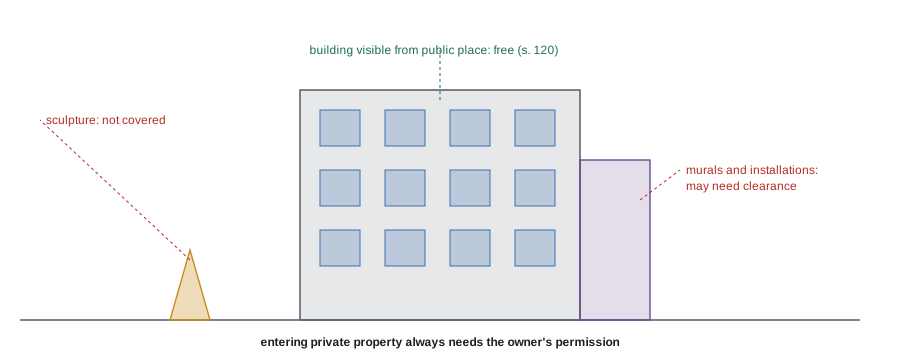
Section 120(a) of the US Copyright Act provides that the copyright in a constructed architectural work does not include the right to prevent making, distributing or displaying pictures, paintings, photographs or other pictorial representations of the work, if the building is located in or ordinarily visible from a public place. Photographers may therefore photograph buildings visible from public places and use the images commercially without the architect's permission. The exception does not extend to sculptures and other artworks: in Gaylord v. United States (Federal Circuit, 2010), the sculptor of the Korean War Veterans Memorial successfully claimed that a postage stamp based on a photograph of the sculpture infringed his copyright. Murals, sculptures and installations in or on buildings may still need clearance. The exception's wording also leaves some uncertainty for interiors not visible from public places, although the permission needed to enter such interiors usually comes with an agreement on use.
Trademarks, signs and distinctive buildings
Some building owners claim trademark rights in a building's distinctive appearance, or use the building as a logo. Trademark law protects against confusion about the source of goods or services, not against photographs as such. In the United States, the owners of the Rock and Roll Hall of Fame and Museum sued a photographer who sold posters of the building; the Sixth Circuit (1998) refused an injunction because the museum had not shown that it used the building's image consistently as a trademark. Still, using a famous building prominently in advertising for another product, or implying endorsement, can create trademark or passing-off risk in both countries. Logos, signs and brand names on buildings should be handled with care in commercial work and are often removed or avoided when the image will advertise a different product.
Some lighting displays and artworks on buildings are protected in their own right. The often-cited example is the night lighting of the Eiffel Tower in Paris, which the operator treats as a copyright work under French law. Photographers working abroad should check local rules, as some countries have narrower freedom-of-panorama exceptions than Canada and the United States.
Permission to enter and photograph
Copyright exceptions do not give a right to enter property. Photographing interiors, private grounds, roofs and many semi-public spaces requires the owner's or occupant's permission. Shopping centers, office lobbies, campuses and airports are private property even when open to the public, and their owners can set conditions on photography. Commissioned work normally includes access arranged by the client, but the photographer should confirm in writing that the client has authority to grant access, especially for occupied buildings with tenants.
A property release is a written permission from an owner to photograph the property and use the images. No statute generally requires a property release to publish a photograph of a building, but stock agencies, advertising clients and broadcasters often insist on one for commercial use, particularly for recognizable private homes and distinctive interiors. In real estate work, the listing agreement and the seller's consent cover access and marketing use.
People in architectural images raise privacy and right-of-publicity issues. State laws, such as New York's Civil Rights Law sections 50 and 51 and California Civil Code section 3344, restrict commercial use of a person's name or likeness without consent. Commercial use of identifiable people needs a model release, as PHOT-310 explained.
Who owns the photographs
In the United States, the photographer owns copyright unless the photograph is a work made for hire, meaning it was made by an employee in the course of employment, or it was specially commissioned within certain statutory categories under a signed work-for-hire agreement, or the photographer assigned copyright in a signed writing. Architectural photographs commissioned by an architect are usually licensed, not transferred, and credit is a matter of contract rather than moral rights for most photographs.
Architectural photographers almost always retain copyright and grant licenses. The license defines who may use the images, for what purposes, in which media and territories, for how long and whether the use is exclusive. Typical architectural licenses let the commissioning architect use images for portfolio, website, social media, award submissions, publications and proposals, without time limit, but exclude advertising for third parties and transfer to others.
Licensing to several parties and cost-sharing
A single building interests several parties: the architect, the builder, the developer, engineers, interior designers, landscape architects, and suppliers of glazing, cladding, lighting, furniture and finishes. Each may want the images. Two common approaches are:
- Additional licenses: the architect commissions and pays; other parties later buy licenses for their own use at a fee, often a percentage of the original creative fee.
- Cost-sharing: before the shoot, several parties agree to share the creative fee and expenses, each receiving a license for its own defined use. This reduces each party's cost and increases the photographer's total income. Each party's license must be clearly defined, and all parties should know who else is sharing.
Magazines and editorial outlets usually license images for one-time publication at modest editorial rates, sometimes asking for first-publication or short exclusivity windows. Award programs normally receive a license through the entrant to reproduce images in connection with the award.
Worked problem
Sharing the cost of a shoot
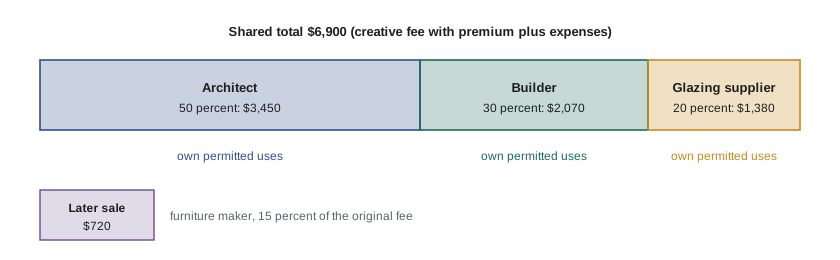
A photographer quotes $4,800 in creative fees for a two-day commission plus $900 in expenses, with standard architect licensing. The architect, builder and glazing supplier agree to share: the architect pays 50 percent, the builder 30 percent and the supplier 20 percent, plus a 25 percent cost-sharing premium on the creative fee because three licenses are granted. Later, a furniture maker buys a license for six images at 15 percent of the original creative fee. What does each party pay, and what is the photographer's total income before tax?
Show solution
- Creative fee with premium: 4,800 × 1.25 = $6,000.
- Total to share: 6,000 + 900 = $6,900.
- Architect: 0.50 × 6,900 = $3,450. Builder: 0.30 × 6,900 = $2,070. Supplier: 0.20 × 6,900 = $1,380.
- Furniture maker's later license: 0.15 × 4,800 = $720.
- Total income: 6,900 + 720 = $7,620, of which $900 reimburses expenses.
Answer: The architect pays $3,450, the builder $2,070 and the supplier $1,380; the later license adds $720. The photographer earns $6,720 in fees plus $900 expenses, compared with $4,800 plus expenses from the architect alone. These percentages are illustrative; photographers set their own terms.
Write every license down. Specify the licensee, the images, the permitted uses, any excluded uses (such as paid advertising or resale), the term, the territory, the credit line required and the fee. Require that third parties obtain their own licenses. Registered copyright (available in both countries and especially important in the United States for statutory damages and attorneys' fees) strengthens enforcement.
Taxes and contracts
Sales taxes on photography fees differ between the countries and among provinces and states, and contracts follow provincial or state law. PHOT-302 covers registration thresholds, invoicing and contract basics; PHOT-310 covers estimates and usage pricing. Architectural contracts should also address weather postponement, client preparation responsibilities, access, insurance and liability for property damage, and what happens if the building is not ready.
Capstone: a complete architectural project
The capstone asks you to plan, shoot and deliver a small architectural project to a professional standard. Choose a building you can access legally: a public library, a community center, a house with the owner's permission, a campus building or a small commercial space. Then:
- Brief: write a one-page brief as if from the architect or owner, describing the building, its design intent and the intended uses of the images.
- Recce and plan: visit the site, record sun angles with a planning app, list views grouped by light and identify preparation tasks, permissions and risks.
- Shot list: plan at least eight images: an establishing view, two exteriors, an entrance, three interiors and one detail, plus a twilight exterior if possible.
- Shoot: use a tripod, level the camera, use shift or software correction for verticals, bracket or use flash for interiors, and keep notes on settings.
- Post-production: correct lens distortion and geometry, blend exposures, match color across the set and remove only temporary distractions. Keep originals.
- Rights: identify the copyright exception that applies, any artworks needing clearance, access permissions and releases for any identifiable people.
- License and estimate: write a license for the architect and a cost-sharing proposal for one additional party, with fees and expenses.
- Deliver: export a numbered, captioned set at web and print sizes, and write a short reflection on what worked and what you would change.
| Element | Canada | United States |
|---|---|---|
| Building protected | Architectural works, any building or structure | Architectural works created on or after 1 December 1990 |
| Photo exception | Section 32.2(1)(b): buildings and permanent public sculpture | Section 120(a): buildings visible from public places |
| Sculpture and murals | Permanent public sculpture covered; paintings not | Not covered; clearance may be needed |
| Photograph first owner | Photographer, unless employee or written agreement | Photographer, unless work for hire or assignment |
| Credit | Moral rights, waivable | Mostly by contract |
Credits and captions
Credit lines matter to photographers, architects and everyone else involved in a project. A typical architectural caption names the project, the location, the architect, sometimes the interior designer and landscape architect, and the photographer, for example: 'Riverside Library, Halifax. Architect: Example Studio. Photo: Jane Doe.' Licenses should require credit in a specified form wherever practical, and photographers should supply caption text with every delivery so that clients and publishers can credit correctly.
Handling infringement
Architectural images are frequently copied by websites, suppliers and aggregators without a license. Reverse image search tools help photographers find unauthorized uses. A polite message offering a retroactive license often resolves the issue; formal demand letters, takedown notices to hosting services and legal action are further steps. Keeping records of registration, licenses and delivery dates makes enforcement easier. Before acting, confirm that the use is not covered by an existing license held by one of the project partners.
Licensing for awards and publications
Award programs and publications often request images directly from the architect, who may not realize that the license must cover such use. Architectural licenses commonly include award submissions and editorial publication by name, with credit required. Some awards require the right to use images in exhibitions, books and promotion of the program; check the entry terms and make sure the license covers them, or grant an extended license for the purpose.
Common mistakes
MistakeAssuming a copyright exception gives the right to enter a building.
InsteadGet permission from the owner or occupant for private property.
MistakeTreating murals and sculptures like buildings.
InsteadCheck whether artworks need clearance before commercial use.
MistakeTransferring copyright to the architect by default.
InsteadRetain copyright and grant a written license for defined uses.
MistakeLetting partners use images without their own license.
InsteadOffer cost-sharing or additional licenses and write them down.
MistakeUsing a famous building prominently to advertise unrelated products.
InsteadConsider trademark and endorsement risks and seek advice.
Summary and key terms
- Buildings are protected by copyright, usually owned by the architect or firm.
- Canada's section 32.2(1)(b) and the US section 120(a) allow photographs of buildings without the architect's permission.
- Artworks such as murals and sculptures may need clearance, especially in the United States.
- Copyright exceptions do not grant access; private property needs the owner's permission.
- Photographers usually own their photographs and grant written licenses.
- Cost-sharing and additional licenses let several parties use images fairly and increase income.
- The capstone combines planning, shooting, post-production, rights review, licensing and delivery.
Practice problems
Work each problem on paper first, then reveal the answer to check.
Which section of the Copyright Act permits photographs of buildings?
Show answer
Section 120(a).
Does the exception let you enter a private building?
Show answer
No. Access needs the owner's permission.
Is a sculpture covered by the US exception?
Show answer
No; see Gaylord v. United States.
Who usually owns architectural photographs?
Show answer
The photographer, who grants licenses.
Fee $5,000 plus 20 percent premium, shared 60/40. Shares of the fee?
Show answer
$6,000: $3,600 and $2,400.
Later license at 15 percent of a $4,000 fee?
Show answer
$600.
Why might a property release be requested?
Show answer
Stock and advertising clients often require one for commercial use.
Name three items in a license.
Show answer
Licensee, permitted uses, term, territory, media, credit, fee.
Why register copyright in the United States?
Show answer
It is required for statutory damages and attorneys' fees in most cases.
What does the capstone deliver?
Show answer
A numbered, captioned set with license, estimate and reflection.
Lesson quiz · 5 questions
Score 60% or more to complete this lesson.
Create a free account to save your progress, take quizzes and earn a certificate.