
PHOT-230 · Lesson 9 of 12 · 25 min
Research, access and fieldwork
Strong documentary work rests on knowledge. Photographers who understand the history, politics, economics and culture of their subject make better decisions about what to photograph, ask better questions, avoid errors and earn the respect of the people they work with. Fieldwork, the time spent on location with people, requires planning, logistics, safety measures and careful record-keeping. This lesson covers researching a subject, finding and negotiating access, working with fixers and interpreters, planning fieldwork, keeping notes and recording information, gathering audio and other material, digital security, personal safety and wellbeing, and leaving the field well.
Researching a subject
Research begins before photography and continues throughout a project. Useful sources include books and academic studies; news coverage and investigative reports; government data and reports; archives and historical photographs; the work of other photographers and filmmakers on the subject; community organizations and advocacy groups; and, above all, conversations with people who live the subject. Research helps a photographer understand the context of what they see, identify important places, events and people, spot stereotypes to avoid, and plan visual approaches. It also improves captions and accompanying text (Lesson 11). Keep research notes organized and cite sources, especially for facts that will appear in publication.
| Source | Useful for | Caution |
|---|---|---|
| Books and academic research | Depth, history, analysis | May be dated or theoretical |
| News and investigative reports | Recent events, facts, contacts | Check accuracy and bias |
| Government data and reports | Statistics, policies | Check definitions and dates |
| Archives and historical images | Change over time, visual history | Consider who made them and why |
| Community organizations | Access, knowledge, introductions | May have their own agendas |
| Interviews and conversations | Lived experience, stories | Verify facts, respect confidentiality |
Finding and negotiating access
Access is often the hardest part of documentary work. Some subjects are public and open, but many involve private homes, workplaces, institutions or communities that require permission. Ways to gain access include introductions through people you know; contacting organizations that work with the community; attending public events and meetings; volunteering; writing clear, respectful requests to institutions; and spending time without a camera to build relationships. Institutions such as hospitals, schools, prisons, police services, companies and government agencies often have media or communications departments with formal approval processes, which may impose conditions, such as review of images, restrictions on identifying people or escorts. Weigh these conditions carefully: some protect people's privacy legitimately, while others may compromise editorial independence. Put agreements in writing.
Working with fixers and interpreters
When working outside their own community or country, documentary photographers often rely on fixers, local professionals who arrange access, translate, advise on customs and safety, and provide knowledge that outsiders lack. Fixers are often essential to the work and sometimes take significant risks, yet their contributions have historically been undervalued and uncredited. Good practice includes paying fixers and interpreters fairly and promptly, crediting them where appropriate and safe, listening to their advice on safety and ethics, and considering the risks they face after the photographer leaves. Interpreters should be chosen carefully: a translator connected to a powerful local figure, for example, may change how people speak or what they are willing to say.
Planning fieldwork
Fieldwork planning balances preparation with flexibility. A fieldwork plan might include:
- Objectives for the trip or period: people to meet, events to attend, gaps to fill.
- Logistics: travel, accommodation, transport on location, permits and visas.
- Equipment: cameras, lenses, batteries, chargers, cards, backup drives, audio recorder, weather protection.
- Contacts: fixers, local partners, emergency contacts, embassy or consulate information when abroad.
- Schedule: a rough outline with time for unplanned opportunities and rest.
- Budget: daily costs, fees and contingencies.
- Risk assessment and safety plan, discussed below.
Plans should be shared with a trusted person at home, who knows where you are and when to expect contact.
Worked problem
Planning a week of fieldwork
A photographer will spend a week documenting a fishing community on the coast during the start of the lobster season. What should their plan include?
Show solution
- Objectives: photograph the first day of the season, families on the wharf, work on a boat, processing plant workers, and portraits with names and quotes.
- Access: confirm with the harbor authority, a fishing family who has agreed to host them on a boat, and the plant manager.
- Equipment: weather-sealed camera, waterproof cover, spare batteries, cards, a backup drive and an audio recorder for interviews.
- Safety: a personal flotation device on boats, seasickness medication, checking weather forecasts and following the captain's instructions.
- Schedule: early mornings on the wharf, afternoons for interviews, evenings for backup and notes, and one flexible day.
Answer: Clear objectives, confirmed access, suitable gear, a safety plan for working on the water, and a flexible schedule with daily backups and notes.
Notes and records
Documentary photographers must record information accurately at the time it is gathered, because memory fades and errors in captions damage credibility and can harm people. Keep a notebook or use a phone app to record names (with spellings confirmed), ages if relevant, roles, locations, dates and times, what was happening, quotations, and contact details, along with notes about consent and any restrictions people requested. Photographing a person's written name, or a business card, helps with spelling. Many photographers link notes to images by noting frame numbers or times, which match the camera's metadata. Synchronizing the camera clock with your phone each day makes matching easier. Securely store notes containing personal information.
Audio, video and other material
Documentary stories increasingly combine photographs with other media. Recording interviews and ambient sound provides quotations for captions and text, and material for multimedia pieces, podcasts or exhibitions. Short video clips can capture movement and voice. Collecting documents, maps, family photographs (with permission to copy them) and objects can enrich a project and support research. Recording audio requires attention to consent and, in some jurisdictions, to laws on recording conversations (Lesson 7). Good audio requires a decent recorder or microphone and quiet surroundings (CRE-130 covers basics).
Digital security
Images, notes and contact lists can endanger people if they fall into the wrong hands, particularly when photographing activists, vulnerable communities, conflicts or illegal activities. Digital security practices include encrypting devices and backup drives; using strong passwords and two-factor authentication; backing up to secure locations; removing location metadata from images shared online; using secure messaging apps for sensitive communications; minimizing personal information kept on devices that may be seized at borders or by police; and knowing your rights when crossing borders, where devices may be searched. Press freedom and digital rights organizations publish practical guides for photographers and journalists.
Personal safety
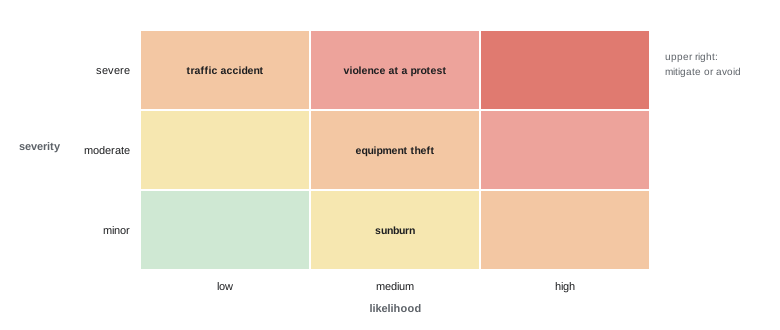
Fieldwork can involve physical risks: traffic, crowds, unrest, crime, extreme weather, remote locations, dangerous workplaces and illness. A risk assessment identifies likely hazards and how to reduce them, from wearing protective equipment on industrial sites to avoiding certain areas at night. Basic safety habits include sharing your plans and checking in regularly, carrying identification and emergency contacts, knowing where the nearest medical help is, having appropriate insurance, keeping some money and a charged phone, and trusting your instincts: if a situation feels wrong, leave. Photographers covering protests, conflict or disasters should seek specialized safety training, such as hostile environment and first aid courses, and follow guidance from press freedom organizations.
Wellbeing and trauma
Documentary work can be emotionally demanding. Witnessing suffering, listening to traumatic stories and living with the people affected can lead to stress, grief, burnout, vicarious trauma and post-traumatic stress, even for photographers who do not see themselves as working in dangerous situations. Signs include sleep problems, irritability, intrusive memories, numbness and withdrawal. Protecting wellbeing involves recognizing these risks, taking breaks, maintaining relationships and routines outside the work, debriefing with trusted colleagues, and seeking professional support when needed. Organizations such as the Dart Center for Journalism and Trauma provide resources for photographers and journalists. Caring for yourself is not selfish; it allows you to continue doing the work well.
Leaving the field well
How a photographer leaves a community matters as much as how they arrive. Before leaving, thank people, confirm agreements about how images will be used, collect any missing information for captions, and arrange how you will share images with participants. After leaving, follow through on promises, such as sending prints, which build trust for future visits and for other photographers. Consider the effects of publication on people who remain in the community, and keep in touch where appropriate. Many documentary relationships last long after the project is finished.
Ethics review and institutional research
Documentary projects undertaken within universities, or in partnership with health or social service organizations, may require review by a research ethics board (in Canada) or an institutional review board (in the United States), particularly when they involve vulnerable participants, interviews or personal information. These processes, guided in Canada by the Tri-Council Policy Statement and in the United States by federal regulations on human subjects research, ask researchers to consider consent, privacy, risk and benefit, and can be a useful framework even for independent photographers. Journalism is often exempt from such reviews, but the questions they raise, about informed consent, confidentiality and minimizing harm, apply to all documentary work.
Working ethically with institutions
When documenting hospitals, schools, prisons, shelters or other institutions, photographers depend on institutional permission but must remember that the people inside, patients, students, prisoners and residents, have their own rights and perspectives, which may differ from the institution's. An institution's permission does not replace individual consent. Photographers should be clear with institutions about editorial independence, avoid becoming publicists for them, and be alert to situations in which people feel unable to refuse because of the institution's authority. Showing work to participants before publication, where possible, helps ensure fair representation.
Equipment for fieldwork
Fieldwork equipment should be reliable, compact and suited to conditions. A typical documentary kit might include one or two camera bodies, two or three prime lenses or a versatile zoom, ample batteries and cards, a small flash, a compact audio recorder or lavalier microphone, a notebook and pens, a portable SSD for backups, chargers and adapters, a rain cover, and a small first aid kit. Duplicating critical items, such as a second body or extra cards, protects against failure in remote places. Many photographers carry less than they expect to need, because lighter kits make them more mobile, less conspicuous and less tired. Insure equipment for travel and fieldwork, and keep serial numbers recorded.
Field routines
Daily routines in the field keep work organized: back up images to two places each evening; rename or tag folders by date and location; transcribe notes and match them to frames while memories are fresh; charge batteries; review the day's images briefly to see what is working and what is missing; and plan the next day. These routines also provide a moment to reflect on ethical questions that arose, such as a person who seemed uncomfortable or a promise that needs to be kept.
Sharing research with participants
Research is not only something photographers take from communities; it can be shared. Participants may be interested in historical images, archival documents or reports the photographer has found, and sharing them can enrich conversations, uncover new stories and correct the photographer's understanding. In some projects, research becomes part of the final work, for example by pairing archival photographs with contemporary images of the same places or families. Treat sensitive information carefully, and check with participants before using personal documents or family photographs in publication.
When access is refused
Not every request for access succeeds. Institutions may decline, communities may be wary, and individuals may say no. Refusals are information: they may reveal sensitivities, past experiences with photographers or legitimate privacy concerns. Respect them, ask whether there are conditions under which access might be possible later, and consider whether the project can be approached differently, for example from public spaces, through participants who are willing, or through archival and collaborative methods. Persistence should never become pressure.
Common mistakes
MistakeArriving without research.
InsteadStudy the subject's history and context first.
MistakeUnderpaying or ignoring fixers.
InsteadPay fairly, credit and protect them.
MistakeRelying on memory for names and facts.
InsteadRecord notes at the time and confirm spellings.
MistakeCarrying sensitive data unprotected.
InsteadEncrypt devices and minimize sensitive data.
MistakeIgnoring signs of stress and trauma.
InsteadTake breaks, debrief and seek support.
Summary and key terms
- Research informs decisions, questions and captions.
- Access may require introductions, time and written agreements.
- Fixers and interpreters deserve fair pay, credit and protection.
- Fieldwork plans cover objectives, logistics, equipment, contacts and safety.
- Accurate notes link names, facts and consent to images.
- Digital security and personal safety protect subjects and photographers.
- Wellbeing matters; leave the field with care and follow through.
- Fieldwork
- Time spent documenting on location.
- Fixer
- Local professional who arranges access and logistics.
- Interpreter
- Person who translates conversations.
- Media approval
- Formal permission from an institution.
- Risk assessment
- Identification and mitigation of hazards.
- Safety plan
- Procedures to keep a photographer safe on location.
- Encryption
- Protecting data so only authorized people can read it.
- Metadata
- Information embedded in image files.
- Vicarious trauma
- Trauma from exposure to others' suffering.
- Debriefing
- Discussing experiences after difficult work.
Practice problems
Work each problem on paper first, then reveal the answer to check.
Name four research sources.
Show answer
Books, news, government data, archives, organizations, interviews.
Name three ways to gain access.
Show answer
Introductions, organizations, public events, volunteering, formal requests.
What should you consider about institutional conditions?
Show answer
Whether they protect privacy or compromise independence.
How should fixers be treated?
Show answer
Paid fairly, credited where safe, listened to, protected.
List four parts of a fieldwork plan.
Show answer
Objectives, logistics, equipment, contacts, schedule, budget, safety.
Why synchronize the camera clock?
Show answer
To match notes with image times.
Name two digital security practices.
Show answer
Encryption, strong passwords, metadata removal, secure messaging.
What does a risk matrix compare?
Show answer
Likelihood and severity of hazards.
Name two signs of trauma stress.
Show answer
Sleep problems, intrusive memories, numbness, irritability.
What should happen when leaving the field?
Show answer
Thank people, confirm agreements, share images, follow through.
Lesson quiz · 5 questions
Score 60% or more to complete this lesson.
Create a free account to save your progress, take quizzes and earn a certificate.