
PHOT-201 · Lesson 6 of 12 · 29 min
Lens types, mounts and equivalence
Choosing lenses is choosing how you will see. Beyond focal length, lenses differ in maximum aperture, zoom range, close-focusing ability, size, weight, autofocus performance, sealing and special functions such as perspective control. Mounts determine which lenses fit which bodies, and the relationship between sensor size and lens behavior, captured in the idea of equivalence, explains how the same photograph can be made with different systems. This lesson covers primes and zooms, fast lenses, macro lenses and magnification, telephoto and wide-angle designs, tilt-shift lenses, lens mounts and adapters, image circles, and equivalence between formats.
Primes and zooms
Prime lenses have a single focal length; zoom lenses cover a range. Primes are typically smaller, lighter and faster (wider maximum aperture) for their focal length, often sharper and with smoother bokeh, and they encourage deliberate composition by moving the feet. Zooms offer flexibility, reduce lens changes in dusty or fast-moving situations, and let event, travel and documentary photographers respond quickly. Modern professional zooms, such as 24–70 mm f/2.8 and 70–200 mm f/2.8 designs, rival primes in sharpness, though they are heavy and their constant f/2.8 aperture is two stops slower than an f/1.4 prime. Variable-aperture zooms, such as 18–55 mm f/3.5–5.6, become slower as they zoom in, saving size and cost.
Fast lenses
Lenses with very wide maximum apertures, f/1.2 to f/1.8, gather more light, allowing faster shutter speeds or lower ISO in dim conditions, and produce shallow depth of field for subject isolation. An f/1.4 lens gathers four times as much light as an f/2.8 lens. Fast lenses are larger, heavier and more expensive, and wide open they demand precise focus, since depth of field may be only a few centimeters at portrait distances. Their aberrations at full aperture vary widely between designs, giving each a distinct character.
Macro lenses and magnification
Macro lenses are designed for close focusing and high image quality at short distances. Magnification is the ratio of the size of the image on the sensor to the size of the subject: a 1:1 (1×) lens reproduces a 24 mm subject at 24 mm on the sensor, filling a full-frame sensor's height. Most true macro lenses reach 1:1; some reach 2× or more. Macro focal lengths range from about 50 mm to 200 mm; longer ones give more working distance, useful for insects and to avoid shading the subject. At high magnification, depth of field becomes extremely shallow, often a millimeter or less, and the effective aperture becomes smaller than the marked f-number, reducing light: at 1:1, the effective aperture is about two stops smaller for most lenses. Extension tubes and close-up filters give cheaper alternatives with some loss of quality or convenience.
Worked problem
Light loss at macro distances
A 100 mm macro lens set to f/8 is used at 1:1 magnification. Approximately what is the effective aperture, and how much more exposure is needed than at infinity?
Show solution
- Effective f-number: \(N(1 + m) = 8 \times (1 + 1) = 16\).
- From f/8 to f/16 is two stops.
- Cameras with through-the-lens metering compensate automatically; with a handheld meter or flash calculations, add two stops.
Answer: About f/16 effective, needing two stops more exposure than the marked aperture suggests.
Telephoto and wide-angle designs
A true telephoto design places a negative lens group behind a positive group, making the lens physically shorter than its focal length; most long lenses use this design. Super-telephoto lenses (300 mm and longer) for wildlife and sports are large and expensive, especially fast ones; teleconverters, extra optics between lens and body, multiply focal length by 1.4× or 2× at the cost of one or two stops of light and some sharpness. Wide-angle lenses for SLRs needed retrofocus designs, with a negative front group, to clear the mirror; mirrorless cameras allow simpler, more compact wide-angle designs, though very wide angles still produce strong perspective effects and, without correction, barrel distortion. Fisheye lenses deliberately curve straight lines to capture angles of view of 180° or more.
Tilt-shift lenses
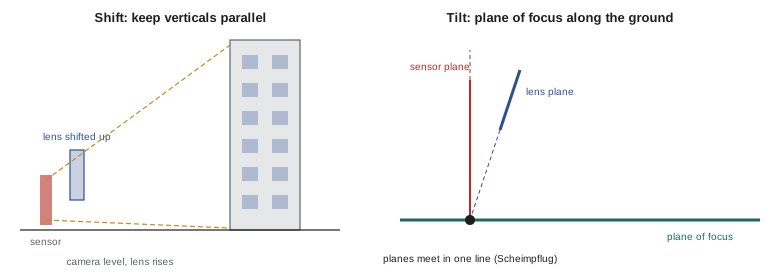
Tilt-shift lenses give some of the control of large-format view cameras. Shifting moves the lens parallel to the sensor, changing the framing without tilting the camera: an architectural photographer can keep the camera level, so that vertical lines remain parallel, and shift up to include the top of a building. Tilting angles the lens relative to the sensor, which tilts the plane of sharp focus according to the Scheimpflug principle: a landscape photographer can align the plane of focus with the ground, so that near and far are both sharp at a moderate aperture, while a portrait or product photographer can tilt the other way for a selective, miniature-like focus effect. Tilt-shift lenses are manual focus, expensive and require practice, but are standard tools in architecture and product photography (PHOT-310 and PHOT-311).
Mounts and adapters
Each system has its own lens mount, defined by its diameter, bayonet design, electrical contacts and flange distance, the distance from the mount to the sensor. Mirrorless mounts have short flange distances, about 16 to 20 mm, compared with 42 to 47 mm for SLR mounts, because no mirror is needed. A short flange distance allows adapters to fill the gap for lenses designed for longer distances, so mirrorless bodies can use DSLR lenses from their own or other brands, often with full autofocus through electronic adapters, as well as vintage manual lenses. The reverse is generally impossible without optics that degrade the image. Adapted lenses may focus more slowly, lack some features, or vignette if their image circle is too small for the sensor.
| Mount | Flange distance (approx.) | Typical use |
|---|---|---|
| Canon EF (DSLR) | 44.0 mm | Canon DSLRs; widely adapted |
| Nikon F (DSLR) | 46.5 mm | Nikon DSLRs since 1959 |
| Canon RF | 20.0 mm | Canon mirrorless full frame and APS-C |
| Nikon Z | 16.0 mm | Nikon mirrorless |
| Sony E | 18.0 mm | Sony mirrorless full frame and APS-C |
| Fujifilm X | 17.7 mm | Fujifilm APS-C mirrorless |
| L-Mount | 20.0 mm | Leica, Panasonic and Sigma |
| Micro Four Thirds | 19.25 mm | OM System and Panasonic |
Image circles and crop modes
A lens projects a circular image that must cover the sensor's diagonal. Lenses designed for APS-C cover only the smaller sensor; mounted on full-frame bodies of the same system, they cause dark corners unless the camera switches to a crop mode that uses only the central part of the sensor, reducing resolution. Full-frame lenses work on APS-C bodies of the same mount, with a narrower field of view. Medium format lenses have still larger image circles. When buying lenses, check that the image circle matches the bodies you intend to use, now and in the future.
Equivalence
Photographs made with different sensor sizes can look identical if the settings are scaled appropriately. Equivalence states that, for the same framing from the same position, the same depth of field and the same total light (and therefore similar noise, with similar sensor technology), both the focal length and the f-number scale by the crop factor, the ratio of sensor diagonals relative to full frame (about 1.5 for APS-C and 2 for Micro Four Thirds). ISO scales by the square of the crop factor to keep the same shutter speed and brightness.
Worked problem
Equivalent settings across formats
A portrait is made on full frame with an 85 mm lens at f/2, 1/250 s and ISO 400. What settings on a Micro Four Thirds camera (crop factor 2) would give the same framing, depth of field and noise?
Show solution
- Focal length: 85 / 2 ≈ 42.5 mm (a 42.5 mm lens exists for MFT).
- Aperture for the same depth of field: f/2 / 2 = f/1.
- ISO for the same shutter speed and brightness at f/1: 400 / 2² = 100.
- Equivalent: 42.5 mm, f/1, 1/250 s, ISO 100 on MFT.
Answer: About 42.5 mm at f/1, ISO 100. If such a fast lens is unavailable, the MFT image will have deeper depth of field and, at matching shutter speed, more noise.
Equivalence explains why larger formats are associated with shallower depth of field and cleaner low-light images: equivalent fast lenses for small formats are rare, expensive or impossible. It also explains why smaller formats are valued when depth of field is wanted, as in macro, landscape and documentary work, and when compact long telephoto reach matters, as in wildlife photography: a 300 mm lens on Micro Four Thirds frames like a 600 mm lens on full frame, at a fraction of the size.
Lens specifications decoded
Lens names carry a dense set of abbreviations, which vary between manufacturers. The focal length or range comes first, such as 24–70 mm, followed by the maximum aperture, such as f/2.8, or a range such as f/4–5.6 for zooms whose maximum aperture narrows as they zoom in. Other common markings indicate stabilization (IS, VR, OSS, OIS), the motor type (USM, STM, SSM, HSM), special glass such as extra-low dispersion (ED, UD, SLD) and aspherical elements, macro capability, and professional or premium lines (L for Canon, S for Nikon Z, G Master for Sony, Art for Sigma). Many lenses also list a minimum focus distance and maximum magnification, a filter thread size, weight and weather sealing. Reading these markings, and checking whether the maximum aperture is constant across the zoom range, helps when comparing options.
Variable-aperture and constant-aperture zooms
Consumer zooms usually have variable maximum apertures, such as 18–55 mm f/3.5–5.6, which keeps them small, light and inexpensive. Professional zooms such as 24–70 mm f/2.8 or 70–200 mm f/2.8 keep the same maximum aperture throughout the zoom range, so exposure does not change when zooming, which matters for video and manual exposure with flash. Constant-aperture zooms are larger, heavier and more expensive. A popular middle ground is a constant f/4 zoom, which offers consistent exposure with lower weight. Recent designs, especially for mirrorless systems, include compact zooms such as 28–75 mm f/2.8 and lenses with variable apertures that remain bright, reflecting the freedom that short flange distances give optical designers.
Worked problem
Equivalent focal length and aperture
A photographer wants the same field of view and depth of field on a Micro Four Thirds camera (crop factor 2) as a full-frame 85 mm lens at f/2.8 gives. What focal length and aperture are needed, and what happens to exposure?
Show solution
- Focal length: 85 / 2 = 42.5 mm, so a 42.5 mm lens.
- Aperture for equal depth of field: f/2.8 / 2 = f/1.4.
- Exposure is set by the f-number, so f/1.4 on Micro Four Thirds admits more light per unit area, allowing a lower ISO for the same shutter speed.
- Total light collected over the smaller sensor is about the same as full frame at f/2.8, so noise is similar.
Answer: A 42.5 mm lens at f/1.4 gives equivalent framing, depth of field and total light; the ISO can be 2 stops lower for the same exposure.
Teleconverters and extension tubes
A teleconverter fits between the camera and lens and multiplies the focal length, typically by 1.4× or 2×, at the cost of light: a 1.4× converter loses one stop and a 2× converter two stops, so a 400 mm f/4 lens becomes a 560 mm f/5.6 or an 800 mm f/8. Image quality and autofocus speed decline somewhat, more so with 2× converters and lenses not designed for them, and some lenses with built-in teleconverters switch in an extra optical group with a lever. Extension tubes are hollow spacers that move the lens farther from the sensor, allowing closer focus and higher magnification at the cost of losing infinity focus; they contain no glass, so image quality is preserved, but light is lost at high magnification. Close-up filters, single or multi-element lenses screwed onto the front, offer an inexpensive way to increase magnification.
Lens maintenance and handling
Lenses are precision instruments. Avoid knocks, which can decentre elements or damage mounts, and carry heavy lenses by the lens rather than by the camera body when the combination is front-heavy, using tripod collars where available. Keep front and rear caps on when lenses are stored, change lenses quickly with the camera pointed downward to reduce dust, and check the mount contacts occasionally for dirt. Zooms that extend when zooming can draw dust inside, so sealed internal-zoom designs suit dusty environments. Store lenses in a dry place to prevent fungus, and have lenses checked by a service center after impacts or if autofocus becomes erratic.
Common mistakes
MistakeAssuming zooms are always inferior to primes.
InsteadProfessional zooms rival primes; choose by need.
MistakeForgetting light loss at macro distances.
InsteadExpect about two stops loss at 1:1.
MistakeTilting the camera up to fit a building.
InsteadKeep the camera level and shift, or correct in software.
MistakeMounting APS-C lenses on full frame without crop mode.
InsteadCheck image circles and use crop modes.
MistakeComparing formats at the same f-number only.
InsteadUse equivalent focal length, aperture and ISO.
Summary and key terms
- Primes are smaller, faster and often sharper; zooms are flexible.
- Fast lenses gather more light and give shallow depth of field.
- Macro magnification is image size over subject size; light loss grows with magnification.
- Telephotos, teleconverters, wide angles and fisheyes serve distinct purposes.
- Tilt-shift lenses control perspective and the plane of focus.
- Short mirrorless flange distances allow adapters; image circles must cover the sensor.
- Equivalence scales focal length and f-number by the crop factor, ISO by its square.
- Prime lens
- Lens with a single focal length.
- Zoom lens
- Lens with variable focal length.
- Fast lens
- Lens with a wide maximum aperture.
- Magnification
- Image size divided by subject size.
- Teleconverter
- Optic multiplying focal length.
- Retrofocus
- Wide-angle design with long back focus.
- Shift
- Moving the lens parallel to the sensor.
- Tilt
- Angling the lens to tilt the plane of focus.
- Flange distance
- Distance from mount to sensor.
- Equivalence
- Matching photographs across formats.
Practice problems
Work each problem on paper first, then reveal the answer to check.
How much more light does f/1.4 gather than f/2.8?
Show answer
Four times (two stops).
Image size of a 10 mm insect at 1:2?
Show answer
5 mm.
Effective aperture of f/5.6 at 0.5× magnification?
Show answer
About f/8.4.
Light lost with a 2× teleconverter?
Show answer
Two stops.
What does shift correct?
Show answer
Converging verticals, by keeping the camera level.
What principle governs tilt?
Show answer
The Scheimpflug principle.
Why can mirrorless cameras adapt DSLR lenses?
Show answer
Their shorter flange distance leaves room for adapters.
What happens with an APS-C lens on full frame without crop mode?
Show answer
Dark corners (vignetting).
APS-C equivalent of 50 mm f/1.8 on full frame?
Show answer
About 33 mm at f/1.2.
Full-frame framing of 300 mm on MFT?
Show answer
Like 600 mm.
Lesson quiz · 5 questions
Score 60% or more to complete this lesson.
Create a free account to save your progress, take quizzes and earn a certificate.