
PET-450 · Lesson 8 of 12 · 16 min
Royalties, severance and income taxes
The placeholder burden in Lesson 7 was a single percentage. The real calculation is more involved, and the company's tax and finance analyst, Farid Haddad, joins Ethan for a week to build it properly. “Governments and mineral owners take their share in three ways,” he explains: “royalties to whoever owns the minerals, severance taxes to the state, and income taxes on profit, with rules on what you can deduct and when. The rules change the value of a well as much as a change in the oil price, and they change more often than people expect.” This lesson covers mineral ownership and royalties, North Dakota's production taxes, federal income tax and its special provisions for oil and gas, and how they combine into the after-tax cash flow that companies use for investment decisions.
Who owns the minerals
In the United States mineral rights are mostly privately owned. In North Dakota most oil comes from fee minerals owned by individuals and families, with federal minerals managed by the Bureau of Land Management, state school trust lands, and tribal minerals on the Fort Berthold Reservation. A company acquires the right to produce by leasing from the mineral owner, paying a bonus per acre and agreeing to a royalty, which in the Bakken is commonly 3/16 (18.75 percent) or more on recent leases, compared with the traditional 1/8. Overriding royalties, carved out of the working interest, add further burdens on some leases. Most of the Bakken wells at Tamarack Lake field are on fee leases with a 3/16 royalty.
Federal onshore leases carry a statutory minimum royalty. The Inflation Reduction Act of 2022 raised it from 12.5 percent to 16.67 percent for new leases, and the 2025 budget reconciliation law, the One Big Beautiful Bill Act, restored the 12.5 percent minimum for new federal onshore leases. Rates on existing leases are set by their terms, so an evaluator must read the lease records rather than assume a rate.
Severance taxes
States levy severance taxes on the value of oil and gas produced. North Dakota charges two taxes on oil: a gross production tax of 5 percent and, since a 2023 reform, an oil extraction tax of 5 percent, both on the gross value at the well. Stripper wells are exempt from the extraction tax, and lower rates apply to some production outside the Bakken and Three Forks. Royalty owners bear their share of the production taxes on their royalty barrels, so the working-interest owner pays them on its own share. North Dakota oil wells are not subject to local property taxes, which the gross production tax replaces; other states, such as Texas, levy ad valorem taxes on the value of reserves in addition to a severance tax.
For a well on a 3/16 fee lease, the combined burden is the royalty plus the production taxes on the remaining 81.25 percent: 0.1875 + 0.8125 × 0.10 = 0.269, or about 27 percent of revenue, which is the figure used in Lesson 7. Gas production pays a gross production tax per Mcf that is adjusted each year.
Worked problem
The burden on a fee lease well
A Phase 2 well on a 3/16 fee lease earns 8.55 million dollars of gross revenue in its first year. Find the royalty, the production taxes paid by the working-interest owner, and the revenue after both.
Show solution
- Royalty: 0.1875 × 8.55 = 1.60 million dollars.
- Working-interest share of revenue: 8.55 − 1.60 = 6.95 million; production taxes on it: 0.10 × 6.95 = 0.69 million.
- Revenue after royalty and taxes: 6.95 − 0.69 = 6.25 million, or 73 percent of gross revenue.
Answer: About 27 percent of every dollar of revenue goes to the mineral owner and the state before operating costs.
Income tax
Corporations pay federal income tax at 21 percent of taxable income, and most states, including North Dakota, add a state corporate income tax, which is deductible for federal purposes. Oil and gas producers have several special provisions. Intangible drilling costs (IDC), the non-salvageable costs of drilling and completing a well such as labor, fuel, rig time and fracturing services, which are typically 70 to 85 percent of the well cost, can be deducted in the year they are incurred by independent producers; integrated companies deduct 70 percent immediately and amortize the rest over 60 months. Tangible equipment such as casing, tubing and wellhead equipment is depreciated, and the 2025 law permanently restored 100 percent bonus depreciation for qualifying property acquired after January 19, 2025, so it too can be deducted in the first year.
Producers also deduct depletion on their leasehold costs. Cost depletion recovers the cost of acquiring the lease in proportion to production divided by reserves. Independent producers may instead claim percentage depletion of 15 percent of gross income from the property, net of royalties, on up to 1,000 barrels per day of production, limited to the net income from the property and to 65 percent of overall taxable income. Percentage depletion can exceed the cost of the lease, which makes it a significant benefit. For project evaluation, Prairie Crest assumes that the deductions from a new well are used as they arise against other income.
From before-tax to after-tax value
# Royalties and income tax for the Phase 2 well: from before-tax to after-tax cash flow (illustrative terms).
import math
SI = False     # True: Alberta-style Crown royalty and Canadian tax pools, False: North Dakota fee lease and US federal tax
V1 = 10710.0 if SI else 134144.0                       # first-year oil of the P50 type well, m3 or bbl
Di, b, Dt = 1.6, 1.1, -math.log(1 - 0.08)
capex = 5.2e6 if SI else 7.0e6
price = 505.0 if SI else 59.0                          # dollars per m3 or bbl
fixed, var = (120000.0, 40.0) if SI else (120000.0, 7.0)
aband = 0.15e6 if SI else 0.20e6
rate = 0.10
t_sw = (Di / Dt - 1) / (b * Di)
shape = lambda t: (1 + b * Di * t) ** (-1 / b) if t <= t_sw else (1 + b * Di * t_sw) ** (-1 / b) * math.exp(-Dt * (t - t_sw))
yearly = lambda y, qi: sum(qi * shape(y + (k + 0.5) / 48) for k in range(48)) * 365.25 / 48
qi = V1 / yearly(0, 1.0)
if SI:
    cstar = 4.6e6                                      # drilling and completion cost allowance C* for this well (illustrative)
    bbl_price = price / 6.2898                         # Canadian dollars per bbl, for the price-sensitive rate
    post = min(0.40, max(0.10, 0.10 + (bbl_price - 55.0) / (130.0 - 55.0) * 0.30))   # illustrative post-C* oil rate
    tax_rate = 0.23                                    # federal 15 percent + Alberta 8 percent
    cde, c41 = 0.85 * capex, 0.15 * capex              # Canadian development expense and Class 41 equipment pools
else:
    roy_frac, sev = 0.1875, 0.10                       # 3/16 lessor royalty; ND gross production tax 5 % + extraction tax 5 %
    tax_rate = 0.21 + 0.03 * (1 - 0.21)                # federal 21 percent plus a small state tax, net of its federal deduction
bt, at = [-capex], []
cum_rev = 0.0; tot_rev = tot_roy = 0.0; deds0 = 0.0
if SI:
    d_cde = 0.30 * cde; cde -= d_cde; d41 = 0.125 * c41; c41 -= d41; deds0 = d_cde + d41   # half-year rule on Class 41
else:
    deds0 = capex                                      # 80 % IDC expensed + 20 % equipment with 100 % bonus depreciation
at.append(-capex + tax_rate * deds0)                   # deductions used against the company's other income
y = 0
while True:
    v = yearly(y, qi); rev = v * price * 1.08
    if SI:
        below = max(0.0, min(rev, cstar - cum_rev))    # revenue still inside the pre-payout window
        roy = 0.05 * below + post * (rev - below); cum_rev += rev
    else:
        roy = rev * roy_frac + rev * (1 - roy_frac) * sev
    ncf = rev - roy - fixed - var * v
    if ncf <= 0: break
    if SI:
        d_cde = 0.30 * cde; cde -= d_cde; d41 = 0.25 * c41; c41 -= d41; ded = d_cde + d41
        taxable = ncf - ded
    else:
        taxable = ncf
        taxable -= min(0.15 * (rev - roy), max(taxable, 0.0))   # percentage depletion, capped at the property's net income
    bt.append(ncf); at.append(ncf - tax_rate * taxable)
    tot_rev += rev; tot_roy += roy; y += 1
    if SI and y == 1: first_roy = roy / rev
bt[-1] -= aband; at[-1] -= aband * (1 - tax_rate)
npv = lambda c: c[0] + sum(x / (1 + rate) ** (t + 0.5) for t, x in enumerate(c[1:]))
print(f"life {len(bt) - 1} years; royalties and production taxes take {100 * tot_roy / tot_rev:.1f} percent of revenue")
if SI:
    print(f"5 percent royalty until revenue reaches C* = {cstar / 1e6:.1f} million (in the first year: {100 * first_roy:.1f} percent average)")
    print(f"post-payout rate {100 * post:.1f} percent at {bbl_price:.1f} Canadian dollars per bbl")
else:
    print(f"royalty 18.75 percent + 10 percent severance on the working-interest share = {100 * (roy_frac + (1 - roy_frac) * sev):.2f} percent")
print(f"before-tax NPV10 {npv(bt) / 1e6:.2f} million, after-tax NPV10 {npv(at) / 1e6:.2f} million (ratio {npv(at) / npv(bt):.2f})")
print(f"income tax rate {tax_rate:.1%}; undiscounted after-tax cash flow {sum(at) / 1e6:.2f} vs before-tax {sum(bt) / 1e6:.2f} million")
gov = tot_roy + (sum(bt) - sum(at))
print(f"government take (royalty, severance and income tax) {100 * gov / (sum(bt) + tot_roy):.0f} percent of undiscounted pre-royalty net cash flow")life 30 years; royalties and production taxes take 26.9 percent of revenue royalty 18.75 percent + 10 percent severance on the working-interest share = 26.88 percent before-tax NPV10 5.95 million, after-tax NPV10 5.14 million (ratio 0.86) income tax rate 23.4%; undiscounted after-tax cash flow 10.06 vs before-tax 11.92 million government take (royalty, severance and income tax) 54 percent of undiscounted pre-royalty net cash flow
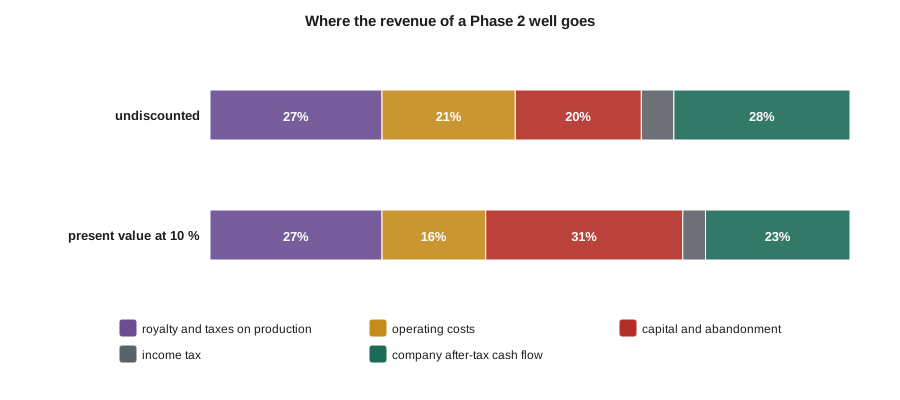
With the actual 3/16 royalty and North Dakota taxes, the burden is 26.9 percent of revenue and the before-tax NPV10 is 5.95 million dollars. Income tax, at a combined rate of 23.4 percent, lowers the NPV10 to 5.14 million, 86 percent of the before-tax value. The ratio is high because IDC and bonus depreciation allow the whole well cost to be deducted in the first year and percentage depletion shelters part of the later income. Royalties, severance and income taxes together take about 54 percent of the well's undiscounted pre-royalty net cash flow, a higher share than in the Canadian case mainly because the lease royalty is large.
Government take and fiscal design
The share of a project's economic rent that goes to governments and mineral owners is called the government take. It is usually measured as the undiscounted sum of royalties, production taxes and income taxes divided by the project's pre-royalty net cash flow. Fiscal systems differ less in their average take than in how the take responds to price and profitability. A flat royalty on revenue, like a fee lease royalty or a severance tax, takes the same share whether the well is very profitable or marginal, so it can make marginal wells uneconomic and shortens their lives. A royalty that rises with price or profitability, like the post-payout MRF rate, takes more from the most profitable wells and less from marginal ones.
Investors compare fiscal systems by their effect on the value and the risk of projects, and governments adjust them to attract investment or capture more of a windfall. For the evaluator, the practical points are to apply the rules actually in force at the effective date, to read the lease and royalty records for each well rather than use averages, and to note in the report any changes that have been announced but not yet enacted. Royalty and tax rules have changed several times in both countries in the last decade, and a forecast that runs 30 years will see further changes that no one can predict.
Common mistakes
MistakeApplying the pre-payout or a flat royalty rate for the whole life of a well.
InsteadFollow the actual royalty formula, including payout, price sensitivity and maturity provisions.
MistakeTreating capital as deductible when spent in every jurisdiction.
InsteadUse the actual deduction rules: pools and declining balances in Canada, IDC, bonus depreciation and depletion in the United States.
MistakeUsing after-tax values for one project and before-tax values for another.
InsteadCompare projects on the same basis; companies normally decide on after-tax values.
MistakeAssuming royalty and tax rules stay fixed for decades.
InsteadUse the rules in force and test the sensitivity of value to plausible changes.
Summary and key terms
- In North Dakota most minerals are privately owned; lease royalties of 3/16 or more are common, and federal onshore leases have a 12.5 percent minimum.
- North Dakota charges a 5 percent gross production tax and a 5 percent extraction tax on oil.
- Federal income tax is 21 percent; IDC expensing, bonus depreciation and percentage depletion reduce and defer it.
- The timing of deductions matters as much as their total.
- Government take measures the combined share of royalties and taxes in a project's economic rent.
- Progressive royalties take less from marginal wells than flat royalties do.
- Lease royalty
- The mineral owner's share of production or revenue, free of costs.
- Overriding royalty
- A royalty carved out of the working interest, in addition to the lessor's royalty.
- Severance tax
- A state tax on the value of oil or gas produced.
- Intangible drilling costs
- Non-salvageable costs of drilling and completing a well, deductible when incurred by independent producers.
- Bonus depreciation
- A first-year deduction of the cost of qualifying equipment.
- Percentage depletion
- A deduction of 15 percent of gross income from a property, available to independent producers within limits.
- Government take
- The share of a project's pre-royalty net cash flow paid in royalties and taxes.
Practice problems
Work each problem on paper first, then reveal the answer to check.
What is the combined burden of a 1/5 royalty and 10 percent production taxes on the working-interest share?
Show answer
0.20 + 0.80 × 0.10 = 0.28, or 28 percent.
Why is IDC expensing valuable even though the total deduction is the same as depreciation?
Show answer
It moves the deduction to the first year, when its present value is greatest.
What does a flat royalty on revenue do to marginal wells?
Show answer
It takes the same share regardless of profit, shortening their economic life.
Why do evaluators read lease and royalty records rather than use averages?
Show answer
Rates and terms vary by lease and well, and averages can misstate value and the economic limit.
Lesson quiz · 5 questions
Score 60% or more to complete this lesson.
Create a free account to save your progress, take quizzes and earn a certificate.