
NUC-300 · Lesson 7 of 12 · 23 min
Two-group theory
One-group theory treats every neutron as if it had the same energy, which is plainly wrong: fission neutrons are born at about 2 MeV and are absorbed mostly below 1 eV. Teodora shows Hana that the simplest correction, splitting neutrons into a fast group and a thermal group, already reproduces most of what matters for power reactor design, including the thermal peak in a reflector and the large difference between heavy water and light water migration. Two-group diffusion was the workhorse of reactor design for decades, and nodal codes for TVA's pressurized water reactor fleet still use two groups today.
Two groups and their equations
Group 1 contains fast and epithermal neutrons, from birth down to about 0.625 eV; group 2 contains thermal neutrons below that. Fission neutrons are all born in group 1. Neutrons leave group 1 by absorption (mostly resonance capture), by leakage and by slowing down into group 2, described by a removal or down-scattering cross section \(\Sigma_r = \Sigma_{1\to2}\). Group 2 neutrons are absorbed or leak; in a thermal reactor, upscattering from group 2 back into group 1 is negligible. In steady state, with the fission source divided by \(k\):
The fast group is fed by fission and drained by removal into the thermal group, which is in turn fed only by that removal. Each group has its own diffusion coefficient and absorption, and therefore its own migration length. Fast neutrons travel much further than thermal ones in water, because hydrogen's scattering cross section is smaller at high energy and the transport correction is larger.
Infinite medium and bare-core results
In an infinite uniform medium the Laplacian terms vanish. The thermal equation gives the ratio of thermal to fast flux, and substituting it into the fast equation gives \(k_\infty\):
For a bare core in its fundamental mode, both group fluxes share the same spatial shape, and \(\nabla^2 \to -B_g^2\). This gives the two-group criticality formula, which separates into fast and thermal non-leakage factors:
When fast fission is small, this reduces to \(k_{\text{eff}} \approx k_\infty/[(1 + L_1^2B_g^2)(1 + L_2^2B_g^2)]\), where \(L_1^2 = D_1/(\Sigma_{a1} + \Sigma_r)\) is the fast diffusion area, close to the Fermi age \(\tau\), and \(L_2^2 = D_2/\Sigma_{a2}\) is the thermal diffusion area. For large cores the product of the two factors is approximately \(1/(1 + M^2B_g^2)\), with migration area \(M^2 = L_1^2 + L_2^2\). This connects two-group theory to the modified one-group formula of lesson 5 and to the non-leakage factors of the six-factor formula.
Two kinds of lattice
The program compares two sets of illustrative two-group constants, one typical of a heavy water lattice with natural uranium and one typical of a light water lattice with enriched uranium. The contrast is striking. The heavy water lattice has a thermal diffusion area of a couple of hundred square centimeters and a fast diffusion area of more than a hundred: its migration area is several hundred square centimeters. The light water lattice has a thermal diffusion area of only a few square centimeters and a fast area of about fifty. Its migration area is dominated by the slowing down of fast neutrons, while the heavy water lattice's is dominated by thermal diffusion.
The flux ratio is just as different. In the heavy water lattice, \(\Sigma_r/\Sigma_{a2}\) is close to two: the thermal flux exceeds the fast flux, because heavy water moderates well and absorbs little. In the light water lattice it is about 0.2: the thermal flux is only a fifth of the fast flux, because the strongly absorbing enriched fuel removes thermal neutrons quickly. That harder spectrum is one reason light water reactors breed less plutonium per fission than CANDU reactors do, and why their reactivity responds differently to changes in coolant density.
Worked problem
Two-group k for a bare cylinder
For the PWR-like constants in the program (\(D_1 = 1.40\), \(D_2 = 0.40\) cm; \(\Sigma_{a1} = 0.010\), \(\Sigma_r = 0.017\), \(\Sigma_{a2} = 0.085\), \(\nu\Sigma_{f1} = 0.006\), \(\nu\Sigma_{f2} = 0.135\ \text{cm}^{-1}\)), find \(k_\infty\) and \(k_{\text{eff}}\) for a bare cylinder of radius 170 cm and height 370 cm.
Show solution
- \(k_\infty = (0.006 + 0.135 \times 0.017/0.085)/(0.010 + 0.017) = (0.006 + 0.027)/0.027 = 1.222\).
- \(B_g^2 = (2.405/170)^2 + (\pi/370)^2 = 2.00 \times 10^{-4} + 0.72 \times 10^{-4} = 2.72 \times 10^{-4}\ \text{cm}^{-2}\).
- Fast denominator: \(0.027 + 1.40 \times 2.72 \times 10^{-4} = 0.02738\); thermal denominator: \(0.085 + 0.40 \times 2.72 \times 10^{-4} = 0.08511\).
- \(k_{\text{eff}} = 0.006/0.02738 + (0.135/0.08511)(0.017/0.02738) = 0.219 + 0.985 = 1.204\).
Answer: \(k_{\text{eff}} \approx 1.20\). Leakage costs only about 18 mk in a core this large, and the large remaining excess, typical of fresh enriched fuel, is held down by boron and burnable absorbers.
# Two-group, bare-core criticality with illustrative CANDU-like and PWR-like constants.
import math
cores = {
    # D1, D2 (cm), Sigma_a1, Sigma_r (1->2), Sigma_a2, nuSf1, nuSf2 (1/cm)
    'CANDU-like': (1.26, 0.94, 0.0010, 0.0075, 0.0040, 0.0001, 0.0047),
    'PWR-like':   (1.40, 0.40, 0.0100, 0.0170, 0.0850, 0.0060, 0.1350),
}
for name, (D1, D2, Sa1, Sr, Sa2, nf1, nf2) in cores.items():
    kinf = (nf1 + nf2 * Sr / Sa2) / (Sa1 + Sr)
    L1sq = D1 / (Sa1 + Sr); L2sq = D2 / Sa2; M2 = L1sq + L2sq
    print(name)
    print(f"  k_inf = {kinf:.4f}, fast diffusion area {L1sq:.1f} cm2, thermal {L2sq:.2f} cm2, M2 = {M2:.1f} cm2")
    for R, H in ((300, 600), (170, 370)):
        Bg2 = (2.405 / R) ** 2 + (math.pi / H) ** 2
        k = (nf1 + nf2 * Sr / (Sa2 + D2 * Bg2)) / (Sa1 + Sr + D1 * Bg2)
        print(f"  cylinder R = {R} cm, H = {H} cm: k_eff = {k:.4f}")
print(f" thermal to fast flux ratio (infinite medium) = {Sr / Sa2:.2f}")CANDU-like k_inf = 1.0485, fast diffusion area 148.2 cm2, thermal 235.00 cm2, M2 = 383.2 cm2 cylinder R = 300 cm, H = 600 cm: k_eff = 1.0129 cylinder R = 170 cm, H = 370 cm: k_eff = 0.9479 thermal to fast flux ratio (infinite medium) = 1.88 PWR-like k_inf = 1.2222, fast diffusion area 51.9 cm2, thermal 4.71 cm2, M2 = 56.6 cm2 cylinder R = 300 cm, H = 600 cm: k_eff = 1.2160 cylinder R = 170 cm, H = 370 cm: k_eff = 1.2039 thermal to fast flux ratio (infinite medium) = 0.20
The heavy-water-like lattice tells a different story in the output. In a cylinder 3.4 m across it is subcritical, \(k \approx 0.95\), because its migration area is so large that leakage costs more than its modest \(k_\infty\) can afford. Only at about 6 m across and 6 m long does it exceed one. That is the physics behind the large size of heavy water reactors such as Canada's CANDU units, compared with the compact cores of TVA's pressurized water reactor fleet: natural uranium lattices have little reactivity to spare, so they must be large enough to keep leakage small.
Where two-group constants come from
Two-group constants are not measured directly; they are averages of energy-dependent cross sections over the neutron spectrum in each group and over the geometry of a fuel cell or assembly. A lattice physics code solves the transport equation in a single fuel assembly or bundle cell with many energy groups, typically tens to hundreds, then collapses the results into two groups and homogenizes them over the assembly so that the whole-core code can treat each assembly as a uniform block. The constants also depend on fuel burnup, fuel temperature, coolant density and boron concentration, so they are tabulated against all of these. Reactor Physics II covers this process; for now, Hana treats the constants as given.
Two-group theory in a reflected core
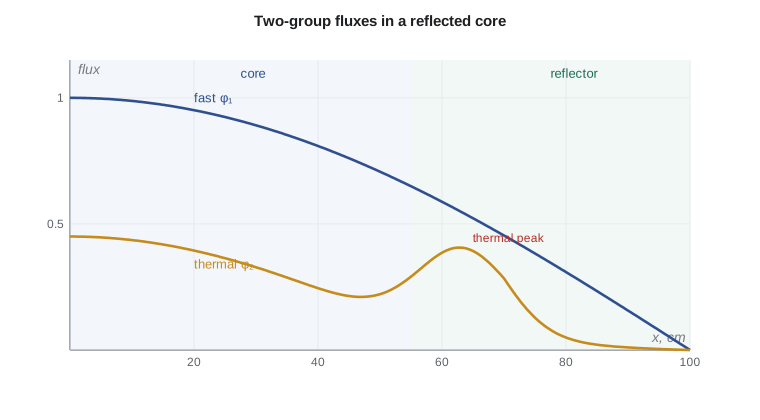
Applying the two-group equations to a reflected core shows the thermal peak described in lesson 6. In the reflector there is no fission, so the fast flux decays smoothly outward. But the thermal equation in the reflector has a source \(\Sigma_r\phi_1\) from fast neutrons slowing down, and very little absorption. Near the interface the thermal flux therefore rises above its value in the core, peaks a few centimeters into the reflector and then falls. The fuel nearest the reflector sees that elevated thermal flux and produces more power than a one-group model would predict, which is why core designers watch the power of peripheral assemblies closely and sometimes load them with partly burned fuel.
Numerical solution and coupling
Two-group problems are solved by the same power iteration as one-group problems, with an inner step for each group. For each iteration, solve the fast equation with the current fission source, use the new fast flux as the source for the thermal equation, solve that, then update the fission source and \(k\). Because the thermal group depends only on the fast group, no inner iteration between groups is needed in a thermal reactor without upscattering. Hana extends her lesson 4 solver to two groups and checks it against the bare-slab formula above, then adds a reflector and sees the thermal peak appear.
How the constants change with conditions
Hana looks at the table of two-group constants that feeds the core simulator. Each entry depends on several state variables, and she traces how a few of them move. Adding soluble boron raises \(\Sigma_{a2}\) and slightly hardens the spectrum. Raising fuel temperature raises \(\Sigma_{a1}\) through Doppler broadening of resonances. Lowering coolant density lowers \(\Sigma_r\) in a light water lattice, because there is less hydrogen to slow neutrons, and also lowers \(D\)'s denominator so that \(D_1\) rises. Burnup lowers \(\nu\Sigma_{f2}\) as uranium-235 is consumed, partly offset by plutonium, and raises \(\Sigma_{a2}\) as fission products accumulate.
Each of these changes enters the two-group formula in a predictable way, which is why two-group reasoning remains useful for understanding the outputs of detailed codes. If the simulator reports that \(k\) falls when coolant density drops, Hana can check the sign by asking whether the drop in \(\Sigma_r\) and the rise in leakage outweigh the reduction in thermal absorption by hydrogen. In an undermoderated lattice they do.
Worked problem
Effect of boron on k∞
In the PWR-like lattice, adding boron raises \(\Sigma_{a2}\) from 0.085 to 0.088 cm⁻¹ with other constants unchanged. Find the new \(k_\infty\) and the reactivity change.
Show solution
- New thermal term: \(0.135 \times 0.017/0.088 = 0.02608\).
- \(k_\infty = (0.006 + 0.02608)/0.027 = 1.188\), down from 1.222.
- \(\Delta\rho = (1.188 - 1.222)/(1.188 \times 1.222) = -0.0234\), about −23 mk.
Answer: A 3.5 percent increase in thermal absorption removes about 23 mk, consistent with boron worth in large PWRs of the order of 10 pcm per part per million.
Interpreting the migration area
The migration area \(M^2\) has a simple physical meaning: it is one sixth of the mean square distance a neutron travels from its birth as a fast fission neutron to its absorption as a thermal neutron. The fast part, \(L_1^2\) or \(\tau\), covers the slowing-down journey; the thermal part, \(L_2^2\), covers diffusion after thermalization. A core's leakage depends on \(M^2B_g^2\), so cores with long migration lengths must be large, and small cores must use materials with short migration lengths or effective reflectors.
| Lattice type | Fast area L₁² (cm²) | Thermal area L₂² (cm²) | Migration area M² (cm²) |
|---|---|---|---|
| Light water, enriched UO₂ | about 50 | about 2 to 5 | about 55 to 60 |
| Heavy water, natural UO₂ | about 120 to 150 | about 200 to 250 | about 350 to 400 |
| Graphite, natural uranium | about 350 | about 300 to 400 | about 700 |
Common mistakes
MistakeAssuming the fast and thermal fluxes are equal.
InsteadTheir ratio depends on Σ_r/Σ_a2, about 2 in heavy water lattices and 0.2 in light water lattices.
MistakeForgetting that thermal neutrons are fed only by slowing down.
InsteadIn group 2 the source is Σ_r φ₁, not fission.
MistakeUsing one migration length for both groups.
InsteadEach group has its own D and removal, so L₁ and L₂ differ.
MistakeTreating two-group constants as fixed properties of a material.
InsteadThey are spectrum and geometry averages that vary with burnup and conditions.
Summary and key terms
- Two-group theory splits neutrons into fast (fission born) and thermal groups, linked by down-scattering Σ_r.
- Infinite medium: φ₂/φ₁ = Σ_r/Σ_a2 and k∞ = (νΣ_f1 + νΣ_f2 Σ_r/Σ_a2)/(Σ_a1 + Σ_r).
- Bare core: k_eff ≈ k∞/[(1 + L₁²B²)(1 + L₂²B²)] ≈ k∞/(1 + M²B²).
- Heavy water lattices have large migration areas and need large cores; light water lattices are compact.
- Two-group theory reproduces the thermal flux peak in a moderating reflector.
- Two-group constants come from lattice codes, collapsed and homogenized from many groups.
- Fast group
- Neutrons from birth down to about 0.625 eV in a two-group model.
- Thermal group
- Neutrons below the thermal cutoff, about 0.625 eV.
- Removal cross section
- Σ_r, the rate at which neutrons slow down from the fast group into the thermal group.
- Fermi age
- τ, the slowing-down area, one sixth of the mean square distance from birth to thermalization.
- Migration area
- M² = L₁² + L₂², one sixth of the mean square distance from birth to absorption.
- Group collapse
- Averaging many-group cross sections into a few groups using a weighting spectrum.
- Homogenization
- Replacing a heterogeneous assembly by uniform material with equivalent reaction rates.
Practice problems
Work each problem on paper first, then reveal the answer to check.
Σ_r = 0.008 and Σ_a2 = 0.004 cm⁻¹. Find the infinite-medium thermal-to-fast flux ratio.
Show answer
0.008/0.004 = 2.0.
D₁ = 1.3 cm, Σ_a1 + Σ_r = 0.009 cm⁻¹. Find L₁².
Show answer
1.3/0.009 = 144 cm².
L₁² = 144 and L₂² = 230 cm². Find M² and the non-leakage at B² = 2 × 10⁻⁴.
Show answer
M² = 374 cm²; 1/(1 + 0.075) = 0.930.
Using the program, what is k_eff of the CANDU-like lattice in a 6 m by 6 m cylinder?
Show answer
About 1.013.
Why does the light water lattice have a much lower thermal-to-fast flux ratio?
Show answer
Enriched fuel absorbs thermal neutrons strongly, so Σ_a2 is large.
In a reflector, what is the source term in the thermal group equation?
Show answer
Σ_r φ₁, neutrons slowing down from the fast group.
Lesson quiz · 5 questions
Score 60% or more to complete this lesson.
Create a free account to save your progress, take quizzes and earn a certificate.