
NUC-300 · Lesson 10 of 12 · 23 min
Point reactor kinetics
Lesson 1 left an uncomfortable puzzle. With a prompt generation time of \(10^{-4}\) s, a reactor at \(k = 1.001\) would multiply its power about twenty thousand times in one second, far too fast for any control system. Yet operators raise power gently every day, and Hana has watched the power climb over minutes on the simulator at Meridian Nuclear Engineering. The answer is that about 0.65 percent of fission neutrons are not prompt. They are emitted by fission products seconds after fission, and those delayed neutrons slow the whole population down. Point kinetics is the model that makes this precise.
Prompt and delayed neutrons
Most fission neutrons appear within about \(10^{-14}\) s of fission. A small fraction \(\beta\) appears later, after the beta decay of certain neutron-rich fission products called delayed neutron precursors. When a precursor such as bromine-87 decays, the daughter nucleus is sometimes left in an excited state above its neutron binding energy, and it emits a neutron at once. The neutron therefore appears with the half-life of the precursor, 55.7 s for bromine-87. For thermal fission of uranium-235, \(\beta \approx 0.0065\); for plutonium-239 it is about 0.0021, and for uranium-238 fast fission about 0.0148. Lesson 11 describes the six groups in which precursors are usually lumped. Here a single group, with an average decay constant \(\lambda \approx 0.08\ \text{s}^{-1}\), captures the main behavior.
The point kinetics equations
If the flux shape stays fixed and only its amplitude changes, the neutron population \(n(t)\) and the precursor concentration \(C(t)\) obey two coupled equations:
Here \(\Lambda\) is the prompt neutron generation time, about \(2 \times 10^{-5}\) s in a light water reactor and about \(10^{-3}\) s in a heavy water reactor. In the first equation, the term \((\rho - \beta)n/\Lambda\) says that prompt neutrons alone multiply as if the reactivity were \(\rho - \beta\), while \(\lambda C\) adds delayed neutrons from earlier fissions. In the second, precursors are created by the fraction \(\beta\) of fissions and decay at rate \(\lambda\). In steady state, \(\rho = 0\) and \(\lambda C = \beta n/\Lambda\): the delayed neutrons arriving exactly replace those that would be missing from each generation.
The model is called point kinetics because it ignores spatial detail. That is accurate when the flux shape changes little during a transient, as for small uniform changes or for well-coupled cores. For large local perturbations, such as a rod ejection in a light water reactor or a large-break loss of coolant in a CANDU, spatial kinetics codes solve the time-dependent diffusion or transport equation in full. Point kinetics remains the way every reactor physicist thinks about reactor response.
The prompt jump
Because \(\Lambda\) is tiny, the prompt part of the population adjusts almost instantly to a reactivity change, within a few hundred prompt generations, while the precursors, with their seconds-long lifetimes, cannot change quickly. Just after a step change from zero to \(\rho\) (with \(\rho < \beta\)), the precursor concentration is still at its old value, and the neutron population jumps to a new level where the first equation is momentarily balanced:
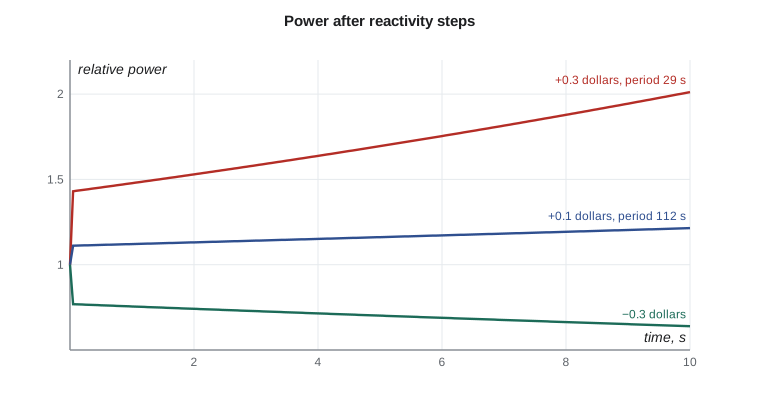
This is the prompt jump approximation. For a step of +0.1 dollars, \(\rho = 0.1\beta\), and the power jumps by about 11 percent. For −0.3 dollars, it drops by about 23 percent. A large negative step, such as a reactor trip worth many dollars, gives a prompt drop to a small fraction of the initial power, followed by a slower decline governed by the longest-lived precursors.
The stable period
After the prompt jump, the population settles into exponential behavior, \(n \propto e^{t/T}\), with a stable period \(T\). For one delayed group and small reactivity,
so a +0.1 dollar step gives a period of about \(0.9/(0.08 \times 0.1) \approx 112\) s, and the power rises by a factor of \(e\) every couple of minutes. The prompt generation time has dropped out: as long as \(\rho\) is well below \(\beta\), the period is set by the precursors' lifetimes. This is the central fact of reactor control. Operators commonly keep periods longer than about 30 s during power changes, and reactor protection systems trip on very short periods or high rates of change of log power.
Worked problem
Response to a small positive step
A light water core at constant power receives a step of +0.3 dollars. With \(\beta = 0.0065\), \(\lambda = 0.08\ \text{s}^{-1}\) and \(\Lambda = 2 \times 10^{-5}\) s, estimate the prompt jump, the stable period and the relative power after 10 s.
Show solution
- Prompt jump: \(1/(1 - 0.3) = 1.43\).
- Period: \((1 - 0.3)/(0.08 \times 0.3) = 29\) s.
- After 10 s: \(1.43\, e^{10/29} \approx 1.43 \times 1.41 = 2.0\).
Answer: The power roughly doubles in ten seconds, fast enough that operators would never make such a step deliberately, but slow enough that control and protection systems can respond comfortably.
# Point kinetics with one delayed group: numerical solution and the prompt jump.
import math
beta, lam, Lam = 0.0065, 0.08, 2.0e-5     # 1/s and s (LWR-like generation time)
def run(rho, t_end=10.0, dt=1e-4):
    n, C = 1.0, beta / (lam * Lam)            # equilibrium start
    t, out, nxt = 0.0, [], 0.0
    while t <= t_end + 1e-12:
        if t >= nxt: out.append((t, n)); nxt += 2.0
        dn = ((rho - beta) / Lam * n + lam * C) * dt
        dC = (beta / Lam * n - lam * C) * dt
        n += dn; C += dC; t += dt
    return out
for r_dollars in (0.1, 0.3, -0.3):
    rho = r_dollars * beta
    res = run(rho)
    jump = beta / (beta - rho)
    # stable period from the one-group inhour root, small-rho approximation
    T = (beta - rho) / (lam * rho)
    print(f"rho = {r_dollars:+.1f} dollars: prompt jump to {jump:.3f}; period about {T:7.1f} s")
print(" " + " ".join(f"t={t:4.1f}s n={n:6.3f}" for t, n in res))rho = +0.1 dollars: prompt jump to 1.111; period about 112.5 s t= 0.0s n= 1.000 t= 2.0s n= 1.131 t= 4.0s n= 1.151 t= 6.0s n= 1.172 t= 8.0s n= 1.193 rho = +0.3 dollars: prompt jump to 1.429; period about 29.2 s t= 0.0s n= 1.000 t= 2.0s n= 1.529 t= 4.0s n= 1.638 t= 6.0s n= 1.754 t= 8.0s n= 1.879 rho = -0.3 dollars: prompt jump to 0.769; period about -54.2 s t= 0.0s n= 1.000 t= 2.0s n= 0.741 t= 4.0s n= 0.715 t= 6.0s n= 0.689 t= 8.0s n= 0.664
The numerical results match the formulas: the power jumps within the first fraction of a second and then grows or decays on the predicted period. For the negative step, the long-term decline is slower than a naive reading of the formula suggests, because precursors from the earlier, higher power keep supplying delayed neutrons. With six groups, as lesson 11 shows, the longest-lived group sets a limit: after a large negative insertion, power can fall no faster than with a period of about 80 s.
Prompt criticality
If \(\rho\) reaches \(\beta\), one dollar, the reactor is prompt critical: prompt neutrons alone sustain the chain reaction, and the term \((\rho - \beta)/\Lambda\) is no longer negative. Above one dollar, the period becomes roughly \(\Lambda/(\rho - \beta)\), only fractions of a second in a light water reactor. Power reactors are designed so that no credible event can insert anywhere near that much reactivity, and their strong negative feedback, the subject of lesson 12, limits any excursion that begins. The one-dollar line is the most important number in reactor safety analysis, which is why reactivity is so often expressed in dollars.
In a light water reactor, the short prompt generation time makes the prompt part of any transient very fast, so the design relies on prompt negative fuel temperature feedback and on limits on rod worth. Design basis analyzes for TVA's pressurized water reactor fleet include the control rod ejection accident, in which one rod is assumed to leave the core in a fraction of a second, and show that Doppler feedback limits the resulting energy deposition in the fuel.
Research reactors and pulsing
a university TRIGA research reactor uses fuel in which uranium is mixed with zirconium hydride. When the fuel heats up, the hydrogen in it hardens the neutron spectrum almost instantly, producing a large, prompt negative temperature coefficient. That allows the reactor to be pulsed: a rod is ejected to make the core briefly prompt supercritical, power rises to around a thousand megawatts for a few milliseconds, and the fuel's own heating shuts the pulse down. Students use pulses to observe point kinetics directly.
Measuring with point kinetics
Point kinetics also works in reverse. If the power history \(n(t)\) is measured, the equations can be solved for \(\rho(t)\). This inverse kinetics method underlies the digital reactivity meters used in physics tests at new-core start-ups: as rods move, the meter shows reactivity in real time, and integrating the readings over a rod's motion gives its worth curve. The accuracy depends on the delayed neutron data, which is why those data are known to a few percent and still refined.
Reactivity and power during routine operation
In normal operation reactivity changes are tiny. A power increase of a few percent per minute needs only a few hundredths of a dollar of net reactivity, which the control system adds and removes continuously as feedback responds. Hana watches the simulator's reactivity trace during a load change: it never exceeds a few cents, and the power follows the demand smoothly. The point kinetics equations with feedback reproduce this behavior, and the operators never think in terms of prompt jumps. The large-step results of this lesson are for understanding and for safety analysis rather than for daily operation.
Start-up is the one routine activity in which period matters directly. As a subcritical core approaches critical, operators withdraw rods or dilute boron in small steps and watch the start-up rate, often displayed in decades per minute. One decade per minute corresponds to a period of about 26 s, since \(\ln 10/60 \approx 0.038\ \text{s}^{-1}\). Procedures limit the start-up rate to a value well below the trip setting, and most start-ups are run at a fraction of a decade per minute. Once the reactor is critical and the power is high enough for heat to be measured, feedback begins to act and the operators raise power under the control system.
Worked problem
Start-up rate and period
A start-up rate meter reads 0.5 decades per minute. Find the period and the reactivity in dollars, using the one-group formula with \(\lambda = 0.08\ \text{s}^{-1}\).
Show solution
- Rate: \(0.5 \times \ln 10/60 = 0.0192\ \text{s}^{-1}\), so \(T = 52\) s.
- From \(T = (\beta - \rho)/(\lambda\rho)\): \(\rho/\beta = 1/(1 + \lambda T) = 1/(1 + 4.16) = 0.19\) dollars.
Answer: About 0.19 dollars, a deliberate but modest insertion typical of a careful start-up.
Protection systems are set with these numbers in mind. A log-rate or period trip is set so that, during start-up, an unexpectedly short period stops the approach before power reaches the range where feedback acts. At power, overpower and rate-of-change trips cover faster events. Hana notes that every trip setting she has seen is ultimately a statement about how much reactivity could be added how quickly, and how long the delayed neutrons give the protection system to act.
Numerical solution
The point kinetics equations are stiff: the prompt term changes on a microsecond time scale while the precursors change over seconds. Explicit integration, as in the program, needs time steps small compared with \(\Lambda/\beta\), a few milliseconds here, which is why the program takes small steps. Production codes use implicit or analytic methods that remain stable with much larger steps, or use the prompt jump approximation to remove the fast term entirely. Hana's simple solver is enough to see every important feature, as long as she keeps the step small.
Common mistakes
MistakeUsing the prompt generation time to estimate the period for small reactivity.
InsteadFor ρ well below β, the period is set by delayed neutrons, T ≈ (β − ρ)/(λρ).
MistakeForgetting the prompt jump.
InsteadA step change produces an immediate change of β/(β − ρ) before the period takes over.
MistakeAssuming power after a trip falls as fast as the rods move.
InsteadAfter the prompt drop, the longest-lived precursors limit the decline to a period near 80 s.
MistakeApplying point kinetics to strongly local transients without checking.
InsteadLarge local perturbations need spatial kinetics.
Summary and key terms
- A fraction β, about 0.0065 for U-235, of fission neutrons is delayed by precursor decay.
- Point kinetics: dn/dt = (ρ − β)n/Λ + λC and dC/dt = βn/Λ − λC.
- A step change gives a prompt jump n₊/n₀ = β/(β − ρ).
- The stable period for small ρ is about (β − ρ)/(λρ), independent of Λ.
- At ρ = β (one dollar) the reactor is prompt critical and the period becomes very short.
- Inverse kinetics turns measured power histories into reactivity.
- Delayed neutron precursor
- A fission product whose beta decay leads to neutron emission.
- Delayed neutron fraction
- β, the fraction of fission neutrons that are delayed.
- Prompt generation time
- Λ, the average time between successive prompt neutron generations.
- Point kinetics
- A model of reactor power as a single amplitude with a fixed spatial shape.
- Prompt jump
- The almost instantaneous change in power following a reactivity step, β/(β − ρ).
- Stable period
- The time for power to change by a factor of e once transients have died away.
- Prompt critical
- The condition ρ ≥ β, in which prompt neutrons alone sustain the chain reaction.
Practice problems
Work each problem on paper first, then reveal the answer to check.
Find the prompt jump for a step of +0.2 dollars.
Show answer
1/(1 − 0.2) = 1.25.
Estimate the stable period for +0.2 dollars with λ = 0.08 s⁻¹.
Show answer
0.8/(0.08 × 0.2) = 50 s.
Using the program, what is the relative power 8 s after a +0.1 dollar step?
Show answer
About 1.19.
A step of −2 dollars is inserted. Estimate the prompt drop.
Show answer
1/(1 + 2) = 0.33 of the initial power.
Why does the period for small reactivities not depend on Λ?
Show answer
The rate of rise is limited by how fast precursors decay, not by the prompt generation time.
What is the reactivity in mk of one dollar for β = 0.0065?
Show answer
6.5 mk.
Lesson quiz · 5 questions
Score 60% or more to complete this lesson.
Create a free account to save your progress, take quizzes and earn a certificate.