
NUC-300 · Lesson 11 of 12 · 21 min
Delayed neutrons
The one-group kinetics model of lesson 10 gets the main features right, but Teodora's safety analysis team uses six delayed neutron groups, data for each fissile nuclide, and a correction for the energy at which delayed neutrons are born. Hana's task this week is to understand where those data come from, why six groups, how the inhour equation turns them into a period-reactivity relation, and why the effective delayed neutron fraction in a real core differs from the textbook value.
Where delayed neutrons come from
About forty to sixty fission products are known delayed neutron precursors. Each is a neutron-rich nucleus whose beta decay sometimes leaves the daughter in a state above its neutron separation energy, so that the daughter emits a neutron almost at once. The longest-lived important precursor is bromine-87, with a half-life of about 55.7 s; others include iodine-137 at about 24 s and many isotopes of bromine, iodine, rubidium and arsenic with half-lives from a few seconds down to fractions of a second. The delayed neutron appears with the half-life of the precursor, not of the excited daughter.
Delayed neutrons are emitted at lower energies than prompt ones, typically around 0.4 to 0.5 MeV rather than about 2 MeV. That matters because lower-energy neutrons are less likely to leak while slowing down and less likely to cause fast fission in uranium-238. Their importance to the chain reaction is therefore slightly different from that of prompt neutrons.
Six groups
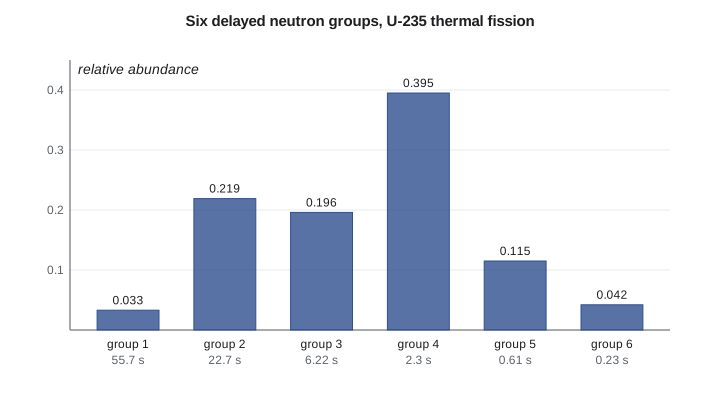
Tracking dozens of precursors separately is unnecessary for most purposes. Measurements of the delayed neutron decay curve after a burst of fissions, first done systematically by Keepin and colleagues in the 1950s, are fitted well by six exponential groups. Each group has a decay constant \(\lambda_i\) and a relative abundance \(a_i = \beta_i/\beta\). The program lists widely used values for thermal fission of uranium-235.
| Group | Half-life (s) | Decay constant (s⁻¹) | Relative abundance |
|---|---|---|---|
| 1 | 55.7 | 0.0124 | 0.033 |
| 2 | 22.7 | 0.0305 | 0.219 |
| 3 | 6.22 | 0.111 | 0.196 |
| 4 | 2.30 | 0.301 | 0.395 |
| 5 | 0.610 | 1.14 | 0.115 |
| 6 | 0.230 | 3.01 | 0.042 |
Other fissile nuclides have different totals and group structures. Plutonium-239 has a total delayed fraction of about 0.0021, roughly a third of uranium-235's. Uranium-233 has about 0.0026. Fast fission of uranium-238 has about 0.0148, the largest of all, which partly offsets the plutonium effect in uranium fuel. Newer evaluations sometimes use eight groups with half-lives fixed across nuclides, which simplifies mixing data for different fissile isotopes, but the six-group format remains common.
The mean delay and why it matters
The weighted mean lifetime of delayed neutron precursors is
Averaged over all fission neutrons, prompt and delayed, the mean time between generations is therefore about \((1 - \beta)\,l + \beta\,\bar{t}_d \approx 0.0065 \times 13 \approx 0.085\) s, whatever the prompt lifetime \(l\). That is roughly a thousand times longer than the prompt lifetime in a light water reactor. A reactor at \(k = 1.001\) therefore grows by a factor of about \(e^{0.001/0.085} \approx e^{0.012}\) per second, a period near 85 s, rather than the explosive growth of the prompt-only picture. This simple estimate, which the program reproduces, captures why delayed neutrons make reactors controllable.
The inhour equation
Seeking solutions of the six-group point kinetics equations of the form \(n \propto e^{\omega t}\) gives a relation between the reactivity and the inverse period \(\omega = 1/T\):
This is the inhour equation, named after an old unit, the inverse hour, in which periods were once expressed. For a given \(\rho\) it has seven roots in \(\omega\). One is positive for positive \(\rho\); the other six are negative and describe transients that die away. After a few seconds only the positive root survives, giving the stable period. Plotting \(\rho\) against \(T\) gives a curve that physicists use every day: at long periods, reactivity is nearly proportional to \(1/T\); as \(\rho\) approaches one dollar, the period falls steeply toward the prompt regime.
Worked problem
Period for a small step from the inhour equation
Using the six-group data and \(\Lambda = 2 \times 10^{-5}\) s, find the stable period for a reactivity step of 0.1 dollars.
Show solution
- \(\rho = 0.1 \times 0.0065 = 6.5 \times 10^{-4}\).
- For long periods, \(\omega\Lambda\) is negligible and each term is roughly \(\beta_i\,\omega/\lambda_i\), so \(\rho \approx \omega\,\beta\,\bar{t}_d\).
- \(\omega \approx 6.5 \times 10^{-4}/(0.0065 \times 13.0) = 0.0077\ \text{s}^{-1}\), a first estimate of \(T \approx 130\) s.
- Solving the full equation numerically, as the program does, gives \(T \approx 98\) s, because the shorter-lived groups contribute less than the long-period approximation assumes.
Answer: About 98 s. The one-group model of lesson 10 gave 112 s, close but not identical.
# Six delayed-neutron groups (U-235 thermal fission, Keepin-type values, approximate).
import math
groups = [  # half-life s, relative abundance
    (55.72, 0.033), (22.72, 0.219), (6.22, 0.196), (2.30, 0.395), (0.610, 0.115), (0.230, 0.042)]
beta = 0.0065
lam_eff_inv = 0.0
for i, (t12, a) in enumerate(groups, 1):
    lam = math.log(2) / t12
    lam_eff_inv += a / lam
    print(f"group {i}: half-life {t12:6.2f} s, lambda {lam:7.4f} /s, beta_i {a * beta:.5f}")
print(f"\nmean delayed precursor lifetime {lam_eff_inv:.1f} s; effective one-group lambda {1 / lam_eff_inv:.4f} /s")
for l_prompt in (1e-4, 1e-3):
    l_eff = (1 - beta) * l_prompt + beta * lam_eff_inv
    print(f"prompt lifetime {l_prompt:.0e} s: average generation time with delayed neutrons {l_eff:.4f} s")
# inhour equation for one reactivity: find the stable period numerically
def rho_of(w, Lam=2e-5):
    return w * Lam + sum(a * beta * w / (w + math.log(2) / t12) for t12, a in groups)
target = 0.1 * beta
lo, hi = 1e-6, 10.0
for _ in range(200):
    mid = (lo + hi) / 2
    if rho_of(mid) > target: hi = mid
    else: lo = mid
print(f"\n0.1 dollar step: stable period from the six-group inhour equation = {1 / lo:.1f} s")group 1: half-life 55.72 s, lambda 0.0124 /s, beta_i 0.00021 group 2: half-life 22.72 s, lambda 0.0305 /s, beta_i 0.00142 group 3: half-life 6.22 s, lambda 0.1114 /s, beta_i 0.00127 group 4: half-life 2.30 s, lambda 0.3014 /s, beta_i 0.00257 group 5: half-life 0.61 s, lambda 1.1363 /s, beta_i 0.00075 group 6: half-life 0.23 s, lambda 3.0137 /s, beta_i 0.00027 mean delayed precursor lifetime 13.0 s; effective one-group lambda 0.0768 /s prompt lifetime 1e-04 s: average generation time with delayed neutrons 0.0847 s prompt lifetime 1e-03 s: average generation time with delayed neutrons 0.0856 s 0.1 dollar step: stable period from the six-group inhour equation = 98.4 s
The program finds the positive inhour root by bisection. Hana changes the reactivity and watches the period: 0.2 dollars gives a period of about 37 s, 0.5 dollars about 6 s, and at 0.8 dollars the period is already about one second, which is where operators would never be. The same code with plutonium-239 data gives much shorter periods for the same reactivity in mk, because plutonium's dollar is smaller.
Shutdown and the 80-second limit
After a large negative step, such as a reactor trip, the prompt neutron population collapses almost at once to a fraction \(\beta/(\beta - \rho)\) of its initial value. What remains is sustained by precursors decaying, and as the short-lived groups disappear the decline is governed by group 1, with its 55.7 s half-life. Power therefore falls no faster than with a negative period of about \(1/\lambda_1 \approx 80\) s. This is why neutron power after a trip shows a rapid drop followed by a slow tail, and why fission power does not vanish instantly. Decay heat from fission products, a separate effect discussed in Nuclear and Radiation Physics, falls more slowly still.
Effective delayed neutron fraction
Because delayed neutrons are born at lower energies than prompt ones, they are, on average, slightly more or slightly less likely to cause a new fission, depending on the core. In a thermal reactor they are less likely to leak during slowing down but also less likely to cause fast fission in uranium-238. The importance-weighted fraction is called the effective delayed neutron fraction \(\beta_{\text{eff}}\). It is computed with the adjoint flux, which measures how important a neutron of each energy and position is to the chain reaction, and is typically a few percent different from the physical \(\beta\). In large thermal cores \(\beta_{\text{eff}}\) is often slightly larger than \(\beta\); in small cores where leakage dominates, or in fast reactors, the difference can be larger.
As fuel burns, \(\beta_{\text{eff}}\) falls because plutonium-239 and plutonium-241, with smaller delayed fractions, contribute more fissions. A light water core might start a cycle near 0.0070 and end near 0.0050; a CANDU core at equilibrium sits near 0.0058, about where the program of lesson 9 put it. Safety analyzes use \(\beta_{\text{eff}}\) values for the relevant point in the cycle, because the margin to prompt criticality in mk is proportional to it.
In a light water reactor, photoneutrons from deuterium are negligible because ordinary water contains only about 0.015 percent deuterium, so kinetics models for TVA's pressurized water reactor fleet use the fission delayed groups alone. In heavy water reactors, by contrast, photoneutron groups are added to the model.
Delayed neutrons and the source after shutdown
Delayed neutrons also explain what the start-up instruments show after a shutdown. Within a minute of a trip, the shorter-lived groups have decayed and the count rate falls with the group 1 half-life. After ten minutes, the fission chain is sustained only by the residual subcritical multiplication of whatever neutron sources remain: spontaneous fission, alpha-neutron reactions in oxide fuel, and in heavy water or beryllium-reflected cores, photoneutrons. The count rate then settles to a source-dominated level that slowly declines over days.
Operators use that level to check that the reactor is as far below critical as expected. If the count rate after shutdown were higher than predicted for the intended shutdown margin, it would indicate that the core was closer to critical than planned, and procedures would require investigation before any further reactivity changes. In this way delayed neutrons, photoneutrons and subcritical multiplication, three ideas from this course, combine into one practical check made every time a reactor is shut down.
The same physics appears in fuel handling. When a fresh fuel assembly or bundle is loaded into a shut-down light water core, or a channel is refueled in a CANDU, the change in count rate on the source range detectors, read against the expected subcritical multiplication, confirms that the loading is behaving as calculated.
Delayed neutrons in reactor design
Delayed neutron data enter almost every safety calculation. They set the margin to prompt criticality, the response time available to control and protection systems, the interpretation of reactivity measurements, and the behavior of the reactor during start-up and shutdown. Designers check that no single credible event can insert reactivity approaching one dollar faster than feedback and protection can respond. Reactors with fluid fuel, in which precursors are carried out of the core before they decay, have an extra complication: some delayed neutrons are emitted outside the core and lost, reducing the effective delayed fraction, which molten salt reactor designers must account for.
Checking the numbers
Hana ends the week by checking her inhour code against a measured start-up test from a past cycle: a rod step produced a stable period of 61 s, and the reactivity meter, using inverse kinetics with the same delayed data, reported 0.142 dollars. Her code, with the same \(\Lambda\) and data, gives a period of 61.4 s for that reactivity. Teodora nods: the agreement says less about Hana's code than about the delayed neutron data, which have been measured and refined for seventy years precisely because so much depends on them.
Common mistakes
MistakeUsing β for uranium-235 in a plutonium-rich core.
InsteadUse β_eff for the actual fuel mix and burnup.
MistakeAssuming one delayed group is enough for accurate periods.
InsteadSix groups give noticeably different periods, especially at short and long periods.
MistakeExpecting neutron power to vanish within seconds of a trip.
InsteadGroup 1 limits the decline to a period near −80 s.
MistakeConfusing photoneutrons with fission delayed neutrons.
InsteadPhotoneutrons come from gamma reactions in deuterium or beryllium and add extra groups in heavy water cores.
Summary and key terms
- Delayed neutrons come from beta decay of fission-product precursors such as bromine-87.
- Six groups fit the delayed neutron decay curve; for U-235, β ≈ 0.0065 and the mean delay is about 13 s.
- The average generation time including delayed neutrons is about 0.085 s, which makes reactors controllable.
- The inhour equation relates reactivity to the stable period; one root dominates after transients die away.
- After a large negative step, power falls no faster than a period of about 80 s.
- β_eff weights delayed neutrons by importance and falls as plutonium contributes more fissions.
- Delayed neutron group
- A lumped set of precursors with a common decay constant and abundance.
- Relative abundance
- The fraction a_i = β_i/β of delayed neutrons in group i.
- Inhour equation
- The relation between reactivity and inverse stable period from point kinetics.
- Effective delayed neutron fraction
- β_eff, the delayed fraction weighted by neutron importance.
- Adjoint flux
- A function measuring the importance of a neutron at each position and energy to the chain reaction.
- Photoneutron
- A neutron released when a gamma ray splits a nucleus such as deuterium or beryllium.
- Keepin data
- Classic six-group delayed neutron parameters measured in the 1950s.
Practice problems
Work each problem on paper first, then reveal the answer to check.
Find the decay constant of group 1 (half-life 55.7 s).
Show answer
ln 2/55.7 = 0.0124 s⁻¹.
β for U-235 is 0.0065 and group 4 has a = 0.395. Find β₄.
Show answer
0.0065 × 0.395 = 0.00257.
Using the program, what is the mean precursor lifetime?
Show answer
About 13.0 s.
Estimate the stable period for ρ = 0.001 using ρ ≈ ωβt̄_d.
Show answer
ω ≈ 0.001/(0.0065 × 13) = 0.0118 s⁻¹, so T ≈ 85 s.
Why does β_eff fall over a fuel cycle?
Show answer
Plutonium isotopes with smaller delayed fractions contribute more fissions.
After a reactor trip, what sets the slowest part of the neutron power decline?
Show answer
The longest-lived precursor group, with a half-life near 56 s.
Lesson quiz · 5 questions
Score 60% or more to complete this lesson.
Create a free account to save your progress, take quizzes and earn a certificate.