
NUC-300 · Lesson 3 of 12 · 23 min
Neutron flux and reaction rates
Teodora hands Hana a printout of a core-follow calculation: a map of numbers in units of neutrons per square centimeter per second, and next to it a map of power in each fuel assembly. The operators care about the second map; the physicists compute the first and turn it into the second. Hana's task this week is to understand exactly how that conversion works, and to check by hand that the core's total power is consistent with the flux the code reports.
Neutron density and flux
Let \(n(\mathbf{r}, E)\) be the number of neutrons per cubic centimeter at position \(\mathbf{r}\) with energies near \(E\), and let \(v\) be their speed. The scalar neutron flux is
Its units are neutrons per square centimeter per second, but it is not a flow through a surface. The flux is best understood as the total distance traveled by all neutrons in one cubic centimeter during one second. Neutrons move in every direction, so the net flow through a surface, called the current \(\mathbf{J}\), can be zero even where the flux is large. At the center of a symmetric core the flux is at its maximum and the net current is zero.
This track-length picture explains why flux multiplies cross sections. A macroscopic cross section \(\Sigma\) is the probability of an interaction per centimeter of path. Multiply the path traveled per cubic centimeter per second by the interactions per centimeter of path, and the result is the number of interactions per cubic centimeter per second.
This one equation underlies every reaction rate in a reactor: fission, capture, activation of structural materials, burnup of fuel and production of isotopes. For neutrons spread over energies, the rate integrates over the spectrum:
In practice the integral is replaced by a sum over energy groups, each with an average cross section weighted by the flux shape within the group. Lesson 7 uses two groups, and Reactor Physics II uses many more.
Power and the energy per fission
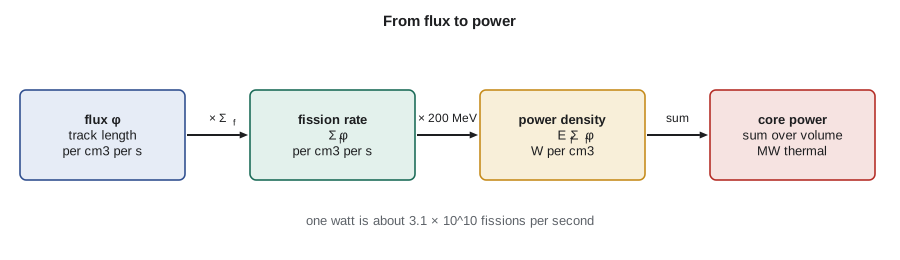
Each fission releases about 200 MeV of recoverable energy in a thermal reactor, most of it as kinetic energy of the fission fragments deposited within micrometers of the fission site. A further few percent comes from capture gamma rays after neutrons are absorbed elsewhere, and about 10 MeV is carried away by antineutrinos and never recovered. With \(E_f \approx 200\ \text{MeV} = 3.2 \times 10^{-11}\ \text{J}\), the power density is
and the total thermal power of a core of volume \(V\) is \(P = E_f \int_V \Sigma_f \phi\, dV\). A useful rule of thumb follows: one watt of thermal power corresponds to about \(3.1 \times 10^{10}\) fissions per second, and one megawatt sustained for one day fissions about 1.05 g of uranium-235. Counting capture as well, about 1.23 g of uranium-235 is consumed per megawatt-day.
Worked problem
Power density in a fuel pellet
Enriched UO₂ fuel contains about \(1.0 \times 10^{21}\) uranium-235 atoms per cm³. Using an effective thermal fission cross section of \(0.88 \times 585 = 515\) b to allow for spectrum hardening, find the fission rate and power density at a thermal flux of \(3 \times 10^{13}\ \text{cm}^{-2}\text{s}^{-1}\).
Show solution
- \(\Sigma_f = 1.0 \times 10^{21} \times 515 \times 10^{-24} = 0.515\ \text{cm}^{-1}\).
- \(R_f = 0.515 \times 3 \times 10^{13} = 1.54 \times 10^{13}\) fissions per cm³ per second.
- \(q''' = 1.54 \times 10^{13} \times 3.2 \times 10^{-11} = 495\ \text{W/cm}^3\).
Answer: About 500 W/cm³ in the fuel, a realistic order of magnitude for a light water reactor pellet near the peak of the core.
# Reaction rates, power density and the flux needed for a given power.
barn = 1e-24
E_fission = 200 * 1.602e-13          # J per fission (about 200 MeV recoverable)
N235 = 1.0e21                        # U-235 atoms per cm3 in enriched UO2 (approx.)
sigma_f = 585 * barn * 0.88          # effective thermal fission cross section (approx.)
Sigma_f = N235 * sigma_f
for phi in (1e13, 3e13, 1e14):
    R = Sigma_f * phi
    print(f"flux {phi:.0e}: fission rate {R:.3e} /cm3/s, power density {R * E_fission:6.1f} W/cm3")

# Flux needed for a core power, from P = E_f * Sigma_f * phi * V
P = 3.4e9          # W thermal, a large PWR-type core
V = 3.0e7          # cm3 of fuel-bearing core (homogenized, approx.)
Sigma_f_core = 0.09     # cm^-1 homogenized thermal value (illustrative)
phi_avg = P / (E_fission * Sigma_f_core * V)
print(f"\naverage thermal flux needed: {phi_avg:.2e} n/cm2/s")
print(f"fissions per second in the core: {P / E_fission:.2e}")
print(f"U-235 burned per day (about 1.23 g per MW-day): {1.23 * P / 1e6:.0f} g")flux 1e+13: fission rate 5.148e+12 /cm3/s, power density 164.9 W/cm3 flux 3e+13: fission rate 1.544e+13 /cm3/s, power density 494.8 W/cm3 flux 1e+14: fission rate 5.148e+13 /cm3/s, power density 1649.4 W/cm3 average thermal flux needed: 3.93e+13 n/cm2/s fissions per second in the core: 1.06e+20 U-235 burned per day (about 1.23 g per MW-day): 4182 g
The second half of the program runs the calculation the other way: given a thermal power of 3400 MW, a homogenized core volume and a homogenized fission cross section, it finds the average thermal flux, about \(4 \times 10^{13}\ \text{cm}^{-2}\text{s}^{-1}\). That is the right order for a large light water reactor. The program also shows that such a core fissions about \(10^{20}\) nuclei every second and consumes several kilograms of uranium-235 per day.
Power, flux and fuel depletion
Because \(P \propto \Sigma_f \phi\), keeping power constant as fuel depletes requires the flux to rise. Early in a cycle, when \(\Sigma_f\) is high, a lower flux gives full power; late in the cycle, more flux is needed. This has practical consequences. Flux sets the fast neutron fluence on the pressure vessel or pressure tubes and therefore the rate of radiation damage to them, and it sets the activation of structural materials, which decides how much radioactive waste a station produces at the end of its life.
In a light water reactor, the whole batch of fuel ages together between refueling outages, so the flux climbs over the cycle while the boron concentration is reduced to keep the core critical. Core-follow calculations at TVA's pressurized water reactor fleet track that change week by week against measured detector readings.
Measuring flux
Flux cannot be seen directly; it is inferred from reaction rates in detectors. Fission chambers coated with uranium-235 give a current proportional to the local thermal fission rate. Self-powered detectors use a metal, such as rhodium, vanadium or platinum, whose neutron capture produces beta decay or prompt gammas, driving a small current without an external supply. Activation foils, such as gold or cobalt, are irradiated and then counted to measure the integrated flux. Each detector responds to a particular cross section and energy range, so turning signals into flux requires knowing the spectrum, which is why detector calibration is a reactor physics problem in its own right.
In light water reactors, movable fission chambers or fixed self-powered detectors measure the axial and radial flux shape, while out-of-core ion chambers give a fast, continuous indication of total power for the protection system.
Flux shapes and peaking
The flux is never uniform. It is highest near the center of a bare core and falls toward the edges, because neutrons near the surface are more likely to leak. Within a fuel assembly it dips inside fuel pins and peaks in water gaps. Power follows flux and fissile content together. The ratio of the peak to the average is called a peaking factor, and limits on peaking factors protect the fuel from overheating. Designers flatten the power shape by using reflectors, by loading fresher fuel toward the edge, by placing burnable absorbers in high-flux positions and, in CANDU reactors, by adjuster rods that absorb in the center. Lessons 5 and 6 compute the flux shapes that cause these peaking factors.
| Quantity | Symbol | Units | Typical value |
|---|---|---|---|
| Thermal flux, power reactor core | φ | cm⁻² s⁻¹ | 10¹³ to 10¹⁴ |
| Thermal flux, SLOWPOKE-2 or TRIGA at full power | φ | cm⁻² s⁻¹ | 10¹¹ to 10¹³ |
| Recoverable energy per fission | E_f | MeV | about 200 |
| Fissions per watt-second | s⁻¹ | 3.1 × 10¹⁰ | |
| U-235 fissioned per MW-day | g | about 1.05 | |
| U-235 consumed per MW-day | g | about 1.23 |
Spectrum-averaged cross sections
The fission cross section of uranium-235 at exactly 0.0253 eV is about 585 b, but real thermal neutrons are spread over a range of energies and the moderator is hot. Two corrections convert the textbook value into one that can be multiplied by a measured thermal flux. First, because many absorption cross sections follow the 1/v law at low energies, averaging over a Maxwellian distribution at the neutron temperature reduces the effective value by a factor of about \(\sqrt{\pi}/2 \approx 0.886\) at room temperature, and more at higher temperatures. Second, uranium-235 departs slightly from 1/v, which is described by small correction factors tabulated by Westcott. Lesson 8 derives the first correction; the factor 0.88 used in the example above is the same idea.
Engineers sometimes avoid these corrections by defining the flux in a different way, for example as the 2200 m/s flux, \(n v_0\), with \(v_0 = 2200\) m/s. With that convention the textbook cross section can be used directly for a 1/v absorber. Both conventions are correct as long as they are not mixed, and most reactor physics errors in hand calculations come from mixing them. Teodora's rule is to write down which flux definition a number uses every time it appears in a calculation sheet.
Worked problem
Activation of a cobalt foil
A cobalt-59 foil with \(N\sigma = 0.036\ \text{cm}^{-1}\) (37 b, effective thermal value) sits in a thermal flux of \(5 \times 10^{12}\ \text{cm}^{-2}\text{s}^{-1}\) in a university TRIGA research reactor's irradiation site. Find the capture rate per cubic centimeter.
Show solution
- \(R = \Sigma \phi = 0.036 \times 5 \times 10^{12}\).
- \(R = 1.8 \times 10^{11}\) captures per cm³ per second.
Answer: Counting the cobalt-60 activity after irradiation and working back through this equation is how flux is measured with foils.
Flux in a teaching reactor
Hana spends a day at a university TRIGA research reactor, a pool-type reactor that runs steadily at a few hundred kilowatts to around a megawatt and can also be pulsed briefly to much higher power. Its steady flux in the central irradiation positions is of order \(10^{12}\) to \(10^{13}\ \text{cm}^{-2}\text{s}^{-1}\). The physics is the same as in a power reactor: power is still \(E_f \int \Sigma_f \phi\, dV\), and the operators still read power from neutron detectors. The difference is that a small core reaches a useful flux at modest total power, which is exactly what activation analysis, isotope work and student experiments need.
Small cores also show clearly why flux and power are not the same thing. Moving an experiment with a strong absorber into an irradiation site lowers the local flux and the reactivity, and the operators must compensate. Flux maps at a research reactor therefore depend on what is loaded, and staff remeasure them with foils after major changes. Hana's measurements that day, with gold and cobalt foils, give her a feel for the numbers that a code usually supplies.
Current and the link to diffusion
The neutron current \(\mathbf{J}\) is a vector giving the net number of neutrons crossing a unit area per second. In a region where the flux is higher on one side than the other, more neutrons cross from the high-flux side, so a net current flows down the flux gradient, exactly as heat flows down a temperature gradient. Lesson 4 turns this observation into Fick's law and the diffusion equation, which predicts the flux shapes that the core-follow code calculates. For now, Hana checks the code's total: summing \(E_f \Sigma_f \phi V\) over all assemblies gives a thermal power within half a percent of the plant's heat balance, which is the agreement Teodora expects.
Common mistakes
MistakeThinking flux is a flow of neutrons through a surface.
InsteadFlux is track length per volume per time; the net flow is the current J.
MistakeMultiplying flux by the microscopic cross section to get a rate per cm³.
InsteadUse the macroscopic cross section Σ = Nσ.
MistakeAssuming constant power means constant flux over a fuel cycle.
InsteadAs fissile atoms deplete, the flux must rise to hold power.
MistakeUsing 200 MeV as the total energy per fission.
InsteadAbout 200 MeV is recoverable; antineutrinos carry away about 10 MeV more.
Summary and key terms
- Flux φ = nv is the total neutron track length per cubic centimeter per second.
- Reaction rate density R = Σφ; integrate over energy or sum over groups for a spectrum.
- Power density q''' = E_f Σ_f φ, with about 200 MeV recoverable per fission.
- One watt is about 3.1 × 10¹⁰ fissions per second; about 1.05 g of U-235 fissions per MW-day.
- Flux must rise as fuel depletes to hold power constant.
- Detectors infer flux from reaction rates; peaking factors limit local power.
- Neutron flux
- The product of neutron density and speed, equal to track length per volume per time.
- Neutron current
- The net number of neutrons crossing a unit area per unit time, a vector.
- Reaction rate density
- The number of reactions per cubic centimeter per second, Σφ.
- Recoverable energy per fission
- The energy deposited in the reactor per fission, about 200 MeV.
- Self-powered detector
- An in-core detector whose current is driven by neutron capture in an emitter metal.
- Peaking factor
- The ratio of peak to average power or flux in a core or assembly.
- Fluence
- The time integral of flux, which governs radiation damage and activation.
Practice problems
Work each problem on paper first, then reveal the answer to check.
Σ_f = 0.1 cm⁻¹ and φ = 2 × 10¹³. Find the fission rate density.
Show answer
2 × 10¹² fissions per cm³ per second.
Convert that fission rate to power density.
Show answer
2 × 10¹² × 3.2 × 10⁻¹¹ = 64 W/cm³.
How many fissions per second produce 1 MW?
Show answer
About 3.1 × 10¹⁶.
A 900 MW thermal core runs for 300 days. Estimate the U-235 fissioned.
Show answer
900 × 300 × 1.05 g ≈ 283 kg.
Using the program, what average flux does the 3400 MW core need?
Show answer
About 3.9 × 10¹³ cm⁻² s⁻¹.
Why can the current be zero where the flux is largest?
Show answer
At a symmetric flux maximum, equal numbers of neutrons cross in each direction.
Lesson quiz · 5 questions
Score 60% or more to complete this lesson.
Create a free account to save your progress, take quizzes and earn a certificate.